Squarespace Farro Template: It Isn't Brine, and That Matters
Farro is a Squarespace version 7.0 template, and it is not a member of the Brine family — it heads its own two-template family with Haute. We verified it in August 2026: farro-demo.squarespace.com and haute-demo.squarespace.com both report "templateVersion":"7" and template ID 5630efcfe4b076f55fe4837f. Brine's family ID is 55f0aac0e4b0f0a5b7e0b22e, and it is not the same number. Farro looks like Brine because it inherited Brine's style-editor vocabulary, not its markup — which is exactly why Brine CSS often does nothing on a Farro site.
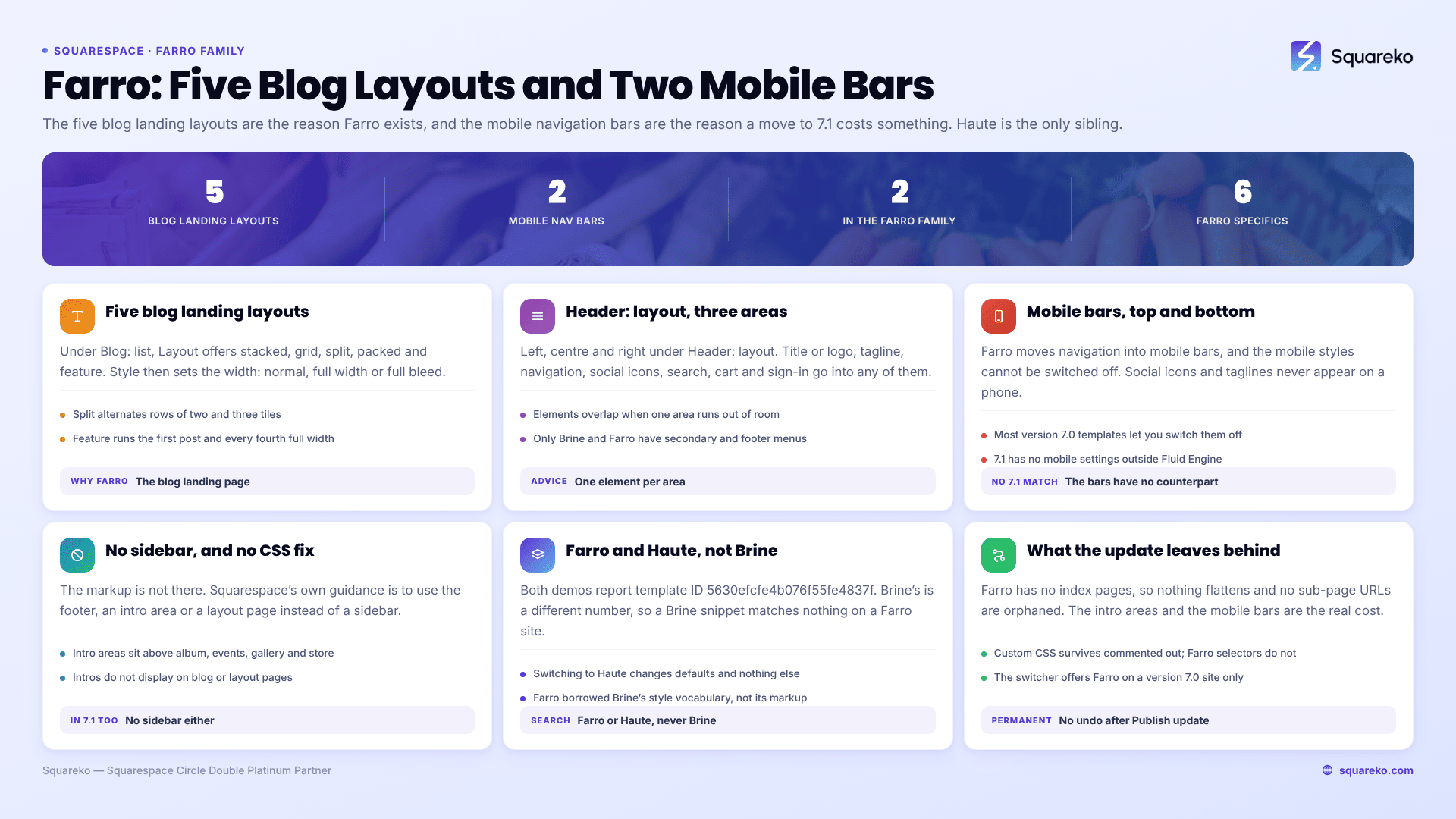
Should you stay on Farro, restyle it, or move to 7.1?
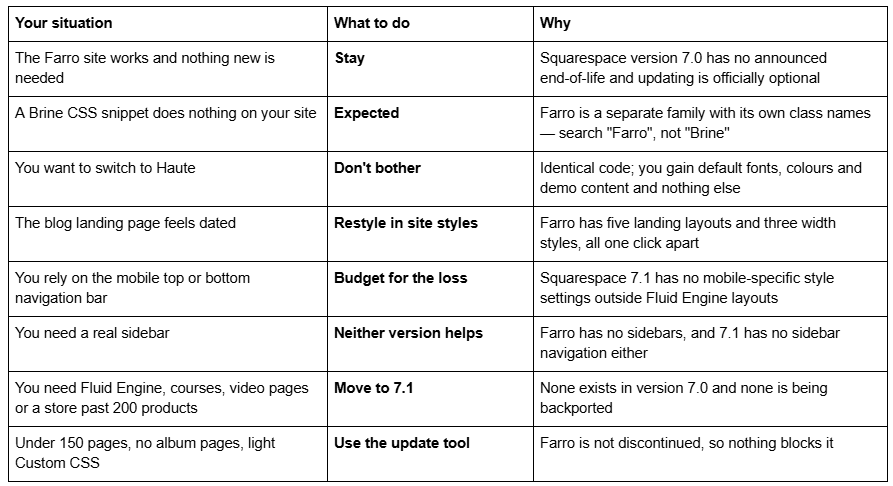
The Farro family is Farro and Haute — not Brine
Squarespace's own family guide opens with the roster: "The Farro template family (Farro, Haute)…". Two templates. That is the whole family.
We confirmed the codebase rather than relying on the list. Both demos returned HTTP 200 in August 2026 and both report template ID 5630efcfe4b076f55fe4837f. For comparison, the Brine family ID is 55f0aac0e4b0f0a5b7e0b22e and is reported by Brine, Rally, Mojave and the other 44 members. Two different numbers means two different codebases.
Three practical consequences:
Brine CSS is not Farro CSS. Selectors written against .Header-branding, .Index-page or .Intro — the Brine class names that most freely available Squarespace 7.0 snippets use — will not match anything on a Farro site. If a "Squarespace 7.0" snippet silently does nothing, this is usually why, not a syntax error.
Search "Farro" or "Haute", not "Brine". There is far less material, which is genuinely annoying, but the Brine material is wrong for you.
A template detector will report "Farro" for both Farro and Haute sites. templateId identifies the family, never the individual template, so no detector can tell them apart.
Why the confusion is understandable. Farro shipped in the same era as Brine and inherited much of its style-editor thinking. Both have a content inset under Main. Both have intro areas. Both have an Advanced store page. Both have separate mobile style tweaks. And most tellingly, Squarespace's navigation documentation lists only two version 7.0 families with both secondary navigation in the site header and footer navigation — Brine and Farro. Everything else has one menu or none.
What Farro did not inherit is the thing Brine is famous for: Brine's two-part header, with a separate top header and bottom header, does not exist in Farro. Farro's header is a single row split into three areas.
The 47-name Brine roster is in the Squarespace Brine family templates guide, and the list of Squarespace 7.0 templates covers all 121 templates across the 22 families.
What the Squarespace Farro template does well
Everything below is Farro family behaviour, so it is equally true of Haute.
A three-area header. Left, centre and right, configured under Header: layout. Into any area you can place the site title or logo, tagline, navigation links, built-in social icons, a search bar, the shopping cart and a sign-in link. Squarespace's own advice is to keep each element in a different area, because elements overlap when an area runs out of room.
Five blog landing layouts. This is the reason Farro exists. Under Blog: list, the Layout tweak offers stacked, grid, split (alternating rows of two and three tiles), packed (one large image beside a column of smaller ones) and feature (the first post and every fourth post at full blog width). The Style tweak then sets the width: normal, full width, or full bleed, which runs the grid behind the header at browser width.
Post banners with three widths. Under Blog: item, the Header tweak gives you banner (inside the side padding), full width banner (browser width, below the header), full bleed (behind the header, browser width) and text (no banner at all — the title sits on the Post background color).
Ledes, author profiles and floating pagination. If the first block in a post is a text block, its opening paragraph can be styled separately as a lede. Author profiles link to a filtered author archive. Pagination: floating pins next/previous arrows to the middle of the viewport as the reader scrolls.
Intro areas on album, events, gallery and store pages — a block-editable region above the main content, so you can put text, buttons or forms at the top of a page without a banner. Intros do not display on blog pages, layout pages or individual collection items.
An Advanced store page — the newest version 7.0 commerce layout, shared with Brine, Skye, Tremont and York.
Ajax loading for content-heavy blogs, toggled with Enable Ajax loading under Site: loading.
What breaks or feels dated on a Farro site in 2026
No Fluid Engine. Squarespace version 7.0 editing is the classic block editor — a 12-column grid, no drag-anywhere canvas, no overlapping blocks without CSS. Fluid Engine is 7.1-only and is not coming to Farro.
No sidebars. Squarespace's guidance for Farro sites wanting sidebar-style content is to put it in the footer, the intro area or a layout page. No CSS produces a real sidebar, because the markup is not there.
Mobile styles cannot be disabled. Most version 7.0 templates let you switch mobile styles off. Farro does not. That is a reasonable default in 2026, but it removes an escape hatch that other 7.0 templates still have.
Social icons and taglines never appear on mobile. Not a bug, not stylable — they are simply excluded from the mobile navigation bars.
Store pages cap at 200 products. That is a version 7.0 limit rather than a Farro one. Squarespace 7.1 raises it to 10,000 per page and per site.
Ajax loading occasionally fights custom code. Squarespace documents conflicts with custom code, anchor links and analytics. On a heavily customised Farro site, test with Enable Ajax loading unchecked before debugging an intermittent script failure.
Farro quirks Squarespace documents and is not going to fix
Squarespace maintains a Troubleshooting Farro section, prefaced with its actual position on version 7.0: "Although we still support Squarespace version 7.0, fixing bugs or issues is a lower priority for us while we focus on our current platform, version 7.1."
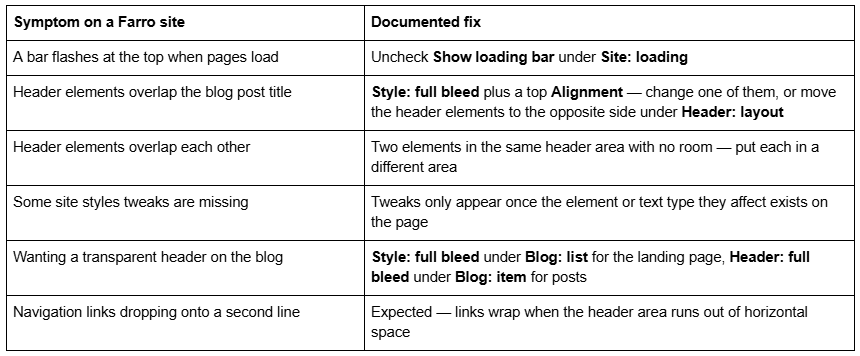
None of these is a fault in your setup. All are Farro behaving as documented, on both Farro and Haute.
Is the Squarespace Farro template still available?
Yes — on an existing version 7.0 site, via Design → Template → Install new template. Farro is not on Squarespace's discontinued list, which covers 32 retired templates including Bryler, Fulton, Jones, Taylor, Lincoln and the whole Marquee family. Neither Farro nor Haute appears on it.
You cannot start a new site on Farro, which is exactly what the forum poster ran into: "can't find it anywhere to install." Every new Squarespace site is 7.1, and the live gallery at squarespace.com/templates returned 198 templates in August 2026, all 7.1. The old squarespace.com/templates/farro-demo URL that still ranks for this keyword now serves that generic gallery — we fetched it and it reports the marketing site's own template ID, not Farro's. Squarespace's demo at farro-demo.squarespace.com is still live and still genuinely Farro.
Watch for name collisions. Farro is a common food word and several unrelated third-party 7.1 templates and stock listings use it. If you land on a page about sections and Fluid Engine, you are reading about a different product. Check your own page source: version 7.0 reports "templateVersion":"7" — not "7.0" — and Farro's family ID. Version 7.1 reports the universal ID 5c5a519771c10ba3470d8101.
Version 7.0 has no announced end-of-life, and Squarespace states the move is optional: "Updating your site from version 7.0 to 7.1 is optional." Whether old Squarespace templates are still supported covers the support position in full.
Moving a Squarespace Farro site to version 7.1
The tool is at Design → Update to Version 7.1. It is permanent, capped at 150 pages and 200 products, requires developer mode off, and leaves Custom CSS commented out — remove the comment tags in the CSS editor afterwards, and expect Farro-specific selectors to match nothing in 7.1 markup.
What happens to the parts a Farro site is built from:
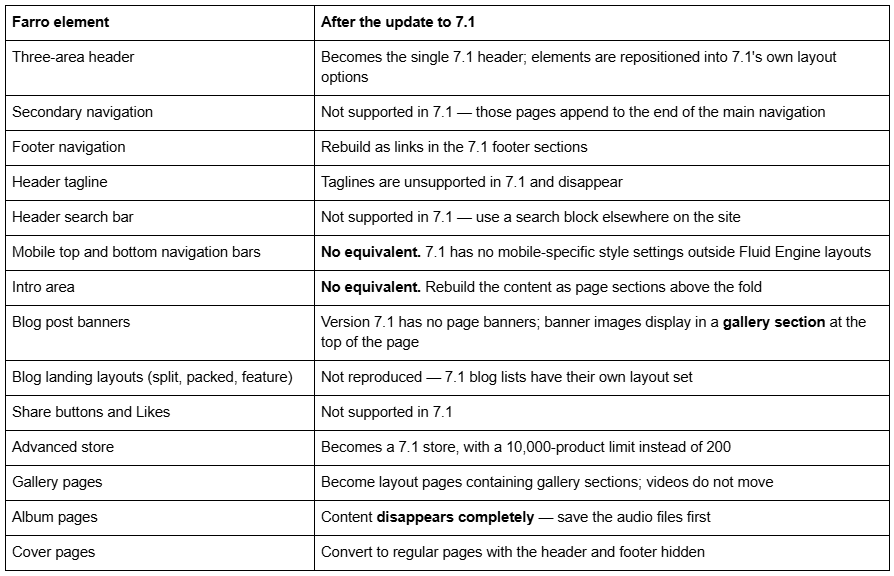
Farro is a structurally easier migration than Brine, and this is the good news buried under the family confusion. Farro has no index pages, so nothing flattens and no sub-page URLs are orphaned — the single most expensive part of a Brine migration simply does not apply. What you lose instead is presentational: the intro area, the mobile bars, the blog landing layouts and the banner width options.
Audit before you press the button. Screenshot the Header: layout, Blog: list, Blog: item and Mobile tweaks — those are the settings you will be re-deciding, not re-importing. Copy the contents of every intro area into a document. Note which blog posts rely on full-bleed banners. Count pages and products, and export the Custom CSS.
And the one that costs money later: changing a page slug on Squarespace creates no automatic 301 redirect, ever. Any URL that shifts during the rebuild needs an entry in Settings → Advanced → URL Mappings in the /old -> /new 301 format.
The screen-by-screen version is in the Squarespace 7.0 to 7.1 guide, and the Squarespace 7.0 template comparison chart shows how Farro's feature set compares with the other 21 families. The Squarespace Brine template guide works through the same decision for the family Farro is constantly mistaken for.
So: stay on Farro, or move?
Stay if the blog is the site and one of Farro's five landing layouts is doing work you would have to rebuild by hand in 7.1. Farro is not discontinued, version 7.0 has no end-of-life date, and the update tool will still be there next year.
Restyle if the objection is aesthetic. Header arrangement, blog layout and style, banner widths, ledes, pagination style, colours and fonts are all site styles values. Switching to Haute unlocks nothing at all — it is the same code with different defaults.
Move if you need Fluid Engine, courses, video pages, a store past 200 products, or an independently editable mobile layout — and go in knowing that the intro areas and the mobile navigation bars are the two things with no 7.1 counterpart.
For scale: across 54 Squareko-built client sites measured in August 2026 (Playwright/Chromium lab test, cloud datacenter, unthrottled, single run per site), 53 of 54 run Squarespace 7.1. Version 7.0 is the minority case now, but a working Farro site is not an emergency.
Most Farro sites we are sent migrate cleanly on structure — no index pages means no orphaned URLs — and then spend the time on the blog landing page, rebuilding a split or packed layout out of 7.1 sections and auto layouts. The exception is the Farro site carrying several hundred lines of family-specific Custom CSS, where you are rewriting the stylesheet as well: there, starting from a premium Squarespace template built for 7.1 and Fluid Engine is usually the shorter path. The table at the top of this page settles it for most people without spending anything.
FAQ
-
No. Farro heads its own two-template family with Haute. We fetched both demos in August 2026 and both report template ID 5630efcfe4b076f55fe4837f, while the Brine family ID is 55f0aac0e4b0f0a5b7e0b22e. Farro shares style-editor concepts with Brine — content inset, intro areas, an Advanced store — but not its codebase.
-
Generally no. Brine class names such as .Header-branding, .Index-page and .Intro do not exist in Farro markup, so Brine snippets usually apply to nothing. This is the most common reason a "Squarespace 7.0" CSS snippet appears to do nothing on a Farro site. Search for Farro or Haute material instead.
-
Two: Farro and Haute. Squarespace's family guide names them both, and both demos report the same template ID. Because templateId identifies the family rather than the individual template, no detector tool can distinguish a Farro site from a Haute one.
-
Because new Squarespace sites are all version 7.1. Farro is only installable on an existing version 7.0 site, via Design → Template → Install new template. The live template gallery returned 198 templates in August 2026, every one of them 7.1, and the old squarespace.com/templates/farro-demo URL now serves that generic gallery.
-
Five, under Blog: list in site styles: stacked, grid, split, packed and feature. A separate Style tweak sets the width as normal, full width, or full bleed, where the grid runs behind the header at browser width. Farro is the version 7.0 family built specifically around these options.
-
No. Squarespace's documented guidance is to put sidebar-style content in the footer, in an intro area, or on a layout page instead. Squarespace 7.1 does not support sidebar navigation either, so this is one limitation the update does not resolve.

Author Bio
I'm Walid Hasan, a Certified Squarespace Expert and Squarespace Circle Platinum Partner with over 12 years of hands-on experience designing and optimizing high-performing websites. Over the years, I've had the privilege of building more than 2,000 Squarespace websites for clients around the world, always focusing on clean design, strong user experience, and conversion-driven results.