Squarespace Templates for Small Businesses: 13 Compared by Business Model
The short answer: stop shopping by industry. What decides which Squarespace template fits a small business is the revenue model — whether the business sells a service, sells a product, sells time, or sells access. Those four models need four different page sets, and two businesses in the same industry often sit in different ones. Below, 13 Squarespace templates are grouped by model and scored against one published rubric, with Squareko's five reviewed in detail and competitors' genuine strengths named where they exist.
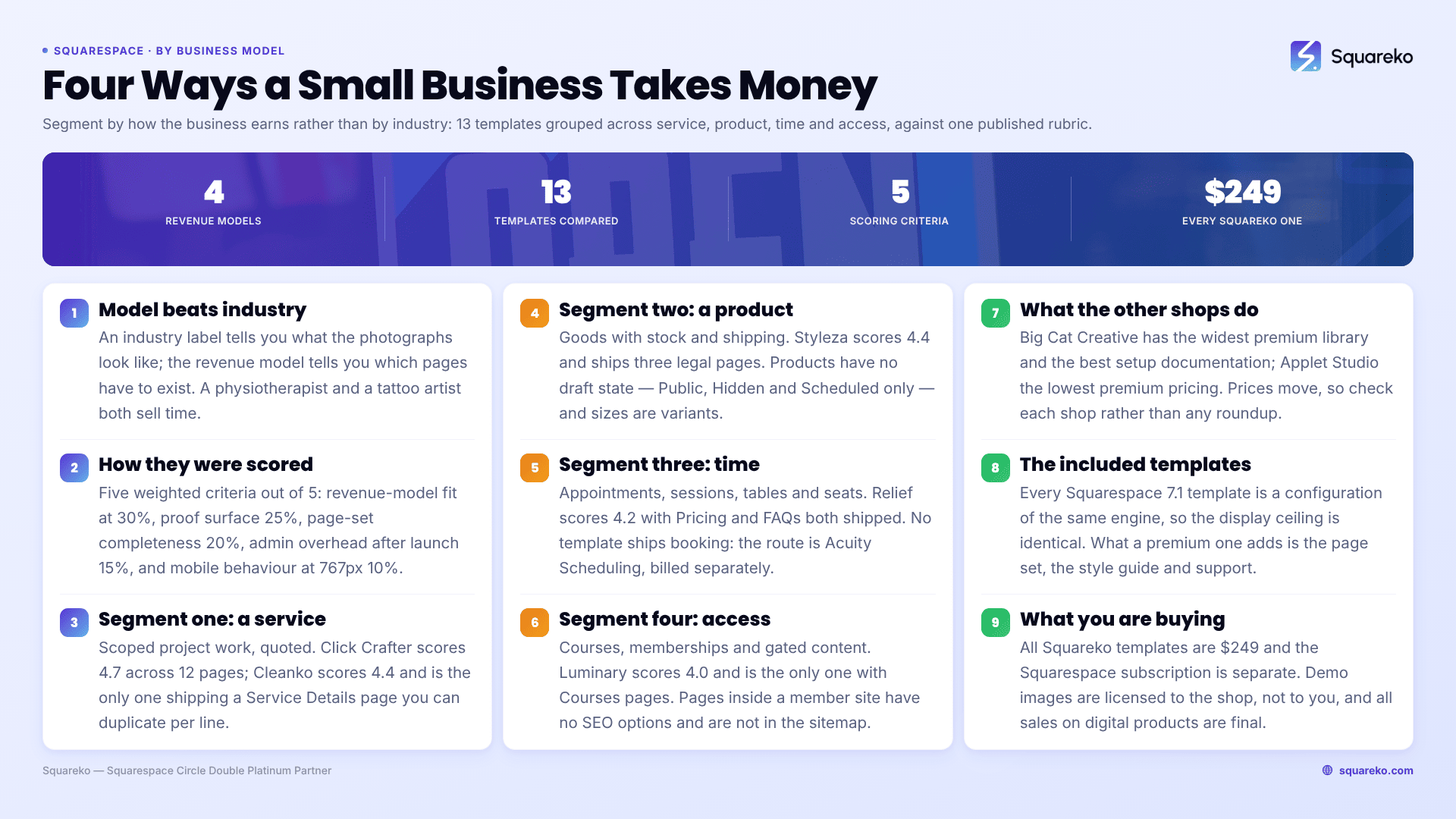
Why business model beats industry when choosing a Squarespace template
An industry label tells you what the photographs look like. The revenue model tells you what pages have to exist. A physiotherapist and a tattoo artist are in unrelated industries and both sell time — both need a bookable calendar, a price list and an FAQ page answering the same nine questions. A tattoo artist and a print shop both sit under "local creative business" and share almost nothing structurally, because one sells time and the other sells a product with variants, stock and shipping.
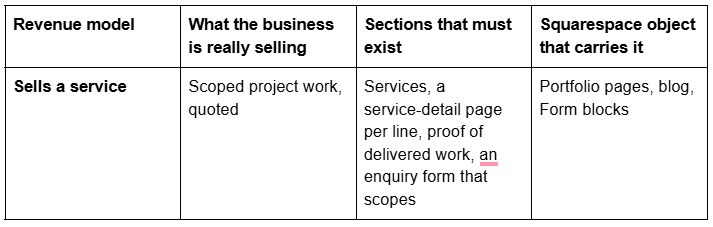
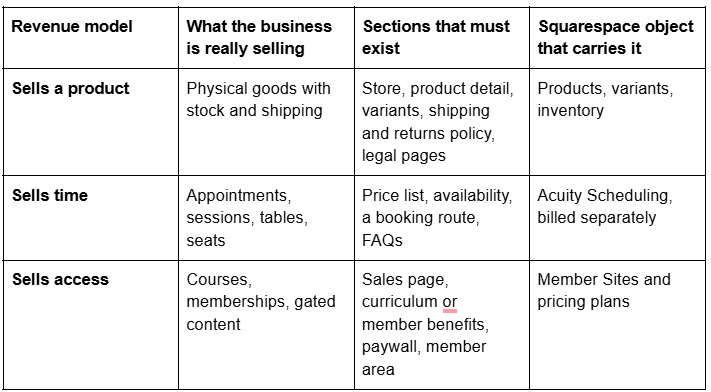
Most small businesses sit in one model with a second bolted on — a physiotherapist who sells supports, a studio that sells presets. The primary model decides the template; the secondary decides whether you need a Shop page.
How these Squarespace templates were scored
Five weighted criteria, scored out of 5, applied identically to every template regardless of who sells it.
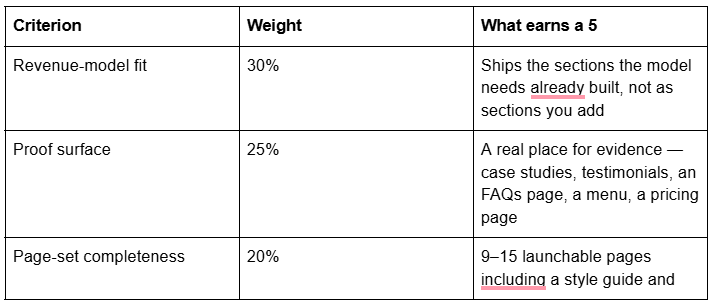
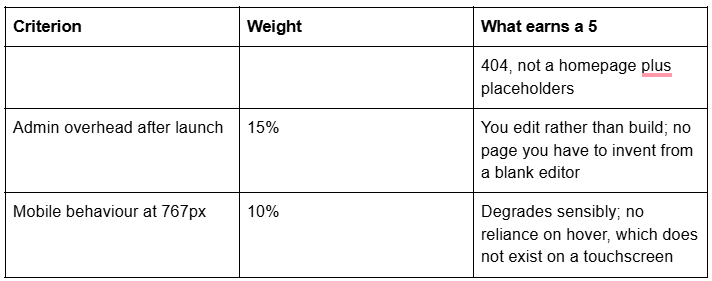
What this rubric is and is not. It is a structural assessment made from each template's published page list, from walking its live demo, and from 12 years of building Squarespace sites. It is not a lab benchmark of demo sites. Aggregate star ratings and "used by X businesses" counts are not scored anywhere on this page, because they cannot be verified from outside the shop publishing them.
Disclosure: Squareko sells the five templates in positions 1–5, because this is Squareko's site. The rubric, the page counts and every weakness are stated so you can check the reasoning. Competitor shops and Squarespace's own included templates follow, and in two of the four segments a competitor is the better answer.
Segment 1 — Squarespace templates for businesses that sell a service
Agencies, consultants, trades, cleaners, law firms, copywriters, studios. The structural requirement is one page per service line, not one Services page carrying five offers — five offers on one page is a single URL competing with itself for five different searches.
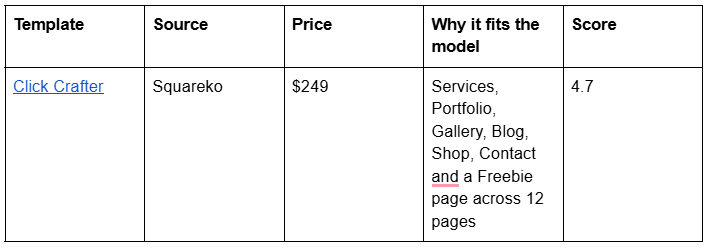
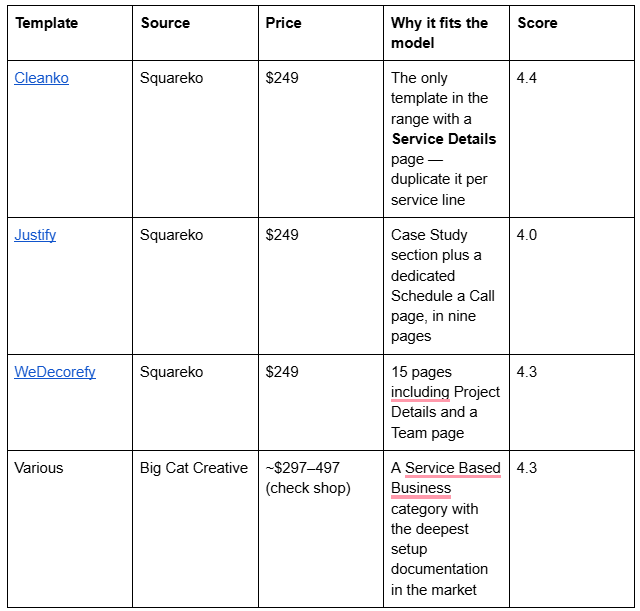
The page most templates omit is a service-detail page you can duplicate. Cleanko ships one; most do not. The full architecture for project-work firms is in Squarespace templates for agencies and Squarespace templates for service-based business.
Segment 2 — Squarespace templates for businesses that sell a product
Retail, makers, food producers, print sellers, anyone shipping a box. The template matters less than the commerce configuration behind it, but three shipped pages save real time: a store page, a policies set, and somewhere to write.
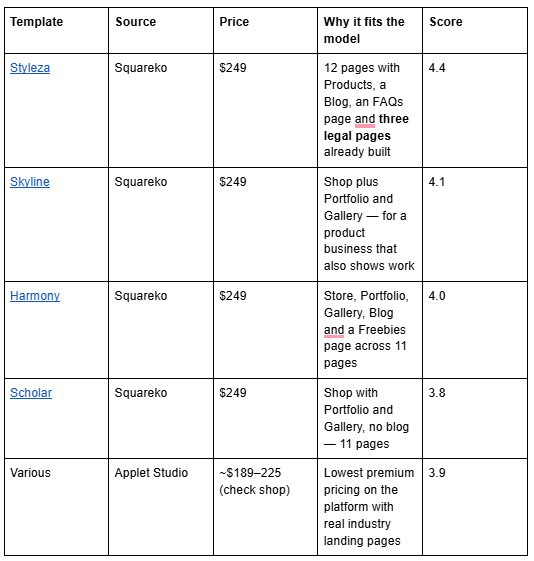
Two Squarespace 7.1 constraints before you build a store. Products have no draft state — Public, Hidden and Scheduled only — so an unfinished listing must be set Hidden. And sizes, colours and finishes are variants, so the full matrix needs deciding before the product exists; restructuring variants after orders exist is genuinely painful. Styleza's three legal pages are the quiet win here: refunds, shipping and privacy are the pages every product business needs, writes last, and usually writes badly.
Segment 3 — Squarespace templates for businesses that sell time
Therapists, trainers, salons, clinics, tutors, restaurants taking reservations. The site's job is to get someone onto a calendar; the template's job is to answer the objections first.
The platform fact that decides this segment: the scheduling product is Acuity Scheduling, billed separately from your Squarespace plan. Squarespace's own Help Center states that Squarespace Scheduling is now officially Acuity Scheduling. A template cannot ship "booking" — it ships a page where the Acuity embed goes.
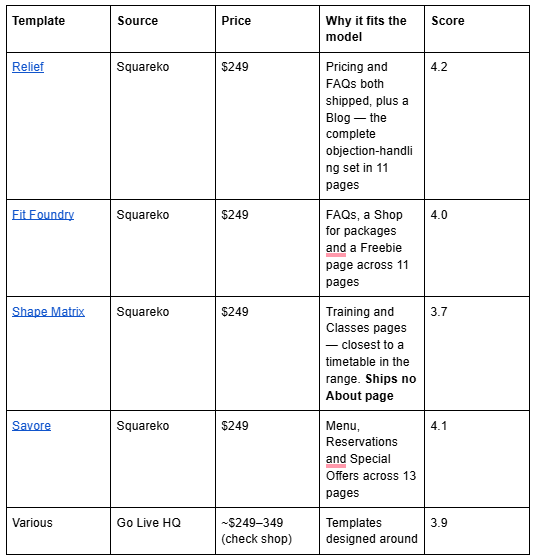
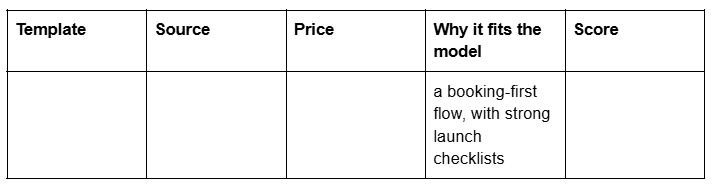
Publish your prices — the enquiries you never receive are the ones who could not find a number. Dated, capacity-limited sessions have their own problems, worked through in Squarespace template for workshops.
Segment 4 — Squarespace templates for businesses that sell access
Course creators, membership communities, paid newsletters, cohort programmes. This is the segment where the template matters least and the platform mechanics matter most, and every roundup on this SERP skips it.
The mechanics you are buying into. Member Areas is now Member Sites under Content & Memberships. It is not a flat paid add-on — it is included on paid plans and carries a Digital Content and Memberships transaction fee, published at 7% on Basic, 5% on Core, 1% on Plus and 0% on Advanced. The standalone Digital Products plan is gone for new customers: Squarespace's wording is "As of July 23, 2026, you can't sign up for a Digital Products plan." Confirm the percentages against the live pricing page.
The constraint that changes your site map: pages inside a member site have no SEO options and are not in your sitemap — "Pages in a member site don't have SEO options and aren't indexed in your site map." Everything you want found lives outside the paywall.
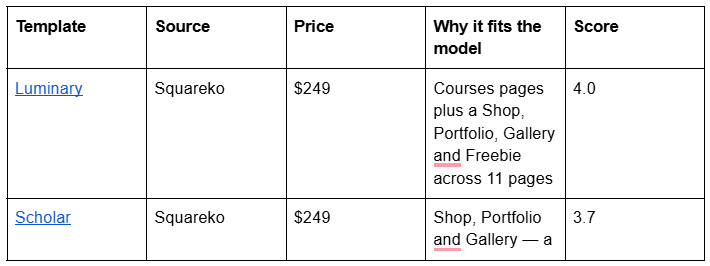
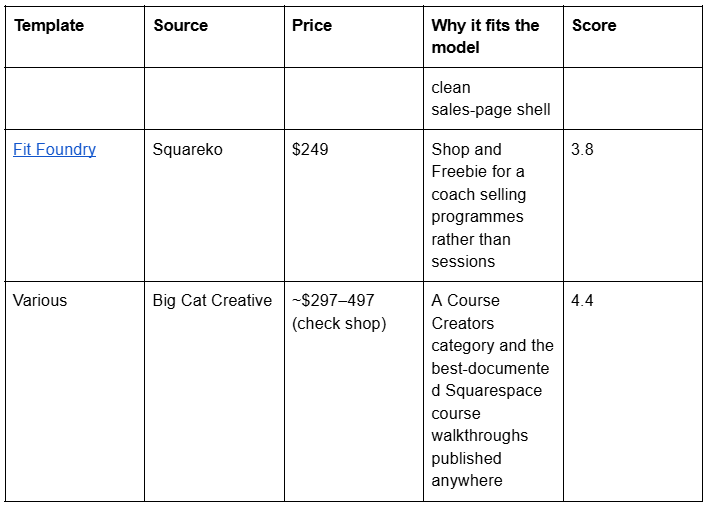
Big Cat Creative genuinely wins this segment on documentation, though Luminary is the better structural fit if you sell services alongside the programme. The full mechanics — fees, paywalls, cohorts — are in Squarespace template for an online coaching business.
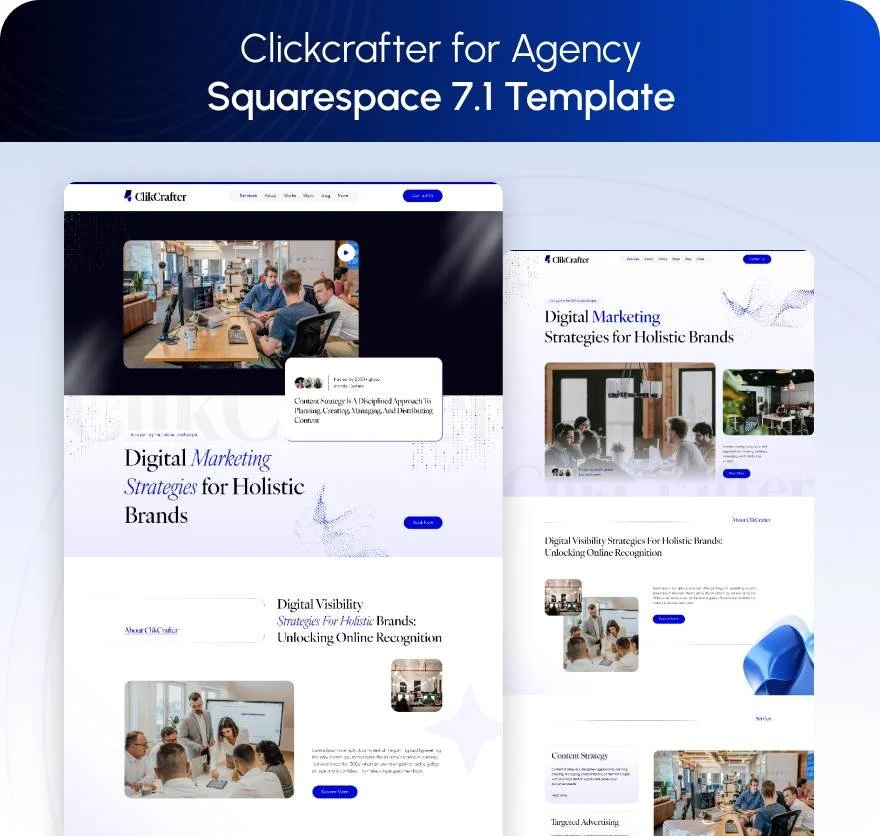
1. Click Crafter — the best all-round small business template in the range
Squareko · $249 · 12 pages · Score 4.7
Click Crafter is tagged Agency and Service-Based, and most small businesses should look at it first because its 12 pages contain no filler: two homepage variants, About, Services, Portfolio, Gallery, Blog, Shop, Contact, a Freebie page, a Style Guide and a 404. Those names were read off the live demo, not a product description.
It suits so many models because it is the only Squareko template pairing a work-display structure with a working shop and a blog. A service business uses the Portfolio for case studies and ignores the Shop until it productises something; a product business inverts that. Nothing has to be deleted for either.
The Freebie page is the underrated one. For most small businesses the highest-converting asset is a document — a checklist, a price guide, a sample audit — and Click Crafter ships a built page for it with a form, which is a working lead magnet on day one rather than a task you never get to.
Two honest weaknesses. It ships one Services page, so a business with four or five service lines builds the per-service pages itself; Cleanko is better there. And the register reads as a studio rather than a solo operator — a ten-minute fix in Site Styles, but worth knowing.
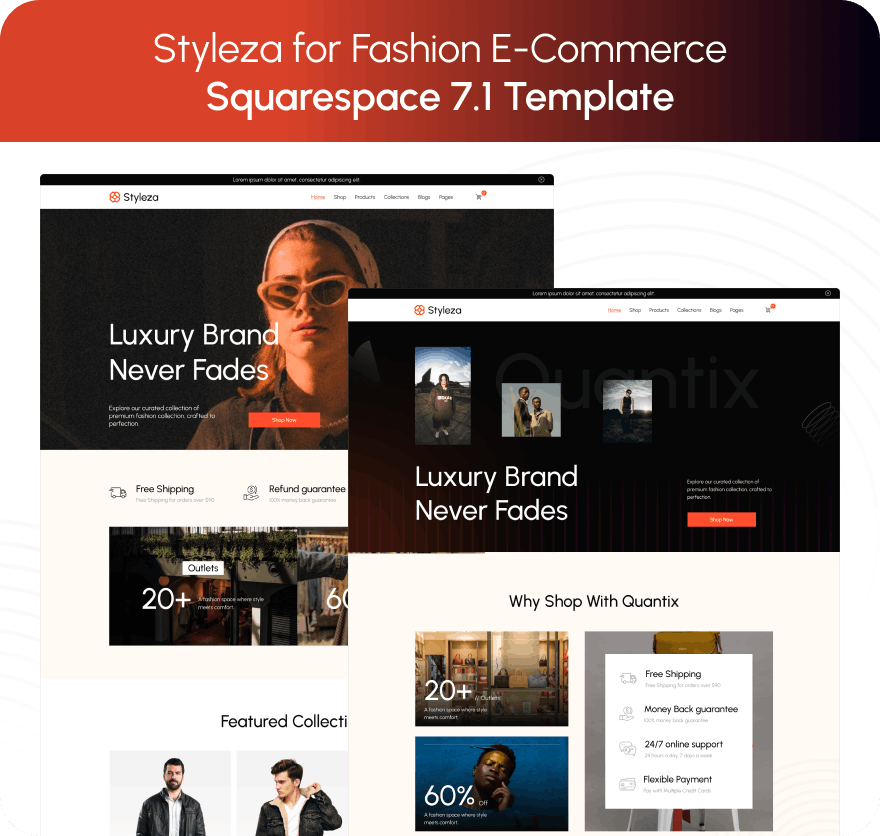
2. Styleza — the product business template that ships its legal pages
Squareko · $249 · 12 pages · Score 4.4
Styleza is tagged E-Commerce, Fashion and Shop, and across 12 pages it ships Products, a Blog, an FAQs page and three legal pages. It is one of only two Squareko templates including a Figma file — the other is Skyline — which matters if a designer will touch the brand before launch.
The three legal pages are why it scores where it does. Shipping, returns and privacy are compulsory for anyone taking money for physical goods, they are the pages every small business writes last, and having them already in the site map with the right names is the difference between writing content and inventing structure at 11pm.
The FAQs page pairs with it. Squarespace 7.1's native Accordion block renders server-side, so question and answer text is crawlable rather than hidden behind JavaScript — an FAQs page built with accordions is a ranking surface, not decoration.
The weakness is that Styleza has no Portfolio and no Gallery. A maker showing process, or a retailer wanting lookbooks, builds that from sections. If showing work matters as much as selling it, Skyline or Harmony are the same price and ship both.
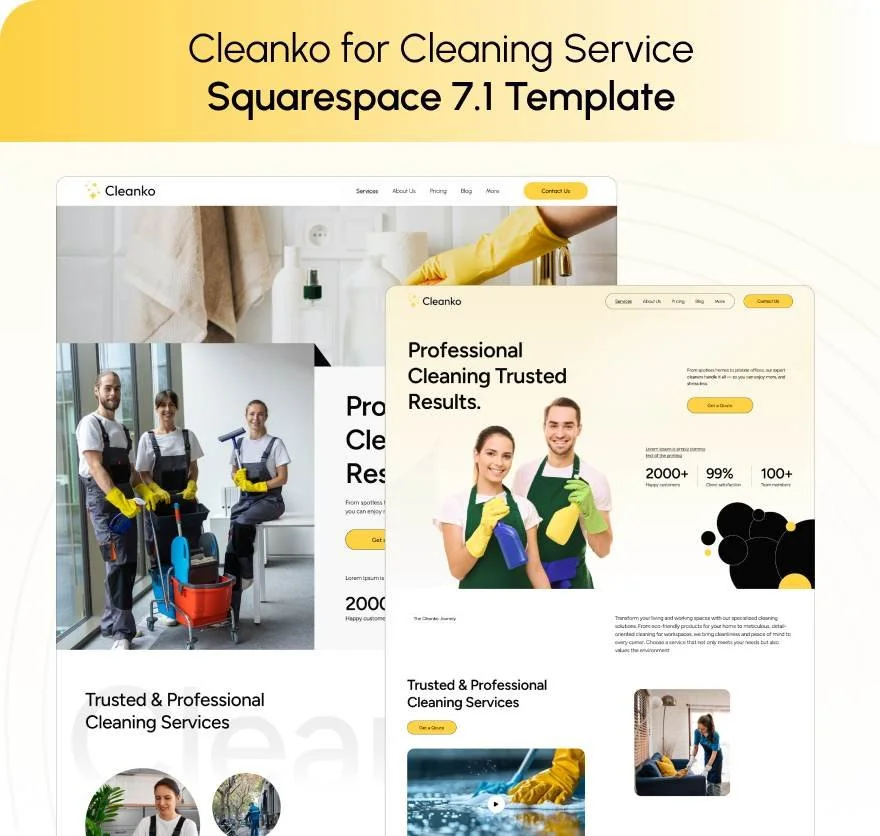
3. Cleanko — the best service-line architecture for a local business
Squareko · $249 · 12 pages · Score 4.4
Cleanko is tagged Cleaning Service, and every local service business should look at it regardless of trade, because it is the only Squareko template shipping a Service Details page alongside the Services index. That page is the pattern for one service line: duplicate it four times and you have four URLs that can each rank for their own search.
The full set is 12 pages: two homepage variants, About, Services, Service Details, Pricing, Portfolio, FAQs, Blog, Contact Us, Style Guide and 404. Pricing plus FAQs is a complete objection-handling layer, and for a local trade those two pages do more for conversion than any design decision on the site.
Where Cleanko loses points is register: operational and plain, correct for a cleaner, an electrician or a maintenance firm, wrong for a business selling taste. Its Portfolio is also lighter than Click Crafter's, so if case studies carry the pitch, buy Click Crafter instead.

4. Relief — the objection-handling template for businesses that sell time
Squareko · $249 · 11 pages · Score 4.2
Relief is tagged Therapist and Wellness Coach, and its 11 pages ship the two pages a time-selling business always needs and rarely builds — a Pricing page and an FAQs page — alongside a Blog, About, Services and Contact.
That combination is the whole argument. Someone deciding whether to book a first session has a short, predictable list of questions — how long, how much, what happens, do you take insurance, what if I cancel — and a site that answers them in public converts better than one answering by email three days later.
Two things Relief does not do. There is no ecommerce, so packages or gift vouchers mean adding a Products page yourself; Fit Foundry ships one at the same price. And no template ships booking — the route is Acuity Scheduling, billed separately and embedded into a page you designate.
If you handle client health information, note that Squarespace's HIPAA BAA is available only on its highest tiers and explicitly does not cover form blocks. Intake goes somewhere else.
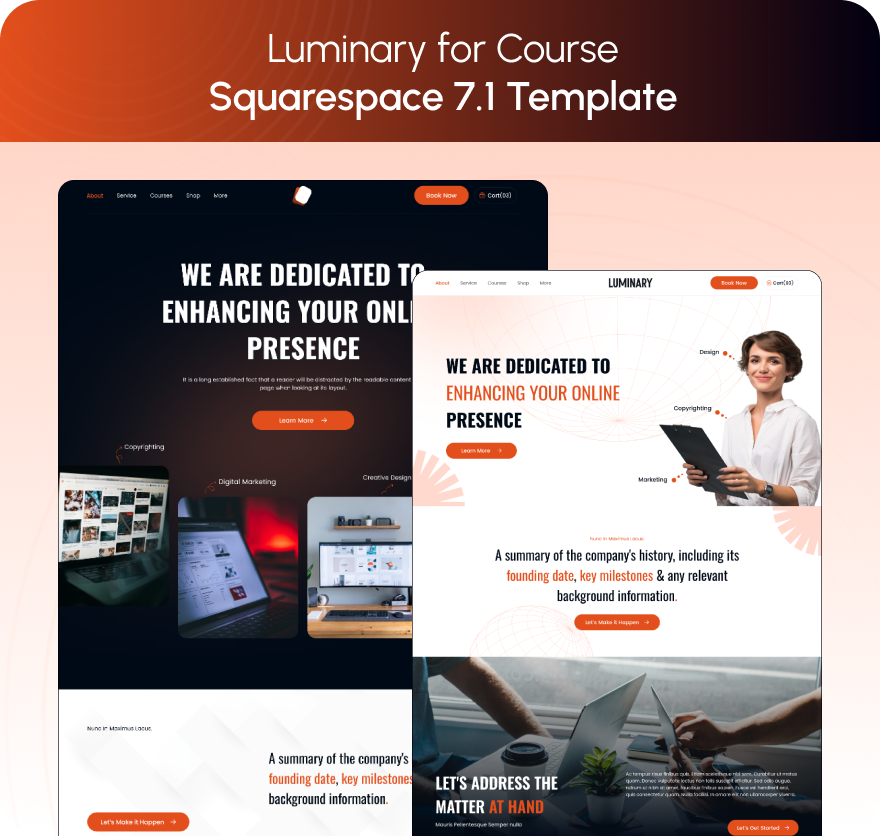
5. Luminary — the access-business template, with one page missing
Squareko · $249 · 11 pages · Score 4.0
Luminary is tagged Service-Based, Course and Speaker, and it is the only Squareko template shipping Courses pages. Its 11 pages, verified on the live demo: two homepage variants, About, Services, Courses, Shop, Portfolio, Gallery, Freebie, a Style Guide and a 404.
For a business selling access alongside services — a consultant with a programme, a trainer with a cohort — that is the right shape. Services sells the one-to-one work, Courses sells the productised version, Shop takes the money, and the Freebie page feeds the list that fills the next cohort.
Two things you must know before buying it. Luminary ships no Contact page — verified live, not a documentation gap. For a business whose funnel ends in an enquiry that is a page you build on day one, and it is a genuine deduction rather than a quirk. Luminary also ships no blog, correct for an operator who will not write and wrong for one who will.
Squareko also does not publish whether Luminary's Courses pages are wired to Squarespace Member Sites. Treat them as a layout for a course, not a configured membership system.
Competitor shops, and what each genuinely does better
Squareko is not the only good answer, and pretending otherwise would be worth nothing to you.
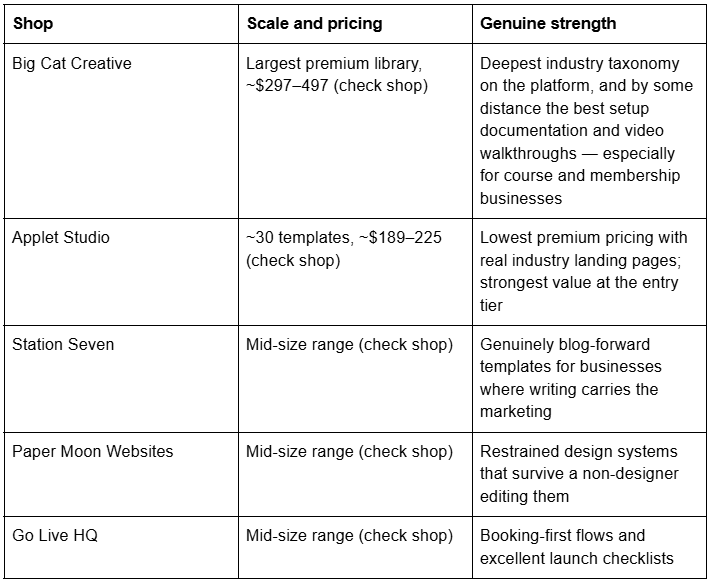
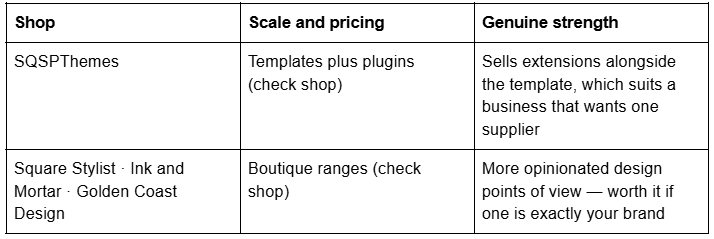
Where Squareko wins is delivery and support, not exclusivity. Squareko templates arrive as a Squarespace contributor invitation — no file to download, no upload, no FTP. Two routes exist: a new 12-month trial site that Squareko builds and then transfers ownership of, leaving your existing site live throughout; or installation onto an existing site, a paid add-on taking around 48 hours. Sixty days of email support is included; customisation is not.
Where competitors win is choice. If you want fifteen designs for your exact trade side by side, Big Cat Creative has them and Squareko does not. Prices move — check each shop rather than trusting a figure in any roundup, this one included.
Squarespace's own templates, honestly assessed
Squarespace publishes a small business template gallery included with any subscription. It is worth being blunt about what that means.
Every Squarespace 7.1 template is a configuration of the same engine. Anything a $249 template can display, an included one can be configured to display. The ceiling is identical — the single most under-stated fact on this SERP, including on pages selling templates.
What you do not get is the page set, the style guide page, or anyone to ask. A premium template's value is the eight to twelve other pages already in the site map with the right names, plus support while you fill them. Launching with no revenue yet, start included and upgrade when the site is earning.
Be careful with older roundups. Several pages ranking for this keyword still recommend Brine, Bedford, Five, Tremont, Avenue, Pacific and Hayden — all Squarespace 7.0-era templates a new site cannot be started on in 2026.
Buying mechanics and the running cost
Four facts that apply to Squareko and, with variation, to every premium shop.
The Squarespace subscription is separate. The $249 covers the design and use of the template only. Squareko recommends the Business plan, states its templates work on Basic, and passes on 20% off the first year.
Your plan is decided by your revenue model, not your size. Custom CSS is available on every plan, including Basic — what needs Core or above is JavaScript or iframes inside Code Blocks, and site-wide Code Injection. Discounts, limited-availability labels and product waitlists sit on Core and above. If you sell access, the Digital Content and Memberships transaction fee falls as the plan rises: 7% on Basic, 5% on Core, 1% on Plus, 0% on Advanced. Confirm all of it against the live pricing page.
Demo images are not licensed for live use. Every shop ships placeholder photography you must replace before launch.
All sales are final. Squareko's policy is that digital products cannot be returned, exchanged or refunded under any circumstances — the industry norm for digital goods, and a good reason to walk the live demo, every page, on your phone, before buying. Six Squareko demos do not resolve publicly; every demo linked here was tested with a live request before publication.
Real page counts run 9 to 15, read off the templates themselves.
Performance is an image problem, not a template problem
Across 54 Squareko-built client sites measured in August 2026 — Playwright and Chromium, cloud datacentre, unthrottled, single run per site, load-only CLS, so lab data rather than field data — median mobile LCP was 2.01s and median page weight 3.0 MB across 93 requests. What moves those numbers is image discipline, not template choice: upload at 1500–2500px on the long edge, since 2500px is the maximum Squarespace serves, and set filenames before upload because they cannot be changed afterwards.
Pick the model first. If you sell scoped project work, Click Crafter. If you ship products, Styleza. If you run service lines locally, Cleanko. If you sell time, Relief. If you sell access, Luminary — and build the Contact page it does not ship. If you want fifteen designs for your exact trade, Big Cat Creative genuinely has more of them than Squareko does.
Where a second opinion earns its cost is the business sitting in two models at once — services plus a shop plus a programme — because that is where structure gets locked in early and Squarespace creates no automatic 301 when a URL changes, ever. That is why the premium Squarespace templates in our shop are listed with their full page structure rather than a homepage screenshot. Most small businesses reading this will decide from the tables above without asking anyone.
FAQ
-
It depends on how the business earns. For scoped service work, Click Crafter — 12 pages with Services, Portfolio, Blog, Shop and a Freebie page. For physical products, Styleza, which ships three legal pages. For appointments, Relief, which ships Pricing and FAQs. For courses or memberships, Luminary.
-
Custom CSS is on every plan including Basic. Core or above is needed for JavaScript and iframes in Code Blocks, site-wide Code Injection, discounts, limited-availability labels and product waitlists. If you sell digital content or memberships, the transaction fee falls from 7% on Basic to 0% on Advanced. Confirm current rates on Squarespace's pricing page.
-
Squareko's are $249 each, with no variants or sale prices. Across the market, premium Squarespace templates run roughly $189 to $500 — Applet Studio at the lower end, Big Cat Creative higher. Squarespace's own templates are included with a subscription. Prices move, so check each shop directly.
-
Enough that every buying question has a URL. In practice that is 9 to 15 — the range Squareko's templates actually ship — covering home, about, one page per service line or product category, proof, pricing, FAQs and contact. Fewer than that and one page is trying to answer several different searches.
-
Only if the buyer judges you on delivered work. Agencies, trades and studios do need one. Cleaners, accountants and clinics usually convert better on a Pricing page and an FAQs page than on a portfolio. Click Crafter ships a Portfolio; Cleanko and Relief lead with pricing and objection handling instead.
-
Squareko's are not — the policy is that digital products cannot be returned, exchanged or refunded under any circumstances, which is the industry norm for digital goods. Walk the live demo page by page on your phone before buying, and check each shop's own policy, as terms differ between sellers.

Author Bio
I'm Walid Hasan, a Certified Squarespace Expert and Squarespace Circle Platinum Partner with over 12 years of hands-on experience designing and optimizing high-performing websites. Over the years, I've had the privilege of building more than 2,000 Squarespace websites for clients around the world, always focusing on clean design, strong user experience, and conversion-driven results.