Squarespace Template for a Marketing Agency
The short answer: for a marketing agency the numbers are the argument, so choose the Squarespace template that ships a service-detail page you can duplicate per service line and a structure for outcome-led case studies. In the Squareko range that is Cleanko, with Click Crafter second. A marketing agency running one "Services" page and a portfolio of logos is competing on adjectives against agencies competing on evidence.
There is also an uncomfortable second requirement, and it is the one your prospects will actually test.
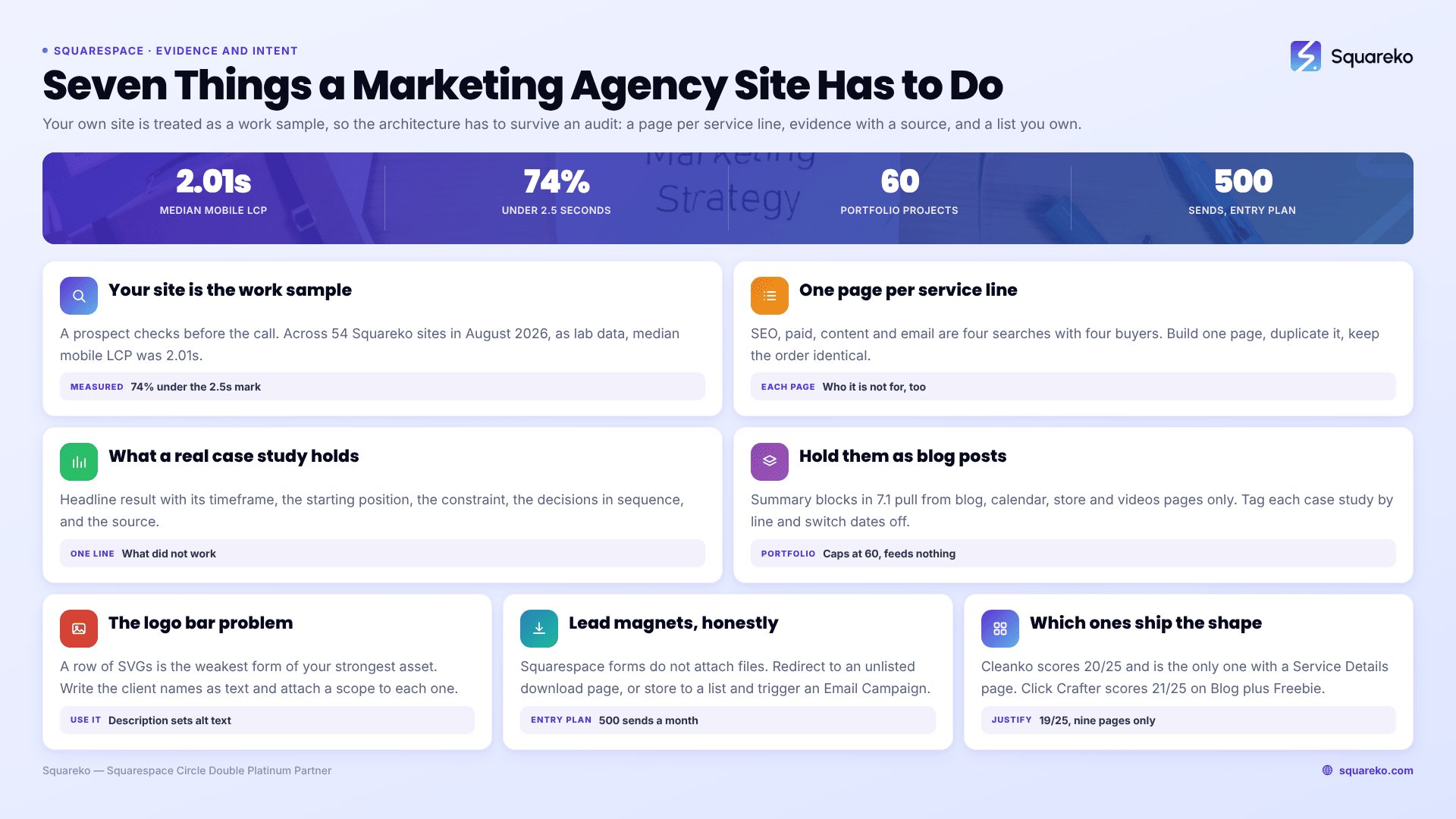
Your own site is the first case study
A marketing agency is the only kind of business whose website is treated as a work sample by default. If you sell SEO and your site does not rank for anything, that is not a neutral fact — it is the first objection in every pitch, and the prospect will have checked before the call.
This is not an argument for a perfect site. It is an argument for a site whose structure is defensible when someone opens it in a professional capacity:
Pages that target something. One page per service line, each with an intent it can plausibly win.
Content with dates on it. A blog that stopped in 2023 is worse than no blog. If you cannot maintain a publishing cadence, publish fewer, better, undated resources instead.
Technical basics visible on inspection. Squarespace 7.1 handles most of this automatically — sitemaps, clean static URLs, automatic redirects between connected domains, and structured data for Blog post, Event, Local business, Organization, Product and Website that you cannot edit or remove. What is left to you is SEO titles, SEO descriptions and image alt text, and their absence is exactly what a prospect's audit tool will surface.
Speed that survives a public test. Across 54 Squareko-built client sites measured in August 2026 — Playwright and Chromium, cloud datacentre, unthrottled, single run, load-only CLS, so lab data rather than field data — median mobile LCP was 2.01s with 74% under Google's 2.5s threshold, and median mobile CLS was 0.000 with 94% under 0.1. Desktop CLS is weaker at a median of 0.029. Those are achievable numbers on Squarespace; they are not automatic ones, and a homepage carrying six full-bleed hero videos will not reach them.
Service-line architecture is the whole SEO surface
"Marketing agency" is a term almost nobody searches when they are ready to buy. They search "SEO agency for ecommerce", "Google Ads management", "B2B content agency", "email marketing agency". Four searches, four buyers, four different objections. One combined Services page cannot rank for four intents and cannot answer four objections.
So the architecture is one page per service line, and each one needs to carry:
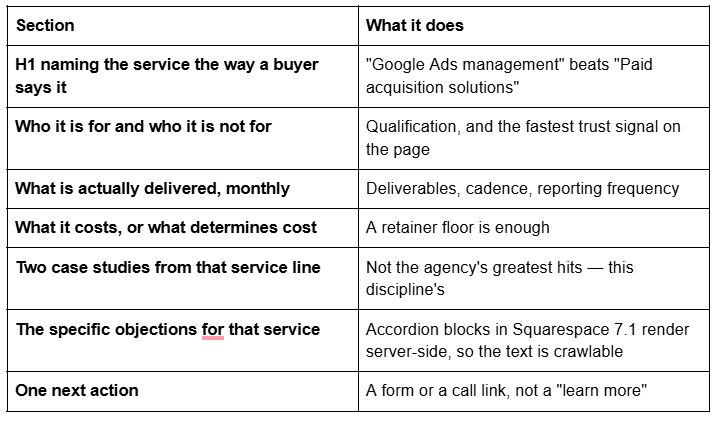
Build one page properly with Fluid Engine sections, then duplicate the page per service line. Keep the section order identical across all of them. A template that ships a Service Details page hands you that model already built; without one you are designing it from scratch and then rebuilding it four times.
Outcome-led case studies, and what a real one contains
A creative agency case study is judged on the work. A marketing agency case study is judged on whether the number is believable. That changes the structure.
Headline result, above the fold, with the timeframe. "Organic revenue up 41% in eight months" — not "up 41%".
Situation. Client, sector, size, and where they started. A starting number makes the finishing number credible.
Constraint. Budget, seasonality, a legacy platform, a compliance review, one person on the client side. Constraints are what a prospect recognises themselves in, and they are the section most agencies delete.
What was actually done. Specific decisions in sequence. "We cut 60% of the keyword set and moved the budget to three bottom-funnel campaigns" is a decision. "SEO strategy, technical audit, content" is a receipt.
The measurement, with its source named. Which tool, which date range, which metric. GA4 sessions, GSC clicks, platform-reported ROAS and CRM-attributed revenue are four different things and a sophisticated buyer knows it.
What did not work. One honest line. It costs nothing and it is the single most persuasive sentence on most agency case studies.
A client quote about the constraint, and the client's name and role where you have permission.
Where to hold them. Squarespace 7.1 gives three options and they behave differently. Portfolio pages give five layouts, per-project SEO titles and descriptions, per-project featured and social images, and Fluid Engine sections inside each project — but they cap at 60 projects, projects cannot become standalone pages or move between portfolios, and critically summary blocks cannot pull from portfolio pages. Summary blocks in 7.1 support blog pages, calendar pages, store pages and videos pages only.
For a marketing agency that matters more than it does for a creative studio, because you want the two relevant case studies to appear automatically at the foot of each service-line page. That is a summary block filtered by category — and it only works if the case studies are blog posts. So: run case studies as a blog collection, tag each one by service line, switch the date display off, and place a filtered summary block on every service page. Use a Portfolio only if you are certain you will never need that automation.
The logo bar problem
Almost every marketing agency site opens with a strip of client logos. It is the weakest form of the strongest asset you have, for two reasons.
First, logo images are invisible to search engines and to screen readers, so a homepage whose only mention of your clients is a row of SVGs contains no evidence at all as far as an AI answer engine summarising your agency is concerned. Write the client names out as text somewhere on the page as well — a single line reading "Clients include Halden, Norsk Retail Group and Perch Health" does more work than the strip above it.
Second, a logo bar makes a claim it does not substantiate. Did you run a full-service retainer or one landing page test? Attach a scope to each name — "Halden — paid search, 18 months" — and the bar becomes a credential rather than decoration. Where an NDA prevents naming a client, name the sector and the scope instead. Squarespace 7.1 also gives image blocks and gallery images a Description field that sets both caption and alt text; at minimum, use it.
Lead magnets, and what Squarespace forms actually do
Marketing agencies sell a document before they sell a retainer — an audit, a benchmark report, a teardown, a template. Then they discover Squarespace does not do the thing they assumed it does. Squarespace forms do not deliver files. There is no native "send this PDF on submit".
Here is what a Squarespace 7.1 form block does. Every form requires at least one storage option, and the options are a Squarespace mailing list, the form submitters list in the Contacts panel, an email address, Google Drive, Mailchimp or Zapier. Mailchimp and Zapier require Core plan or above. After submission the form either shows a confirmation message — which accepts HTML — or redirects to a URL or a page on your site.
That gives two honest delivery routes:
Redirect to an unlisted download page. Set the form's post-submit action to a page disabled in navigation that holds the download button. Instant, simple, and copyable by anyone who shares the URL.
Store to a mailing list and trigger an automated campaign. Squarespace Email Campaigns can send an automated campaign when someone joins a mailing list. This is the route that actually builds a list. Email Campaigns is billed separately from your site subscription, the entry plan is capped at 500 sends a month, and automations are not available during a free trial.
A Freebie page — Click Crafter, Luminary, Fit Foundry and Shape Matrix all ship one in the Squareko range — is that lead magnet with the layout already built. If you want the asset genuinely gated rather than merely unlisted, that is Member Sites, which is included on paid plans with a Digital Content and Memberships transaction fee of 7% / 5% / 1% / 0% from Basic to Commerce Advanced. Note that member-site pages have no SEO options and are not included in the sitemap, which for a marketing agency is usually a reason not to put anything you want found behind one.
Which Squarespace templates suit a marketing agency
Scored on the rubric published in the agency pillar: case-study surface, service architecture, credibility layer, enquiry path, and depth.
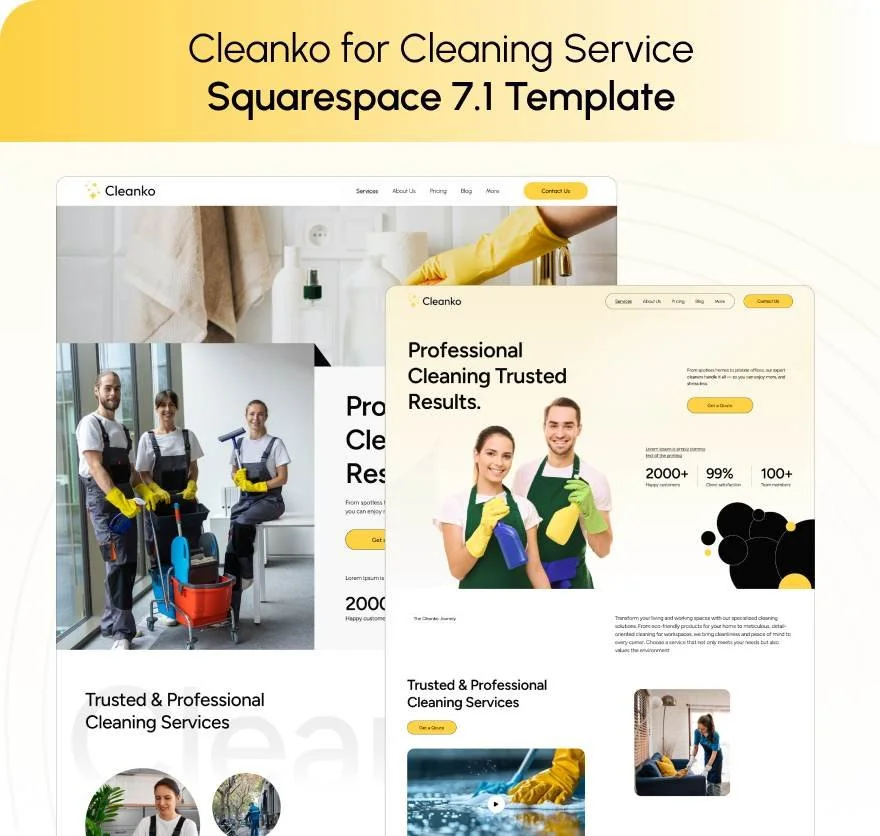
Cleanko — 20/25, and the right answer for service-line depth. Twelve pages, tagged Cleaning Service, and the only template in the Squareko range with a dedicated Service Details page sitting alongside a Services index. Duplicate it per service line and you have four pages that can each rank. It also ships Pricing, FAQs, a Portfolio, a Blog, a Contact Us page, an About page, two homepage variants, a Style Guide and a 404. Pricing plus FAQs is a complete objection-handling layer, and objection handling is most of what a marketing agency's site does.
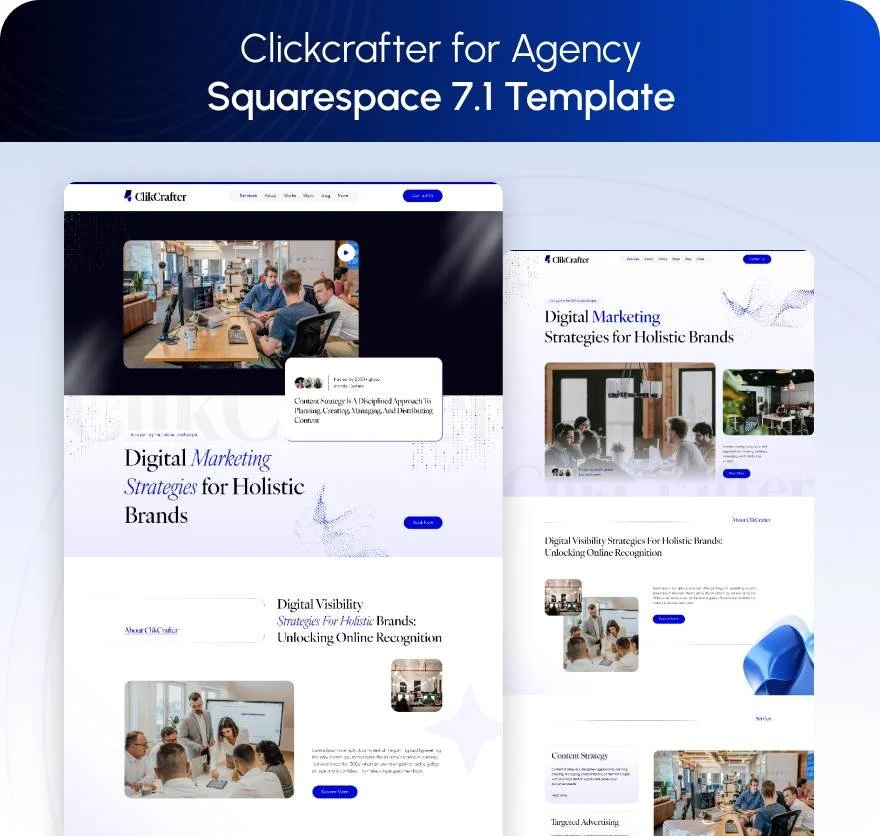
Click Crafter — 21/25, the purpose-built agency template. Twelve pages tagged Agency and Service-Based: Portfolio, Gallery, Services, Blog, Shop, Contact, a Freebie page, About, two homepage variants, a Style Guide and a 404. The Blog plus Freebie pairing is the top of a marketing agency funnel already built. Its weakness for this use case is the single Services page — the per-service-line pages are yours to build.

Justify — 19/25, when the case studies are the pitch. Nine pages, the smallest in the range, with a Case Study section, an Our Practice Area page that maps cleanly onto service lines, a Services page, a Blog and a dedicated Schedule a Call page instead of a generic contact form. Thin on depth, strong on exactly the two structures that matter here.

Relief — 16/25, for a solo consultant or a two-person shop. Eleven pages with Pricing, an FAQ page, Services, Blog, Contact and two legal pages. No portfolio and no gallery, which for a strategy consultant is a feature.
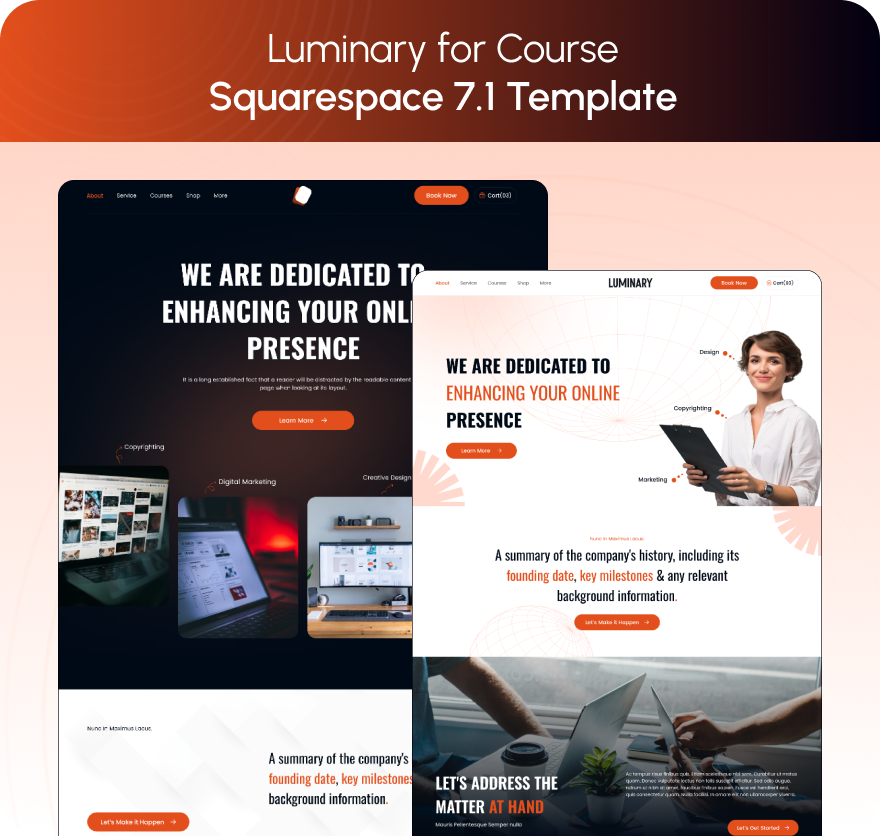
Luminary — 14/25, with a real caveat. Eleven pages tagged Service-Based, Course and Speaker with Services, a Courses page, a Portfolio, a Gallery, a Shop and a Freebie page — a good shape for an agency that also sells a course or a productised training offer. But Luminary ships no Contact page and no Blog page. For a marketing agency, launching without a blog and without an enquiry page removes both the top and the bottom of the funnel until you build them.
Advisory is worth asking about for a consultancy that leads with fees: 11 pages tagged Consultation and Speaker with a Pricing page, a Blog and two legal pages. Its published live demo returns HTTP 401, so no demo link is given here.
Choosing one
Choose on service-line architecture first: a template with a service-detail page you can duplicate is worth more than a template with a better homepage. Run case studies as a blog collection so a filtered summary block can surface the right two on each service page. Put a real number, a timeframe and a named measurement source in every case study. Then look at the design, because in Squarespace 7.1 design is the easiest thing to change and page architecture is the hardest.
If you would rather not run the install yourself, the premium Squarespace templates in our range arrive as a Squarespace contributor invitation rather than a file download, and can be installed onto an existing live site in around 48 hours without taking it down. Most marketing agencies reading this will do it themselves, and Cleanko and Click Crafter are the two worth starting from.
-
One page per service line — SEO, paid, content, email — plus a services index, an outcome-led case study archive, a lead magnet page, an about page with the team, and an enquiry page with a budget field. The per-service-line pages produce nearly all of the organic traffic.
-
Yes. "SEO agency for ecommerce" and "Google Ads management" are different searches with different buyers and different objections. One combined services page cannot rank for four intents. Build one page properly, then duplicate it per service line and keep the section order identical.
-
Headline result with a timeframe above the fold, the starting position, the constraint, the specific decisions in sequence, and the measurement with its source named — GA4 sessions, GSC clicks, platform ROAS and CRM-attributed revenue are four different claims. Add one line on what did not work.
-
Not directly — Squarespace forms do not attach files. Either redirect the form to an unlisted download page after submission, or store submissions to a Squarespace mailing list and trigger an automated Email Campaign on signup. Email Campaigns is billed separately and the entry plan caps at 500 sends a month.
-
A blog collection, for most agencies. Summary blocks in Squarespace 7.1 cannot pull from portfolio pages, so only a blog collection lets you place a filtered "related case studies" block at the foot of each service page. Tag each case study by service line and switch date display off.
-
Yes, with Member Sites, which is included on paid plans with a Digital Content and Memberships transaction fee of 7% / 5% / 1% / 0% from Basic to Commerce Advanced. Member-site pages have no SEO options and are not in the sitemap, so do not gate anything you want found in search.

Author Bio
I'm Walid Hasan, a Certified Squarespace Expert and Squarespace Circle Platinum Partner with over 12 years of hands-on experience designing and optimizing high-performing websites. Over the years, I've had the privilege of building more than 2,000 Squarespace websites for clients around the world, always focusing on clean design, strong user experience, and conversion-driven results.