Squarespace Templates for Agencies: The Full Decision Map
The short answer: an agency website is a case-study machine. Your buyer has three agencies shortlisted and is reading the work, in order, comparing. So choose the Squarespace template on where the case studies live and what structure they have — Portfolio pages, a blog collection, or plain pages — not on the homepage animation. In Squarespace 7.1 the visual layer is trivially editable later. The collection type holding your work is not.
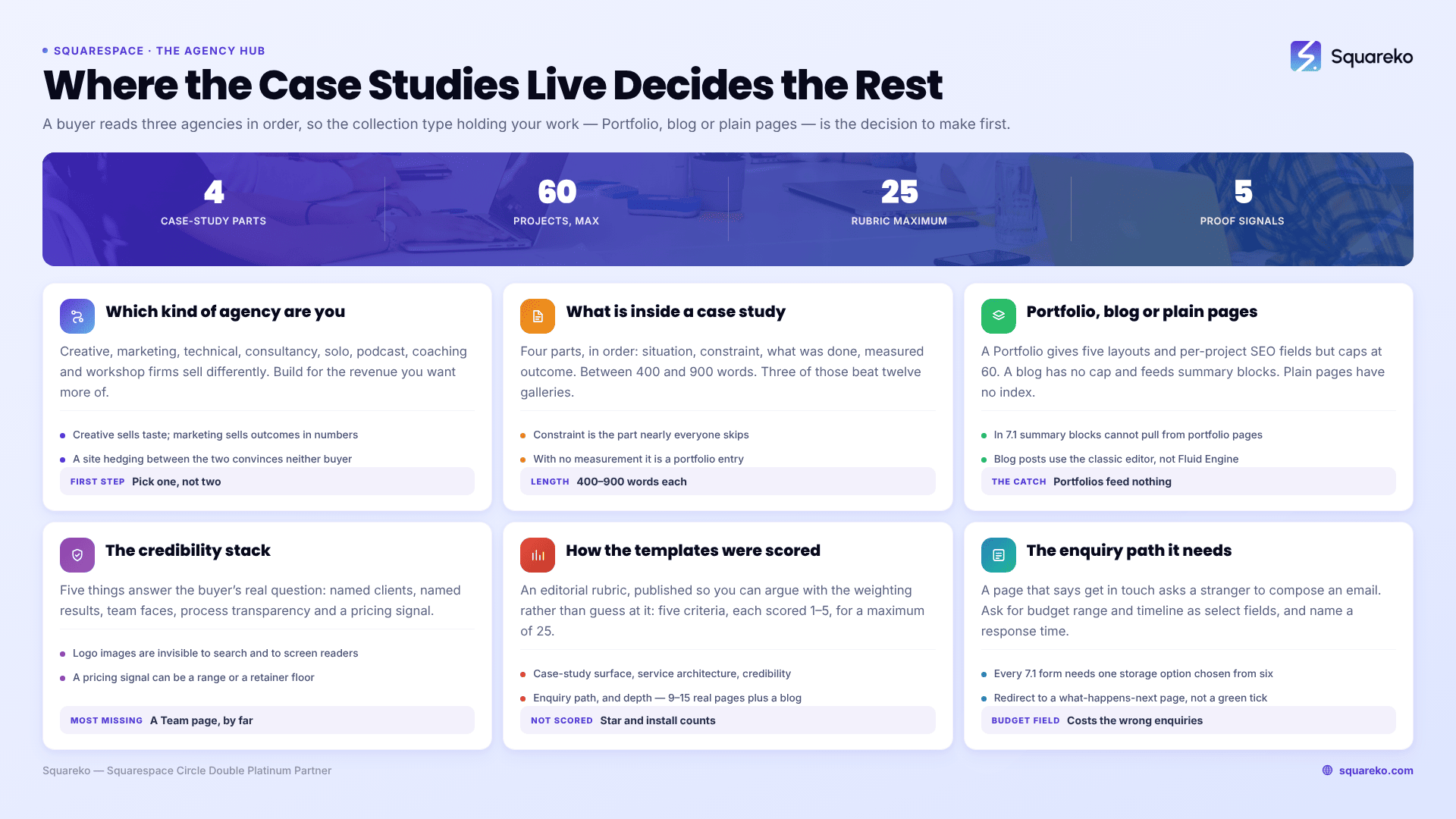
"Agency" covers several businesses that sell in completely different ways. Work out which one you are before you look at a single thumbnail.
Which kind of agency are you?
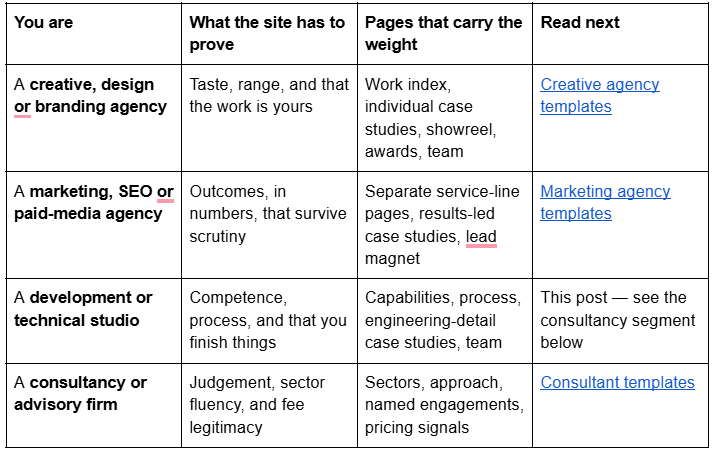
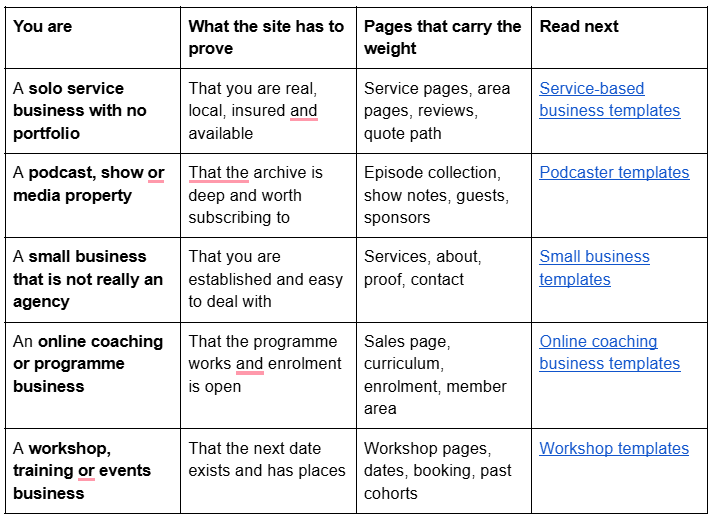
If you sit in two of these, build for the one that produces the revenue you want more of. A site that hedges between creative studio and performance marketing agency convinces neither buyer. If you have already decided and just want a single verdict, the best template for agencies makes one.
What is actually inside an agency case study
Most agency websites publish a project gallery and call it a case study. A gallery is not an argument. A buyer comparing three agencies is trying to answer one question — has this agency solved a problem shaped like mine — and a grid of pretty screenshots does not answer it.
A case study that works has four parts, in this order:
Situation. Who the client was, what business they are in, what size. Name them if you have permission; an anonymised case study loses most of its persuasive weight, and "a leading fintech" reads as fiction.
Constraint. Budget, timeline, legacy platform, regulatory limit, internal politics. This is the section nearly everyone skips, and it is the section that makes the work credible. Constraints are what a prospective client recognises themselves in.
What was done. Specific decisions, not deliverables. "We moved the booking flow ahead of the pricing table" is a decision. "Brand identity, web design, copywriting" is a receipt.
Measured outcome. A number, a timeframe, and a source. Where you cannot publish a commercial number, publish an operational one — support tickets, time-to-publish, page speed. A case study with no measurement is a portfolio entry.
Add one client quote that speaks to the constraint rather than to how lovely you were to work with, and one link to the live site. Between 400 and 900 words. Three of these beat twelve galleries.
Where case studies live in Squarespace 7.1: Portfolio, blog, or pages
This is the decision that a template makes for you, and it is worth understanding before you buy.
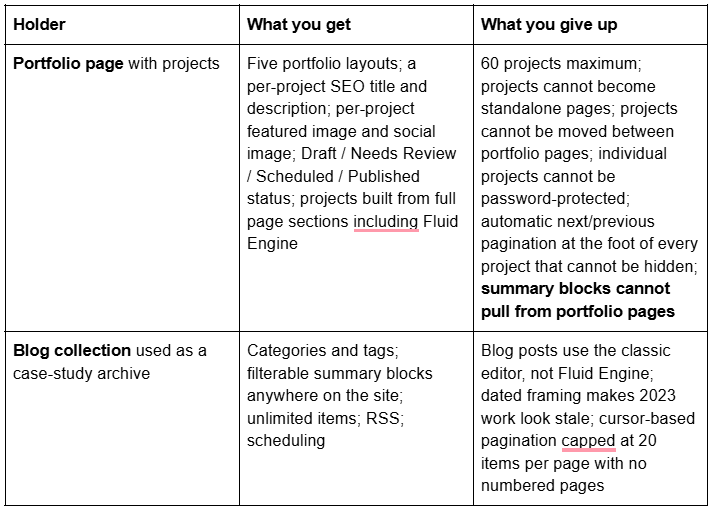
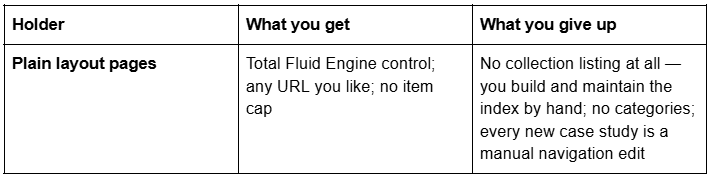
The constraint that catches people out: in Squarespace 7.1, summary blocks display blog posts, calendar events, store products and videos pages only. Portfolio pages and gallery sections are not supported. So if your work sits in a Portfolio, you cannot drop a filtered "three recent branding projects" block onto your homepage or onto a service page. You link to the portfolio page, or you rebuild the grid by hand.
The pragmatic answer for most agencies: Portfolio pages for the work index, because the layouts and the per-project SEO fields are genuinely good, and a blog collection for anything you want to resurface contextually. If you expect more than 60 case studies, or you want service pages to automatically show relevant work, use the blog collection instead and style it to not look like a blog.
The credibility stack, in the order a buyer needs it
Agency buying is risk reduction. The prospect is not asking whether you are good; they are asking whether hiring you will embarrass them internally. Five things answer that, and most agency templates ship two of them.
Named clients. Logos are the weakest form of this because logo images are invisible to search engines and to screen readers. Write the names as text somewhere on the page as well.
Named results. A number attached to a client attached to a timeframe. One real figure outperforms a page of adjectives.
Team faces. A Team page with real photographs and real titles is the single most requested thing in agency selection processes and the single most commonly missing page in agency templates. Buyers want to know who will actually do the work.
Process transparency. A short, honest account of what the first four weeks look like. This is what separates an agency from a freelancer in a procurement conversation.
Pricing signals. Not necessarily a price list. A minimum engagement size, a typical project range, or a retainer floor. Publishing one filters out the enquiries that were never going to close and raises the proportion of calls that do.
How these Squarespace agency templates were scored
This is an editorial rubric, not a lab measurement. It is applied identically to every template so the scores compare to each other, and it is published so you can disagree with the weighting instead of guessing at it. The same rubric is used in the child posts, so the cluster does not contradict itself.
Five criteria, each scored 1–5, maximum 25:
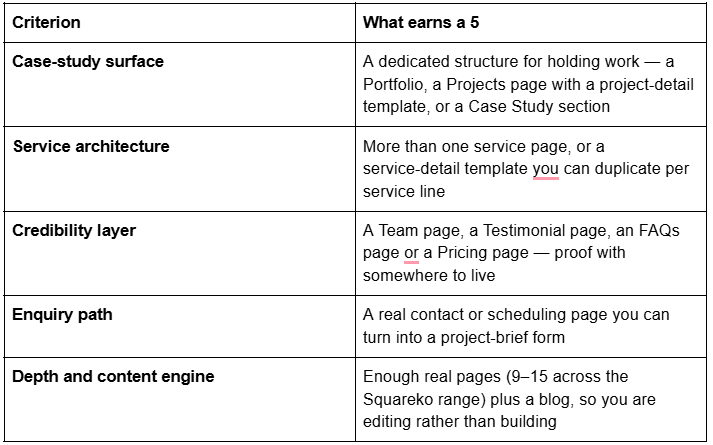
What is not scored: aggregate star ratings, "trusted by" counts and install figures. Those are unverifiable from outside the shop selling them, and this post does not cite them for its own templates either.
A note on demo access. Streamify and Advisory do not currently have a publicly viewable demo — their published live-demo links return HTTP 401 — so no demo link is given for either. Ask for a walkthrough before buying rather than judging from a thumbnail. Every other demo linked below was tested with a live request before publication.
Squarespace templates for creative and design agencies
Creative agencies are judged on the work itself, so the case-study surface carries almost all the weight.

WeDecorefy — best overall for an agency that needs a Team page
Score: 23/25. WeDecorefy is the largest template in the Squareko range at 15 pages, and although it is tagged Interior & Home Design, its page architecture is the most agency-shaped in the set: Projects, a dedicated Project Details page, a Team page, Service and Offering pages, a Gallery, a Blog, a Shop, a Freebie page and a Contact page, plus a Style Guide and a 404.
Project Details is the piece that matters. It is a worked example of a single case study laid out as a page — which is exactly the thing most agencies stare at a blank editor trying to invent. Duplicate it, and every case study on your site has the same rhythm. The Team page is rarer still: it is the only template in the range that ships one, and team faces are a top-three factor in agency shortlisting.
Case-study surface 5, service architecture 4, credibility layer 5, enquiry path 4, depth 5.
Worst for: anyone who wants to launch in a weekend. Fifteen pages is fifteen pages of copy.
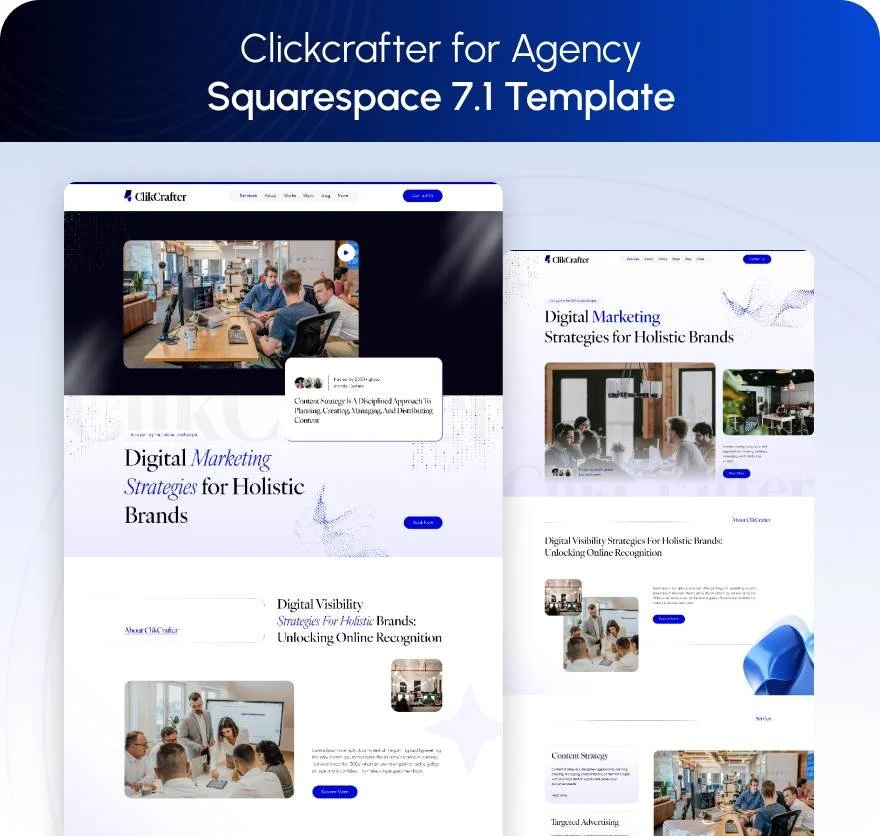
Click Crafter — best purpose-built agency template
Score: 21/25. Click Crafter is the template in the range actually tagged Agency and Service-Based, and it runs to 12 pages: Home and a second homepage variant, About, Services, Portfolio, Gallery, Blog, Shop, Contact, a Freebie page, a Style Guide and a 404.
The Portfolio-plus-Gallery pairing is the right shape for a design or branding agency: the Portfolio holds one project per item with its own SEO title and description, and Gallery sections inside each project hold the imagery. The Freebie page is the underrated one — in agency work the highest-converting asset is usually a document, and a built page for it plus a form is a working lead magnet on day one.
Case-study surface 5, service architecture 3, credibility layer 4, enquiry path 4, depth 5.
Worst for: an agency with five distinct service lines. Click Crafter ships one Services page, so the per-service pages are yours to build.
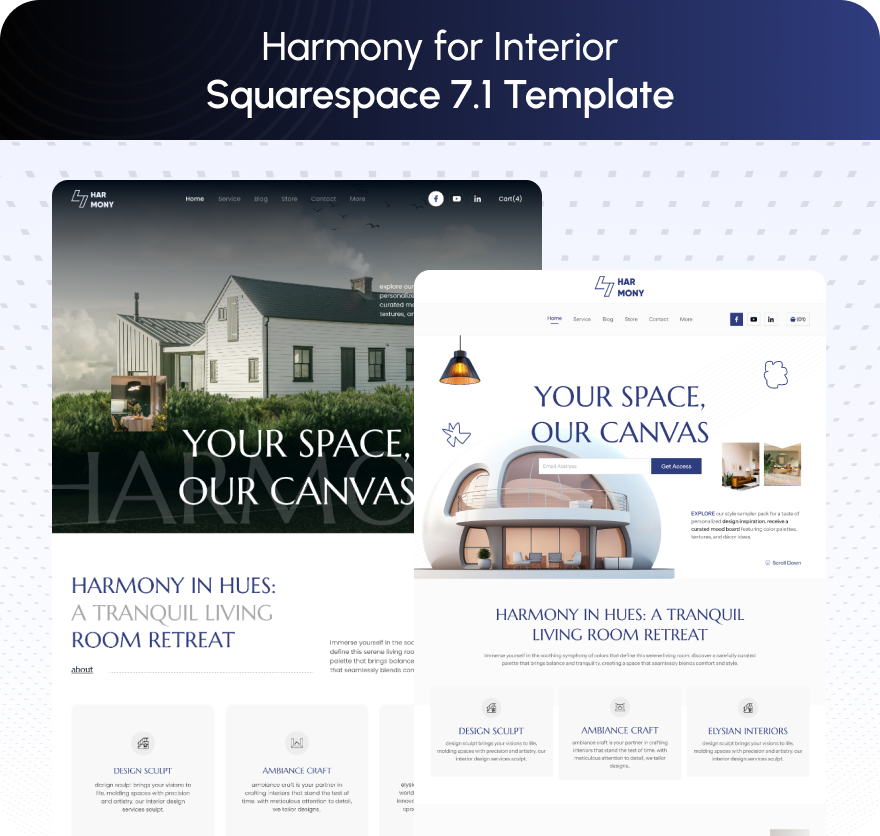
Harmony — best for a small studio that also sells products
Score: 17/25. Harmony is 11 pages — Services, Portfolio, Gallery, a Store, a Blog, a Freebies page and a Contact page — and suits the design studio with a product line alongside client work: presets, templates, type, print.
Case-study surface 4, service architecture 3, credibility layer 2, enquiry path 4, depth 4.
Worst for: a firm selling on process and people. There is no Team page and no Testimonial page.
Streamify is worth naming even without a demo link: 12 pages tagged Streaming and Videography, with a Project structure, a Team page, a Pricing page, FAQs and a Blog — the strongest credibility layer in the range for a production company. Scored 19/25.
Squarespace templates for marketing, technical and consulting firms
These buyers want service-line depth and evidence before they want a conversation. The full treatment is in the marketing agency post; the two structural picks are here.
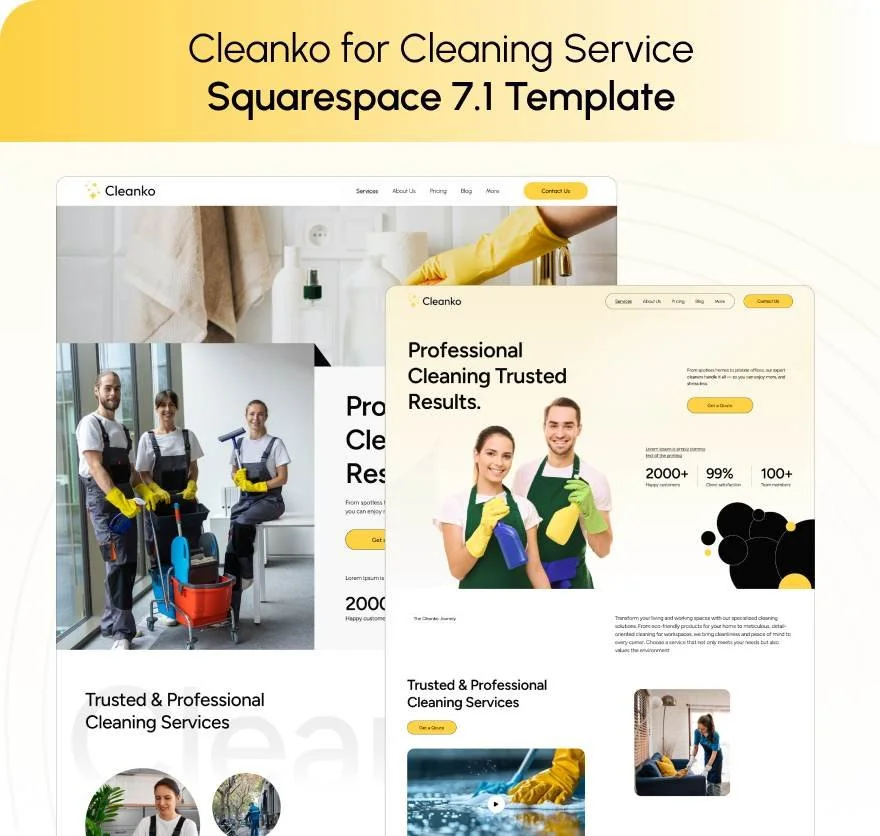
Cleanko — best service-line architecture in the range
Score: 20/25. Cleanko is tagged Cleaning Service, and every marketing and technical agency should look at it anyway, because it is the only template in the range that ships a Service Details page alongside the Services index. That is the template for a single service line — SEO, paid search, content, email — and duplicating it four times gives you four pages that can each rank for their own keyword.
The rest is 12 pages: About, Services, Service Details, Pricing, Portfolio, FAQs, Blog, Contact Us, two homepage variants, Style Guide and 404. Pricing plus FAQs is a complete objection-handling layer.
Case-study surface 3, service architecture 5, credibility layer 4, enquiry path 4, depth 4.
Worst for: a visual-first creative studio. The register is operational, not expressive.

Justify — best when the case studies are the entire pitch
Score: 19/25. Justify is built for law firms and is the smallest template in the Squareko range at nine pages, with a Case Study section, an Our Practice Area page, a Services page, a Blog and — unusually — a dedicated Schedule a Call page rather than a generic contact form.
For a consultancy or a technical studio whose credibility comes entirely from documented outcomes, that combination is close to ideal. Practice Area maps cleanly onto sectors or capabilities.
Case-study surface 5, service architecture 4, credibility layer 3, enquiry path 5, depth 2.
Worst for: anyone who needs depth. Nine pages, no Team page, no Pricing page.
Advisory, again with no publicly viewable demo, is 11 pages tagged Consultation and Speaker with a Pricing page, a Blog and two legal pages — the pick for a consultancy that leads with fees. Scored 15/25.
Squarespace templates for solo service businesses
If you sell a service and have no visual work to show — accountancy, trades, training, cleaning, therapy — the portfolio question disappears and service pages become the entire SEO surface. That is a different post: Squarespace templates for service-based businesses.
Two picks worth naming here. Relief is 11 pages with a Pricing page, an FAQ page, a Blog, a Contact page and two legal pages — scored 16/25, and the cleanest objection-handling structure in the range for a one-person practice. Luminary is 11 pages tagged Service-Based, Course and Speaker, with a Portfolio, a Gallery, a Courses page, a Shop and a Freebie page — scored 14/25, and it comes with a warning worth reading before you buy: Luminary ships no Contact page and no Blog page. Both are straightforward to add in Squarespace 7.1, but you are adding them, and an agency site without an enquiry page on day one is a real gap.
The enquiry path an agency site actually needs
A Contact page that says "get in touch" asks a stranger to compose an email, and composing an email is work. Enquiries die in that gap.
An agency enquiry page should carry four things: a form that asks for budget range and timeline as select fields, a stated response time, a named human, and an alternative route for people who would rather talk. Squarespace 7.1 form blocks require at least one storage option, and the choices are a Squarespace mailing list, the form submitters list in the Contacts panel, an email address, Google Drive, Mailchimp or Zapier — Mailchimp and Zapier need Core plan or above. After submission the form either shows a confirmation message, which accepts HTML, or redirects to a page on your site. Redirecting to a "what happens next" page beats a green tick.
Adding a budget field costs you the enquiries you did not want. That is the point.
What the rest of the market offers
Being fair about this earns more trust than pretending there is one option.
Big Cat Creative is the largest premium Squarespace shop and maintains a service-based business category with a strong self-service education layer. Applet Studio runs around 30 templates at roughly $225 with industry landing pages and a large showcase of real agency builds. Station Seven, Paper Moon Websites, Ink and Mortar, SQSPThemes and Square Stylist all sell into this niche, and Go Live HQ sells add-on pages rather than whole templates, which suits an agency that only needs one missing structure.
Squarespace's own free templates are the honest baseline, included with every subscription, and Squarespace maintains an agency template category. If your agency site is five pages and your writing is strong, a free template plus a weekend is a reasonable outcome — the free versus premium comparison sets out where that stops being true.
Where the Squareko range differs is delivery. Templates arrive as a Squarespace contributor invitation rather than a file download, and installation onto an existing live site is a manual add-on taking around 48 hours — which matters when your current site is producing enquiries.
What it costs over the life of the site
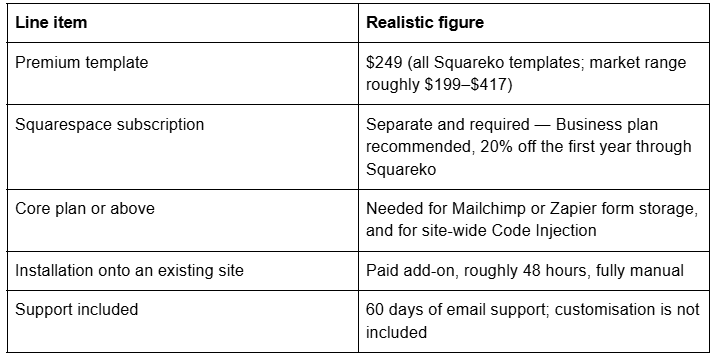

Two things get missed. Demo images are licensed to the template shop, not to you — every one must be replaced before launch, which for an agency means real project photography and real team headshots. And all sales are final, so use the demo properly first.
Choosing one
Work it in this order. Decide which of the five agency businesses you are and build for that one. Decide where case studies live — Portfolio if you will publish fewer than 60 and never need to filter them onto other pages, blog collection if you will. Check the credibility layer: is there a Team page, a Testimonial page, a Pricing page, or a homepage strip pretending to be one. Then look at the design, because in Squarespace 7.1 design is the easiest thing to change and page architecture is the hardest.
If you would rather not run the install yourself, the premium Squarespace templates in our range are delivered as a contributor invitation and can be installed onto an existing live site without taking it down. Most agencies reading this will do it themselves over a weekend, and the templates above are the shortlist worth starting from.
FAQ
-
Five carry the weight: a homepage naming who you work with, a work index, individual case studies, a services page or one page per service line, and an enquiry page with a budget field. A team page and a process page are the two additions that most improve shortlist conversion.
-
Portfolio pages give five layouts, per-project SEO fields and Fluid Engine sections, but cap at 60 projects and cannot be pulled into summary blocks. A blog collection gives categories, tags and filterable summary blocks with no item cap, but uses the classic editor. Choose portfolio for fewer than 60 case studies you will never need to resurface elsewhere.
-
Up to 60. Projects also cannot be moved between portfolio pages, cannot become standalone pages, and cannot be individually password-protected. Each project does get its own SEO title, SEO description, featured image, social image and publication status.
-
Only if the projects are blog posts, events, products or videos. In Squarespace 7.1 summary blocks do not support portfolio pages or gallery sections, so a portfolio-based work index has to be linked to rather than embedded, or rebuilt by hand on the homepage.
-
A price list, rarely. A pricing signal, usually — a minimum engagement size, a typical project range or a retainer floor. It filters out enquiries that were never going to close. Cleanko, Relief and Advisory all ship a dedicated Pricing page in the Squareko range.
-
All Squareko templates are $249. The wider market runs roughly $199 to $417, with most premium shops between $225 and $299. A Squarespace subscription is separate and required, and installation onto an existing live site is a paid add-on taking around 48 hours.

Author Bio
I'm Walid Hasan, a Certified Squarespace Expert and Squarespace Circle Platinum Partner with over 12 years of hands-on experience designing and optimizing high-performing websites. Over the years, I've had the privilege of building more than 2,000 Squarespace websites for clients around the world, always focusing on clean design, strong user experience, and conversion-driven results.