Squarespace York Template: Family of Nine, Limits and the 7.1 Path
York is a Squarespace version 7.0 template and it heads a family of nine. Artesia, Flores, Harris, Jasper, Jones, Lange, Shibori, Taylor and York share one codebase and one template ID, so every York tutorial applies to all nine. Two of them, Taylor and Jones, are discontinued. York's distinguishing feature is the project page, which exists nowhere else on Squarespace — and which converts cleanly to a 7.1 portfolio page, redirect included.
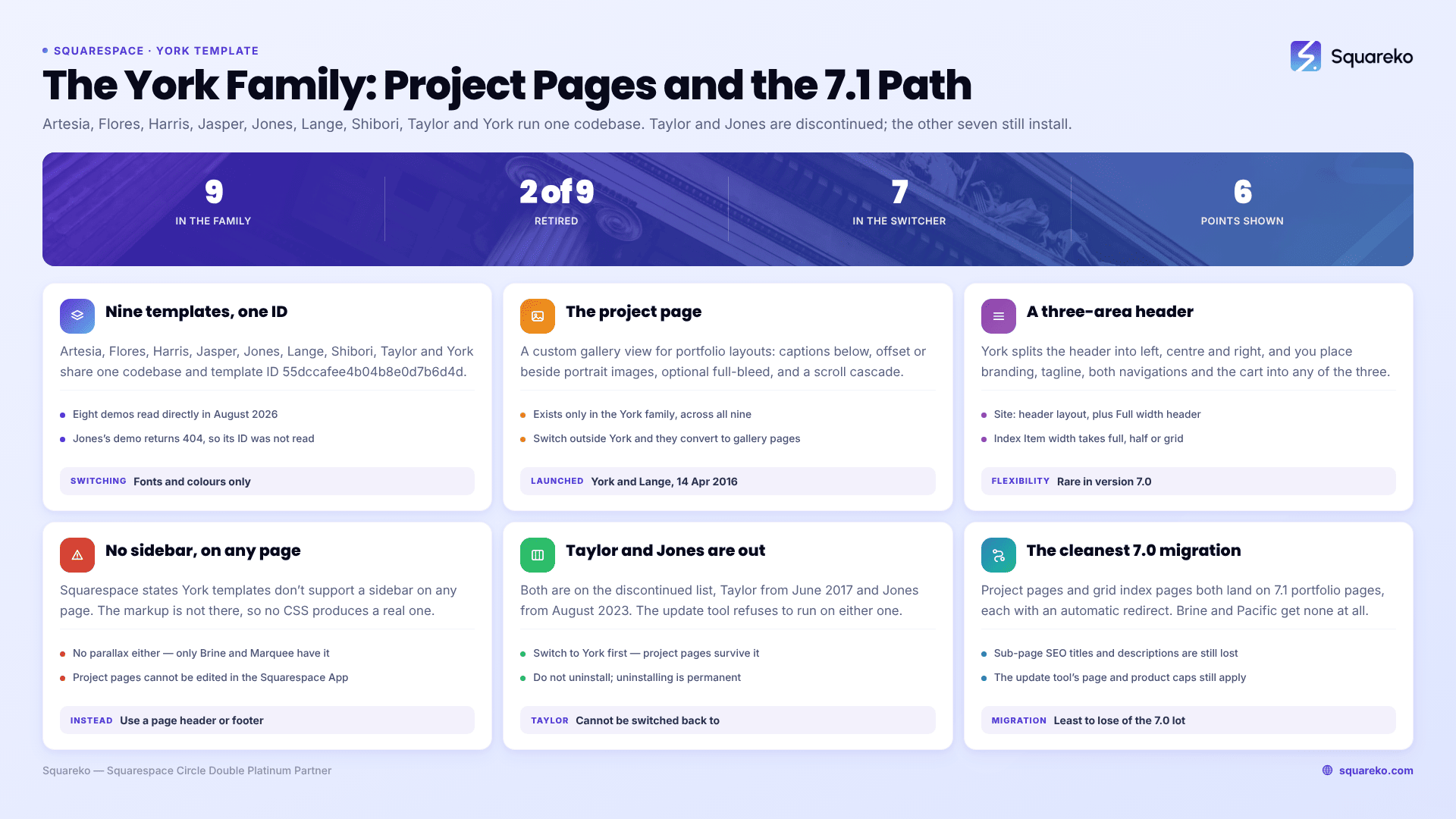
Should you stay on York, restyle it, or move to 7.1?
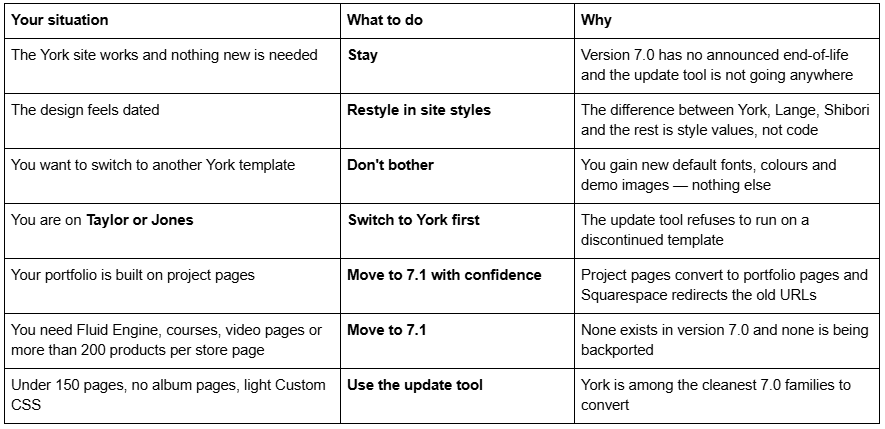
Who is in the Squarespace York family
Squarespace's family guide is unambiguous: "The York template family (Artesia, Flores, Harris, Jasper, Jones, Lange, Shibori, Taylor, and York) is designed to showcase the work of illustrators, photographers, creative agencies, and other visual content producers."
We confirmed the shared codebase in August 2026. On squarespace.com, the demos for York, Artesia, Flores, Harris, Jasper, Lange, Shibori and Taylor all report "templateVersion":"7" and the identical template ID 55dccafee4b04b8e0d7b6d4d. jones-demo.squarespace.com returns HTTP 404, so Jones's demo is no longer served and we did not read its ID directly — Squarespace's discontinued-templates guide lists it as York family, retired in August 2023.

Search for "York" rather than your member name, because the class names and tweaks are family-level. A detector tool will report your site as "York" and it is not wrong: templateId identifies the family, not the member. And switching between the seven available members changes nothing but defaults.
Every York template supports non-English site languages, which is not true of most version 7.0 families. The list of Squarespace 7.0 templates covers all 121 templates across the 22 families.
What a project page is, and why York owners care
The project page is the reason people chose the York family, and it is the single thing that makes York different from every other version 7.0 template.
Squarespace describes it as "a custom gallery view, designed for making elegant portfolio layouts" that "arranges images, titles, and captions into elegant layouts." Practically, it is a case-study page: a mix of images and text where captions can sit below an image, offset from it, or beside portrait images, with images optionally full-bleed and a cascade animation as the visitor scrolls. Turn that animation off with Cascade images and captions.
Two rules matter:
Project pages exist only in the York family, across all nine templates. Squarespace: "York, Artesia, Flores, Harris, Jasper, Jones, Lange, Shibori, and Taylor" share them.
Switching to a non-York version 7.0 template destroys the format. Squarespace: "If you switch to a template outside of the York family, project pages convert to gallery pages." You can rebuild them by creating new project pages and moving the images back, but the layout is gone.
Squarespace launched York and Lange together on 14 April 2016, describing York as "ideal for illustrators, animators, and graphic designers" and Lange as the photographer's variant. That is still an accurate description of who a York site suits.
What else the Squarespace York template does well
A three-area header. York splits the header into left, centre and right areas, and you place branding, tagline, main navigation, secondary navigation and the shopping cart into any of them. Layout lives under Site: header layout, with Full width header and Left / Center / Right layout switching each area between horizontal and stacked. Styling is under Site: header and Site: navigation.
A flexible index. York index pages create navigation thumbnails as banners or as a grid. Item width under Index: layout takes full, half or grid; Alternate widths and Alternate sides break up the rhythm; Full bleed index takes thumbnails to the browser edge. Album, blog, gallery, events, store, project and layout pages can all sit inside one.
Banners with an auto colour background. Check Auto color background under Banner and the banner pulls a background colour out of the featured image itself, so illustrations with a flat background appear to extend to the edges. Full bleed banner, Image alignment, Crop image and Height do the rest.
Page headers and footers on nearly every page type. Enable Show page header and Show page footer in the Page section of site styles, then add blocks through the Collection header content and Collection footer content annotations. York supports them on album, blog, events, gallery, index, store and project pages.
Advanced store pages and both a primary and a secondary navigation.
What breaks or feels dated on a York site in 2026
No Fluid Engine. Version 7.0 editing is the classic block editor — a 12-column grid, no overlapping elements without CSS, no drag-anywhere canvas. Fluid Engine is 7.1-only and is not coming to York.
No sidebar, and no way to add one. Squarespace states it plainly: "York templates don't support a sidebar on any page." The markup is not there, so no CSS produces a real one.
No parallax. Brine and the discontinued Marquee family are the only two version 7.0 families with site-wide parallax. York has none.
Mobile is one inherited layout. Index pages drop to one thumbnail per row, the ☰ "always displays on mobile, even if the main and secondary navigations are empty," and banner text needs scaling fonts enabled with reduced minimums to stop it breaking. Squarespace 7.1 with Fluid Engine keeps a genuinely separate mobile layout per section at a 767px breakpoint.
Project pages are not editable in the Squarespace app. Squarespace: "You can't add or edit project pages in the Squarespace App." On a portfolio site that is where your content lives, so York is a desktop-only editing experience in practice.
Missing blog features that are now standard. The York family uses the standard grid/list blog page — no related posts, no author profile block, no infinite scroll.
York bugs Squarespace documents and is not going to fix
Squarespace maintains a Troubleshooting York section, prefaced with its actual position on version 7.0: "Although we still support Squarespace version 7.0, fixing bugs or issues is a lower priority for us while we focus on our current platform, version 7.1."
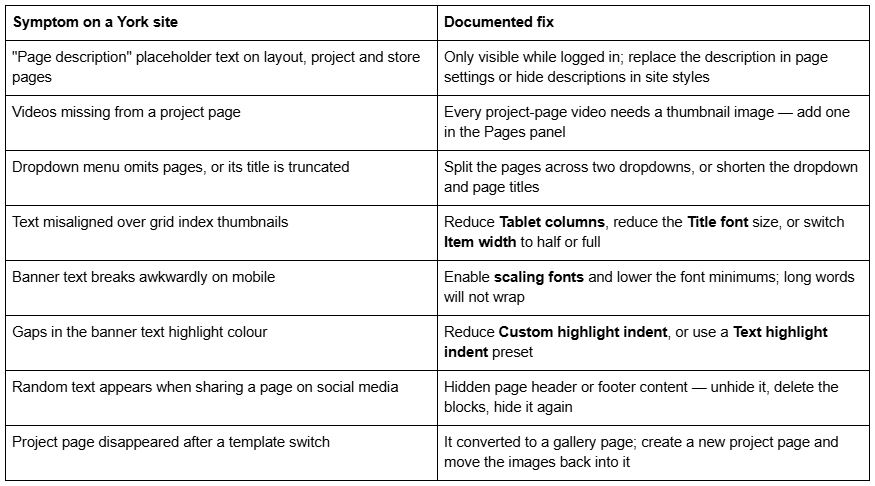
None of these is a fault in your setup. All are York behaving as documented.
Is the Squarespace York template still available?
York, Artesia, Flores, Harris, Jasper, Lange and Shibori are, on an existing version 7.0 site, via Design → Template → Install new template. Taylor and Jones are not — both are on Squarespace's discontinued list.
Discontinued does not mean dead. Squarespace's wording: "Your site will stay online, and you can continue to use and edit the template as you've always been able to," and "you can switch to a different template, and switch back to the discontinued template as long as you don't uninstall it." Uninstalling is the irreversible act. Taylor in particular cannot be switched to at all — you can switch away from it, but not back through the template picker.
You cannot start a new site on any York template. The live gallery at squarespace.com/templates returned 198 templates in August 2026, every one of them version 7.1 — we counted them. The old squarespace.com/templates/york-demo URL now serves that generic gallery, which is why older "York demo" links land somewhere unrecognisable. Squarespace's demo, york-demo.squarespace.com, is still up.
Version 7.0 has no announced end-of-life, and Squarespace states the move is optional: "Updating your site from version 7.0 to 7.1 is optional." Whether old Squarespace templates are still supported covers the support position in full.
Moving a Squarespace York site to version 7.1
The tool is at Design → Update to Version 7.1. Before you touch it:
If you are on Taylor or Jones, you cannot start. Squarespace's first preparation step: "Ensure your site isn't using a discontinued 7.0 template. If your template is discontinued, switch to another template before starting the update." Switch to York — a within-family switch, so your project pages survive it — then run the tool. Do not uninstall the discontinued template.
It is permanent. "After you click Publish update, your site will update to version 7.1 permanently."
It caps at 150 pages and errors above 200 products on a store page.
Developer mode must be off, and Developer Platform code disappears when you disable it.
Custom CSS survives commented out. Remove the comment tags in the CSS editor and save. Selectors written against York class names will mostly not match 7.1 markup.
What happens to the parts a York site is built from:
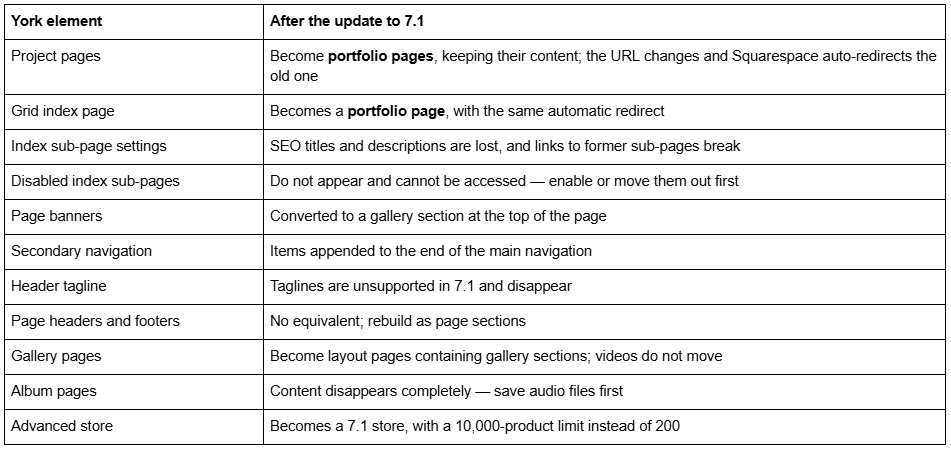
York is one of the better version 7.0 families to migrate, for a specific reason: Squarespace maps both project pages and grid index pages onto 7.1 portfolio pages, with an automatic redirect for each. Compare that with Brine or Pacific, whose stacked indexes flatten onto a single layout page with no redirect at all.
Audit before you press the button. Export every index sub-page's navigation title, SEO title and description to a spreadsheet — that is the data the tool discards. Enable every disabled sub-page. Confirm every project-page video has a thumbnail. Count pages and products, export the Custom CSS, and screenshot the Site: header layout, Index: layout and Banner tweaks.
And the expensive one: changing a page slug on Squarespace creates no automatic 301 redirect, ever. Project and index URLs are redirected for you; anything you rename afterwards is not.
The screen-by-screen version is in the Squarespace 7.0 to 7.1 guide, and the Squarespace 7.0 template comparison chart shows how York's feature set compares with the other 21 families. The Squarespace Brine template guide works through the same decision for the largest 7.0 family.
So: stay on York, or move?
Stay if the York site does its job, the portfolio is stable, and nothing on your list requires 7.1. It is not a liability, and project pages still look good.
Restyle if the objection is aesthetic — fonts, colours, banner heights, index thumbnail widths and header arrangement are all site styles values. Switching to Lange, Shibori or Artesia will not change a single feature.
Move if you need Fluid Engine, courses, video pages, a store past 200 products per page, editing on mobile, or an independently editable mobile layout. And move without dread: York is the version 7.0 family with the least to lose, because its two signature page types both land on portfolio pages with their URLs redirected.
For scale: across 54 Squareko-built client sites measured in August 2026 (Playwright/Chromium lab test, cloud datacenter, unthrottled, single run per site), 53 of 54 run Squarespace 7.1. Version 7.0 is the minority case now, but a working York site is not an emergency.
Most York sites we are sent come through the update tool in good shape and then need a week of tidying — re-entering sub-page SEO data, rebuilding page headers as sections, restyling portfolio pages to match the old project-page rhythm. The exception is the York site running on Taylor or Jones with heavy Custom CSS, where you are switching templates and migrating versions and repairing both: there, rebuilding from a premium Squarespace template built for 7.1 and Fluid Engine is usually the shorter path. The table at the top of this page settles it for most people without spending anything.
FAQ
-
Nine: Artesia, Flores, Harris, Jasper, Jones, Lange, Shibori, Taylor and York. They share one codebase and the template ID 55dccafee4b04b8e0d7b6d4d, differing only in default fonts, colours and demo content. Taylor was discontinued in June 2017 and Jones in August 2023; the other seven are still installable.
-
Functionally, yes. Lange is a York family member with photography-oriented demo content and different default styling, launched alongside York on 14 April 2016. It runs identical code, so switching between Lange and York unlocks no features — every difference is a site styles value you already control.
-
A page type unique to the York family that arranges images, titles and captions into portfolio layouts, with captions below, offset or beside portrait images, optional full-bleed images and a scroll cascade animation. Switching to a template outside the York family converts project pages to gallery pages and loses the layout.
-
No. Version 7.1 does not support project pages. When you use the version update tool, project pages keep their content and become portfolio pages instead, and Squarespace automatically redirects the old URLs to the new ones. Project pages also cannot be added or edited in the Squarespace app.
-
No. Squarespace states that York templates don't support a sidebar on any page. The markup does not exist, so no CSS produces a real one. Put the content in a page footer, a page header, or the site-wide footer instead — all three are supported across most York page types.
-
Not directly. Squarespace requires you to switch off a discontinued template first, so switch to York — a within-family switch that preserves your project pages — then run Design → Update to Version 7.1. Do not uninstall Taylor or Jones; uninstalling is permanent, and Taylor cannot be switched back to.

Author Bio
I'm Walid Hasan, a Certified Squarespace Expert and Squarespace Circle Platinum Partner with over 12 years of hands-on experience designing and optimizing high-performing websites. Over the years, I've had the privilege of building more than 2,000 Squarespace websites for clients around the world, always focusing on clean design, strong user experience, and conversion-driven results.