Squarespace Bryant Template: A Business Template in the Bedford Family
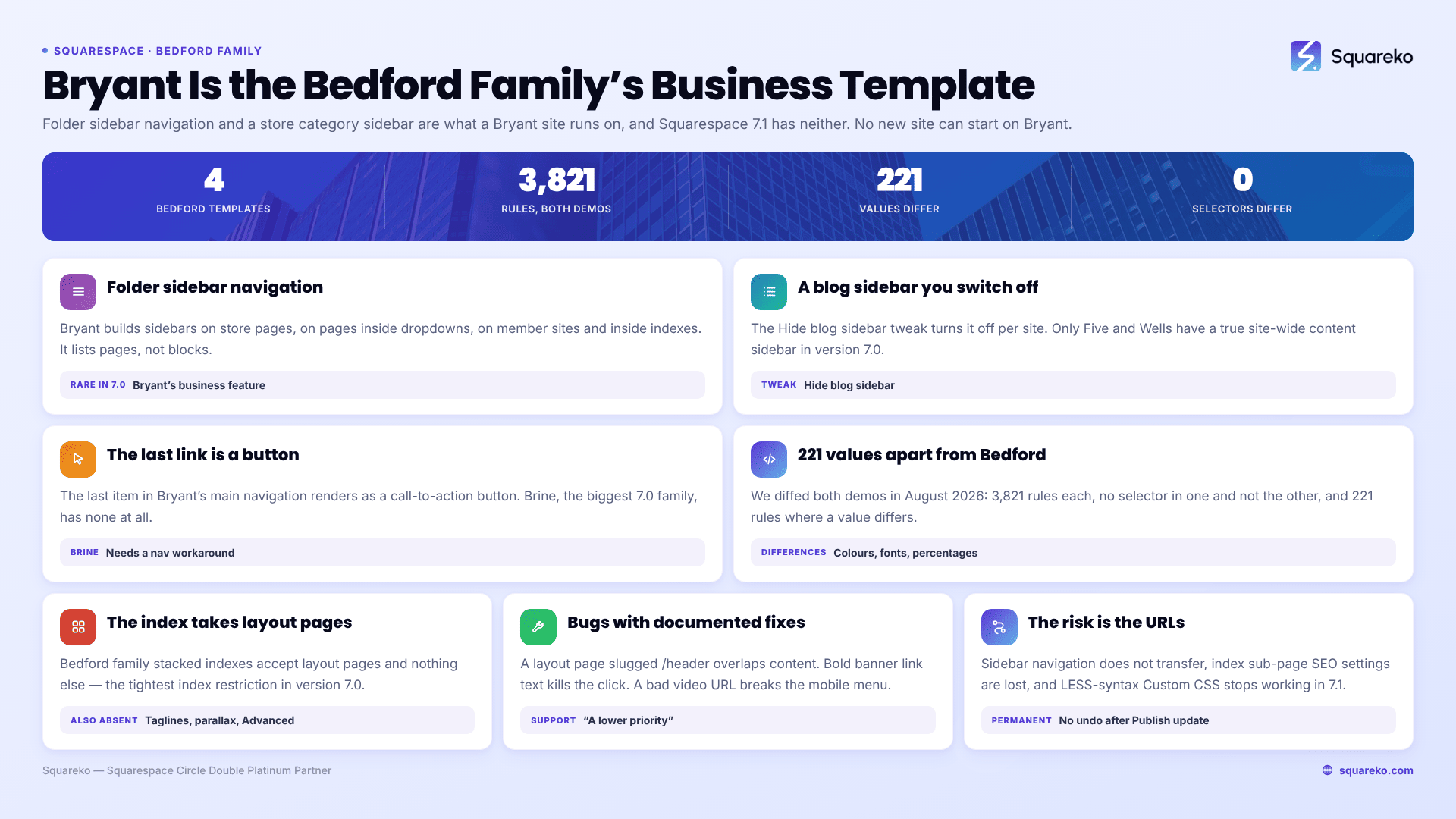
Bryant is a Squarespace version 7.0 template in the Bedford family, alongside Anya, Bedford and Hayden. All four report the same template ID, 52a74dafe4b073a80cd253c5, and run the same code — we diffed the compiled stylesheets from the Bryant and Bedford demos and found identical selector lists with 221 differing values. Bryant's own Read Me page calls it "ideal for your Business or Organization", and the two features business sites actually lean on — the blog and store sidebar, and folder sidebar navigation — are the two that Squarespace 7.1 does not have.
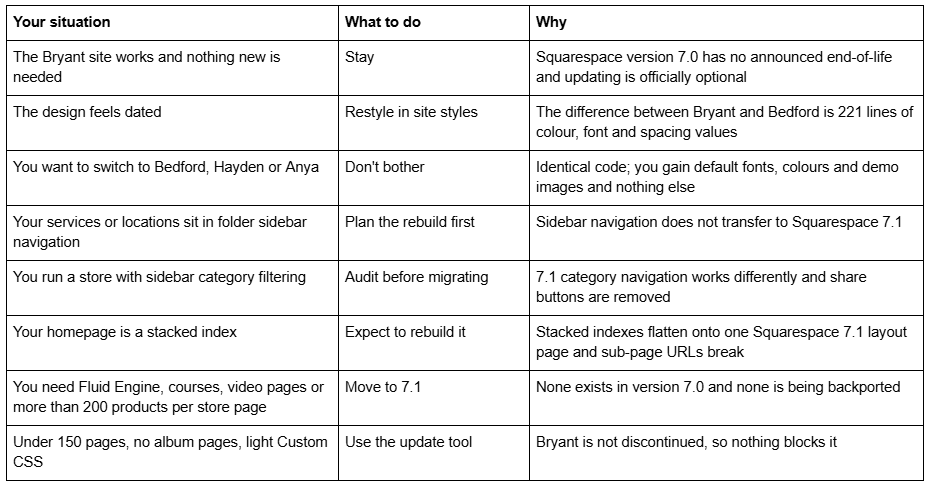
Should you stay on Bryant, restyle it, or move to 7.1?
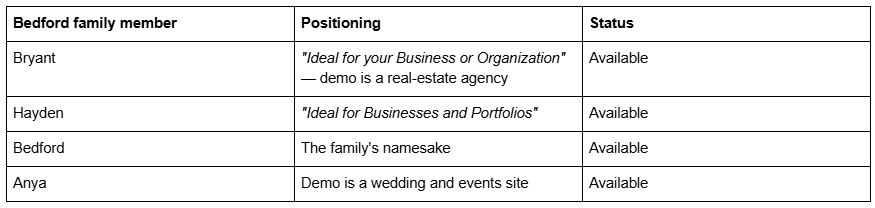
Bryant is a Bedford family template
Squarespace's family guide states it directly: "The versatile Bedford template family (Anya, Bedford, Bryant, Hayden) works for all types of sites, from nonprofits to real estate listings."
We verified all four in August 2026. bryant-demo.squarespace.com, bedford-demo, hayden-demo and anya-demo each returned HTTP 200 and each reports "templateVersion":"7" and the identical template ID 52a74dafe4b073a80cd253c5.
Then we compared Bryant's compiled stylesheet with Bedford's:
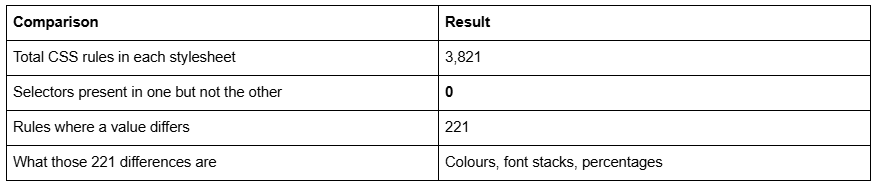
We also read the tweak values both demos expose in their page source. Across the 25 exposed tweaks, exactly one differs: siteTitleContainerWidth, set to 360px on Bryant and 220px on Bedford. That is the level at which these two templates diverge.
Two practical consequences. Search "Bedford", not "Bryant" — you will find far more material and all of it works, because class names and tweaks are family-level. And a template detector will report your site as "Bedford", correctly: templateId identifies the family, never the individual template. The list of Squarespace 7.0 templates covers all 121 templates across the 22 families.
What the Squarespace Bryant template does well for a business site
Folder and category sidebar navigation. This is Bryant's strongest business feature and it is rare in version 7.0. Bryant creates sidebars on store pages, on pages inside dropdowns, on member sites and inside indexes — which is exactly how a services company or a real-estate agency organises listings, locations or practice areas. One caveat from Squarespace: "Sidebar navigation doesn't support blocks." It lists pages, not content.
A blog sidebar you can switch off per site. Controlled by the Hide blog sidebar tweak. Only Five and Wells have a true site-wide content sidebar in version 7.0; most families have no sidebar at all.
A navigation button. The last item in the main navigation renders as a call-to-action button rather than a link. Brine, the biggest 7.0 family, has no header button at all and needs a secondary-navigation workaround. Bryant just has one — which matters on a business site where "Book a call" or "Get a quote" belongs in the header.
A store with sidebar category filtering. Classic store pages, with product categories in the sidebar. Capped at 200 products per page, which is a version 7.0 limit rather than a Bedford one.
Customer accounts and member sites, which is where the ranking forum thread for this template comes from — someone wanting to relabel the Sign In link. Squarespace moderator creedon's answer was a pseudo-element swap, written in the LESS syntax that version 7.0 site styles accept:
.unauth {
visibility: hidden;
}
.unauth::before {
content: 'Log In';
visibility: visible;
}
Worth noting for the migration section below: that snippet targets Bedford family markup and will not survive a move to Squarespace 7.1.
Real page banners. Full-bleed images and video banners on layout, album, blog, event and store pages, with formatted text overlays supporting headings, body copy and button-style links, plus a Banner overlay color filter. Heights are fixed at 600px desktop, 700px with a transparent header and 300px mobile.
Slideshow banners — add a slideshow gallery block as the first element on a page — plus a stacked index with a fixed header and footer navigation.
What breaks or feels dated on a Bryant site in 2026
No Fluid Engine. Version 7.0 editing is the classic block editor — a 12-column grid, no overlapping elements without CSS, no drag-anywhere canvas. Fluid Engine is 7.1-only and is not coming to Bryant.
The index accepts layout pages only. Bedford family stacked indexes take layout pages and nothing else — no gallery, blog or store sub-pages. It is the tightest index restriction in Squarespace version 7.0.
No taglines. Squarespace states it for the family: "Taglines don't display." Set one in site settings and Bryant ignores it.
A Classic store, not an Advanced one. Brine, Farro, Skye, Tremont and York have the Advanced store page. Bryant does not, and every version 7.0 store page caps at 200 products.
No parallax. Parallax scrolling exists in exactly two version 7.0 families, Brine and the discontinued Marquee. Bryant has none.
Fixed banner heights. 600px desktop, 300px mobile, no per-page override without Custom CSS. Squarespace 7.1 sets section height per section in the editor.
Mobile is one inherited layout. Navigation "collapses to a ☰ in the top right", sidebars drop beneath the main content, a Back to top link appears at the foot of the page, and slideshow banners compress to 300px. Squarespace 7.1 with Fluid Engine keeps a genuinely separate mobile layout per section at a 767px breakpoint.
Bryant bugs Squarespace documents and is not going to fix
Squarespace maintains a Troubleshooting section for the Bedford family, prefaced with its actual position on version 7.0: "Although we still support Squarespace version 7.0, fixing bugs or issues is a lower priority for us while we focus on our current platform, version 7.1."
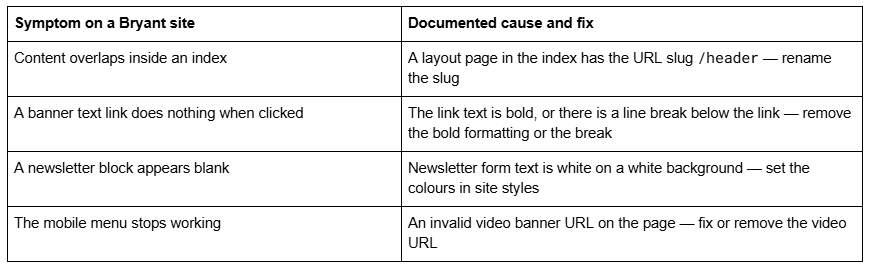
None of these is a fault in your setup. All are Bedford family behaviour, and all of them affect Bryant, Bedford, Hayden and Anya identically.
Is the Squarespace Bryant template still available?
Yes — on an existing version 7.0 site, via Design → Template → Install new template. Bryant is not on Squarespace's discontinued list, and neither are Bedford, Hayden or Anya. The whole Bedford family is intact, which means no Bryant owner is blocked from the version update tool the way every Marquee owner is.
You cannot start a new site on Bryant. The live gallery at squarespace.com/templates returned 198 templates in August 2026, every one of them version 7.1 — we counted them. Both squarespace.com/templates/bryant-demo and squarespace.com/templates/bryant now serve that generic gallery, which is why older "Bryant demo" links land somewhere unrecognisable. Squarespace's actual demo, bryant-demo.squarespace.com, is still up and still Bryant.
Version 7.0 has no announced end-of-life, and Squarespace states the move is optional: "Updating your site from version 7.0 to 7.1 is optional." Several competing pages claim specific 7.0 templates have "no upgrade path". That is false for every Bedford family template. Whether old Squarespace templates are still supported covers the support position in full.
Moving a Squarespace Bryant business site to version 7.1
The tool is at Design → Update to Version 7.1. Before you touch it:
It is permanent. "After you click Publish update, your site will update to version 7.1 permanently."
It caps at 150 pages and errors above 200 products on a store page.
Developer mode must be off, and Developer Platform code disappears when you disable it.
Custom CSS survives commented out. Remove the comment tags in the CSS editor and save. Anything written in LESS syntax — like the Sign In relabel above — will not work in Squarespace 7.1, which uses plain CSS.
Move index sub-pages out first if you want to keep their SEO titles and descriptions.
What happens to the parts a Bryant business site is built from:
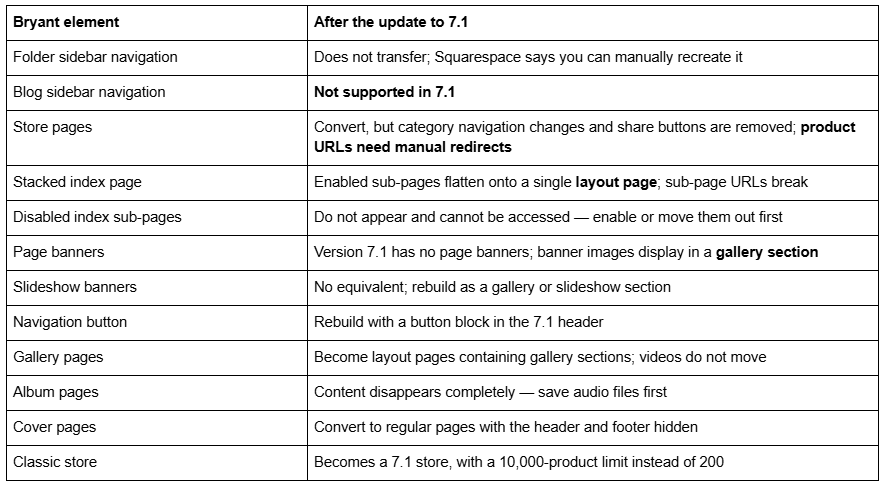
The line to read twice is the store one. Squarespace redirects converted index page URLs automatically, but product URLs require manual redirect setup. On a business site with a catalogue and inbound links or paid traffic pointing at individual products, that is the difference between a clean migration and a month of 404s.
Audit before you press the button. Export every product URL and every index sub-page's navigation title, SEO title and description to a spreadsheet — that is the data the tool discards or orphans. Enable every disabled sub-page. Screenshot the sidebar structure on every page that uses it. Confirm no layout page inside an index uses the /header slug. Count pages and products, and export the Custom CSS.
And the expensive one: changing a page slug on Squarespace creates no automatic 301 redirect, ever. Add every orphaned product and sub-page URL by hand in Settings → Advanced → URL Mappings using the /old -> /new 301 format.
The screen-by-screen version is in the Squarespace 7.0 to 7.1 guide, and the Squarespace 7.0 template comparison chart shows how Bedford's feature set compares with the other 21 families. The Squarespace Brine template guide works through the same decision for the largest 7.0 family.
So: stay on Bryant, or move?
Stay if the Bryant site is doing its job, the sidebar navigation is genuinely how visitors find things, and nothing on your roadmap requires 7.1. Bryant is not discontinued and version 7.0 has no announced end-of-life.
Restyle if the objection is aesthetic. Fonts, colours, banner overlay, button styles, site title width and blog layout are all site styles values, and switching to Bedford, Hayden or Anya changes 221 lines in a 3,821-rule stylesheet and unlocks nothing.
Move if you need Fluid Engine, courses, video pages, a store past 200 products per page, or an independently editable mobile layout — and treat it as a project with a redirect plan attached, not a button press. On a Bryant business site the risk is not the design, it is the URLs.
For scale: across 54 Squareko-built client sites measured in August 2026 (Playwright/Chromium lab test, cloud datacenter, unthrottled, single run per site), 53 of 54 run Squarespace 7.1. Version 7.0 is the minority case now, but a working Bryant site is not an emergency.
Most Bryant sites we are sent come through the update tool and then need one to two weeks of tidying — rebuilding sidebar navigation as sections or a navigation folder, re-entering sub-page SEO data, and writing URL Mappings for every orphaned product and sub-page. The exception is the catalogue-heavy business site whose entire information architecture is folder sidebar navigation: there you are redesigning the structure, not converting it, and starting from a premium Squarespace template built for 7.1 and Fluid Engine is usually the shorter path. The table at the top of this page settles it for most people without spending anything.
FAQ
-
The Bedford family, alongside Anya, Bedford and Hayden. All four demos returned HTTP 200 in August 2026 and report "templateVersion":"7" and the template ID 52a74dafe4b073a80cd253c5. Because templateId identifies the family rather than the individual template, a detector tool will report a Bryant site as Bedford.
-
In code, yes. Comparing both demos' compiled stylesheets in August 2026, each is 3,821 rules long with identical selector lists, and 221 rules differ by value — colours, font stacks and percentages. Of the 25 tweak values exposed in the page source, only siteTitleContainerWidth differs: 360px on Bryant, 220px on Bedford.
-
Yes, on an existing version 7.0 site via Design → Template → Install new template. Bryant is not on Squarespace's discontinued list. You cannot start a new site on it — the live template gallery returned 198 templates in August 2026, all version 7.1 — and both squarespace.com/templates/bryant and /bryant-demo now serve that generic gallery.
-
Yes. Bryant uses Classic store pages with product category filtering in the sidebar, and also creates sidebars on pages inside dropdowns, on member sites and inside indexes. Squarespace notes that sidebar navigation doesn't support blocks — it lists pages, not content. All version 7.0 store pages cap at 200 products per page.
-
Yes, natively. The Bedford family renders the last item in the main navigation as a call-to-action button rather than a link, configured in the navigation tweaks. That is a real advantage over Brine, which has no header button and requires styling a single-item secondary navigation as a workaround.
-
The store converts and the product limit rises from 200 per page to 10,000, but category navigation changes, share buttons are removed, and — the important one — product URLs are not redirected automatically. Export every product URL first and rebuild the redirects by hand in Settings → Advanced → URL Mappings.

Author Bio
I'm Walid Hasan, a Certified Squarespace Expert and Squarespace Circle Platinum Partner with over 12 years of hands-on experience designing and optimizing high-performing websites. Over the years, I've had the privilege of building more than 2,000 Squarespace websites for clients around the world, always focusing on clean design, strong user experience, and conversion-driven results.