Squarespace Template for Realtors: The Agent Is the Product
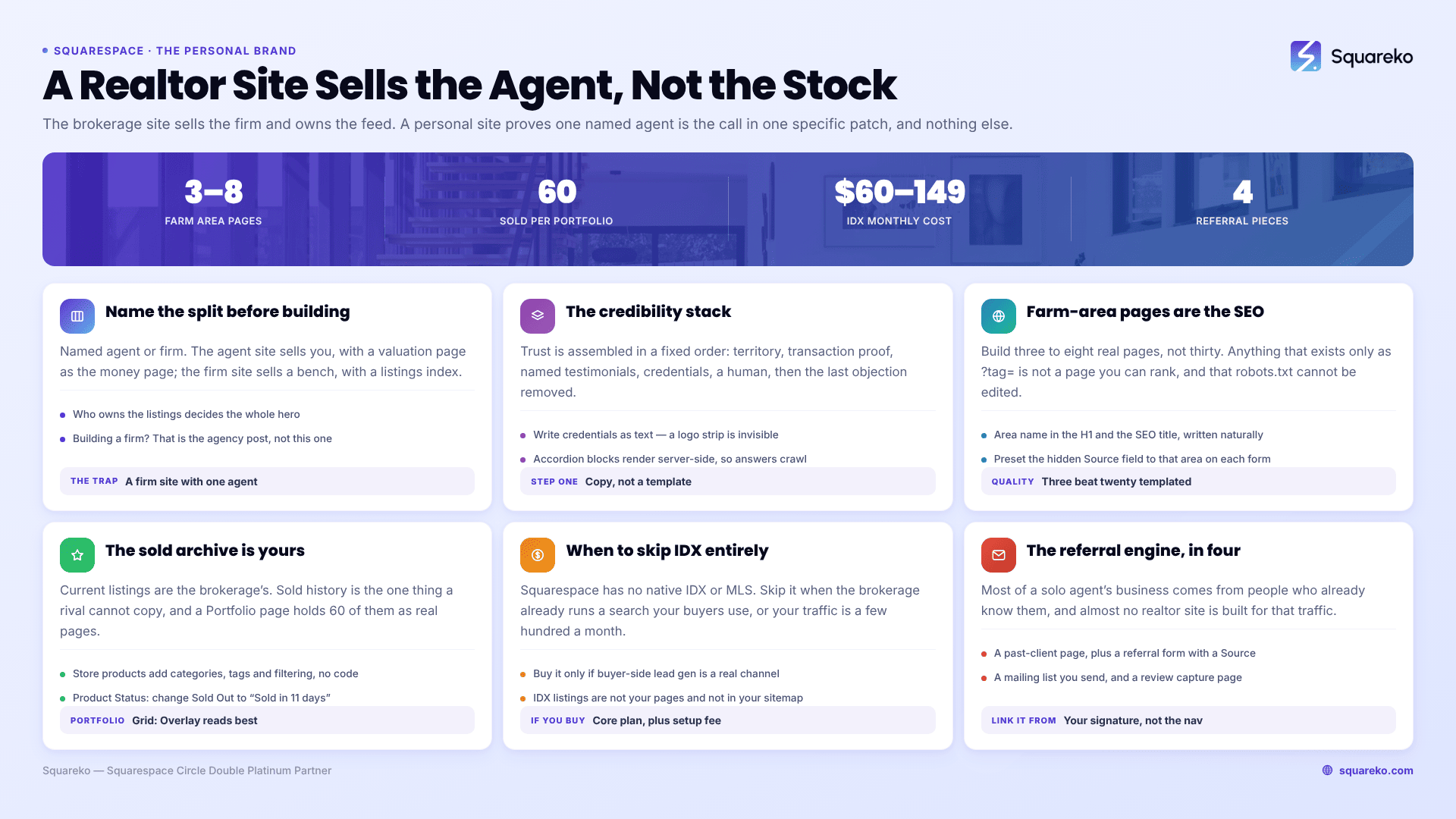
The short answer: for an individual realtor, your brokerage almost certainly already owns the listings feed and the IDX subscription. Duplicating it on your personal site is the most expensive way to add nothing. Your site exists to do the thing the brokerage site structurally cannot — prove that you specifically are the agent to call in this specific area. Choose a Squarespace template for the credibility stack, the farm-area pages and the referral engine. Listings are a distant fourth.
That is the split this whole post turns on, so it is worth stating before anything else.
Personal brand or firm? Name the split before you build
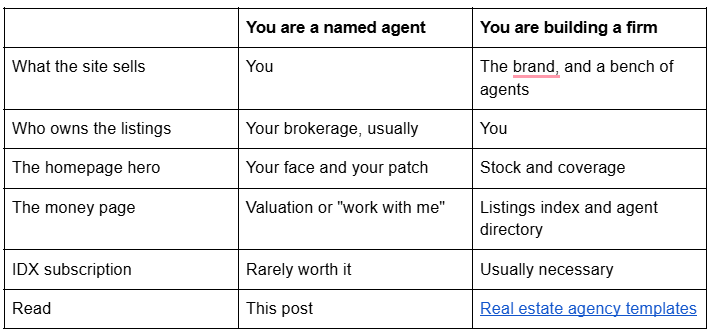
Most agents who stall on this build a small brokerage site with one agent in it, which reads as a firm too small to trust rather than a specialist worth calling. Pick one. If you are the product, build for the product. The full decision map across all seven real estate sub-audiences sits in Squarespace templates for real estate.
The credibility stack, in the order strangers assemble it
A vendor choosing a listing agent is making a decision worth tens of thousands in equity on the basis of a twenty-minute impression. Trust gets assembled in a specific order, and sites that get the order wrong lose people who were willing to call.
Territory. The first screen must name the area, not the emotion. "Selling homes in Chorlton and Whalley Range since 2014" outperforms "Your journey home starts here" every time, because it answers the only question the visitor is actually asking.
Transaction proof. Sold, not listed. Numbers, addresses, timescales, and where possible the gap between asking and achieved. This is the section that separates a real agent from a website.
Named testimonials. Full name, street or development, and what specifically happened. First-name-only praise reads as decoration.
Credentials and affiliations. Licence number, board or association membership, years, awards with the year attached. Write them as text, not a logo strip — logo images are invisible to search engines and to screen readers.
A human. A real photograph, not a stock image, and a plain account of why you do this and who you do it for.
The removal of the last objection. Fee, contract length, marketing spend, what happens if it does not sell. An Accordion block in Squarespace 7.1 renders server-side, so question and answer text is crawlable — it is the right tool for this.
A template helps with 2 through 6, because those are pages you either have or have to build. Step 1 is copywriting and no template does it for you.
Farm-area pages are the entire local SEO strategy
The searches that convert for a named agent are geographic: estate agents in [area], [area] house prices, sell my house [area]. The durable structure is one real page per farm area — not a tag, not a blog category, not a filter parameter. Squarespace's robots.txt cannot be edited and disallows ?tag=, ?author=, ?month= and ?view= by default, so anything that exists only as a query string is not a page you can rank.
Build three to eight of them, not thirty. Each one needs:
The area name in the H1 and in the SEO title, written naturally
Genuine local knowledge — housing stock, transport, schools, where the price pressure is this year
Your own sold examples in that area, linked to the individual sold pages
A short paragraph in your own voice about why you work there
An enquiry form whose Hidden field is preset to that area
That last one matters more than it sounds. Add a Hidden field to the form, label it Source, and Squarespace generates the variable SQF_SOURCE. Append ?SQF_SOURCE=chorlton to the links pointing at the form and every enquiry arrives labelled with the area page that produced it. After two quarters you will know which farm areas are worth the letterbox drops and which are not.
Three thoroughly written area pages beat twenty templated ones with the place name swapped. Search engines have been able to detect that pattern for a decade, and vendors can detect it in about four seconds.
The sold archive is your portfolio, and Squarespace has an object for it
Realtor sites usually show current listings, which are the brokerage's, and hide sold ones, which are yours. That is backwards. Sold history is the only content on the site that a competitor cannot copy.
Two native Squarespace 7.1 routes work well:
Portfolio page. Each sold property becomes a project, with a featured image, an editable URL slug, its own SEO title and SEO description, and a status of Draft, Needs Review, Scheduled or Published. The cap is 60 projects per portfolio page — several years of a solo agent's output, and when you hit it, start a second portfolio page by year. Five layouts are available; Grid: Overlay reads best for property because the address sits on the image. You cannot add blocks inside the portfolio section itself, but block sections above and below it are where the intro copy and the enquiry form go.
Store page. Products give you what Portfolio pages do not: native categories, tags and filtering, so "3 bed", "£400–500k" and "Chorlton" become filters without code. Product URLs in 7.1 always include p/ before the slug. The trick most agents miss is that the sold label is editable — open the Product Status panel, click Out of Stock, and change the text field from "Sold Out" to "Sold", "Under Offer" or "Sold in 11 days". A grid of those is the strongest listing presentation an agent can put on a website.
If you retire a sold page rather than keeping it, add a 301 in the URL mappings panel: the old URL must no longer exist and the destination must exist. And remember that changing a slug in Squarespace creates no automatic 301, ever.
When a realtor should and should not buy IDX
Squarespace has no native IDX or MLS integration. Squarespace's own Help Center article Adding an MLS search says you "should be a member of an IDX service" and names Diverse Solutions, IDXBroker and Displet. The embed goes in a Code Block, and advanced code in Code Blocks requires the Core plan or above; some providers need a second script in site-wide Code Injection, which is Core or above too.
Skip IDX if: your brokerage already runs a search your buyers use, your business is listing-side, or your traffic is under a few hundred visits a month. You would be paying roughly $60–$149 a month for a single-agent IDX plan plus a setup fee, for a feature your buyers reach elsewhere. Confirm figures against the provider's live pricing page.
Buy IDX if: you run buyer-side lead generation as a deliberate channel, you have the follow-up capacity to work registration leads, and search is a genuine part of your funnel.
Either way, understand what you are getting. Squarespace states plainly that this customisation "falls outside the scope of our support" and that it cannot guarantee "full compatibility with Squarespace… including how it functions with our responsive design, particularly its appearance on mobile devices". The embed also will not render while you are logged in and editing, so check it logged out. And IDX-rendered listings are not your Squarespace pages — they are not in your sitemap and they will not rank for you.
The referral engine most realtor sites never build
Most of a solo agent's business comes from people who already know them. Almost no realtor website is built for that traffic. Four pieces, none of which needs a plugin:
A past-client page. Not a testimonial wall — a page addressed to people you have already worked with, holding the referral ask, the market update signup and the "thinking of moving again?" route. Link it from your email signature, not from the main navigation.
A referral form with a source field. Same Hidden-field technique: ?SQF_SOURCE=referral-sarah tells you who is actually sending you business, which is the single most useful number a solo agent can have.
A mailing list that is actually sent. Squarespace form blocks require at least one storage option — a Squarespace mailing list, the form submitters list in the Contacts panel, an email address, Google Drive, Mailchimp or Zapier, with Mailchimp and Zapier requiring Core plan or above. Store to a mailing list and send a genuine quarterly area update through Squarespace Email Campaigns, which is billed separately from the site subscription.
A review capture route. A short page that explains where to leave a review and links straight to the profile, so you are sending one link rather than instructions.
Which templates suit a one-person realtor brand
For a solo agent, smaller is better. A half-empty 15-page site reads worse than a complete 9-page one.
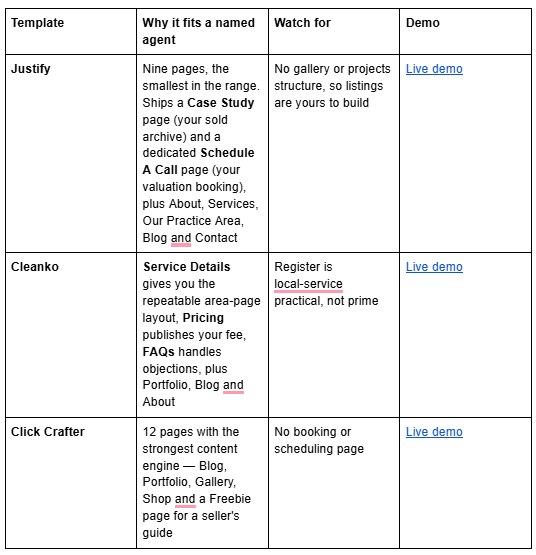
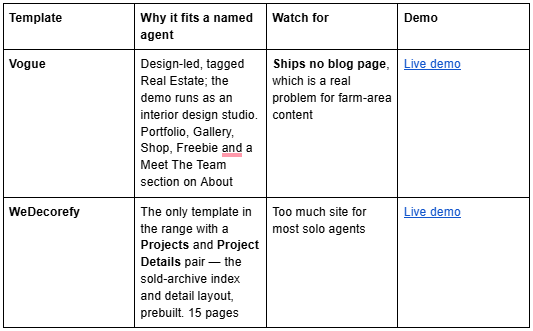
Horizon also carries a Real Estate tag, but its demo runs as a custom home builder rather than an agency, and it ships no blog page in the live demo — a poor fit for a personal agent brand. If you do look at it, use horizon-squareko.squarespace.com; the bare horizon.squarespace.com is an unrelated third-party site.
All Squareko templates are $249. The Squarespace subscription is separate and required, demo images are licensed to the shop rather than to you and must all be replaced — which for a realtor means booking a real headshot — and digital-product sales are final, so use the demo properly before buying.
Building it
Write the territory line first, then the sold archive, then three farm-area pages, then the referral page. Add listings last, and only if your brokerage genuinely does not cover them. An agent site with six excellent pages and a real sold history outperforms a twenty-page site with an IDX feed and nothing personal on it, because the vendor is not choosing a search engine. They are choosing you.
If you want the structure without spending a weekend on it, the premium Squarespace templates in our range arrive as a Squarespace contributor invitation and can be installed onto an existing live site without taking it down. Most agents will build this themselves; the sequence above is the same either way.
FAQ
-
Yes, for a different job. The brokerage site sells the firm and owns the listings feed. A personal site proves that one named agent is the right call in one specific area — territory, sold history, testimonials and a valuation route. Duplicating the brokerage's listings is the most expensive way to add nothing.
-
Usually not. Squarespace has no native IDX, so you would pay roughly $60–$149 a month for a third-party service plus a setup fee, and the Core plan or above for the Code Block. Skip it if your brokerage already runs a search your buyers use. Buy it only if buyer-side lead generation is a deliberate channel.
-
Two native routes. A Portfolio page, where each sold property is a project with its own slug and SEO fields, capped at 60 projects. Or a store page, where each sold property is a product — categories and tags give you filtering, and the Out of Stock label can be renamed to "Sold" in the Product Status panel.
-
Three to eight, written properly. Each needs the area name in the H1 and SEO title, genuine local knowledge, your own sold examples in that area and an enquiry form tagged to that page. Twenty templated pages with the place name swapped are detectable by both search engines and vendors.
-
Six: a homepage that names your territory, a sold archive, an about page with a real photograph and credentials, three to eight farm-area pages, a testimonials page with full names, and a valuation enquiry page. A blog and a past-client referral page are the depth you add once those convert.
-
Add a Hidden field to your Squarespace form block and label it Source, which generates the variable SQF_SOURCE. Append that parameter to the links pointing at the form — for example ?SQF_SOURCE=chorlton — and every submission arrives tagged with the page or referrer that produced it.

Author Bio
I'm Walid Hasan, a Certified Squarespace Expert and Squarespace Circle Platinum Partner with over 12 years of hands-on experience designing and optimizing high-performing websites. Over the years, I've had the privilege of building more than 2,000 Squarespace websites for clients around the world, always focusing on clean design, strong user experience, and conversion-driven results.