Squarespace Templates for Maid and Domestic Services
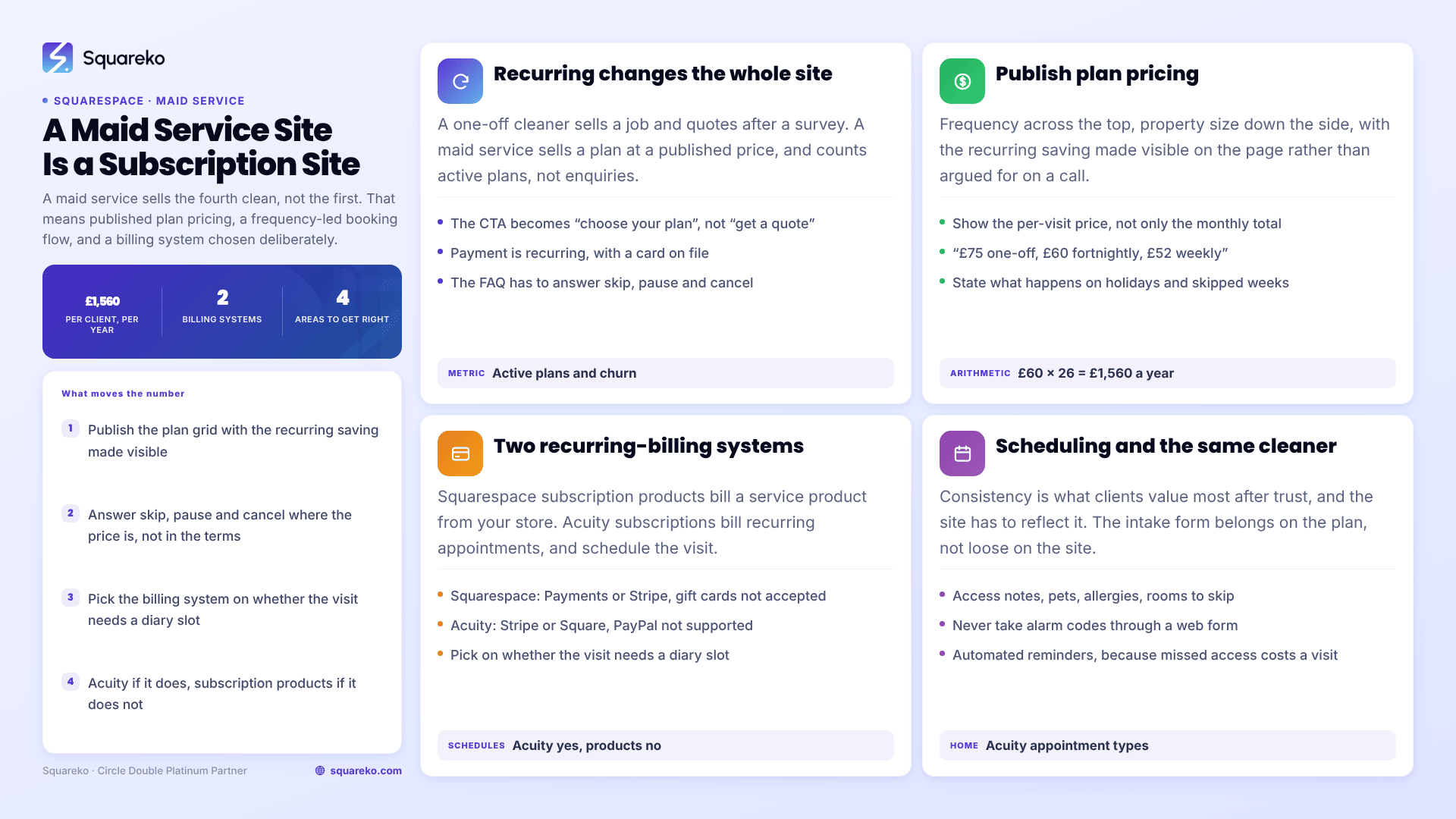
The short answer: A maid service is a subscription business wearing a cleaning uniform. The website's job is not to sell one clean — it is to sell the fourth clean, three months from now. That means published plan pricing rather than per-job quotes, a booking flow built around frequency, and recurring billing chosen deliberately, because Squarespace has two separate recurring systems and they do not do the same thing.
A note on the term: "maid service" is US-leaning. In the UK and Australia the same business is usually "domestic cleaning", "housekeeping" or simply "a cleaner". If you are outside North America, write the term your clients search for and treat everything below as applying identically.
This is the recurring-revenue post in the cleaning template cluster. The trust material — vetting, insurance, named staff, breakage policy — sits in the house cleaning services guide and is not repeated here, though a maid service needs all of it.
Why the recurring model changes the whole site
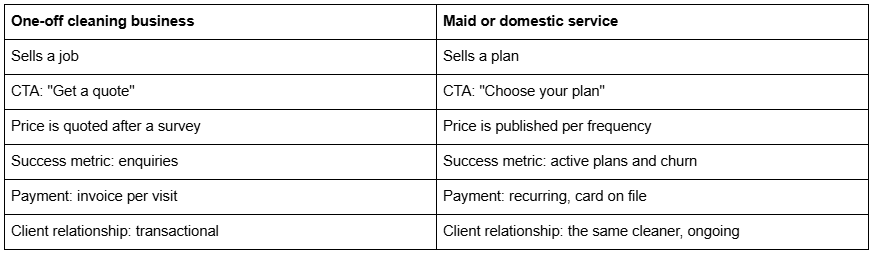
Once you see the right-hand column, several website decisions stop being debatable. Publishing prices is no longer optional, because a plan you cannot price on the page is a plan nobody signs up to. The homepage CTA stops being a quote form. The FAQ has to answer plan questions — can I skip a week, can I cancel, what if I go on holiday — because those are the objections that stop a subscription, not a job.
The arithmetic that justifies the site
This is worth doing on paper before you decide how much website to buy.
A fortnightly domestic clean at £60 a visit is 26 visits a year, so £1,560 per client per year. Domestic cleaning clients who stay past the first three months commonly stay for years. At an average retained life of two years, one client is worth roughly £3,000.
Against that, a premium Squarespace template at $249 plus a year's subscription is recovered by a single retained client, and comfortably by the first month of one. That is the honest case for spending on the site — not "your website is your shopfront", but the fact that the unit you are acquiring is worth four figures, so the cost per acquisition you can justify is much higher than a one-off cleaning business could.
It also explains where to spend the effort: not on the homepage, but on the two or three pages that convert an enquiry into a recurring client rather than a single visit.
Publishing plan pricing
A maid service should publish plan prices. It is the clearest signal that you run a real operation with a real schedule, and it does the qualifying work before anyone picks up the phone.
The structure that works is frequency across the top, property size down the side, with the recurring discount visible rather than argued for. Three details make the difference:
Show the per-visit price, not only the monthly total. People compare cleaners on per-visit cost. A monthly figure looks larger and gets compared against the wrong thing.
Make the recurring saving explicit. "£75 one-off, £60 fortnightly, £52 weekly" moves people up the frequency ladder without a sales conversation. That single line is the highest-leverage sentence on a maid service website.
State what happens to the plan when life happens. Holidays, illness, a skipped week. Put it on the pricing page rather than in the terms, because it is a live objection at the point of decision.
Cleanko ships a three-tier Pricing page with a "what's included" list per tier and a CTA on each — the closest layout in our range to a plan grid, and unusual in this trade generally. You can see it on the Cleanko demo.
Squarespace has two recurring-billing systems. Pick deliberately
This is the part that gets built wrong, because the two systems have similar names and do different jobs.
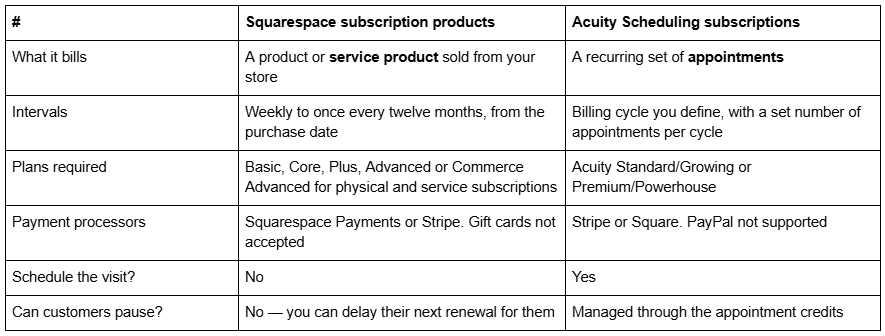
Squarespace's documentation is explicit that Acuity subscriptions are "separate from the subscriptions that you can offer through Squarespace Commerce". They are two products, not two views of one.
The practical rule. If the visit needs a slot in a diary — which for a maid service it almost always does — the scheduling side has to be Acuity, and the billing usually belongs there too. Squarespace subscription products suit a plan billed as a flat monthly retainer where scheduling happens by conversation, which is how plenty of small domestic cleaning rounds actually run.
Two limitations worth knowing before you promise anything on the pricing page. Customers cannot pause or skip a Squarespace subscription themselves; you delay the renewal or cancel the pending order on their behalf. And a service product cannot carry both a payment plan and a subscription option — you choose one.
A template caveat. Cleanko ships no store or shop page. Selling subscription products from a Cleanko site means adding a Store page and configuring commerce, which is straightforward but is a build step, not something the template hands you. Templates in the range that do ship a shop include Click Crafter, Luminary, Fit Foundry and Harmony.
Scheduling and the same-cleaner promise
The thing domestic clients value most after trust is consistency — the same person, the same day, the same time. That is an operations promise, but the website has to reflect it or the promise is invisible.
Squarespace markets exactly this on its own Cleaning Services solutions page: booking from the website, custom intake forms, automated reminders and cancellation management, plus billing "by job type or on a recurring basis" and contracts or estimates with signatures.
What to actually build:
An intake form attached to the plan, not to the site. Access instructions, alarm codes handled securely and never by web form, pets, allergies, products to avoid, rooms to skip. Acuity attaches intake forms to appointment types, which is the right home for this
Automated reminders, because a missed access arrangement costs you a whole visit
A stated cancellation window — 24 or 48 hours — published, not buried
A holiday or skip policy, published on the pricing page
What not to promise on the website: live availability. No Squarespace template ships a real availability calendar, and a demo that appears to show one is showing static content. Availability comes from the scheduler you connect, and only for the appointment types you configure.
Do clients need a login?
Usually not, and it is the most over-specified feature in this category.
A domestic cleaning client interacts with your business roughly twice a month, and both interactions are "confirm" or "reschedule". A client portal is a lot of build and maintenance for that. Automated reminders and a reply-to-a-human address cover it.
Where an account genuinely earns its place is at scale — enough clients that reschedule requests become an administrative load, or a service where clients change plan frequency often. Even then, the account usually belongs in the scheduler rather than on the website, because that is where the data lives.
Squarespace does have Member Areas, but nothing published about the templates in our range states whether any of their pages are wired to Member Areas or to Acuity — treat every such page as a layout, not as configured functionality, and budget time to connect whatever tool you actually use.
Which Squarespace templates suit a maid or domestic service
Scored for the recurring model specifically: plan pricing layout, FAQ depth for plan objections, per-service scope pages, room for trust content, and commerce capability for subscription billing. Each 1–5, maximum 25.
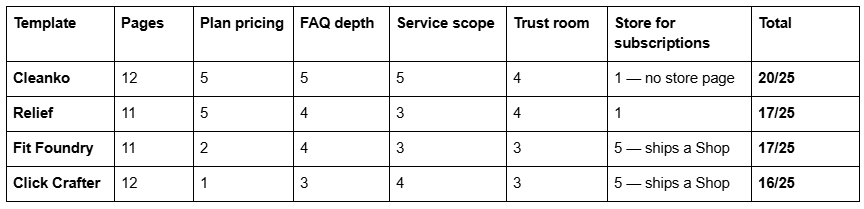
Cleanko — 20/25. Twelve pages: Home, Home 2, About, Services, Blog, Portfolio, Contact Us, FAQs, Pricing, Service Details, 404 and a Style Guide. It wins on the two pages that matter most for a plan business — a three-tier Pricing page ready to become a frequency grid, and an FAQs page built with Squarespace's native Accordion block, which renders server-side in 7.1 so the plan answers are crawlable. Its Service Details page carries a scope breakdown and an add-ons section, which is where "what's in a standard visit versus a deep clean" belongs.
Worst for: anyone who wants to take subscription payments on day one. Cleanko has no store page, so commerce is an addition rather than a starting point.
Relief — 17/25. Eleven pages built for therapists and wellness coaches, with a Pricing page and FAQs already built. Structurally it is a recurring-appointment business with a single trusted practitioner, which is precisely what a small domestic round is. No portfolio or gallery, so before-and-after work has nowhere to live.
Fit Foundry — 17/25. Eleven pages with a Shop, a Blog, an FAQs page and a Freebie page. It is a fitness template, and the reason to consider it is structural: fitness businesses sell memberships, so it is built around recurring commerce rather than one-off enquiries. If subscription billing through Squarespace Commerce is the plan, it starts closer than Cleanko does.
Click Crafter — 16/25. Twelve pages with a Shop, Portfolio, Gallery, Blog and a Freebie page. The Freebie page suits the standard domestic lead magnet — a home cleaning schedule or a move-out checklist. No pricing page.
Free Squarespace templates work too and cost nothing. What they do not ship is a pricing layout, an accordion FAQ page and a per-service detail page, which for a plan business is most of the conversion surface.
The pages a maid service site needs
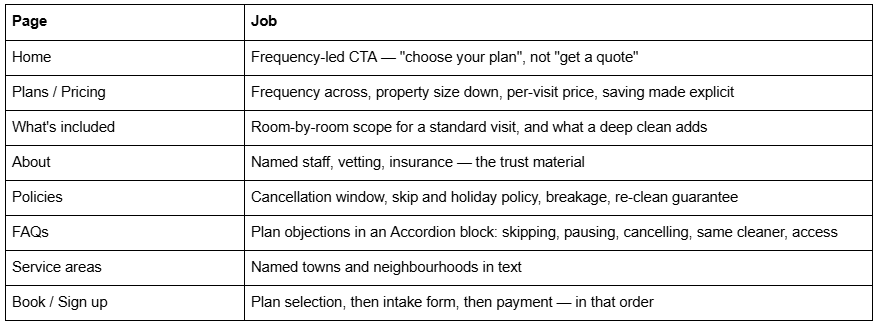
What actually moves the number
Publish the plan grid with the recurring saving visible. Answer the skip, pause and cancel questions where the price is, not in the terms. Then pick your billing system on whether the visit needs a diary slot — Acuity if it does, Squarespace subscription products if it does not.
If you would rather not spend two days building a pricing layout, an accordion FAQ page and a repeatable per-service page in Fluid Engine before you can write any of it, Cleanko sits in our premium Squarespace templates range at $249 with all three already built, and is installed for you rather than delivered as files — including onto an existing live site, which takes around 48 hours as a manual process. Note that all sales are final on digital products, and that demo images are never licensed for live use, so budget for photography of your own team and real jobs.
If you already have a site and no published plan prices, put the plan grid up first. It costs nothing and it is the single change most likely to move you from quoting jobs to selling subscriptions.
FAQ
-
Yes, through two separate systems. Squarespace subscription products bill a service product on a recurring schedule from weekly up to once every twelve months, on Basic, Core, Plus, Advanced or Commerce Advanced plans. Acuity Scheduling subscriptions bill a recurring set of appointments instead. They are distinct products, not two views of one.
-
Acuity, if the visit needs a slot in a diary — which for a maid service it usually does, since it also handles scheduling, reminders and intake forms. Squarespace subscription products suit a flat monthly retainer where scheduling happens by conversation. Acuity subscriptions require Stripe or Square; PayPal is not supported.
-
No. Squarespace documents that customers cannot pause or skip renewals — the merchant delays the next renewal or cancels the pending order on their behalf. Say so on the pricing page rather than implying self-service, and publish your holiday and skip policy where the prices are.
-
Yes. A plan nobody can price on the page is a plan nobody signs up to. Show the per-visit figure rather than only a monthly total, and make the recurring saving explicit — "£75 one-off, £60 fortnightly, £52 weekly" moves clients up the frequency ladder without a sales conversation.
-
Rarely. A domestic client interacts about twice a month and almost always to confirm or reschedule, which automated reminders cover. Accounts earn their place at scale, and usually belong in the scheduler rather than the website, because that is where the appointment data already lives.
-
It is US-leaning. UK and Australian operators normally use "domestic cleaning", "housekeeping" or "cleaner", and search behaviour follows the local term. Write the phrase your clients actually use; the site structure — plan pricing, scope, policies, recurring billing — is identical either way.

Author Bio
I'm Walid Hasan, a Certified Squarespace Expert and Squarespace Circle Platinum Partner with over 12 years of hands-on experience designing and optimizing high-performing websites. Over the years, I've had the privilege of building more than 2,000 Squarespace websites for clients around the world, always focusing on clean design, strong user experience, and conversion-driven results.