Building a Sustainable and Clean Beauty Brand Website on Squarespace
Introduction
The clean beauty market has grown exponentially, driven by consumers who demand transparency, ethical sourcing, and environmental responsibility. If you're launching a sustainable clean beauty brand, your website is far more than an e-commerce platform—it's a storytelling space where values meet products. This guide explores how to build a sustainable clean beauty brand website on Squarespace that resonates with eco-conscious shoppers and positions your brand as trustworthy, authentic, and committed to genuine sustainability.
Squarespace offers the flexibility and design tools needed to create a website that reflects your brand's values whilst maintaining professional functionality. Whether you're selling skincare, cosmetics, or wellness products, this guide covers everything from design philosophy to content strategy and certification displays that build credibility with your audience.
Key Takeaways
Clean beauty consumers prioritise transparency, ethical sourcing, and ingredient clarity above aesthetic marketing alone
Squarespace's design flexibility allows you to showcase sustainability values through thoughtful layout, imagery, and navigation
Certification badges (COSMOS, Leaping Bunny, EWG Verified) act as powerful trust signals and should be prominently displayed
Content strategy should educate consumers about clean beauty principles, ingredient benefits, and your supply chain practices
Product pages require detailed information hierarchies that balance visual appeal with educational content
SEO optimisation specifically targeting sustainable beauty keywords drives qualified traffic from eco-conscious shoppers
Understanding Your Audience: What Clean Beauty Buyers Want
Before designing your website, understand the values that drive your customers' purchasing decisions. Clean beauty consumers are not just buying products—they're investing in a philosophy.
Transparency and Ingredient Lists
Your customers want to know exactly what's in every product. This extends beyond simply listing ingredients; they want to understand why each ingredient matters, its sourcing origin, and why it was chosen over alternatives. Include detailed ingredient breakdowns, explain your exclusion standards (synthetic fragrances, parabens, sulphates, silicones, etc.), and be explicit about what your brand does not use.
Ethical Sourcing and Supply Chain Visibility
Eco-conscious shoppers care about fair labour practices, community impact, and environmental stewardship throughout your supply chain. Document partnerships with suppliers, highlight fair trade certifications, and explain your procurement practices. Many consumers want to know that workers are paid fairly and that extraction or farming methods don't harm ecosystems.
Environmental Commitment and Packaging
Sustainable packaging choices significantly influence purchase decisions. Are your containers recyclable, compostable, or refillable? Do you use minimal packaging, recycled materials, or plant-based alternatives? Quantify your environmental commitments: "100% recyclable packaging" or "We offset carbon emissions for every shipment" demonstrates genuine action, not greenwashing.
Third-Party Validation
Independent certifications lend credibility that self-labelling cannot achieve. Consumers recognise organisations like Leaping Bunny (cruelty-free), COSMOS (organic and natural cosmetics), and EWG Verified as rigorous validators. Prominently feature these badges to reduce purchase hesitation.
Design Principles for Authentic Sustainability
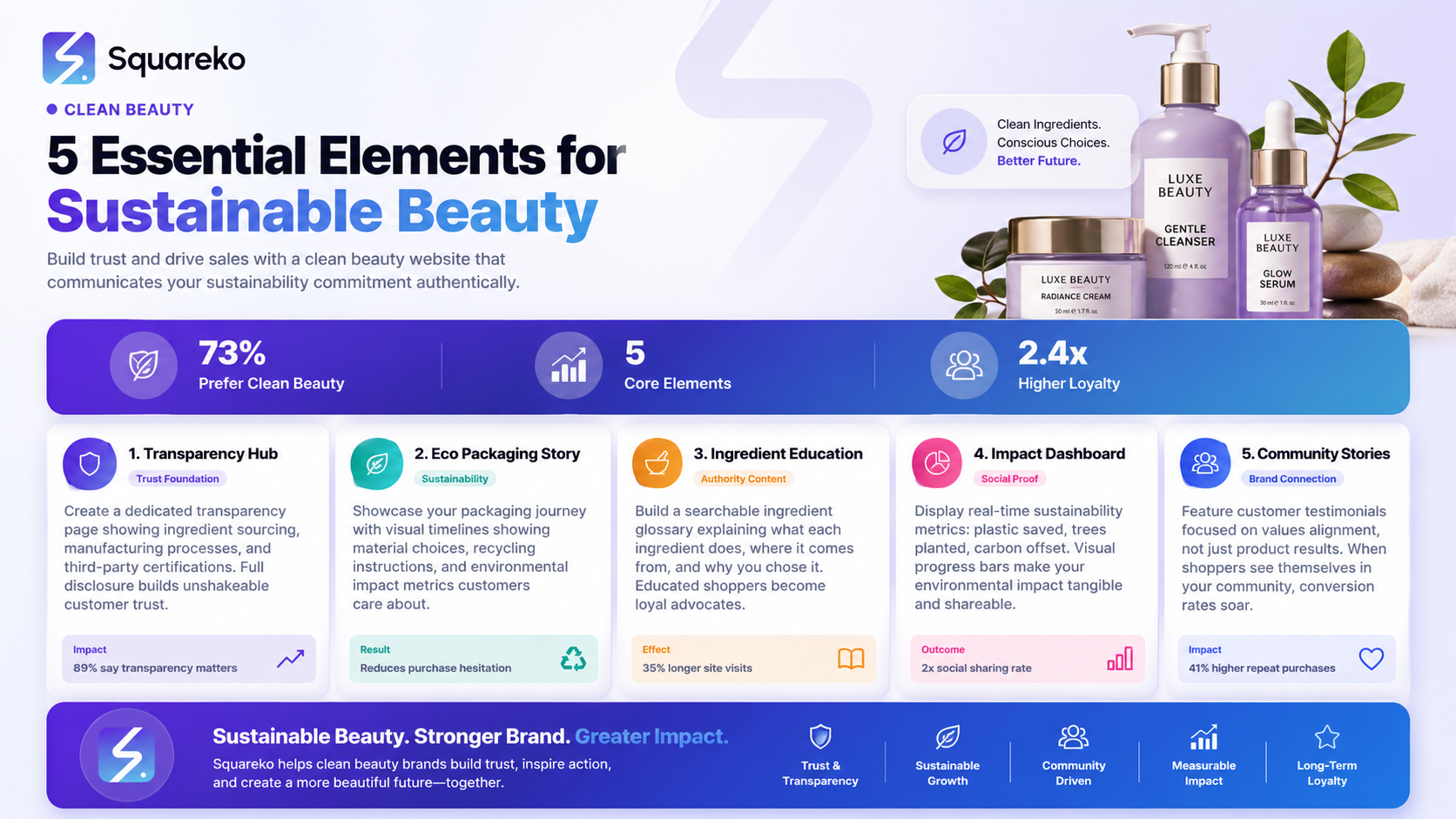
Squarespace's template selection and customisation options allow you to build a website that visually communicates your sustainability values without relying on clichés.
Minimalism and Clean Aesthetics
Resist the urge to overload your site with imagery. Clean beauty design thrives on negative space, clear typography, and deliberately chosen imagery. Use high-quality product photography against neutral or natural backgrounds. Allow pages to breathe—busy, cluttered layouts undermine the "clean" message you're communicating.
Authentic Imagery and Storytelling
Use genuine photography of your team, production facilities, and sourcing partnerships. Lifestyle imagery should reflect real people and authentic moments rather than overly styled stock photography. Behind-the-scenes content (production processes, ingredient sourcing, team stories) builds human connection and transparency.
Colour Palette and Typography
Choose a colour palette that reflects sustainability: earth tones (terracotta, sage green, warm browns), natural whites, and accent colours from your brand identity. Typography should be readable and intentional; sans-serif fonts communicate modernity whilst serif fonts can convey heritage and craftsmanship. Avoid design trends that will date quickly; timeless design reinforces your commitment to lasting values.
Accessibility and Inclusive Design
Ensure your website meets WCAG accessibility standards. Use sufficient colour contrast, provide alt text for all images, and structure content with proper heading hierarchies. An accessible site reflects inclusivity values that align with sustainable and ethical business principles.
Mobile-First Responsiveness
Over 60% of e-commerce traffic originates from mobile devices. Squarespace templates are mobile-responsive, but test functionality thoroughly—product filters, checkout processes, and content readability must work seamlessly across devices.
Certifications and Trust Signals
Third-party certifications are the most effective trust signals you can display. Rather than relying solely on your claims, let independent organisations validate your practices.
COSMOS Certification
COSMOS (Cosmetic Organic Standard) certifies organic and natural cosmetics. It verifies ingredient purity, bans synthetic chemicals, and ensures responsible sourcing. Display the COSMOS badge prominently on product pages and your homepage. Explain in plain language what COSMOS certification means: "All ingredients are derived from organic farming, free of synthetic chemicals."
Leaping Bunny and Cruelty-Free Standards
Leaping Bunny is the gold standard for cruelty-free certification. It verifies that neither finished products nor ingredients were tested on animals. Many clean beauty consumers prioritise this. Display the badge and explain your testing standards: "We use only human volunteer testing and in vitro methods."
EWG Verified
The Environmental Working Group's verification programme assesses product safety and transparency. EWG Verified products meet standards for ingredient safety, transparency, and product integrity. Feature this badge to appeal to consumers who use EWG's Skin Deep database.
B Corp Certification
B Corp status demonstrates that your business meets high standards for social and environmental performance. This signals commitment beyond products to broader business practices.
Social Proof and Customer Reviews
Integrate customer testimonials and reviews directly into product pages. Use Squarespace's native review functionality or integrate third-party review platforms. Real customer voices—particularly those highlighting sustainability features—are powerful trust signals.
Crafting Your Content Strategy
Content drives both SEO performance and consumer education. Your website should serve as a resource hub for clean beauty information, not merely a shop.
Educational Blog Content
Publish blog posts addressing questions your audience asks: "How to Read Cosmetic Labels," "The Truth About Greenwashing in Beauty," "Natural vs Synthetic Ingredients: What's the Difference?" Educational content establishes your brand as a knowledgeable authority and captures long-tail search traffic.
Ingredient Spotlights
Create detailed content about key ingredients in your formulations. Explain botanical origins, skin benefits, sourcing practices, and why you chose them over alternatives. Format these as dedicated pages or blog posts—they serve both as educational resources and SEO content.
Supply Chain Transparency
Document your supply chain visually and narratively. Where do your primary ingredients originate? Which suppliers do you partner with? Have you visited production facilities? Create a dedicated page explaining your sourcing philosophy and include photographs or videos of suppliers, farms, or manufacturing facilities.
Sustainability Reports
Consider publishing annual or quarterly sustainability reports. Share metrics on packaging waste reduction, carbon offset, fair trade purchases, or community investment. This transparency differentiates you from competitors making vague sustainability claims.
Video Content
Squarespace integrates video seamlessly. Film short educational content: formulation explanations, ingredient sourcing stories, team introductions, or customer testimonials. Video increases engagement and time on site, both positive SEO signals.
Optimising Product Pages for Conversions
Product pages require careful information architecture to balance visual appeal with the detailed information clean beauty consumers demand.
Visual Hierarchy and Product Imagery
Feature high-quality product photography from multiple angles. Allow zoom functionality. Include lifestyle imagery showing the product in use, but maintain authenticity—avoid overly styled shots that feel disconnected from reality. On Squarespace, use the gallery feature to showcase multiple images and consider incorporating 360-degree product views if possible.
Detailed Ingredient Lists and Benefits
Place ingredient lists prominently, not hidden behind tabs. Include ingredient explanations: hover effects or expandable sections can reveal the purpose of each ingredient without overwhelming the visual space. Highlight key ingredients—those that differentiate your product or offer specific benefits.
Certifications and Claims
Display all applicable certifications directly on product pages. Use badge imagery provided by certifying organisations and link to the certification on the issuer's website. State claims clearly: "Certified Organic," "Leaping Bunny Approved," "Plastic-Free Packaging."
Product Descriptions That Tell a Story
Write product descriptions that balance persuasive copywriting with transparency. Explain the problem the product solves, the formulation approach, and expected results. Include usage instructions, shelf life, and storage recommendations. For sustainable brands, explain packaging choices: "This glass bottle is infinitely recyclable and free of BPA-lined caps."
Social Proof and Customer Reviews
Prominently feature customer ratings and reviews. Encourage customers to share feedback on how the product performed and its sustainability impact. Consider offering incentives (discount codes, entries into giveaways) for detailed reviews.
Related Products and Bundle Recommendations
Suggest complementary products or bundle options. This increases average order value and guides customers toward a complete skincare or cosmetics routine. Frame bundles around benefits or skin concerns rather than arbitrary pairings.
Shipping and Returns Transparency
Communicate clearly about shipping practices, packaging materials, and return policies. Do you use carbon-neutral shipping? Are boxes made from recycled materials? Clear, upfront communication reduces purchase anxiety and returns.
SEO Strategy for Sustainable Beauty
Search engine optimisation for sustainable beauty targets consumers actively seeking clean, ethical alternatives.
Keyword Strategy
Target keywords that reflect clean beauty values: "sustainable skincare," "natural cosmetics," "cruelty-free beauty," "zero-waste beauty products," "clean beauty brands," "non-toxic skincare." Use tools like Ahrefs or SEMrush to identify search volume and competition. Long-tail keywords ("best sustainable foundation for sensitive skin") often have lower competition and higher conversion intent.
Squarespace SEO Settings
Utilise Squarespace's native SEO tools. Customise your page titles and meta descriptions for each page and product. Ensure title tags include your focus keyword and remain under 60 characters. Meta descriptions should be 150–160 characters and include a clear call-to-action or value proposition.
Heading Structure and Content Optimisation
Use heading hierarchies properly: one H1 per page, followed by logically nested H2s and H3s. Incorporate keywords naturally into headings and body content. Aim for keyword density around 1–2%—mentions should feel organic, not forced.
Internal Linking Strategy
Link related content together. Blog posts about ingredients should link to relevant product pages. Sustainability pages should link to blog content explaining certifications. Strategic internal linking distributes page authority and helps search engines understand site structure.
Mobile Optimisation and Site Speed
Squarespace handles mobile responsiveness automatically, but monitor page speed. Compress images, limit third-party scripts, and leverage Squarespace's content delivery network. Use Google PageSpeed Insights to identify optimisation opportunities.
Structured Data and Schema Markup
Implement schema markup for products, reviews, and FAQs. Squarespace supports basic schema automatically for products and reviews. Rich snippets in search results (star ratings, prices, availability) improve click-through rates.
Backlink Strategy
Build authority through backlinks from sustainable beauty publications, eco-conscious bloggers, and industry directories. Create compelling content that naturally attracts links. Guest posting on established clean beauty blogs introduces your brand to relevant audiences.
Frequently Asked Questions
-
The Commerce plan is ideal for product-based businesses. It includes unlimited products, professional e-commerce features, inventory management, and abandoned cart recovery. For scaling brands, Squarespace's API supports custom integrations with third-party tools.
-
Only display certifications you actually hold. Avoid vague claims like "natural" or "eco-friendly" without third-party validation. Clearly explain what each certification means and link to the certifying organisation's website so customers can verify independently.
-
This depends on margins and target market. Many sustainable beauty brands absorb shipping costs to reduce purchase friction, particularly for first-time customers. Calculate your break-even point. Alternatively, offer free shipping above a threshold (£50+) to encourage larger purchases and reduce per-unit shipping frequency.
-
This is an operational question rather than a platform question. Evaluate refillable containers, compostable packaging, and minimal design. Communicate these choices on product pages and in your content strategy. Some brands offer incentives for customers who return containers for refilling.
-
Focus on education and transparency. Publish blog content addressing common questions about ingredients, certifications, and sourcing. Share your supply chain story visually. Feature customer testimonials emphasising product performance and sustainability alignment. This content ranks for relevant keywords and builds trust with your audience
-
Be specific and transparent. Instead of "sustainable," explain exactly what you mean: "Our packaging is made from 100% recycled glass and is infinitely recyclable." Support claims with data, certifications, or third-party verification. Acknowledge limitations—no product is perfect—and explain the decisions you've made given practical constraints.
-
Squarespace integrates with various tools, but sustainability tracking typically requires custom solutions. Consider using Squarespace's API to integrate with specialised platforms if you want to track carbon offsets, packaging waste, or supply chain impact and display this data on your site.
-
Blogging is extremely valuable. It drives organic traffic through long-tail keywords, establishes authority, educates consumers, and gives customers reasons to return to your site beyond making immediate purchases. Commit to a consistent publishing schedule—at minimum, one to two posts monthly.
Build Your Clean Beauty Brand Website with Squareko
A sustainable clean beauty brand deserves a website that reflects your values and resonates with eco-conscious consumers. Squarespace provides the design flexibility, e-commerce functionality, and SEO tools necessary to build an authentic, professional online presence—but success requires thoughtful strategy around design, transparency, content, and audience understanding.
Your website is your brand's voice. It should communicate not only what you sell, but why you sell it, how you source it, and what you believe about beauty, sustainability, and consumer responsibility. By focusing on transparency, building trust through certifications, educating your audience, and optimising for the specific keywords that clean beauty consumers search for, you create a site that attracts aligned customers and builds lasting brand loyalty.

About the Author
Walid | Founder, Squareko
I'm Walid Hasan, a Certified Squarespace Expert and Squarespace Circle Platinum Partner with over 12 years of hands-on experience designing and optimizing high-performing websites. Over the years, I've had the privilege of building more than 2,000 Squarespace websites for clients around the world, always focusing on clean design, strong user experience, and conversion-driven results.