How to Set Up Squarespace Subscriptions for Your Cosmetics or Skincare Brand
Introduction
Building a sustainable cosmetics or skincare brand requires more than just excellent products—it requires a sustainable revenue model. Squarespace subscriptions offer beauty entrepreneurs the chance to create recurring revenue streams whilst building deeper customer relationships. Whether you're curating monthly skincare boxes, offering exclusive serum collections, or providing seasonal wellness sets, subscriptions turn one-time buyers into loyal repeat customers.
This guide walks you through setting up Squarespace subscriptions for your cosmetics or skincare brand, from initial configuration to optimising retention rates. By implementing subscriptions, you can forecast revenue more accurately, reduce customer acquisition costs, and provide curated experiences your customers will genuinely value.
Key Takeaways
Subscription models generate predictable recurring revenue and improve customer lifetime value
Squarespace offers native subscription functionality with flexible billing cycles and automated fulfilment options
A step-by-step setup process takes less than an hour for most beauty brands
Pricing strategy should balance perceived value, production costs, and competitive positioning
Customer retention requires exceptional service, surprise additions, and transparent communication
Successful beauty subscriptions combine premium packaging, personalised curation, and community building
Why Subscriptions Work for Cosmetics and Skincare
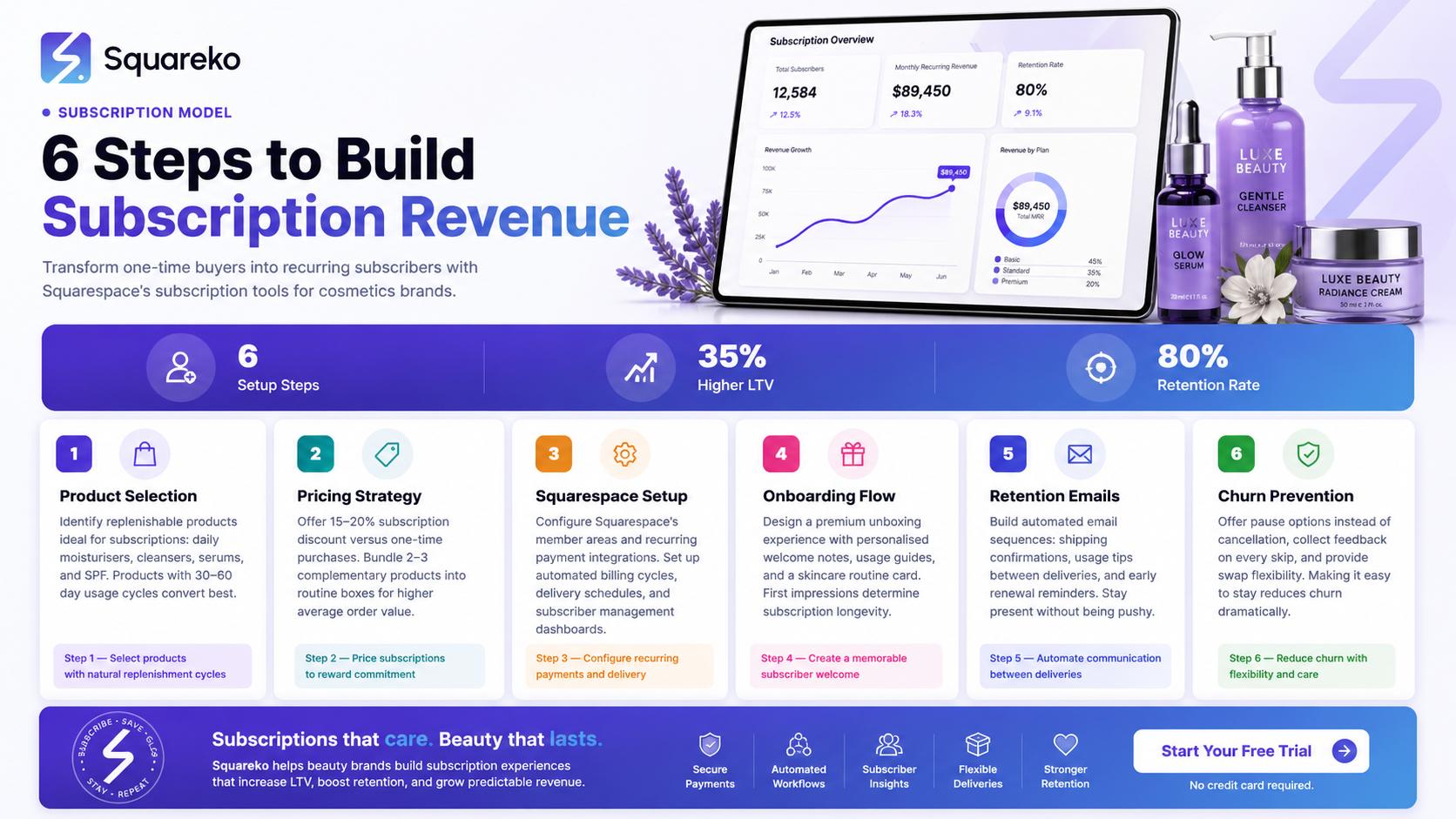
Subscription models have transformed the beauty industry. Unlike traditional retail where customers make sporadic purchases, subscriptions create habit-forming touchpoints that build brand loyalty.
Revenue Predictability
Subscriptions provide consistent monthly or quarterly revenue, making business planning easier. You can confidently forecast growth, budget for inventory, and invest in marketing with greater certainty. This predictability is particularly valuable when scaling a small beauty brand.
Customer Lifetime Value
A customer who subscribes generates significantly higher lifetime value than a one-time purchaser. Research shows subscription customers spend 2–3 times more annually compared to single-purchase buyers. Even after accounting for discount rates typically offered to subscribers, the overall profitability improves substantially.
Reduced Marketing Spend
Once acquired, retaining existing subscribers costs far less than acquiring new customers. This shifts your customer acquisition cost calculus—you can afford to spend more upfront to attract subscribers knowing they'll generate revenue across multiple billing cycles.
Product Experimentation and Discovery
Subscriptions allow you to introduce customers to new products they might not have purchased independently. A curated box creates discovery moments, building affinity for product lines and increasing basket size beyond the subscription itself.
Competitive Differentiation
Offering subscriptions positions your brand as premium and community-focused. It signals that you're invested in long-term customer relationships rather than transactional volume.
Squarespace Subscription Features Explained
Squarespace's native subscription functionality is purpose-built for small-to-medium beauty businesses. Here's what you're working with:
Flexible Billing Cycles
Configure subscriptions for monthly, quarterly, semi-annual, or annual billing. Customers can pause, skip, or cancel subscriptions at any time. This flexibility reduces friction and improves retention—customers know they're not locked in.
Automated Renewals
Squarespace automatically charges customers on their renewal date. You have control over renewal frequency, and customers receive email reminders before billing. This reduces failed transactions and improves collection rates.
Inventory Management
Connect subscriptions to your product inventory. Squarespace deducts stock for each subscription fulfilment, preventing overselling. You can set minimum inventory thresholds and receive alerts when stock is low.
Discount Flexibility
Offer subscription-only discounts to incentivise sign-ups. You can discount individual products within a subscription or apply percentage reductions. This encourages customers to commit whilst maintaining margin control.
Customer Dashboard
Subscribers access a dedicated portal where they can manage billing, skip upcoming shipments, swap products, or cancel subscriptions. This self-service reduces support burden and improves customer satisfaction.
Integration with Fulfilment
Subscriptions integrate with third-party fulfilment services, or you can manage packing in-house. Squarespace generates packing slips and shipment labels automatically.
Email Automations
Automated emails notify customers about upcoming renewals, shipments, and cancellation confirmations. Customisable templates help you maintain brand voice throughout the subscription journey.
Step-by-Step Setup Guide
Step 1: Enable Subscriptions in Your Plan
First, verify your Squarespace plan includes subscriptions. Subscriptions are available on Business and Commerce plans. If you're on a lower tier, upgrade your plan.
Log into your Squarespace account
Navigate to Settings > Billing
Confirm your current plan
If necessary, upgrade to Business or Commerce
Once upgraded, subscriptions are automatically enabled
Step 2: Create Your First Subscription Product
Go to Products in the Squarespace menu
Click Add Product
Upload product images
Enter product name, description, and details
In the Pricing section, select Subscription product
Choose your billing frequency (monthly, quarterly, annually)
Set the subscription price (this is the recurring amount)
Optionally offer an initial discount
Set product categories and tags for organisation
Add product-specific options
Link to inventory or set unlimited
Save and publish
Step 3: Customise Subscription Terms and Conditions
Return to Settings > Subscriptions
Set default cancellation policy
Configure renewal reminders
Add custom subscription terms
Enable or disable customer ability to skip/pause months
Set expiration date for paused subscriptions (optional)
Save changes
Step 4: Set Up Subscription Collections
Create dedicated sections for subscription offerings:
Go to Collections > Create Collection
Name it Subscription Boxes or similar
Add your subscription products to this collection
Write collection description highlighting benefits
Customise the layout and visual presentation
Publish
Step 5: Create a Subscription Landing Page
Add a new page to your website
Title it Our Subscription Box or Join Our Beauty Club
Write compelling copy explaining:
What's included in each box
Billing frequency and renewal details
Cancellation flexibility
Exclusive subscriber benefits
Embed your subscription collection
Add testimonials or reviews from existing subscribers (if applicable)
Publish
Step 6: Configure Email Notifications
Go to Settings > Email
Customise email templates for:
Subscription confirmation
Renewal reminders
Shipment notifications
Cancellation confirmations
Personalise each template with your brand voice
Use dynamic fields like {{customer_name}} and {{renewal_date}}
Save and test
Step 7: Set Up Payment Processing
Navigate to Settings > Payments
Connect your payment processor (Stripe recommended for subscriptions)
Configure your currency and payment methods
Enable automated recurring billing
Test the checkout flow with a test purchase
Save
Step 8: Launch and Monitor
Do a complete test purchase using a test card
Verify the customer receives confirmation emails
Check your inventory reflects the deduction
Monitor the subscription dashboard in Orders
Use analytics to track subscription signups and churn
Pricing Strategies for Beauty Boxes
Pricing is critical to subscription success. Price too high and you'll struggle to convert; price too low and you'll erode margins.
Tiered Subscription Model
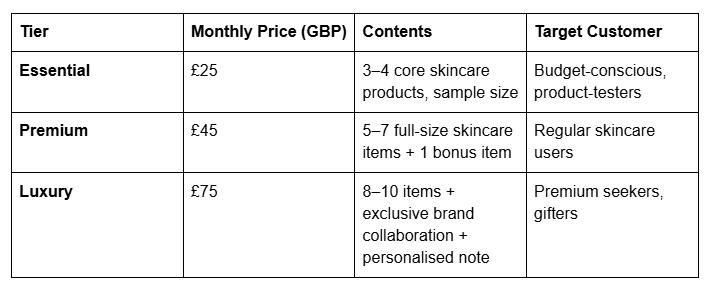
Most successful beauty brands offer 2–3 subscription tiers. Here's an example structure:
Calculating Price Point
Calculate COGS (Cost of Goods Sold): Add the cost of all products, packaging, and labour. For example, if products cost £10 and packaging/labour cost £3, your COGS is £13.
Apply Markup: Typically, beauty brands aim for 50–60% gross margin. If COGS is £13, price should be £26–33 to achieve 50% margin.
Factor in Logistics: Include shipping, payment processing fees (usually 2.9% + £0.30), and customer support costs. Subtract from your margin.
Consider Competitive Positioning: Research competitor subscription boxes. Price within 10–20% of comparable offerings.
Test and Adjust: Launch at a mid-range price and adjust quarterly based on conversion rates and customer feedback.
Discount Strategy
Offer first-box discounts (15–25% off) to lower sign-up friction. Don't discount annually—this trains customers to expect deals and erodes margin. Instead, offer:
Seasonal promotions
Referral bonuses
Annual pre-payment discounts (10–15% off)
Retaining Subscribers and Reducing Churn
Acquiring subscribers is only half the challenge. Retention determines long-term profitability.
Deliver Consistent Value
The simplest retention lever is delivering what you promised. Ensure every box contains products customers genuinely value. If a subscriber consistently receives items mismatched to their skin type or preferences, they'll cancel.
Personalisation matters. Use the product options during signup to capture skin type, preferred brands, and allergies. Remember these preferences for future boxes and personalise communications accordingly.
Surprise and Delight
Include unexpected bonuses—a luxury sample, a handwritten note, or a small gift with no additional cost. These moments create emotional connections that transcend the transactional relationship.
Communicate Authentically
Send monthly emails explaining what's in the box, why you chose each item, and how to use them effectively. Share your brand story, highlight product origins, and discuss beauty trends. Subscribers want to feel part of a community, not just a revenue stream.
Make Pausing Painless
Allow subscribers to pause for one or two months without cancelling. Life happens—financial constraints, travel, or product surplus might warrant a pause. Removing friction at this step recovers customers who might otherwise cancel permanently.
Gather Feedback
Include a simple survey in each box asking what they loved and what they'd change. Act on feedback publicly. When a subscriber's suggestion becomes a future box feature, they feel heard and valued.
Offer Loyalty Tiers
After 6 or 12 months of subscription, reward loyalty with exclusive perks:
Free month after 12 consecutive months
Exclusive product early access
Personalised consultation with a skincare specialist
VIP pricing on one-off purchases
Monitor Churn Metrics
Track monthly churn rate (percentage of subscribers who cancel). Industry benchmark for beauty subscriptions is 5–7% monthly churn. If yours exceeds 10%, investigate:
Are boxes delivering promised value?
Is pricing competitive?
Are there common cancellation reasons?
Are communications resonating?
Real-World Examples of Successful Beauty Subscriptions
Birchbox (US/UK Model)
Birchbox pioneered the beauty subscription category, offering monthly curated boxes for £12–15 (depending on region). Success factors:
Extensive product selection ensures personalisation
Active community and content marketing around beauty education
Flexible tier options (1-month, 3-month, 12-month commitments)
Rewards programme incentivises referrals
Glossybox
Glossybox delivers luxury beauty items for £15–20 monthly, with partnerships with premium brands like Estée Lauder and MAC. Key advantages:
Premium positioning justifies higher price
Brand partnerships add credibility
Unboxing experience prioritised through quality packaging
Flexible cancellation policy (pause anytime)
Ipsy
Ipsy focuses on makeup and beauty education, offering £12–25 subscriptions. Notable approach:
Heavy content marketing (YouTube tutorials, brand spotlights)
Gamification (earning points for reviews and referrals)
Product selection influenced by customer feedback
Exclusive products unavailable elsewhere
The Ordinary × Custom Skincare Brands
Brands using Squarespace often take a simpler approach—curating products from complementary indie brands rather than creating private label items. Benefits:
Lower inventory risk
Ability to rotate products seasonally
Collaboration opportunities with featured brands
Lower operational overhead
These brands succeed by focusing on curation quality and authentic storytelling rather than competing on price.
Frequently Asked Questions
-
Stock for 110–120% of your subscriber base. This accounts for growth, gift subscriptions, and buffer stock. For 100 subscribers each receiving 5 items monthly, stock 550–600 units. Overstock slightly to avoid stockouts that disappoint customers.
-
Absolutely. Create new subscription products each month, but don't force existing subscribers to switch. Instead, let them choose from available options or update their subscription. Communicate changes at least two weeks before renewal.
-
Stripe is the most reliable for subscriptions. It handles recurring billing seamlessly, integrates natively with Squarespace, and offers strong fraud protection. Avoid PayPal for subscriptions—reliability issues make Stripe preferable.
-
Enable Stripe's fraud detection tools, verify CVV codes, monitor for unusual patterns (multiple subscriptions from the same IP), and use CAPTCHA on your checkout. Most fraudulent subscriptions cancel after the first or second billing cycle, so implement a cancellation survey to identify red flags.
-
Offer both. Monthly billing has lower conversion friction, whilst annual prepayment improves cash flow and reduces churn (customers feel more invested). Incentivise annual with a 10–15% discount.
-
2–3 emails monthly is optimal. Send one announcement email about next month's box, one educational/content email, and one promotional email. More than 4 emails monthly increases unsubscribe rates.
-
For beauty subscriptions, CAC ranges from £5–20 depending on your marketing mix. Since average subscriber lifetime value is 6–12 months × monthly revenue, ensure CAC doesn't exceed 1/3 of that figure.
-
Yes, and it's a valuable acquisition channel. Allow customers to gift 3-, 6-, or 12-month subscriptions. After the gift period ends, encourage the recipient to convert to a paying subscriber with a welcome offer.
Ready to Launch Your Beauty Subscription Box?
Setting up Squarespace subscriptions is straightforward, but success depends on execution. You've now learned the technical setup, pricing strategy, and retention tactics that drive real results.
The beauty subscription market is thriving because customers value convenience, discovery, and personalization. By leveraging Squarespace's native subscription tools, you can compete with larger brands whilst maintaining operational simplicity.
Start small—launch with one subscription tier, gather customer feedback, and iterate. Within three months, you'll have data to inform pricing adjustments, content decisions, and retention strategies.
Ready to get started? Visit Squareko for detailed Squarespace guides, templates, and resources tailored to beauty and cosmetics brands. We've helped hundreds of beauty entrepreneurs build thriving subscription businesses using Squarespace, and we're here to support your journey too.

From custom website design to SEO strategy, we help businesses launch a site that looks professional and performs better.

About the Author
Walid | Founder, Squareko
I'm Walid Hasan, a Certified Squarespace Expert and Squarespace Circle Platinum Partner with over 12 years of hands-on experience designing and optimizing high-performing websites. Over the years, I've had the privilege of building more than 2,000 Squarespace websites for clients around the world, always focusing on clean design, strong user experience, and conversion-driven results.