How to Build a Cosmetics Brand Website on Squarespace That Converts and Ranks
Introduction
Building a cosmetics brand website that actually drives sales requires more than a pretty design—it demands strategy. Whether you're launching a new skincare line, establishing your makeup brand, or expanding an existing cosmetics business online, your website is your most powerful sales tool. Squarespace has emerged as a popular choice for beauty entrepreneurs because it combines ease of use with professional design templates, built-in SEO optimisation, and integrated e-commerce features that work out of the box.
The beauty industry is increasingly digital. With consumers researching products online before purchasing, your website must convince them that your cosmetics are worth buying. That means optimising for both human visitors and search engines. In this guide, we'll walk you through building a cosmetics brand website on Squarespace that converts and ranks, covering everything from initial setup to advanced conversion strategies.
The question isn't whether you need a website it's whether yours is working hard enough. Most cosmetics entrepreneurs underestimate the technical and strategic elements required to turn browsers into buyers. We'll address this by combining design principles, conversion psychology, and proven SEO tactics tailored specifically to the beauty sector.
Key Takeaways
Squarespace offers cost-effective, beginner-friendly solutions for cosmetics brands without requiring coding knowledge
Your website structure and navigation must prioritise user experience and guide visitors toward purchase decisions
Product pages need compelling copy, professional photography, and trust signals to convert browsers into customers
On-page SEO optimisation—including keyword placement, meta tags, and technical elements—helps your site rank for beauty-related searches
Conversion elements like testimonials, limited-time offers, and abandoned cart recovery are essential for maximising revenue
Mobile responsiveness and page speed directly impact both rankings and customer experience
Regular content updates and strategic internal linking strengthen your site's authority and search visibility
Why Squarespace Works for Cosmetics Brands
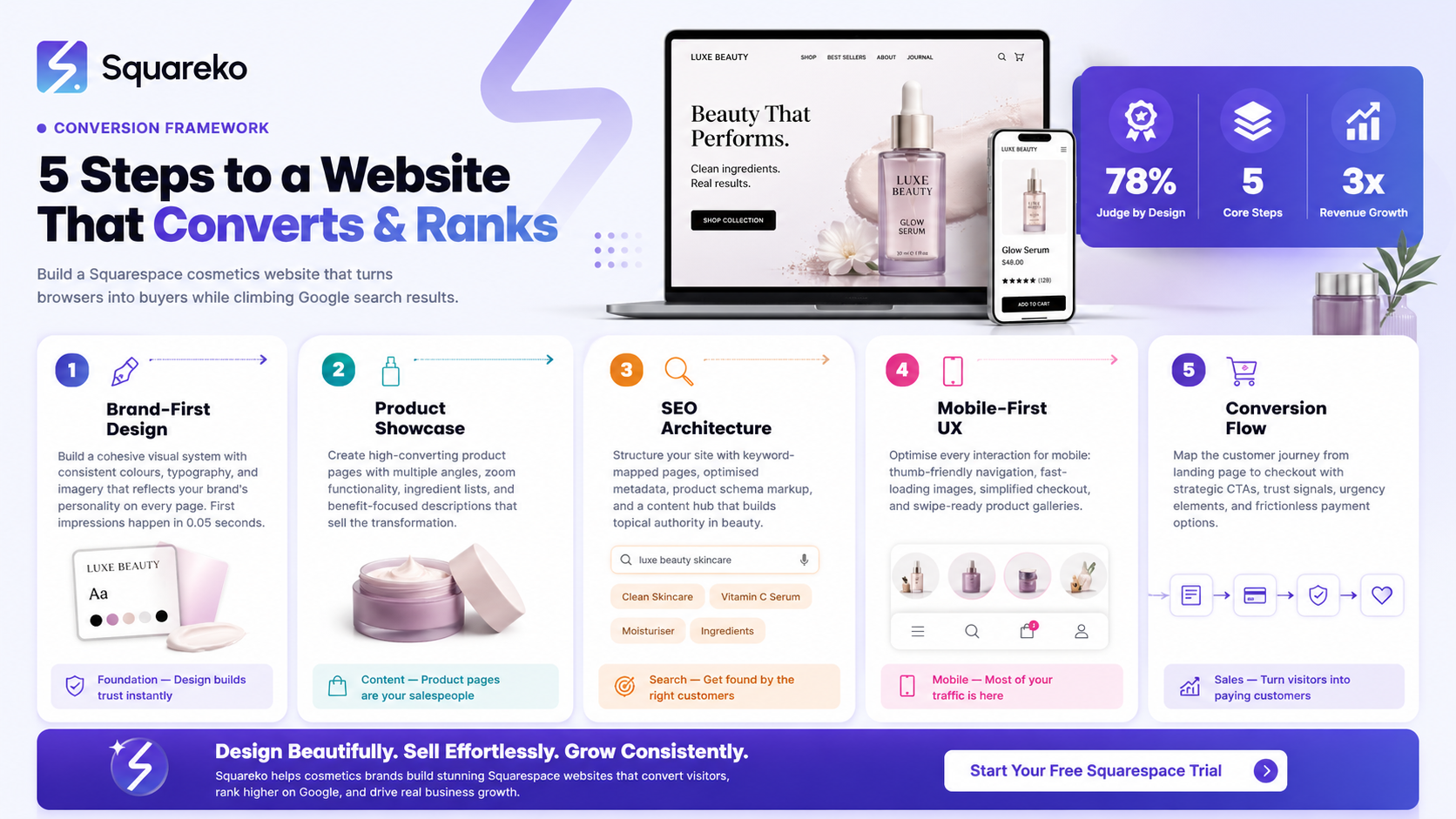
Squarespace has positioned itself as the platform for creative entrepreneurs and small business owners. For cosmetics brands specifically, it offers several distinct advantages over competitors like Shopify or WordPress.
Aesthetic Templates and Design Flexibility:Squarespace's website templates are visually stunning by default. The beauty industry demands premium presentation, and Squarespace delivers this without requiring professional design skills. Each template is mobile-responsive and can be customised to match your brand identity.
Integrated E-commerce: Unlike some website builders that require third-party integrations, Squarespace includes e-commerce functionality natively. You can manage inventory, process payments, apply discounts, and track orders all within one dashboard. This simplicity reduces technical friction and ongoing costs.
Built-in SEO Tools: Squarespace includes on-page SEO features such as editable meta titles, meta descriptions, URL customisation, and structured data support. Whilst it doesn't offer the granular control of WordPress, it provides sufficient optimisation tools for cosmetics brands to rank competitively.
Fast Page Load Times: Squarespace servers are optimised for speed, which affects both user experience and search rankings. Page speed is a confirmed Google ranking factor, and Squarespace's infrastructure ensures your beauty product pages load quickly.
Email Marketing Integration: Squarespace includes email campaigns and subscriber list management. You can capture email addresses and nurture customer relationships directly through the platform.
Customer Support: Unlike self-hosted solutions, Squarespace offers 24/7 customer support. When technical issues arise, help is available.
Setting Up Your Squarespace Cosmetics Store
Before designing or optimising, you need a solid foundation. Here's the correct setup sequence:
Step 1: Choose Your Plan
Squarespace offers several plans. For cosmetics brands, the Business plan or Commerce plan are recommended. The Commerce plan includes abandoned cart recovery, customer accounts, and advanced inventory management—all critical for beauty e-commerce. Basic or Personal plans are insufficient for product-based businesses.
Step 2: Select a Template
Browse Squarespace's template gallery and choose one optimised for e-commerce. Templates with strong product showcase features work best for cosmetics. Look for designs that feature high-quality image galleries, clear product organisation, and prominent call-to-action buttons.
Step 3: Configure Essential Settings
Site Title and Tagline: Use your cosmetics brand name and a brief, descriptive tagline that includes relevant keywords
Logo: Upload a high-resolution logo. This should be professional and instantly recognisable.
Favicon: Set a favicon (the small icon appearing in browser tabs) for brand consistency.
Analytics and Search Tracking: Connect Google Analytics 4 and Google Search Console. These tools reveal how visitors find and interact with your site.
Step 4: Set Up Payment Processing
Squarespace integrates with Stripe, PayPal, and Apple Pay. Configure payment methods to reduce checkout friction. Offer multiple options because customer preferences vary.
Step 5: Configure Shipping and Tax
If you're shipping physical cosmetics products, configure shipping zones and rates. Set up tax calculation if required in your jurisdiction. Clear shipping costs reduce cart abandonment.
Designing Your Cosmetics Website for Conversions
Design isn't merely aesthetic in the beauty industry—it's persuasion. Every visual element must reinforce your brand and guide visitors toward purchase.
Colour Psychology in Beauty E-commerce
Colours trigger emotional responses. For cosmetics, your colour palette communicates brand personality:
Luxury Brands: Black, gold, deep purples, and jewel tones convey exclusivity and premium positioning.
Natural/Organic Lines: Greens, earth tones, and pastels suggest purity and sustainability.
Bold, Trendy Brands: Vibrant pinks, neons, and experimental colour combinations appeal to fashion-forward audiences.
Professional/Clinical Skincare: Blues, silvers, and minimalist whites emphasise science and efficacy.
Ensure your chosen colours appear consistently across headers, buttons, and accent elements. Inconsistency confuses visitors and dilutes brand recognition.
Typography and Readability
Squarespace's typography options must balance aesthetics with readability. Use no more than two or three font families:
Headlines: Choose a distinctive, branded font that reflects your cosmetics niche (elegant serif for luxury, modern sans-serif for contemporary brands).
Body Text: Use highly legible sans-serif fonts like Open Sans or Montserrat. Aim for font sizes of at least 16px on mobile devices.
Contrast: Ensure sufficient contrast between text and background. Light text on dark backgrounds (or vice versa) improves readability and accessibility.
Navigation Structure
Your site's navigation should be intuitive, prioritising product discovery:
Primary Navigation:
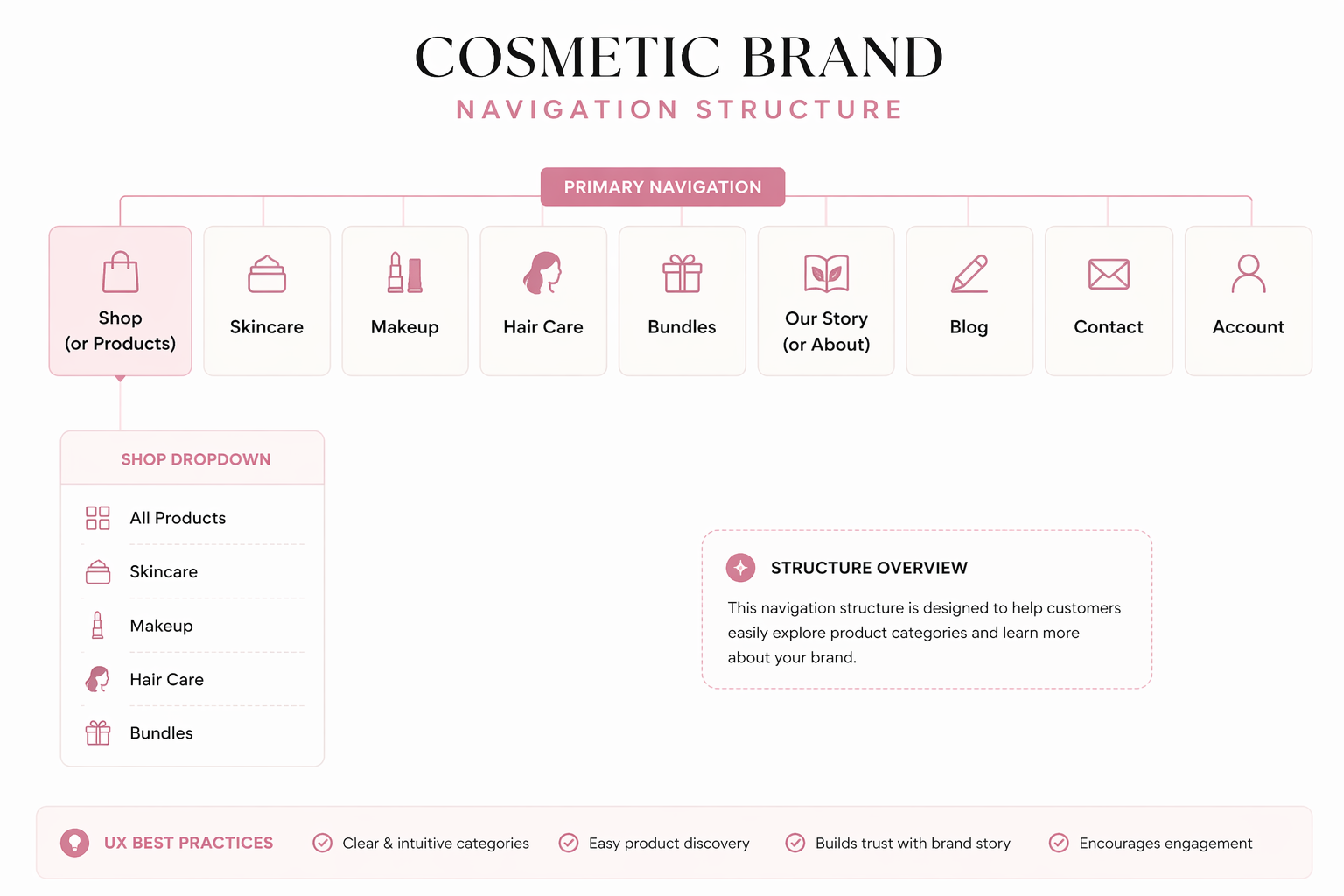
Avoid burying products deep within menus. Visitors should reach product categories within one or two clicks from the homepage. For cosmetics, consider a secondary menu highlighting bestsellers or new arrivals.
Homepage Hero Section
Your homepage's hero section—the large banner at the top—is crucial for first impressions. For cosmetics brands, this section should:
Feature high-quality imagery showcasing your products or a lifestyle image aligned with your brand (a person enjoying your skincare, for example).
Include a clear, benefit-focused headline.
Display a prominent primary call-to-action (CTA) button directing visitors to your best-selling product category or a limited-time offer.
Keep text concise; visitors spend seconds on this section, not minutes.
Product Image Requirements
For cosmetics, professional photography is non-negotiable. Customers cannot touch or smell products online, so images must compensate:
Multiple Angles: Show products from at least 4–5 different angles, including close-ups of textures and packaging details.
Lifestyle Images: Include photos of the product in use (person applying makeup, skincare being used, etc.) to help customers envision the product in their routine.
Consistency: All product images should share consistent lighting, background, and styling. Mismatched photos diminish perceived quality.
Image Size and Format: Use high-resolution JPG or PNG files (at least 1200×1200 pixels) but optimise for web to maintain page speed.
Creating Product Pages That Sell
Product pages are where interest converts to action. A weak product page loses sales even when traffic is strong.
Essential Product Page Elements
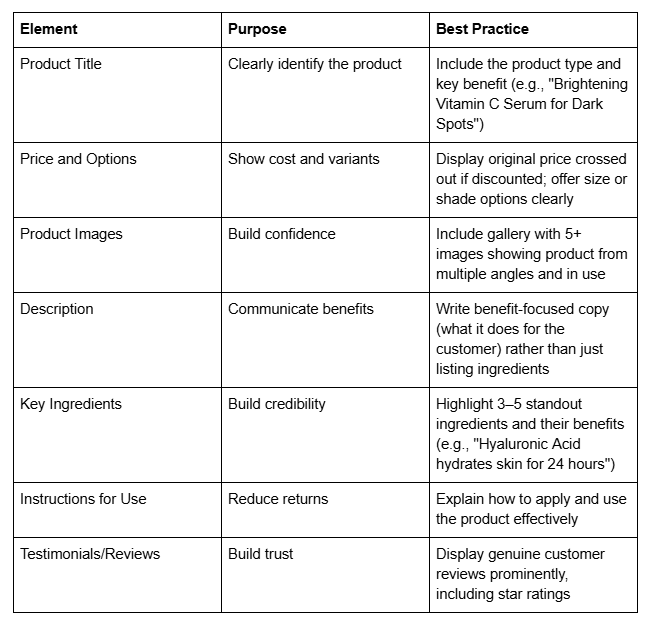
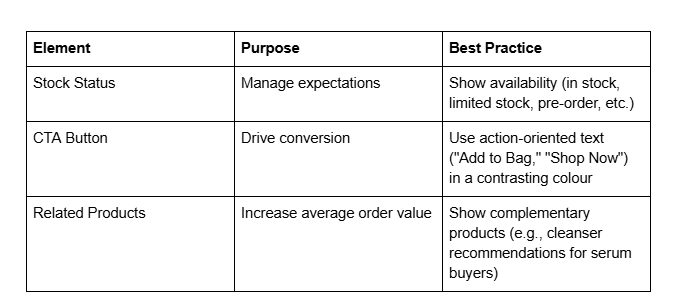
Writing Compelling Product Descriptions
Cosmetics product descriptions must sell benefits, not just features. Compare these approaches:
Feature-Focused (Weak): Contains hyaluronic acid and vitamin E. pH-balanced formula.
Benefit-Focused (Strong): This hydrating serum plumps your skin with hyaluronic acid, delivering 24-hour moisture and reducing the appearance of fine lines. Enriched with vitamin E, it restores a youthful glow whilst protecting against environmental damage.
The second example helps the reader envision the product's effect on their skin and their life. When describing cosmetics, address:
What problem does it solve?
What will the customer experience?
Who is it for?
When and how should it be used?
Customer Reviews and Ratings
Squarespace allows you to collect and display customer reviews directly on product pages. Encourage reviews by:
Sending a follow-up email asking satisfied customers for feedback (typically 2–3 weeks after purchase).
Offering a small incentive (discount code for next purchase) for leaving honest reviews.
Displaying reviews prominently, including star ratings, reviewer name, and reviewer verified purchase badge.
Genuine reviews with detailed comments are more persuasive than generic five-star ratings. A review saying This foundation finally matches my skin tone and doesn't feel heavy is far more convincing than a star rating alone.
Optimising for Search Engines
A beautiful website is worthless if search engines cannot find it. SEO for cosmetics brands requires strategic keyword targeting and technical optimisation.
Keyword Research and Targeting
Begin by identifying keywords your target customers use when searching for cosmetics:
Broad Keywords: cosmetics brand,skincare products, organic makeup
Long-Tail Keywords: best skincare for sensitive skin, vegan makeup brands, cruelty-free foundation UK
Local Keywords: handmade cosmetics London, natural skincare brand Bristol (if location-specific)
Long-tail keywords (3+ words) are crucial for cosmetics brands. They have lower search volume but higher intent. Someone searching "best skincare for sensitive skin is closer to purchasing than someone searching skincare.
Use Squarespace's built-in SEO features to target these keywords:
On-Page SEO Elements
Meta Title (60 characters max): Include your primary keyword naturally. Example: Organic Skincare Products for Sensitive Skin | [Brand Name]
Meta Description (150–160 characters): Write a compelling summary with your keyword. Example: Discover organic skincare for sensitive skin. Our vegan formulas reduce redness and irritation. Free shipping on orders over £30.
URL Structure: Customise URLs to be short and keyword-inclusive. Avoid Squarespace's default random URLs. Use: /organic-skincare-sensitive-skin instead of /products/item123.
Heading Hierarchy: Use H1 for your main page title (only one per page). Use H2 and H3 for subheadings logically. On product pages, the product name is the H1; ingredient benefits could be H2s.
Internal Linking: Link to related products and blog posts using descriptive anchor text. For example, if writing about acne-prone skin, link to your breakout-fighting product: "Our salicylic acid cleanser targets acne-causing bacteria."
Image Alt Text: Write descriptive alt text for every product image. Instead of product-01.jpg, use Vitamin C serum in frosted glass bottle with dropper applicator. Alt text improves accessibility and helps search engines understand your images.
Technical SEO for Squarespace
Squarespace handles many technical SEO elements automatically, but ensure these are configured:
XML Sitemap: Squarespace automatically generates and submits your sitemap to search engines. Verify it's working in Google Search Console.
Robots.txt: Allow search engines to crawl your entire site (Squarespace's default is appropriate for most cosmetics brands).
Mobile Responsiveness: Squarespace's templates are mobile-first, but test your site on various devices to confirm all elements display correctly.
Page Speed: Use Google PageSpeed Insights to identify speed issues. Compress images and minimise large video files.
Blog Content for Authority
Blogging builds search authority and drives organic traffic. For cosmetics brands, create blog content addressing customer questions:
How to Identify Your Skin Type
The Best Ingredients for Anti-Ageing Skincare
Cruelty-Free Makeup: What Does It Really Mean?
Blog posts should be 1,500–2,500 words, thoroughly addressing the topic, and naturally linking to relevant products. Each blog post presents an opportunity to rank for keywords your target audience searches.
Building Trust and Social Proof
Trust is currency in e-commerce, particularly in beauty where customers cannot test products before buying. Build trust through multiple mechanisms:
Customer Testimonials and Case Studies
Feature detailed customer testimonials on your homepage and product pages. Include:
Customer name (or initials for privacy)
Before/after photos (for skincare products)
Specific results (My acne reduced by 70% in six weeks)
A verified purchase badge from Squarespace's review system
Case studies are more persuasive than generic testimonials. A detailed story—Sarah struggled with sensitive skin for years. Within four weeks of using our Barrier Repair Moisturiser, her redness diminished and her skin felt hydrated again—resonates more powerfully than Great product!
About Us Page
Your About Us page humanises your brand. For cosmetics, share:
Your founding story (why did you start this brand?)
Your mission and values (what do you stand for?)
Your qualifications (formulation training, dermatology expertise, etc.)
Behind-the-scenes images or videos (laboratory, ingredients sourcing, team photos)
Consumers increasingly buy from brands aligned with their values. If you're eco-conscious, emphasise sustainability. If you prioritise inclusivity, highlight your shade range. The About Us page is where you communicate these values.
Certifications and Credentials
Display any relevant certifications prominently:
Cruelty-free (Leaping Bunny, PETA)
Vegan certifications
Organic certifications (Soil Association, ECOCERT)
Dermatologist-tested
Hypoallergenic testing results
Add these as small badges or in a dedicated section. They provide third-party validation that your products meet specific standards.
Transparency About Ingredients
Cosmetics-conscious consumers research ingredients. Create transparency by:
Publishing full ingredient lists (not just key ingredients)
Explaining why you chose each ingredient
Addressing common concerns (no parabens, sulfate-free, etc.)
Providing INCI (International Nomenclature of Cosmetic Ingredients) names for transparency
This level of detail signals integrity and appeals to informed customers.
FAQ Section
Anticipate customer questions and answer them on your site:
Are your products suitable for sensitive skin?"
Do you test on animals?
What's your return policy?
How long before I see results?
Can I use this product with my other skincare?
Addressing concerns upfront reduces friction and supports decision-making.
Conversion Rate Optimisation Strategies
Driving traffic to your site means nothing if visitors don't convert. These strategies increase the percentage of visitors who make purchases.
Reduce Friction in Checkout
Every unnecessary step in the checkout process loses customers:
Guest Checkout: Allow purchasing without creating an account. Account creation can come after the purchase.
Minimal Form Fields: Only ask for essential information (name, email, shipping address, payment details). Optional fields like company name add unnecessary friction.
Clear Progress Indicators: Show customers which step of checkout they're on and how many steps remain.
Trust Badges: Display security badges (SSL Secure, Verified by [payment processor]) and your return policy near the checkout button.
Multiple Payment Options: Offer Stripe, PayPal, Apple Pay, and Google Pay. Different customers prefer different methods.
Implement Abandoned Cart Recovery
Squarespace's Commerce plan includes abandoned cart recovery. Configure it to:
Send an email reminder 1 hour after cart abandonment
Include product images and the exact price they were offered
Offer a small incentive (5–10% discount) to complete the purchase
Send a second reminder 24 hours later if the first didn't convert
Abandoned cart recovery typically recovers 10–15% of lost sales at minimal cost.
Limited-Time Offers and Scarcity
Create urgency to motivate immediate purchases:
Flash Sale: 25% off skincare, ends tonight at midnight
Only 3 units left of this bestseller
Pre-order available for 48 hours before official launch
Scarcity (limited stock) and time-based offers both increase conversion rates. Display countdown timers and stock indicators prominently.
Free Shipping Threshold
Offer free shipping on orders over a specific amount (e.g., £30). Customers often add items to reach the threshold, increasing average order value. Display this offer prominently: "Free Shipping on Orders Over £30."
Cross-Selling and Upselling
When customers add a product to their bag, recommend complementary items:
Customer adds cleanser → recommend toner
Customer adds foundation → recommend primer and setting spray
Customer adds single serum → recommend a routine bundle at slight discount
Squarespace allows you to set related products manually on each product page. Strategic cross-selling increases average order value without being pushy.
Build an Email List
Offer a discount code in exchange for email signup. Use Squarespace's email campaigns to send regular newsletters featuring new products, content, and exclusive offers. Email remains one of the highest-ROI marketing channels.
Frequently Asked Questions
-
Both are excellent platforms. Squarespace offers superior design templates and faster setup for creatives, whilst Shopify provides more advanced e-commerce features and third-party app integrations. For most cosmetics brands just starting out, Squarespace's simplicity and aesthetic appeal make it preferable. As your brand scales, you might outgrow Squarespace's limitations.
-
Squarespace plans range from £13–£33 per month (at annual rates). The Commerce plan at approximately £26/month includes e-commerce features needed for cosmetics brands. Domain registration costs £20/year. There are no hidden setup fees. The total first-year cost is approximately £350–400, making it extremely affordable compared to hiring a developer.
-
A basic website with essential pages (homepage, products, about, contact) can be built in 5–10 hours using Squarespace's templates. This assumes you have product photography and copy ready. More complex customisation or if you're writing copy from scratch, allow 20–30 hours. Most entrepreneurs can launch a professional site within two weeks of focused effort.
-
Focus on keyword research, on-page SEO (meta tags, image alt text, internal links), and content creation. Identify keywords your customers search (using Google Search Console and tools like Ahrefs), target these keywords naturally in product descriptions and blog posts, and build internal links between related content. Mobile optimisation and page speed also affect rankings. For most cosmetics brands, organic growth takes 3–6 months of consistent effort.
-
Yes. Configure multiple currencies (GBP, USD, EUR, etc.) so international customers see prices in their currency. Set up shipping zones and rates for different countries. Be aware of cosmetics regulations—certain ingredients are restricted in specific countries (EU regulations differ from the US, for example). Research your target markets' requirements before shipping.
-
Squarespace's built-in review functionality allows customers to leave ratings and written reviews directly on product pages. Encourage reviews by sending follow-up emails asking satisfied customers to share their experience. Consider offering a small incentive (discount code) for verified reviews. Reviews build social proof and improve conversion rates.
-
Product pages showcase individual items with specifications, pricing, and reviews. Landing pages are focused promotional pages designed around a specific offer or campaign (e.g., a page dedicated to a seasonal sale or a new product launch). Squarespace's Commerce plan includes both product pages and the ability to create custom landing pages for campaigns.
-
Influencer partnerships can be effective but are often expensive. Start with micro-influencers (10k–100k followers) in your niche who align with your brand values. Micro-influencers typically have higher engagement rates and charge less than celebrity influencers. Prioritise authentic partnerships over one-off sponsored posts.
Ready to Build Your Cosmetics Brand Website on Squarespace?
Building a cosmetics brand website that converts and ranks doesn't require technical expertise or a substantial budget. With Squarespace's intuitive platform, professional templates, and built-in e-commerce and SEO tools, you have everything needed to launch a competitive beauty brand online. The key is combining intelligent design with strategic optimisation—ensuring your site looks exceptional whilst working hard to attract and convert customers.
Your cosmetics website is more than a digital storefront; it's your brand's ambassador. Every element, from product photography to checkout experience, communicates quality and trustworthiness. By following the principles in this guide—prioritising user experience, optimising for search engines, building social proof, and implementing conversion strategies—you'll create a website that not only looks beautiful but also drives measurable business results.
Ready to get started? At Squareko, we specialise in helping cosmetics entrepreneurs and beauty brand founders build powerful Squarespace websites that sell. Whether you're launching your first collection or scaling an established brand, our team understands the nuances of the beauty industry and how to position your products for maximum visibility and revenue. We handle the technical complexity so you can focus on what you do best—creating exceptional cosmetics. Explore our resources, templates, and services designed specifically for beauty brands, and let's build your dream cosmetics website together.

From custom website design to SEO strategy, we help businesses launch a site that looks professional and performs better.

About the Author
I'm Walid Hasan, a Certified Squarespace Expert and Squarespace Circle Platinum Partner with over 12 years of hands-on experience designing and optimizing high-performing websites. Over the years, I've had the privilege of building more than 2,000 Squarespace websites for clients around the world, always focusing on clean design, strong user experience, and conversion-driven results.