AI Search Strategy for Insurance Brokers on Squarespace: Get Recommended by AI in 2026
Introduction
The insurance industry is at an inflection point. While traditional search engine optimisation remains important, a new frontier has emerged: AI search strategy insurance brokers squarespace 2026. Insurance brokers and agents now face a critical question: how do we appear when clients ask ChatGPT, Perplexity, or Google's AI Overviews for insurance recommendations?
This shift isn't hypothetical. AI-powered search tools are rapidly becoming the primary discovery mechanism for financial services. Insurance clients increasingly prefer asking an AI assistant for recommendations rather than scrolling through search results. For brokers using Squarespace, optimising your website for AI search—known as Answer Engine Optimisation (AEO) or Generative Engine Optimisation (GEO)—is no longer optional. It's essential.
The challenge is significant: AI search systems evaluate whether your firm demonstrates genuine expertise, experience, authority, and trustworthiness (E-E-A-T). For YMYL (Your Money, Your Life) content like insurance advice, AI systems prioritise credentials, regulatory standing, and verified expertise. As an FCA-regulated firm, you possess a substantial competitive advantage that many competitors lack. This guide shows you how to maximise that trust signal and optimise your entire Squarespace presence for AI search discovery.
Key Takeaways AI Search Strategy for Insurance Brokers on Squarespace: Get Recommended by AI in 2026
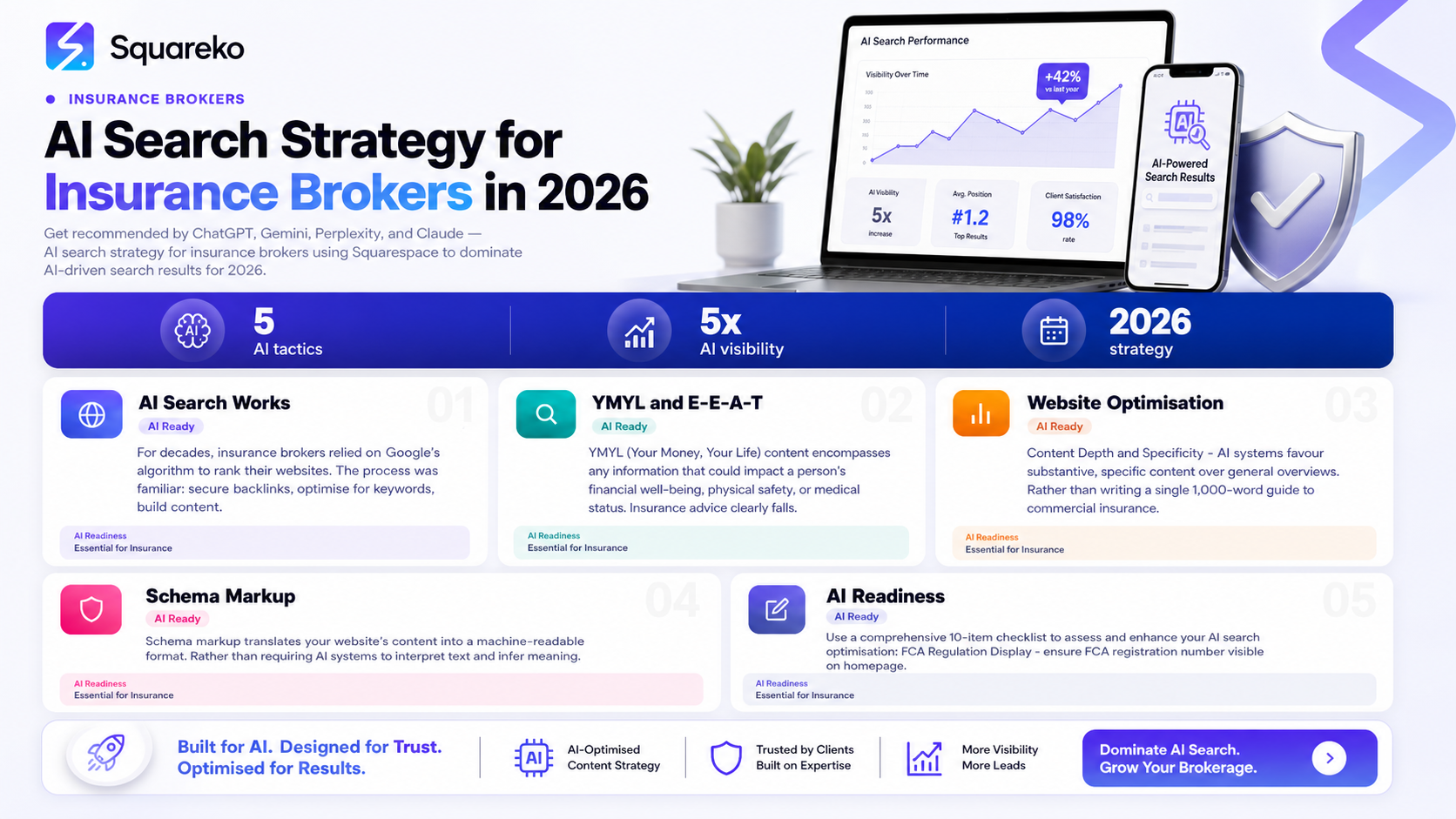
AI search is reshaping how clients discover insurance brokers: Clients increasingly ask ChatGPT and AI Overviews for recommendations rather than conducting traditional Google searches
E-E-A-T and YMYL standards directly impact AI search visibility: FCA regulation acts as a powerful credibility signal that influences AI system rankings and recommendations
Schema markup and structured data are non-negotiable for AEO: InsuranceAgency schema, Review aggregation, and FAQ schema help AI systems understand your firm's expertise
Your Squarespace website must demonstrate expertise visually and textually: High-quality content, client testimonials, and credentials require equal prominence for both human visitors and AI systems
A proactive AI readiness checklist ensures comprehensive optimisation: Systematic implementation of 10 core elements prevents gaps that could exclude you from AI recommendations
How AI Search Works for Insurance Brokers?
The Shift from Traditional Search to AI-Powered Discovery
For decades, insurance brokers relied on Google's algorithm to rank their websites. The process was familiar: secure backlinks, optimise for keywords, build content, and climb the rankings. AI search operates on fundamentally different principles.
When a prospective client asks ChatGPT, Which insurance broker should I use in London? or What questions should I ask my insurance agent?, the AI system doesn't simply return the top-ranking websites. Instead, it synthesises information across multiple sources, evaluates the credibility of each source, and generates a bespoke response that reflects genuine expertise. Your Squarespace website must be visible to these AI systems, and more importantly, it must demonstrate unmistakable competence.
Why FCA Regulation Strengthens Your AI Search Positioning
This is where your regulatory status matters profoundly. An FCA-regulated firm signals to AI systems that your advice is backed by formal oversight, compliance standards, and accountability mechanisms. Unlike general business websites, financial services websites undergo algorithmic scrutiny for E-E-A-T signals. FCA regulation is among the most credible signals available.
AI systems trained on financial data inherently weight regulatory compliance heavily. If you're FCA-regulated, your competitive position in AI search is fundamentally different from unregulated competitors.
AI Search vs. Traditional SEO: Key Differences
Traditional SEO focuses on ranking for specific keywords. AI search focuses on conceptual relevance and demonstrable expertise. A Squarespace website might rank highly for "commercial insurance broker, but that ranking doesn't guarantee a ChatGPT recommendation. Why? Because the AI system prioritises:
Author credentials: Who wrote this content? Are they qualified?
Firm verification: Is this firm legitimate and regulated?
Specificity: Does the content address precise client needs?
Recency: Is the information current?
Corroboration: Does this expertise appear consistently across your site?
Traditional SEO rewards keyword optimisation and backlink volume. AI search rewards substantive expertise, verified credentials, and consistent demonstration of real-world knowledge.
Understanding YMYL and E-E-A-T for Insurance Content
Why YMYL Standards Apply to Insurance Brokers
YMYL (Your Money, Your Life) content encompasses any information that could impact a person's financial well-being, physical safety, or medical status. Insurance advice clearly falls within YMYL scope. Google's official documentation explicitly identifies financial services, including insurance guidance, as YMYL content.
The significance: AI systems apply substantially higher evaluation standards to YMYL content than to other categories. A casual blog post about fitness trends faces far less scrutiny than insurance advice. Your Squarespace content must meet rigorous standards of accuracy, authority, and trustworthiness.
E-E-A-T: The Four Pillars of Credibility
E-E-A-T stands for Experience, Expertise, Authority, and Trustworthiness. For insurance brokers, each pillar requires specific evidence:
Experience: Demonstrate real-world insurance experience. On your Squarespace site, showcase:
Years in the insurance industry
Client testimonials mentioning specific scenarios you've solved
Case studies detailing how your guidance protected clients
Team bios highlighting individual broker certifications and specialisations
Expertise: Prove your team's professional qualifications. Include:
Professional designations (ACII, CII qualifications, etc.)
Continuing education and training records
Industry publications or thought leadership contributions
Specific knowledge of complex insurance products
Authority: Establish your firm's prominence in the insurance sector. Build:
Backlinks from authoritative insurance industry sources
Media mentions and press coverage
Industry award recognition
Association memberships and accreditations
Trustworthiness: This is the factor where FCA regulation provides your greatest advantage. Demonstrate trustworthiness by:
Displaying FCA regulation status prominently on your Squarespace site
Clearly publishing your FCA registration number
Referencing FCA compliance standards in your content
Including a transparent complaints procedure
Publishing relevant regulatory disclosures
AI systems explicitly flag FCA-regulated firms as inherently more trustworthy than unregulated competitors. This isn't merely an advantage—it's a structural benefit in AI search rankings.
Why Traditional SEO Doesn't Capture E-E-A-T
A critical distinction: traditional SEO tools (Ahrefs, SEMrush, Moz) measure authority primarily through backlinks and domain authority. These metrics don't capture E-E-A-T nuance. Your website might have strong traditional SEO metrics but weak E-E-A-T signals, which would severely limit your AI search visibility.
Conversely, a Squarespace website with modest traditional SEO metrics but exceptional E-E-A-T signals—particularly FCA regulation—may appear prominently in AI search recommendations despite not ranking highly in traditional Google results.
Optimising Your Squarespace Website for AI Search
Content Depth and Specificity
AI systems favour substantive, specific content over general overviews. Rather than writing a single 1,000-word guide to commercial insurance, create multiple focused pieces:
Commercial Insurance for Tech Startups: Coverage Gaps Most Founders Miss
Cyber Liability Insurance: What Isn't Covered in Your Business Policy
Supply Chain Disruption Insurance: Protection Against Global Shocks
Each piece should demonstrate specific expertise relevant to a particular client segment. Squarespace's content management system easily accommodates this depth. Create a resource centre or insights section showcasing your specialisations.
Author Information and Credentials
Squarespace allows author bylines on blog posts. Use this feature consistently. Include:
Author name
Professional credentials
Years of experience
Specific expertise areas
Photo of the author
When AI systems evaluate your content, they consider whether named authors appear qualified to discuss insurance matters. Anonymous generic content signals low authority. Named experts with visible credentials signal high authority.
User Experience and Content Accessibility
AI systems increasingly factor user experience into relevance rankings. Your Squarespace site should:
Load quickly (Core Web Vitals optimisation)
Render correctly on mobile devices
Feature clear navigation and hierarchy
Provide readable typography (sufficient font size and contrast)
Include descriptive image alt text
Employ logical heading structures (H1 > H2 > H3, etc.)
These optimisations benefit both human users and AI systems that crawl your site.
FAQ Integration
AI systems frequently extract FAQ content to answer client questions directly. A prominent FAQ section on your Squarespace site serves dual purposes: it answers client questions and provides source material for AI systems.
Your FAQs should address genuine client uncertainties:
"What's the difference between professional indemnity and public liability insurance?
"How often should I review my commercial insurance policies?
"What happens if I don't disclose a relevant fact to my insurance broker?
Structure FAQs clearly with concise questions and detailed answers. Include FAQ Schema markup (addressed below) to signal to AI systems that this is FAQ content.
InsuranceAgency Schema and Structured Data Essentials
Why Schema Markup Matters for AI Search
Schema markup translates your website's content into a machine-readable format. Rather than requiring AI systems to interpret text and infer meaning, schema markup explicitly states, This website belongs to an insurance agency. Here is our address, telephone number, FCA registration, and client reviews.
Squarespace supports schema markup implementation through custom code blocks. This requires some technical configuration, but the investment is essential for AI search visibility.
InsuranceAgency Schema Implementation
The InsuranceAgency schema type (from schema.org) is specifically designed for insurance businesses. A minimal implementation includes:
{
  "@context": "https://schema.org",
  "@type": "InsuranceAgency",
  "name": "Your Firm Name",
  "url": "https://yoursite.com",
  "telephone": "+44 (0)xxx xxxx xxxx",
  "address": {
    "@type": "PostalAddress",
    "streetAddress": "123 Main Street",
    "addressLocality": "London",
    "addressRegion": "London",
    "postalCode": "SW1A 1AA",
    "addressCountry": "GB"
  },
  "sameAs": ["https://www.linkedin.com/company/yourfirm"],
  "areaServed": ["GB"],
  "knowsAbout": ["Commercial Insurance", "Professional Indemnity", "Cyber Liability"],
  "aggregateRating": {
    "@type": "AggregateRating",
    "ratingValue": "4.8",
    "reviewCount": "47"
  }
}
This schema tells AI systems key facts about your firm in a standardised format. It also enables rich snippets in search results, potentially improving click-through rates.
Review Schema and Aggregation
Embed Review schema markup alongside client testimonials. Each review should include:
{
  "@type": "Review",
  "reviewRating": {
    "@type": "Rating",
    "ratingValue": "5",
    "bestRating": "5",
    "worstRating": "1"
  },
  "author": {
    "@type": "Person"
    "name": "Jane Smith"
  },
  "reviewBody": "Outstanding service. The team identified a significant coverage gap in our commercial policy that could have cost us thousands. Highly recommended.",
  "datePublished": "2025-11-15"
}
Aggregating reviews—pulling testimonials from Google, Trustpilot, and other platforms—strengthens your collective credibility signal. AI systems weight aggregated, multi-source reviews more heavily than reviews from your website alone.
FAQ Schema for AI Search
FAQ schema markup signals to AI systems that your content is specifically structured to answer common questions. Implement it for your FAQ section:
{
  "@context": "https://schema.org",
  "@type": "FAQPage",
  "mainEntity":
    {
      "@type": "Question
      "name": "How do I get my insurance brokerage recommended by ChatGPT?",
      "acceptedAnswer": {
        "@type": "Answer",
        "text": "To appear in ChatGPT recommendations, ensure your website demonstrates strong E-E-A-T signals, implement comprehensive schema markup, aggregate client reviews, and publish FAQ content addressing common insurance questions. FCA regulation significantly strengthens your positioning."
      }
    }
  ]
}
Building Review Aggregation and Social Proof
Multi-Platform Review Strategy
Client reviews serve dual purposes: they persuade potential clients and they signal credibility to AI systems. Aggregate reviews from multiple platforms:
Google Business Profile: Essential for local discovery
Trustpilot: Industry-specific review platform
LinkedIn: B2B credibility signals
Industry-specific platforms: Any insurance-focused review sites
Your website: Direct testimonials
Each review platform you appear on increases the likelihood that AI systems encounter positive mentions of your firm.
Structuring Testimonials for AI Visibility
Rather than generic praise ("Great company!"), encourage clients to provide specific, detailed testimonials:
Weak: "Really happy with their service."
Strong: "When our managing director was made redundant, we were unsure if our key person insurance would cover the cost of recruiting his replacement. The team at [Firm] analysed our policy in detail, identified a specific exclusion, and arranged additional cover. This intervention saved us approximately £80,000. Excellent professional guidance."
Specific, detailed testimonials demonstrate real expertise and concrete client benefits. AI systems weighted more heavily.
Responding to Reviews
Maintain an active review management strategy. Respond to all reviews—positive and critical—professionally and thoroughly. AI systems factor review response rates and quality into their assessment of your firm's trustworthiness.
FAQ Content Strategy for AI Search Discovery
Research Client Questions
Begin by identifying the genuine questions your clients ask. Review:
Your sales team's most common inquiries
Incoming email subjects
Live chat conversation transcripts
Google Search Console "queries" data
Social media messages and comments
This research reveals the actual uncertainties your target audience experiences. Address these uncertainties explicitly in your FAQ content.
Structure for AI Extraction
AI systems often extract FAQ answers to provide direct responses to user queries. Structure your FAQs for clarity and extractability:
Question: Clear, conversational phrasing matching how clients actually ask the question
Answer: Concise opening statement (1-2 sentences) followed by detailed explanation. Avoid ambiguity and ensure the answer stands alone without requiring additional context.
Content Examples Relevant to Insurance Brokers
Your FAQ section should address core questions across these categories:
Purchasing Insurance:
How do I know what type of insurance I need?
What's the difference between professional indemnity and public liability insurance?
Should I obtain quotes from multiple brokers?
Insurance Coverage:
What does 'excess' mean in an insurance policy?
What isn't covered by standard commercial insurance?
How do policy exclusions affect my claims?
Claims and Servicing:
How do I make a claim on my insurance policy?
What information do I need to provide when making a claim?
Can the insurance company refuse my claim?
Regulatory and Compliance:
What does FCA regulation mean for insurance brokers?
How are my assets protected if my broker becomes insolvent?
What's the difference between regulated and unregulated advice?
Each answer should be informative, specific, and professional. Aim for 150-250 words per answer—sufficient depth for AI systems to extract meaningful content.
Insurance Broker AI Search Readiness Checklist
Use this 10-item checklist to assess and enhance your AI search optimisation:
1. FCA Regulation Display
FCA registration number visible on homepage
"FCA-regulated" mentioned in meta description and H1 content
Regulatory status referenced in "About" section
Complaints procedure clearly published
2. InsuranceAgency Schema Implementation
InsuranceAgency schema markup added to homepage
All key business information (address, phone, credentials) included
Schema tested with Google's Schema Markup Validator
Review schema aggregating client testimonials implemented
3. Author Credentials and Bylines
All blog posts include named author bylines
Author bios include professional credentials
Team pages list specific qualifications and specialisations
Photos accompany author information
4. Comprehensive FAQ Section
Dedicated FAQ page created (minimum 8-10 questions)
Questions reflect genuine client uncertainties
Answers are detailed (150-250 words minimum)
FAQ Schema markup implemented
FAQ content references insurance decision-making processes
5. E-E-A-T Signal Integration
Case studies demonstrating real client outcomes
Testimonials providing specific results and benefits
Industry awards and accreditations prominently displayed
Years of experience clearly stated
Professional associations and memberships listed
6. Content Depth and Specificity
Blog content addresses specific insurance scenarios
Resource centre contains 10+ substantive guides
Content includes actionable advice, not generic overviews
Industry terminology used correctly and consistently
Content demonstrates specialisation (commercial, personal lines, etc.)
7. Review Aggregation and Management
Google Business Profile optimised with reviews
Trustpilot profile established and active
LinkedIn recommendation strategy implemented
Minimum 20 aggregated reviews across platforms
All reviews responded to within 7 days
8. Technical SEO and User Experience
Core Web Vitals scores in Good range
Mobile responsiveness tested across devices
Page load speed optimised (target: <2.5 seconds)
Heading structure (H1 > H2 > H3) correctly implemented
Image alt text comprehensive and descriptive
9. Keyword Integration Without Stuffing
Focus keyword appears in H1, first 100 words, and meta description
Semantic keywords naturally distributed throughout content
Keyword density 0.5-2% (avoid over-optimisation)
LSI keywords (related concepts) included
Insurance terminology used contextually
10. Ongoing Monitoring and Updates
Analytics tracking AI-driven traffic (where identifiable)
Content audit scheduled quarterly
Testimonials and reviews refreshed regularly
New content published consistently (minimum 2-4 posts/month)
AI search visibility monitored through AI overview tracking tools
Common Questions About AI Search for Insurance
How do I get my insurance brokerage recommended by ChatGPT?
Getting recommended by ChatGPT requires demonstrating extraordinary competence and trustworthiness. ChatGPT's training data includes public websites, but its recommendation mechanisms prioritise:
Regulatory Status: If you're FCA-regulated, ensure this appears prominently across your site. ChatGPT's underlying model has learned that FCA regulation indicates trustworthy financial services firms.
Published Expertise: Create content demonstrating specific knowledge. General articles about insurance are abundant; detailed guides addressing precise client concerns signal genuine expertise.
Client Validation: Aggregated, detailed client reviews—particularly multi-platform reviews—indicate that your expertise translates to real client satisfaction.
Structured Data: Schema markup helps ChatGPT understand your firm's credentials and client feedback without requiring interpretation.
There's no single "ChatGPT optimisation" technique. Rather, comprehensive AI search readiness—combining E-E-A-T signals, structured data, content depth, and review aggregation—increases the likelihood of recommendations.
What schema markup should an insurance broker use?
Insurance brokers should implement multiple schema types:
InsuranceAgency: For your homepage and main business information
Review: Embedding each client testimonial
AggregateRating: Summarising your overall review volume and rating
FAQPage: For your FAQ section
Article: For blog posts and guides
BreadcrumbList: For site navigation clarity
Organization: For your firm's general information
Each schema type serves a specific purpose. InsuranceAgency provides AI systems with structured business data. Review schema amplifies client testimonials. Article schema signals blog content credibility. FAQ schema indicates authoritative Q&A content.
Implementing all relevant schema types creates a comprehensive machine-readable representation of your expertise and credibility.
Does being FCA-regulated help my insurance broker website rank in AI search?
Absolutely. FCA regulation is among the strongest trust signals available for financial services AI search. Here's why:
AI systems trained on financial data have learned that FCA-regulated firms operate under statutory compliance obligations, undergo regular audits, and maintain mandatory professional standards. Unregulated competitors lack these safeguards.
When evaluating two insurance brokers with similar website quality, AI systems will systematically favour the FCA-regulated firm. This isn't conjecture—it reflects how financial AI systems have been trained.
If you're FCA-regulated, treat this as a core component of your AI search strategy. If you're not regulated, ensure you're transparent about your status and clearly identify any regulatory oversight you do operate under.
How frequently should I publish new insurance content for AI search?
Consistency matters more than frequency. Publishing one high-quality, detailed piece monthly signals ongoing expertise. Publishing four mediocre articles weekly signals content volume without substance.
For AI search specifically:
Aim for 2-4 substantive pieces per month
Ensure each piece addresses a specific client question
Maintain consistent quality and depth
Review and update existing content quarterly
This cadence demonstrates active expertise without requiring unsustainable effort.
Can I optimise my Squarespace website for AI search without technical knowledge?
Yes, though some elements require technical capability. Squarespace's built-in features handle basic optimisation:
Basic SEO: Meta titles, descriptions, and heading structure are Squarespace-native
Readability: Squarespace templates provide responsive design by default
Mobile optimisation: Automatic across all Squarespace sites
Schema markup implementation requires more technical knowledge. You can either:
Use Squarespace's SEO features plus a third-party schema markup service
Hire a developer to implement custom schema code
Work with a specialist agency like Squareko.com that specialises in Squarespace optimisation for professional services
The investment in proper schema implementation typically generates substantial returns through improved AI search visibility.
What's the difference between AI Search Optimisation (AEO) and traditional SEO?
Traditional SEO focuses on ranking in traditional search engine results through:
Keyword targeting
Backlink building
On-page optimisation
Domain authority accumulation
AI Search Optimisation (AEO) focuses on appearing in AI-generated recommendations through:
E-E-A-T signal development
Schema markup implementation
Content depth and specificity
Review aggregation
Regulatory credibility signals
There's overlap, but they're distinct disciplines. A website might rank well traditionally but fail to appear in AI recommendations if it lacks strong E-E-A-T signals. Conversely, a high-trust site with weak traditional SEO metrics might appear prominently in AI recommendations.
For insurance brokers, both matter. Invest in traditional SEO for search visibility, but prioritise AEO elements—particularly E-E-A-T and schema markup—for AI search recommendation inclusion.
-
Getting recommended by ChatGPT requires demonstrating extraordinary competence and trustworthiness. ChatGPT's training data includes public websites, but its recommendation mechanisms prioritise:
Regulatory Status: If you're FCA-regulated, ensure this appears prominently across your site. ChatGPT's underlying model has learned that FCA regulation indicates trustworthy financial services firms.
Published Expertise: Create content demonstrating specific knowledge. General articles about insurance are abundant; detailed guides addressing precise client concerns signal genuine expertise.
Client Validation: Aggregated, detailed client reviews—particularly multi-platform reviews—indicate that your expertise translates to real client satisfaction.
Structured Data: Schema markup helps ChatGPT understand your firm's credentials and client feedback without requiring interpretation.
There's no single "ChatGPT optimisation" technique. Rather, comprehensive AI search readiness—combining E-E-A-T signals, structured data, content depth, and review aggregation—increases the likelihood of recommendations.
-
Insurance brokers should implement multiple schema types:
InsuranceAgency: For your homepage and main business information
Review: Embedding each client testimonial
AggregateRating: Summarising your overall review volume and rating
FAQPage: For your FAQ section
Article: For blog posts and guides
BreadcrumbList: For site navigation clarity
Organization: For your firm's general information
Each schema type serves a specific purpose. InsuranceAgency provides AI systems with structured business data. Review schema amplifies client testimonials. Article schema signals blog content credibility. FAQ schema indicates authoritative Q&A content.
Implementing all relevant schema types creates a comprehensive machine-readable representation of your expertise and credibility.
-
Absolutely. FCA regulation is among the strongest trust signals available for financial services AI search. Here's why:
AI systems trained on financial data have learned that FCA-regulated firms operate under statutory compliance obligations, undergo regular audits, and maintain mandatory professional standards. Unregulated competitors lack these safeguards.
When evaluating two insurance brokers with similar website quality, AI systems will systematically favour the FCA-regulated firm. This isn't conjecture—it reflects how financial AI systems have been trained.
If you're FCA-regulated, treat this as a core component of your AI search strategy. If you're not regulated, ensure you're transparent about your status and clearly identify any regulatory oversight you do operate under.
-
Consistency matters more than frequency. Publishing one high-quality, detailed piece monthly signals ongoing expertise. Publishing four mediocre articles weekly signals content volume without substance.
For AI search specifically:
Aim for 2-4 substantive pieces per month
Ensure each piece addresses a specific client question
Maintain consistent quality and depth
Review and update existing content quarterly
This cadence demonstrates active expertise without requiring unsustainable effort.
-
Yes, though some elements require technical capability. Squarespace's built-in features handle basic optimisation:
Basic SEO: Meta titles, descriptions, and heading structure are Squarespace-native
Readability: Squarespace templates provide responsive design by default
Mobile optimisation: Automatic across all Squarespace sites
Schema markup implementation requires more technical knowledge. You can either:
Use Squarespace's SEO features plus a third-party schema markup service
Hire a developer to implement custom schema code
Work with a specialist agency like Squareko.com that specialises in Squarespace optimisation for professional services
The investment in proper schema implementation typically generates substantial returns through improved AI search visibility.
-
Traditional SEO focuses on ranking in traditional search engine results through:
Keyword targeting
Backlink building
On-page optimisation
Domain authority accumulation
AI Search Optimisation (AEO) focuses on appearing in AI-generated recommendations through:
E-E-A-T signal development
Schema markup implementation
Content depth and specificity
Review aggregation
Regulatory credibility signals
There's overlap, but they're distinct disciplines. A website might rank well traditionally but fail to appear in AI recommendations if it lacks strong E-E-A-T signals. Conversely, a high-trust site with weak traditional SEO metrics might appear prominently in AI recommendations.
For insurance brokers, both matter. Invest in traditional SEO for search visibility, but prioritise AEO elements—particularly E-E-A-T and schema markup—for AI search recommendation inclusion.
Conclusion
The insurance industry is experiencing a fundamental shift in how clients discover brokers. AI-powered search tools are becoming primary discovery mechanisms, and the rules for visibility are materially different from traditional SEO.
Your Squarespace website must demonstrate unmistakable expertise, regulatory credibility, and real-world client success. This requires deliberate investment across multiple domains: content depth, schema markup, author credentials, review aggregation, and transparent regulatory status.
As an FCA-regulated firm, you possess a structural advantage that many competitors lack. AI systems systematically favour regulatory oversight and professional standards. Capitalise on this advantage by ensuring your regulatory status appears prominently throughout your site and that your expertise is substantiated through detailed content and aggregated client validation.
The checklist provided above offers a systematic path to AI search readiness. Address each element methodically. The firms that optimise comprehensively for AI search in 2026 will capture the clients who've shifted to asking ChatGPT and AI search engines for insurance recommendations—a growing and increasingly valuable segment.
Work With Squareko
Optimising your Squarespace website for AI search requires expertise spanning content strategy, technical implementation, and regulatory compliance. Squareko.com specialises in helping insurance brokers, agents, and professional services firms achieve AI search visibility.
Our services include:
AI Search Audits: Comprehensive assessment of your current AI search readiness across all 10 checklist elements
Schema Implementation: Custom schema markup setup tailored to insurance brokers
Content Strategy: Development of E-E-A-T-focused content addressing client decision-making
Review Aggregation: Multi-platform review strategy to amplify your credibility signals
Squarespace Optimisation: Technical implementation of all AI search elements within your Squarespace environment
We understand the insurance industry, FCA regulations, YMYL content standards, and the specific requirements for AI search visibility in financial services.
Ready to get your insurance brokerage recommended by AI in 2026? Schedule a consultation with the Squareko.com team today. We'll assess your current position, identify gaps, and build a customised AI search strategy for your firm.

Author Bio
I'm Walid Hasan, a Certified Squarespace Expert and Squarespace Circle Platinum Partner with over 12 years of hands-on experience designing and optimizing high-performing websites. Over the years, I've had the privilege of building more than 2,000 Squarespace websites for clients around the world, always focusing on clean design, strong user experience, and conversion-driven results.