How Patient Education Content Builds Trust for Chiropractors
Introduction
When someone wakes up with lower back pain, they don't immediately call a chiropractor. They search. They ask Google what causes back pain. They scroll through Reddit forums. They watch YouTube videos about spinal health. This moment before they pick up the phone is where trust is built or lost. If your chiropractic website appears in those searches with clear, evidence-based answers, you become the expert they're already looking for. Patient education content isn't a nice-to-have for your Squarespace site. It's a practice builder.
People in pain search for answers. The chiropractors who answer those questions online get the appointments. This guide shows you exactly how.
Key Takeaways
Patient education content answers the questions your prospective patients are already searching for, appearing in search results before they even call your clinic
The "know-like-trust" funnel works for chiropractic: content makes you known → it demonstrates expertise → it builds trust → they book
Evidence-based blog posts about back pain, neck pain, and sports injuries rank for high-intent local searches and reduce appointment anxiety
FAQ pages, video walkthroughs, and condition explainers establish authority within GCC and ASA/CAP advertising standards
Integrating educational content with clear booking CTAs converts readers into patients while maintaining professional credibility
Why Patient Education Content Works for Chiropractic Practice
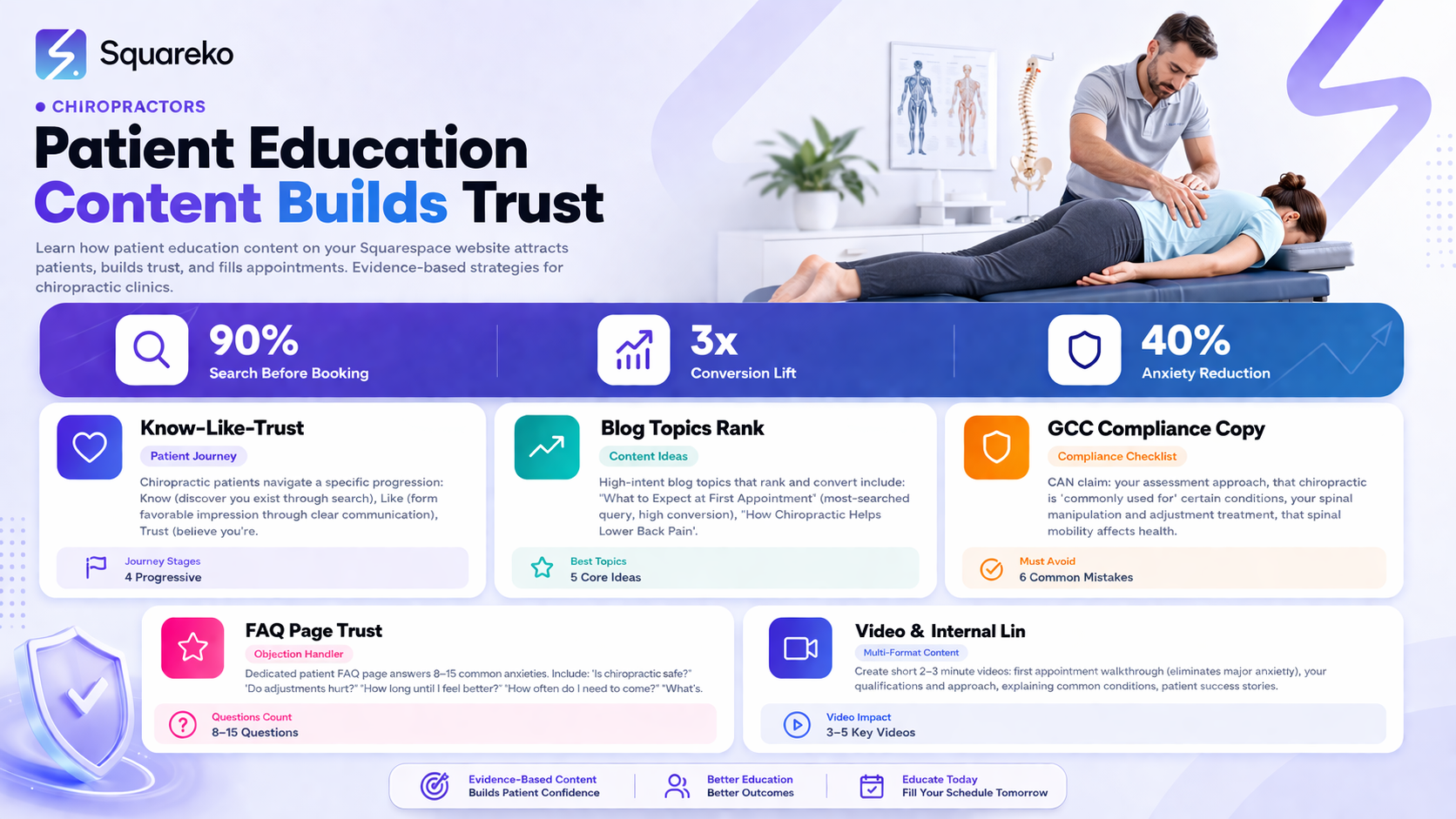
The chiropractic market has a trust problem. People are uncertain about what chiropractors do, skeptical about whether adjustments help, and anxious about their first appointment. Many prospective patients delay booking because they don't understand the process. They worry about pain, about whether their condition is "bad enough" for treatment, or whether they should see a GP first.
Patient education content dissolves all of this.
When someone searches "what causes lower back pain while sitting at a desk," they want an answer from a qualified professional. If your chiropractic website ranks for that query, you've just become that professional. You're no longer competing on price or location alone. You're competing on authority and trust.
The numbers back this up. Patients who read educational content before booking report:
Lower appointment anxiety
Better treatment compliance
Higher satisfaction scores
Greater likelihood of returning for follow-up care
Search engines reward this content too. Google increasingly favors healthcare websites that answer patient questions directly and cite clinical evidence. A chiropractic blog that explains the relationship between postural strain and neck pain ranks higher than a bare-bones contact page. And the patients who find your blog are warm leads—they've already self-qualified by searching for your specialty.
The Know-Like-Trust Funnel for Chiropractic Websites
The path to a booked appointment isn't always direct. Most prospects move through a predictable progression:
Stage 1: Know — They discover you exist. This happens through search, local directories, or word-of-mouth. Patient education content accelerates this stage. A blog post ranking for "chiropractic for sports injuries" doesn't require the reader to know your clinic exists yet. They find you because you answered their question.
Stage 2: Like — They begin to form a favorable impression. This is where your writing voice and expertise become critical. Clear, jargon-free explanations of chiropractic concepts build rapport. A patient reading your post about "how spinal adjustments improve nerve function" gains confidence. They see you as approachable, not clinical or dismissive.
Stage 3: Trust — They believe you're qualified to help them. GCC registration and professional credentials matter here, but so does your content. When you explain the musculoskeletal system with accuracy, reference clinical research where appropriate, and acknowledge what chiropractic can and cannot do, trust follows.
Stage 4: Convert — They book an appointment. This happens when the friction of taking action (finding the phone number, figuring out when to call, worrying about the process) is removed. A clear booking CTA on every educational page, a video walkthrough of your intake process, and a "what to expect at your first visit" page all reduce friction.
Your Squarespace site should map this funnel directly. Blog posts and condition explainers occupy the top (Know/Like). Testimonials and your GCC registration occupy the middle (Trust). Your booking button and "first visit" FAQ occupy the bottom (Convert).
Blog Content Ideas That Rank and Convert
Patient education blogs work because they answer real questions. Here are proven content ideas that rank for local and condition-based searches, all written within clinical scope:
What to Expect at Your First Chiropractic Appointment
This is the most-searched query by prospective chiropractic patients. They're anxious. They don't know what to wear, whether to bring documents, whether they'll be in pain during the appointment. Write 800-1,200 words covering
What happens in the reception area
The initial consultation process (how chiropractors gather health history)
Physical examination procedures (and why you perform them)
Taking X-rays or scans (what they show, why they're used)
The first adjustment (what patients will feel and hear)
Post-appointment care instructions
This content directly reduces appointment no-shows and anxiety-driven cancellations. It also ranks nationally and locally for high-intent keywords like "your town chiropractor first appointme
How Chiropractic May Help Lower Back Pain: Evidence-Based Overview
Back pain is the most common reason people visit chiropractors. Patients search for "does chiropractic work for back pain" before deciding to book. This post should cover:
What causes common lower back pain (postural strain, muscle tension, poor lifting technique, sedentary work)
How spinal function relates to pain (without making unsubstantiated claims about "trapped nerves")
What chiropractic assessment involves
How adjustment and rehabilitation may help (referencing published guidelines from bodies like NICE or relevant clinical literature)
When to see a GP first (red flags, serious conditions)
The role of postural correction and exercise in recovery
Frame this as "may help" or "is commonly used for," not "treats" or "cures." You're describing your clinical approach within scope, not making prohibited claims.
Neck Pain and Desk Workers: A Chiropractic Perspective
The desk worker with neck and shoulder pain is a common patient. They search for "neck pain from computer work" or "upper back pain from desk job." Cover:
How prolonged sitting and screen time affect spinal posture
Common patterns chiropractors see in desk workers
Why neck pain often accompanies headaches (tension referral)
Ergonomic assessment and postural advice
How chiropractic adjustment and postural rehabilitation address the underlying dysfunction
Stretches and exercises for desk workers
When to take breaks and adjust your workspace
This content attracts a patient demographic that's predictable, low-risk, and grateful for practical solutions.
Chiropractic for Sports Injuries and Performance
Athletes and active people search for sports-related injury content. Cover:
Common sports-related musculoskeletal injuries chiropractors see
Assessment methods for sports injuries
How chiropractic rehabilitation supports athletic recovery
The role of spinal alignment in athletic performance
Injury prevention for specific sports (running, golf, tennis, weightlifting)
Return-to-sport protocols
This attracts younger, motivated patients who are likely to be compliant with care and positive in their reviews.
The Chiropractic Adjustment: What Happens and Why It Helps
Many people don't understand what an adjustment is. They hear the term but associate it only with the audible "crack" or "pop." Write 800-1,000 words explaining:
The anatomy of a spinal joint and why it can lose normal motion
How restricted spinal motion affects function and discomfort
What an adjustment does mechanically (restores motion, affects proprioception, reduces muscle guarding)
Why adjustments produce that sound (cavitation, not "realignment")
Different adjustment techniques (manual, instrument-assisted, mobilization)
What patients feel during and after adjustment
This normalizes the adjustment and removes mystery, which converts fence-sitters into bookers.
Creating Compliant Content Within GCC Standards
The General Chiropractic Council (GCC) regulates chiropractic in the UK. Advertising standards matter. The ASA/CAP Code restricts health claims. Your content must stay within scope.
What you CAN claim:
Your approach to assessing spinal dysfunction and musculoskeletal pain
That chiropractic is "commonly used for" or "is used to manage" certain conditions
That your clinic provides spinal manipulation and adjustment as treatment
That spinal mobility, alignment, and function affect health outcomes
Evidence-based information about conditions affecting the spine and musculoskeletal system
Your GCC registration, qualifications, and years of experience
What you CANNOT claim:
That chiropractic "treats" or "cures" specific diseases (cancer, asthma, diabetes, autism, ear infections, etc.)
That adjustments will "boost immune function," "improve heart health," or address non-musculoskeletal conditions
That you can diagnose medical conditions
Health claims not supported by clinical evidence for your scope
Review all blog posts for compliance before publishing. Have a colleague or mentor double-check your language. The cost of a compliance review is negligible compared to the cost of an ASA complaint or GCC sanction.
The Patient FAQ Page as Trust Builder
A dedicated FAQ page specifically for prospective patients (separate from your clinical FAQ) serves multiple purposes. It answers common anxieties, provides SEO value, and appears in featured snippets.
Structure it as 8-15 questions and answers, formatted as H3 headings for schema markup. Cover:
Is chiropractic safe?
Do adjustments hurt?
How long until I feel better?
How often do I need to come?
What's your GCC registration?
Do you accept my insurance/health plan?
What should I bring to my appointment?
Can children be treated?
Is chiropractic suitable for seniors?
What's the difference between a chiropractor and a physiotherapist?
Each answer should be 100-150 words, conversational, and direct. This is where you directly address objections before they stop someone from booking.
Video Content and Consultation Walkthroughs
Written content ranks in search. Video content builds trust faster. Consider creating short videos (2-3 minutes) for your Squarespace site:
Your first appointment walkthrough — film a brief, anonymized walkthrough of your reception area, consultation space, and adjustment room. Show patients where they'll sit, what they'll see, and what happens. This one video eliminates a major source of appointment anxiety.
Your qualifications and approach — a brief introduction to you, your credentials, and your clinical philosophy. Patients want to see who they're calling.
Explaining a common condition — demonstrate how you assess neck pain, lower back pain, or shoulder dysfunction. This shows your process and builds confidence in your methodology.
Patient success stories — (with permission) short testimonials from existing patients about their experience and outcome.
Host videos on YouTube or Vimeo and embed them in your Squarespace blog posts. Video improves time-on-page, reduces bounce rate, and signals to Google that your content is comprehensive.
Publishing Content Without ASA/CAP Violations
Before you hit publish on patient education content, run through this compliance checklist:
Health claims test — Does any sentence claim your clinic treats or cures a specific disease? If yes, remove it or reframe it as "is used to manage" or "may help with."
Evidence test — Can you back up any clinical statement with published research or professional guidelines? If you claim spinal adjustment improves joint motion, that's supported by evidence. If you claim it improves immune function, it isn't.
Scope test — Is the condition musculoskeletal? Is your approach within the scope of chiropractic as defined by the GCC? If you're writing about low back pain caused by muscle strain, yes. If you're writing about treating diabetes, no.
Comparative test — Are you comparing yourself to other healthcare providers (GPs, physiotherapists, osteopaths)? Avoid direct comparisons. Instead, describe what chiropractic offers without implying superiority.
Testimonial test — Any patient testimonial claiming disease cure or miraculous recovery should be removed or toned down. Testimonials stating "the pain went away" or "I can play golf again" are fine.
Make compliance a writing habit, not an afterthought. Your blog becomes a practice builder only if it stays online.
Internal Linking Strategy for Patient Education
Blog content only drives conversions if readers move toward your booking page. Internal linking creates that path.
Within each patient education post, include 2-4 contextual internal links:
From your "lower back pain" post, link to your "back pain exercises" post (if you have one) and to your booking page with the anchor "schedule your assessment"
From your "first appointment" FAQ, link to your patient reviews page and testimonials
From your sports injury post, link to your athlete testimonials or a case study
From every post, include a mid-post CTA: "Ready to book? [Schedule your appointment]"
Use descriptive anchor text ("how chiropractic adjustments work" not "click here") for both SEO and user experience.
Your internal linking strategy should push readers from awareness (blog posts) through trust (testimonials, GCC badge, your bio) to action (booking).
Mid-Post Call-to-Action
Is your chiropractic practice built on a website that educates and converts? Many chiropractors rely on online directories or word-of-mouth alone, missing the patients actively searching for answers online right now. Squareko.com specializes in building Squarespace websites for chiropractors that combine patient education, local SEO, and integrated booking systems. We handle GCC compliance, compliance with ASA/CAP advertising standards, and conversion-focused design. Your patients are searching. Let's make sure they find you.
Frequently Asked Questions
-
Content that answers high-intent, local search queries ranks best. Queries like "what to expect at first chiropractic appointment," "how to fix neck pain from desk work," and "is chiropractic safe" attract prospects who are close to booking. These queries have commercial intent and local modifiers ("near me," "[town] chiropractor"), which means they convert into appointments at higher rates than general informational queries.
-
Consistency matters more than frequency. Publishing one high-quality, compliance-checked blog post every two weeks generates more SEO value and patient trust than publishing four mediocre posts per week. Two weeks gives you time to research, write, have a colleague review for compliance, and optimize for your primary keyword. If your practice is very busy or small, even one post per month is valuable. The key is regular publication so Google sees your site as an active, authoritative source.
-
Yes, absolutely. In fact, repurposing is essential. Write your primary post for your blog (optimized for search), then extract key points for social media posts, create a summary for your email newsletter, and turn a video script into a short YouTube upload. This maximizes the return on the time you invested in writing one piece of content. Just update social posts with a link back to the full blog post on your Squarespace site.
-
Cite research where it strengthens your credibility, but don't force citations if they're not necessary. If you're explaining what happens during a patient's first appointment, you don't need a study. But if you're claiming that spinal manipulation improves neck pain, a reference to published guidelines (like NICE or BCA resources) adds credibility and helps you stay compliant. One or two citations per post is typically enough.
-
Use technical terms where appropriate, but explain them immediately. Example: "A subluxation—that's when a spinal joint loses normal motion—can cause referred pain down the arm." This shows expertise while remaining clear. Avoid jargon for its own sake. If your patient would need to Google a word, explain it.
-
You can discuss injury prevention within your clinical scope. You can write about postural correction, spinal mobility, and how maintaining good spinal alignment supports athletic performance and reduces injury risk. But avoid absolute claims like "chiropractic prevents all injuries." Instead, frame it as "may help reduce the risk of" or "is commonly used for injury prevention in athletes."
-
Link primarily to your own Squarespace site, but one external link per post to a reputable source (NICE guidelines, BCA resources, peer-reviewed research) actually boosts your credibility and SEO authority. It shows you're drawing from reliable sources, not just promoting yourself. External links to authoritative sites signal trustworthiness.
-
Use Squarespace analytics to track page views, bounce rate, and time-on-page. Better: set up a UTM parameter on your booking CTA (e.g., "?utm_source=blog&utm_medium=cta") so you can see exactly which blog posts drive the most appointment bookings. Google Analytics 4 tracks conversions if you connect it to your Squarespace booking system. Track which blog topics generate the most traffic and the highest conversion rate. Double down on what's working.
Ready to Transform Your Chiropractic Website?
Your website is working either for you or against you. If your current site doesn't educate patients, doesn't appear in search results for the conditions you treat, or doesn't make booking appointments easy, you're losing patients to competitors who got their websites right.Squareko builds chiropractic websites that do all three. We combine patient education content, GCC compliance, local SEO optimization, and integrated appointment booking into a single, high-converting system. Patients find you in search, learn to trust you through your content, and book their appointment with one click.

From custom website design to SEO strategy, we help businesses launch a site that looks professional and performs better.

About the Author
Walid Hassan is the founder at Squareko,
I'm Walid Hasan, a Certified Squarespace Expert and Squarespace Circle Platinum Partner with over 12 years of hands-on experience designing and optimizing high-performing websites. Over the years, I've had the privilege of building more than 2,000 Squarespace websites for clients around the world, always focusing on clean design, strong user experience, and conversion-driven results.