Squarespace Template for Public Speaker: Starting From Zero
The short answer: if you have not been booked yet, do not build the site a booked speaker has. Build the site that makes a small number of real engagements read as a direction rather than an accident. That means one topic stated sharply, footage you recorded yourself, three honest credits with what you actually did, and a page that says what you are looking for. Credibility here is a manufacturing process, not a possession.
The trap is copying a professional speaker's website structure with nothing to put in it. A Speaking page with an empty stage list, a "Book me" button nobody presses, and a logo wall with two logos actively signals inexperience. A smaller, honest page signals momentum.
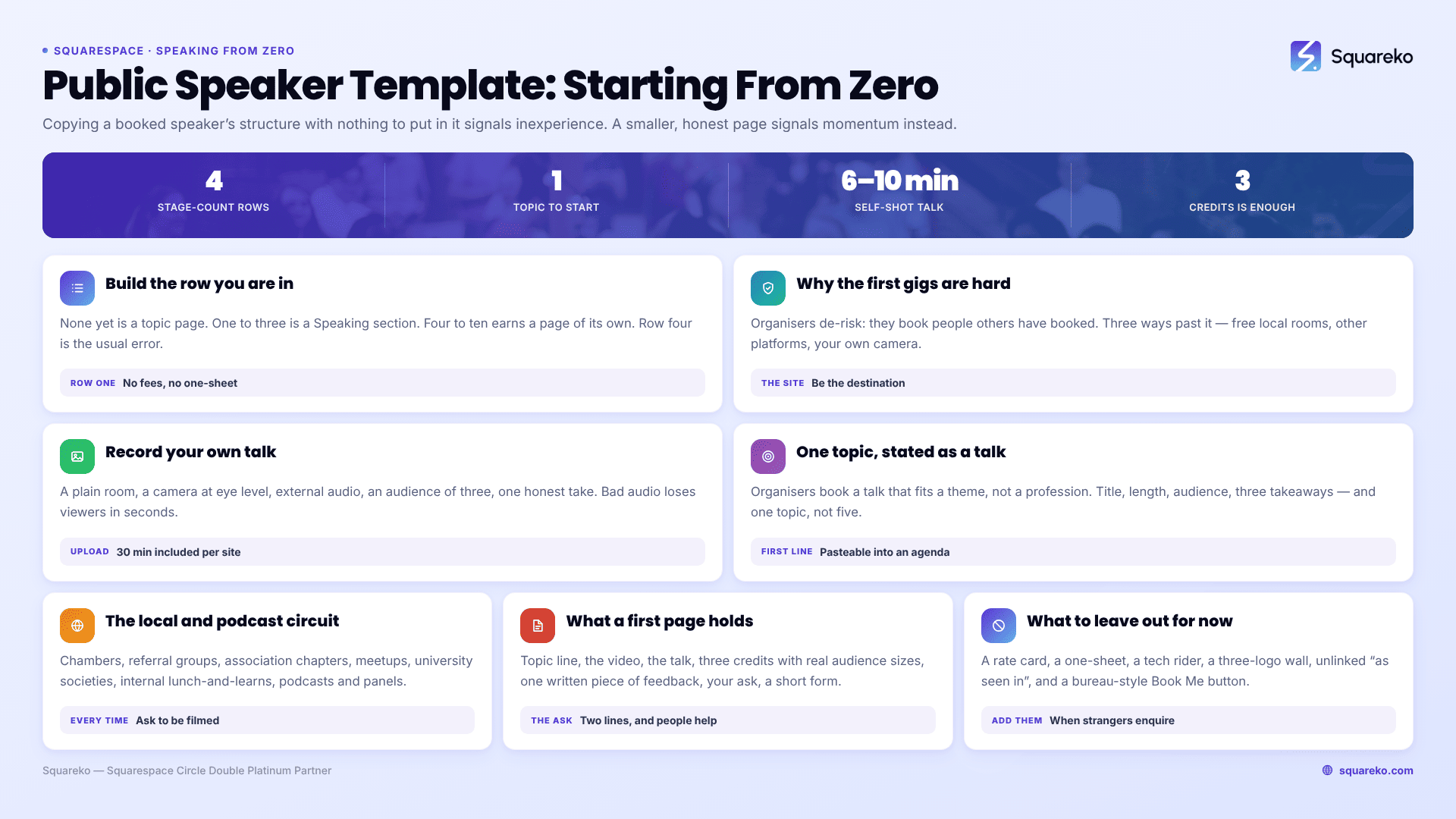
Build the page your stage list can currently support
The right structure changes as the engagement count changes. Work out which row you are in and build that row, not the one below it.
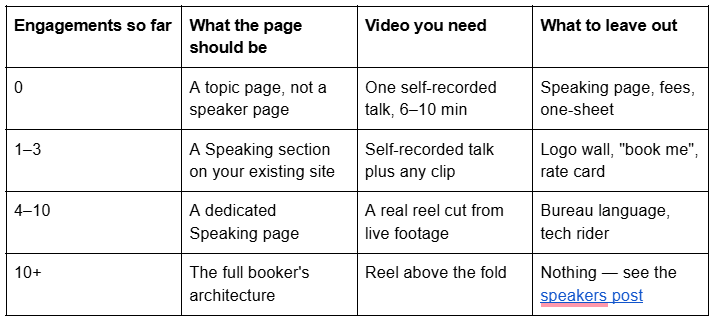
The most common mistake by a distance is building row four while sitting in row one. The second most common is staying in row one after reaching row three, which is a confidence problem rather than a website problem.
The credibility problem, stated honestly
Event organisers de-risk. They book people other people have booked, because the cost of a bad speaker is a room of unhappy delegates and a difficult conversation with their own manager. That is entirely rational and it is why the first engagements are the hardest.
There are exactly three ways out, and all of them are slower than a website:
Speak for free in rooms that do not need de-risking — meetups, local business groups, association chapters, internal company events, student societies. These do not require a track record and they generate the two things you lack: footage and credits.
Speak on other people's platforms — guest podcast episodes, webinars, panels, someone else's YouTube channel. Lower barrier than a stage, and it produces a link and a recording.
Manufacture the artefact — record a talk yourself, properly, and publish it. This is legitimate and nearly everyone does it. What is not legitimate is presenting it as footage from an event that did not happen.
Your website's job in this phase is not to convert bookers. It is to be the credible destination that all three routes point at, so that when someone who heard you on a podcast searches your name, there is a page that makes the next step obvious.
Record your own talk, and do it as though it counts
This is the highest-leverage thing on the list, and most people delay it for a year.
You do not need a stage. You need a talk that is actually good, a room, a camera at eye level, external audio, and one honest take. Six to ten minutes is enough — it is long enough to show that you can hold a structure and short enough that someone watches all of it.
The things that make self-recorded footage work:
External audio. A lapel mic into a phone beats a good camera with room audio every time. Viewers forgive imperfect video and abandon bad audio in seconds.
Eye level, mid-shot. Not a laptop webcam pointing up at the ceiling.
Stand, and use a real room. Standing changes your delivery. A meeting room with a plain wall is fine. A bedroom is not.
A live audience of three. Even a handful of colleagues changes your timing, and reactions on the audio make it feel like a talk rather than a piece to camera.
Do not caption it as something it isn't. "Recorded session on [topic]" is honest and nobody minds. "Keynote, 2026" when it was a meeting room is a lie you will be caught in.
Publishing it on Squarespace 7.1 is straightforward, with a few real constraints. A Video block takes a YouTube or Vimeo URL, or an uploaded file — every site includes 30 minutes of high-resolution video storage and individual videos are capped at 30 minutes, so a ten-minute talk fits comfortably. The player is 16:9, so shoot and export at 16:9 rather than accepting letterboxing. Gallery sections cannot hold video, so if you later want several clips on one page, that is a set of video blocks in a section rather than a gallery.
Use YouTube rather than direct upload for the main talk if you want it discoverable outside your site. Use direct upload if you want the page clean and the viewer to stay on it.
One topic, stated as a promise
Emerging speakers describe themselves by profession — "operations consultant", "paediatric nurse", "founder". Organisers do not book professions. They book a talk that fits a theme they have already chosen.
The conversion from niche to topic looks like this:
Profession: fifteen years in hospital logistics.
Topic area: efficiency in constrained systems.
Talk: "What A&E taught me about running a business that never stops" — 40 minutes, for operational leadership audiences, with three takeaways.
That last line is bookable. The first two are not.
Pick one topic to start. One topic makes you the obvious choice for a narrow set of events, which is how first bookings happen. Five topics make you a plausible choice for nothing. You can broaden later, and everyone does; nobody starts broad successfully.
Then say it in the first line of your homepage, above the fold, in plain text. Not a tagline. A sentence a programme organiser could paste into an agenda.
The local and podcast circuit, in the order that works
This is the part no template shop writes about, and it is the entire mechanism.
Local and community rooms. Chambers of commerce, BNI and other referral groups, Rotary, industry association local chapters, meetup groups in your field, university societies, library and council business events. Most of these programme months ahead and most are short of speakers. Approach with a specific talk title and a length, not an offer to "come and speak sometime".
Internal corporate events. Lunch-and-learns, all-hands sessions, professional development days. If you have a job or clients, these exist around you already and they are real stages with real audiences.
Podcasts. The fastest credibility route available, because supply of guests is high but supply of specific guests is not. Pitch the talk, not yourself: "I have a 40-minute talk on X; here are three angles that would work for your audience." Each episode gives you a link, a recording and a line on the site.
Webinars and panels. Associations, software vendors in your sector, and professional bodies run these constantly and are perpetually looking for panellists.
Two things to do every time, without exception. Ask to be filmed, or film yourself from the back of the room on a tripod with a lapel mic. Ask the organiser for two lines of feedback in writing afterwards. Those two habits are the difference between ten engagements that leave no trace and ten that build a site.
The content flywheel, if you will actually run it
Speaking and publishing feed each other. Every talk contains three or four ideas, and each idea is a post, a newsletter piece or a short video. Every published piece is a reason for someone to invite you to say it out loud
On Squarespace 7.1 the mechanics are simple, with one thing to know: blog posts use the classic editor, not Fluid Engine, so plan for a straightforward text-and-image layout rather than an elaborate one. Blog pagination is cursor-based with a maximum of 20 posts per page and no numbered pages, which matters only once you have written a lot.
The honest caveat: a blog with two posts from eighteen months ago is worse than no blog. If you will not publish at least monthly, do not add one. A single strong "here is my talk and why I give it" page beats an abandoned blog by a wide margin.
If you have a podcast of your own, that is a page rather than a blog. Squareko's Navigate template carries dedicated Speaking, Podcast, Course and Blog pages across its 10, and Storyline runs to 13 with Speaking, Podcast, Testimonial and Booking pages — both assume the publish-and-speak pattern rather than making you build it.
What a first speaker page actually looks like
With three engagements, here is the whole page. It is short on purpose.
The topic line. One sentence naming the talk and who it is for.
The video. Your recorded talk, embedded, captioned honestly. Above or immediately below the topic line.
"The talk." Title, length, formats you can do, audience it suits, three takeaways. Written as though it has been given fifty times, because the content is the same either way.
"Where I've spoken." Three entries, each with the event or organisation, the year, the format and the audience size — even where the audience size is 25. Specificity reads as honesty; vagueness reads as padding. If two of the three are podcasts, list them as podcasts. Nobody expects a beginner to have keynoted a conference, and pretending otherwise is what damages you.
One piece of feedback. The written two lines you asked the organiser for, attributed with their name and role.
"What I'm looking for." The most under-used element on emerging speakers' sites and the one that most reliably produces invitations. Two lines: "I'm currently looking for 30–45 minute slots with operational leadership audiences, in person in the North West or remote anywhere. I'm happy to speak unpaid at community and association events." That paragraph tells the reader exactly how to help you, which people will do surprisingly often when it is easy.
A short enquiry form. Event name, date, format, audience, and a message field. Skip the budget selector for now — it implies a rate you have not set.
That is a Speaking section on your existing site, or a single page. It is not seven pages, and it should not pretend to be.
What to leave out until you have earned it
A fee or rate card. Until you have been paid at least a few times, a published rate is a number you invented.
A one-sheet. Nobody is forwarding you to a committee yet. Build it at ten engagements.
A tech rider. Same reason. Publishing a rider before your first paid gig reads as costume.
A logo wall with three logos. Sparse logo walls draw attention to the sparseness. Use the table format instead, where three entries with real detail read as three real events.
"As seen in" with no links. If it is real, link it. If you cannot link it, leave it out.
A bureau-style "Book [Name]" call to action. "Invite me to speak" is accurate and does not overreach.
Everything in this list belongs on the professional booking site, and there is a specific moment to add it: when enquiries start arriving from people you have never met. That is the signal to move to the full booker's architecture — reel above the fold, one-sheet, rider, fee band, structured stage table.
The order that works
Pick one topic. Record one talk properly. Get three engagements from the local and podcast circuit and ask to be filmed at each. Put those three on a short, honest page with a line saying what you are looking for. Then repeat until the enquiries arrive on their own.
The website is genuinely the easy part of this, and it is worth saying plainly: no template converts a speaker with nothing to show. What a good template does is stop you spending three weeks on layout in a phase where the only thing that moves is booking the next room.
If you would rather start from a page set that already has Speaking, Podcast and Blog pages built — so you can fill them in over the next year rather than construct them — our premium Squarespace templates are installed onto your site for you. Most people at this stage should spend the money on a lapel mic and a tripod first. That is not a joke; it is the higher-return purchase.
FAQ
-
One topic stated as a bookable talk, a talk you recorded yourself, the talk's format and three takeaways, any credits you do have listed honestly with audience sizes, one piece of written feedback, and a short paragraph saying what you are looking for and where. Leave out fees, one-sheets and riders.
-
Book a plain room, set a camera at eye level in a mid-shot, use an external lapel mic, stand up, and invite three people so you have an audience. Six to ten minutes at 16:9. Caption it honestly as a recorded session. Squarespace includes 30 minutes of video storage per site, capped at 30 minutes per video.
-
Local and community rooms that do not need to de-risk — chambers of commerce, referral groups, association chapters, meetups, university societies — plus guest podcast episodes, webinars and panels. Approach with a specific talk title and length rather than an offer to speak generally, and ask to be filmed each time.
-
No. One topic makes you the obvious choice for a narrow set of events, which is how first bookings happen. Several topics make you a plausible choice for nothing. Broaden later — almost every established speaker started narrow and expanded, and almost nobody starts broad successfully.
-
When enquiries start arriving from people you have not met, or at roughly ten paid engagements. That is the point to add a reel above the fold, a downloadable one-sheet, hi-res headshots, a tech rider, a fee band and a structured stage table with audience sizes.
-
Only if you will publish at least monthly. Two posts from eighteen months ago damage credibility more than having no blog. Squarespace 7.1 blog posts use the classic editor rather than Fluid Engine, and pagination is cursor-based at 20 posts per page with no numbered pages.

Author Bio
I'm Walid Hasan, a Certified Squarespace Expert and Squarespace Circle Platinum Partner with over 12 years of hands-on experience designing and optimizing high-performing websites. Over the years, I've had the privilege of building more than 2,000 Squarespace websites for clients around the world, always focusing on clean design, strong user experience, and conversion-driven results.