
How to Switch Templates in Squarespace (7.0 and 7.1)
These are two different jobs, not two routes to the same one. On Squarespace 7.0, switching templates is a real feature: install a template, preview it, set it live. On Squarespace 7.1, template switching does not exist — every 7.1 site is part of a single template family, so the equivalent job is restyling the site you already have. Find your version first; the rest of this guide branches on that answer and nothing else. For the wider picture, see the complete guide to changing your Squarespace template.
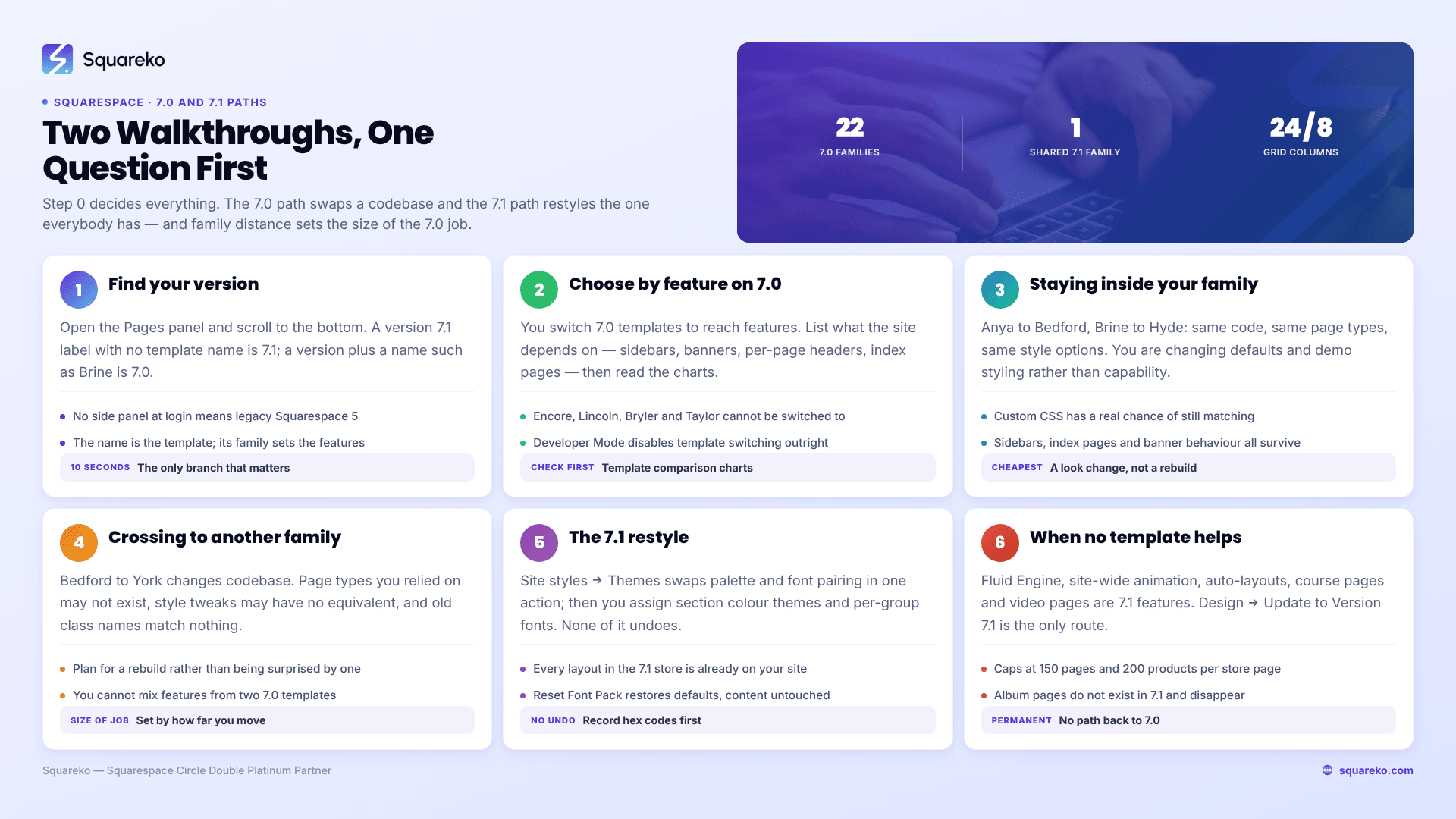
Step 0 — Find your Squarespace version
Open the Pages panel and scroll to the bottom.

That template name matters on 7.0 because features belong to families, not to individual templates. Every template in a family shares the same structure, style options and special features — Anya, Bedford, Bryant and Hayden are one family and behave identically.
The 7.0 walkthrough: switching templates in Squarespace 7.0
Step 1 — Choose by feature, not by screenshot. In Squarespace 7.0 you switch templates to get access to different features. List what your current site depends on — sidebars, banner images, background images, per-page headers or footers, footer navigation, index pages — then check the template comparison charts for a template that supports them.
Step 2 — Record your current design. Site styles, Custom CSS, sidebars, footers, per-page headers, banner images, background images and navigation order are all template-specific: they stay attached to the template you leave, and the new template starts at its own defaults. Copy the Custom CSS panel into a text file, note every hex code and font setting, screenshot the Pages panel including Not Linked, and take full-page captures of the live site.
Step 3 — Install the template. Design panel → Template → Install new template, browse, hover the one you want, click Start with. It appears below the live template in the Template panel. Installing changes nothing for visitors. You can install as many as you like but only one copy of each.
Step 4 — Preview it. Hover the installed template, click Preview. Your content flows into the new structure and a bottom bar appears with Set as live template and Cancel preview. Only you see this; visitors keep seeing the live template.
Step 5 — Rebuild the presentation layer. Reapply fonts and colours in site styles, paste and rewrite Custom CSS (the CSS Editor starts blank on a new template, and selectors written for one family often match nothing in another), re-add sidebar and footer content, re-apply banner and background images, and rebuild navigation order.
Step 6 — Do not delete anything. Deleting a page while previewing removes it from the live site immediately. Preview protects design, not content. Move unwanted pages to Not Linked instead.
Step 7 — Set it live. Click Set as live template in the bottom bar, then Confirm.
Step 8 — Audit. Check navigation links, the homepage, headings, and any URL that changed during the rebuild. Squarespace never creates an automatic redirect for a changed slug — add 301s yourself at Developer tools → URL mappings in the form /old-url -> /new-url 301.
Two things will block this outright: Developer Mode, which disables template switching entirely, and the four templates Squarespace excludes from switching — Encore (Aviator family), Lincoln (Brine family), Bryler (Pacific family) and Taylor (York family). Pick a sibling from the same family instead; features are identical within a family.
The screen-by-screen version of this path is how to switch templates on Squarespace safely.
Switching within a family is a different job from switching across families
Squarespace 7.0 has 22 template families, and the size of your rebuild is decided almost entirely by whether you stay inside one.
Within a family — Anya to Bedford, or Brine to Hyde — the features, page types and style options are identical. Sidebars, index pages, banner behaviour and per-page headers all still exist. You are changing defaults and demo styling, not capability. Custom CSS has a reasonable chance of surviving, because the markup is the same.
Across families — Bedford to York, say — you are changing codebase. Page types you relied on may not exist, style tweaks you used may have no equivalent, and Custom CSS written against the old family's class names will mostly match nothing. This is where a switch turns into a rebuild.
The practical rule: if you like your site's structure and want a different look, look inside your own family first. If you need a feature your family does not have — an index page, a sidebar, a per-page header — you have to cross, and you should plan for the rebuild rather than be surprised by it. Squarespace's template comparison charts list which families support which features.
The 7.1 walkthrough: there is no template to switch
If your Pages panel shows a version 7.1 label, stop looking for the Template panel. It does not exist, and it has not been moved or hidden.
Squarespace's position is explicit: "It's not possible to change templates on a version 7.1 site." All 7.1 sites are part of the same template family with the same features and the same style options, and the template you picked at signup was "only meant as a starting point.
The consequence is genuinely good news, and it is the part most guides skip: every layout, section and style in the 7.1 template store is already available on your site. You are not locked out of anything you saw. So the 7.1 walkthrough is a restyle, in four steps, roughly in order of effort.
Step 1 — Apply a theme. While editing a page, open Site styles and click Themes. Squarespace ships preset style packs — Professional, Bold, Playful and others — that swap the colour palette and font pairing in a single action. This is the closest thing 7.1 has to "changing template", and it takes seconds. Record your existing hex codes and font settings first: applying a pack overwrites your values, and Site styles has no version history and no undo.
Step 2 — Rebuild colours and fonts deliberately. In Squarespace 7.1 you set one palette, from which Squarespace generates around ten section colour themes that you assign per section. Fonts work the same way — a font pack plus per-group assignments. To start clean, Site styles → Fonts → Reset Font Pack restores defaults without touching content.
Step 3 — Replace sections with pre-built layouts. This is the step that changes structure rather than skin, and it is what most people actually mean by switching templates. While editing a page, click + and choose a section type — Images, Newsletter, Music and so on — then pick a layout. For a whole new page, use Pages panel → + → Page Layouts and choose a type such as Contact, Services or Team. Blocks can be moved between sections on the same page, though not between pages.
Step 4 — Take control of the grid. Section layouts in Squarespace 7.1 are drawn on Fluid Engine, a CSS Grid with 24 columns on desktop and a separate 8-column grid on mobile, with the breakpoint at 767px. Once you are comfortable dragging blocks on that grid, the starting layout stops constraining you at all. See how Squarespace Fluid Engine works.
The 7.1 branch is expanded in can you change templates in Squarespace 7.1?. If none of that gets you close enough, the honest remaining option is a rebuild: duplicate the site from Account Dashboard → … → Duplicate Website and redesign the copy, or start a fresh trial with the template whose layouts you wanted and move your content in by hand.
What each path actually achieves
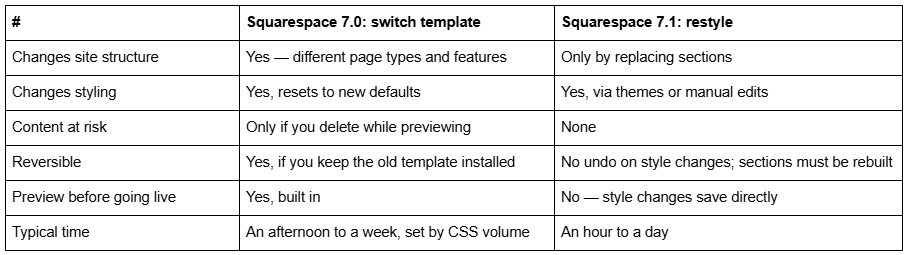
The single sharpest difference is preview. Squarespace 7.0 gives you a real sandbox for design changes. Squarespace 7.1 does not — a style pack applies immediately and cannot be undone. That is why the "record your values first" advice matters more on 7.1 than on 7.0, where the old values are safely stored on the old template.
If what you actually want is 7.1 features on a 7.0 site
A good share of people searching for how to switch templates in Squarespace are on 7.0 and want things no 7.0 template has: Fluid Engine, site-wide animation, auto-layouts, course pages, video pages. No template switch delivers those. The version update tool does.
Design panel → Update to Version 7.1 → Get Started → Preview site in 7.1. You preview first and can cancel at any point.
Before you start:
The update is permanent. Once published you cannot revert to Squarespace 7.0.
Limits: 150 pages for the update tool, 200 products per store page.
Developer Mode must be off, and disabling it discards Developer Platform changes.
Discontinued templates must be switched away from first — one of the few genuinely good reasons to switch a 7.0 template in 2026.
Album pages do not exist in 7.1 and disappear; save audio and text locally.
Sub-pages inside index pages lose their page settings, including SEO titles and descriptions. Move them out of the index first.
SEO settings, orders, sales, customer data, members, domains and URL mappings survive intact.
And the question that comes up every time: no, you cannot apply a 7.1 template to a 7.0 site, and you cannot mix features from two 7.0 templates. Version and family boundaries are hard.
Which path is right
If you are on Squarespace 7.1 — which, for reference, is 53 of the 54 Squareko-built client sites we measured in August 2026 — there is no template switch to make, and the restyle path will get you where you are going faster than any workaround.
If you are on Squarespace 7.0, ask what you are missing. A structural feature another family has? Switch templates. Modern editing? Use the update tool. Just a look? Restyle in site styles and skip the rebuild entirely.
The point where this stops being a weekend job is a 7.0 site with heavy custom styling that has to be rebuilt against different markup, or a 7.1 site where the redesign cannot be allowed to cost search traffic. That is what our premium Squarespace templates and build service are for. For most sites, the walkthrough above is the whole job.
FAQ
-
Open the Pages panel and scroll to the bottom. Version 7.1 sites show a "version 7.1" label with no template name. Version 7.0 sites show the version plus the template name, such as Brine or Bedford. That template name tells you which family's features your site has.
-
You cannot. Squarespace states template switching is not possible on version 7.1, because every 7.1 site belongs to the same template family. Restyle instead: apply a theme in Site styles, rebuild your palette and font pack, and replace sections with pre-built layouts from the + menu.
-
Click Cancel preview in the bottom bar. Your site returns to the live template and every change you made to the previewed template is saved against it, so you can pick the preview up again later without redoing the work.
-
No. Version 7.0 and version 7.1 templates are not interchangeable, and on version 7.0 you cannot mix features from two templates either. To reach 7.1 designs you use the version update tool at Design → Update to Version 7.1, which moves the whole site to version 7.1 permanently and cannot be reversed afterwards.
-
Set a different template live first, since the live template cannot be uninstalled. Then hover the template in Design → Template and click Uninstall, then Confirm. Check whether the template is discontinued first — discontinued templates cannot be reinstalled once removed.
-
The previewed template has no homepage assigned. Open the Pages panel and set a homepage. This happens most often when the old homepage was an info page, which only exists in the Aviator family and will not display in any other template.

Author Bio
I'm Walid Hasan, a Certified Squarespace Expert and Squarespace Circle Platinum Partner with over 12 years of hands-on experience designing and optimizing high-performing websites. Over the years, I've had the privilege of building more than 2,000 Squarespace websites for clients around the world, always focusing on clean design, strong user experience, and conversion-driven results.
