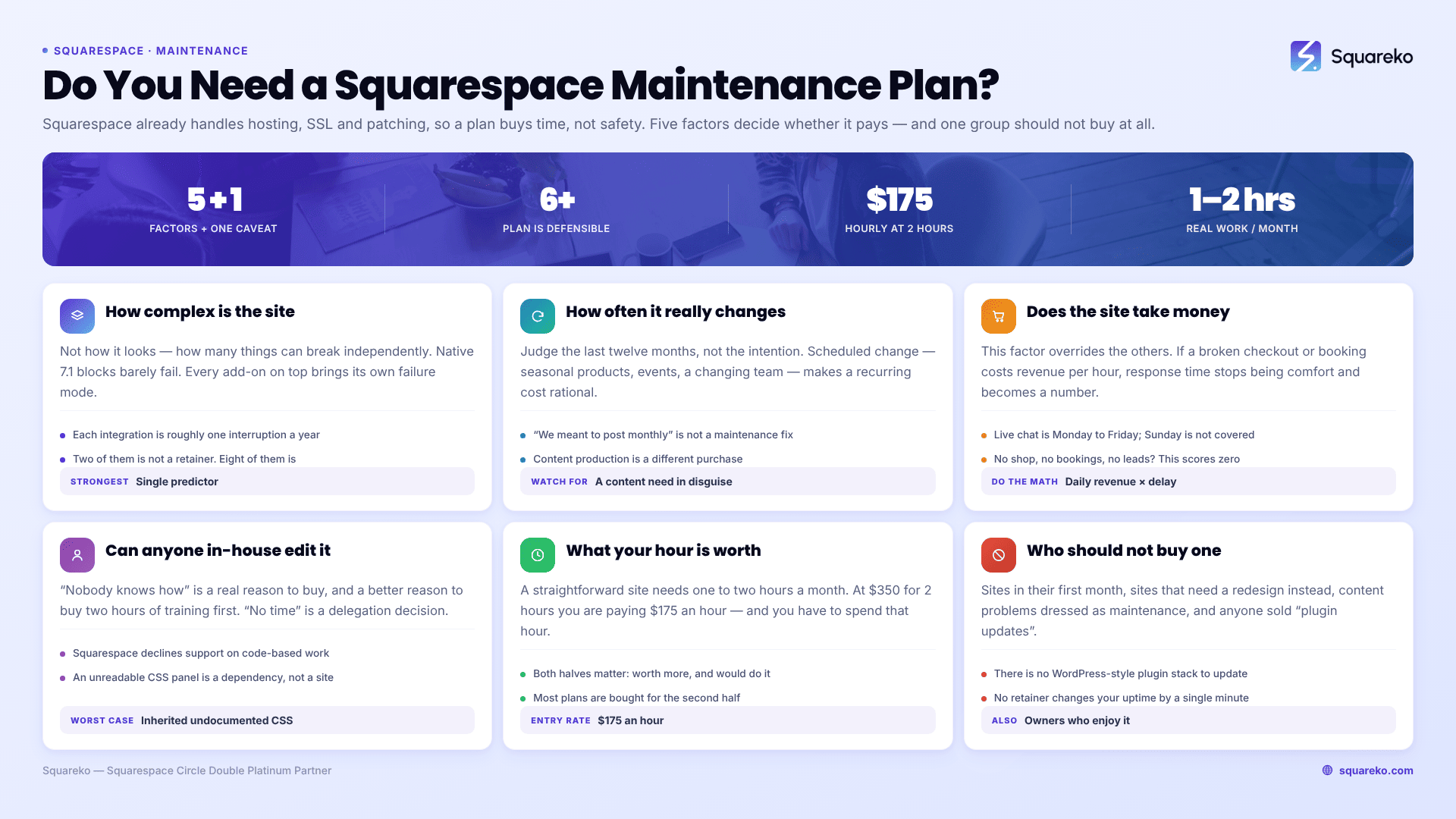
Do You Need a Squarespace Maintenance Plan?
The short answer: For a lot of Squarespace sites, no. Squarespace already handles hosting, SSL renewal, security patching and platform upgrades, so a maintenance plan is not buying you safety — it is buying you someone else's time. If your site is a brochure site that changes twice a year, has no custom code, takes no payments, and you are comfortable in the Squarespace editor, you do not need a plan and you should keep the money.
The five factors below decide it. Score honestly; the arithmetic at the end is more useful than any of them individually.
The five-factor test
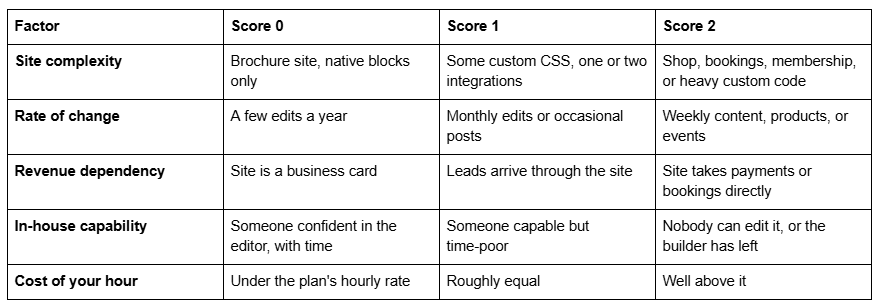
0–2: don't buy a plan. You would be paying for reassurance. Work the quarterly checklist in Squarespace website maintenance yourself and revisit this in a year.
3–5: probably don't buy a plan yet. Buy hours ad hoc when something specific comes up. A retainer at this level tends to go unused, and unused retainers get cancelled resentfully.
6–7: a small plan is defensible. Two hours a month covers a site in this range. Anything larger is over-buying.
8–10: a plan is doing real work. At this level the question is not whether, but how many hours — and the answer usually comes from measuring a month of actual requests rather than guessing.
Factor one: how complex is the site, really
Complexity is the strongest single predictor, and it is not about how the site looks. It is about how many things can break independently.
A Squarespace 7.1 site built entirely from native blocks — sections, text, images, a contact form — has very little surface area. Squarespace does not break its own blocks. There is no plugin stack, no theme to update, no server to patch.
Every addition on top adds a failure mode that Squarespace will not help with. Custom CSS breaks when block IDs regenerate or class names change between section types. Code injections break when a third-party script changes. Instagram blocks break when Meta rotates its API — Meta's long-lived access tokens last 60 days and must be refreshed, and the December 2024 Instagram API migration required every Squarespace Instagram block to be manually reconnected. Google Drive form storage breaks when Google changes its authorisation rules, and disconnects the oldest form automatically once you exceed 50 connected forms.
Count them. Each custom-code block, each integration and each third-party plugin is roughly one predictable interruption a year. Two of them is not a retainer. Eight of them is.
Factor two: how often does the content actually change
Be honest rather than aspirational. Most people describe the site they intend to run, not the one they run.
Look at the last twelve months. How many pages were edited? How many blog posts went up? If the answer is "we meant to publish monthly and published twice", the maintenance plan will not fix that — a content retainer might, but that is a different purchase and should be priced as one.
The genuine trigger here is scheduled change: a shop with seasonal products, a venue with events, a practice with a changing team page. Recurring change is what makes a recurring cost rational.
Factor three: does the site take money
This is the factor that overrides the others.
If a broken checkout or a broken booking form costs revenue per hour, response time stops being a comfort and becomes a business number. Squarespace Customer Support is free, competent and 24/7 by email — but it is asynchronous, live chat runs Monday to Friday only, and it explicitly does not cover custom code or third-party services. On a Sunday, with a booking integration failing, the free channel is not a plan.
Do the arithmetic before deciding: average daily revenue through the site, multiplied by the realistic time to get someone competent looking at it without a retainer. If that number is a meaningful multiple of the monthly plan cost, the plan is insurance rather than convenience.
And if the site takes no money — no shop, no bookings, no revenue that arrives through a form — this factor is genuinely zero. Do not let anyone price it as if it isn't.
Factor four: can anyone in-house actually edit it
Two different situations get confused here.
Nobody knows how. The site was built by an agency, handed over with a walkthrough nobody wrote down, and the person who understood it has left. Every small change becomes a project. This is a real reason to buy support, and often a better reason to buy two hours of training first.
Somebody knows how but has no time. This is not a capability gap, it is a delegation decision, and it should be evaluated as one — see factor five.
There is a third case worth naming: the site carries custom code that the current owner cannot read. Squarespace's own position is unambiguous — "We don't provide support for code-based modifications, unless otherwise specified" — so the free channel is closed on exactly the parts that are most fragile. If you inherited a site with three hundred lines of CSS and no documentation, you have inherited a dependency, not just a website.
Factor five: what is an hour of your time worth
The arithmetic that decides most of these, and the one almost nobody does.
A straightforward Squarespace site needs roughly one to two hours a month of genuine maintenance — form tests, integration checks, content review, a quarterly link crawl. At a $350/month entry plan for 2 hours, you are paying $175 an hour.
So the question is narrow: is your hour worth more than $175, and would you actually spend that hour on the site?
Both halves matter. If your hour is worth $400 and the maintenance keeps not happening, the plan is obviously correct. If your hour is worth $400 but the site genuinely only needs attention twice a year, you are buying twelve months of capacity to use two. If your hour is worth $60 and you quite enjoy editing the site, the plan is a straightforward loss.
The honest version of this is that maintenance plans are usually bought for the second half of the question rather than the first. The work is not hard. It just does not happen.
Three worked profiles
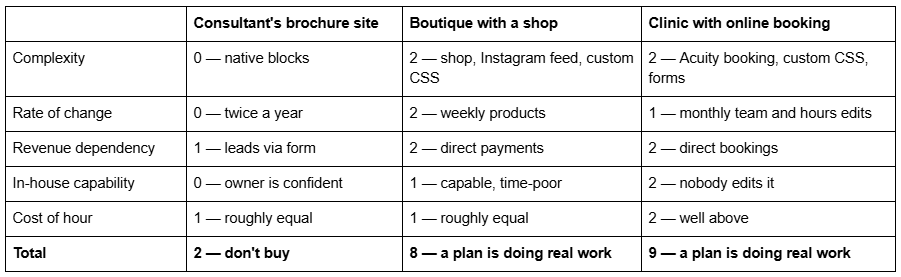
The consultant should bookmark the quarterly checklist and buy an hour of help when something specific breaks. The boutique and the clinic are both paying for response time and continuity, not for "updates".
Who should not buy a maintenance plan
Stated plainly, because it is the part the rest of this SERP will not say.
Brand-new sites in their first month. A site that just launched is usually still covered by post-launch support from whoever built it. Buying a retainer on top duplicates it.
Sites that need a redesign more than they need maintaining. Paying monthly to keep a dated site running is the most expensive way to delay a rebuild. Spend the money once.
Anyone who has been sold "security updates and plugin updates" on Squarespace. That work does not exist on this platform. If it is the headline of the pitch, the pitch was written for WordPress.
Sites where the real need is content, not maintenance. If what you want is four blog posts a month, buy content production. Maintenance hours spent writing are the most expensive words you will ever buy.
Owners who like doing it. Some people genuinely enjoy editing their own site, and their sites are usually well maintained. There is no argument to make here.
Anyone whose only worry is "what if it goes down". Squarespace handles uptime, and a retainer does not change your site's availability by one minute. If downtime is the fear, the honest answer is that no plan sold on this platform affects it.
What a maintenance plan does not protect you against
Worth knowing before you buy, because these are the things people assume are covered and then feel cheated about.
Downtime. Your site's availability is determined by Squarespace's infrastructure. No retainer sold by any agency changes it by a minute. What a retainer changes is how quickly someone competent starts looking when the cause turns out to be your domain, your billing or your code — which, in fairness, is what it usually is.
Squarespace price changes. Your platform subscription is billed by Squarespace directly and is unaffected by any third-party plan. Anyone bundling "hosting" into a Squarespace maintenance fee is reselling something you are already paying for.
Search ranking movements. Maintenance keeps a site technically healthy. It does not counteract an algorithm update, a competitor publishing more, or a market shifting. Ranking recovery is an SEO engagement with different work and a different price.
Your own edits. A plan means someone can fix what you broke. It does not mean the site is protected from being broken — particularly on Squarespace, where there is no version history to roll back to and no native full-site backup. A duplicate taken before a big change is worth more than the retainer that repairs the aftermath.
The middle options
It is not a binary between a monthly retainer and doing everything yourself.
Buy hours as you need them. Ad-hoc Squarespace support in this market runs roughly $100–$175 an hour, with UK providers around £120. Four hours a year is a few hundred dollars against $4,200 for a year of the smallest plan. For low-change sites this is almost always the better arithmetic.
Buy training once. Two hours of screen-shared training on your own site, recorded, usually removes the dependency entirely for a brochure site. It is the highest-return purchase for anyone in the "nobody knows how" case.
Buy an annual health check. One scheduled session a year: link crawl, form delivery tests, integration reconnections, performance review, backup. It catches the things that decay silently without paying monthly for capacity you do not use.
Use the free channel properly. Platform faults — hosting, SSL, DNS, billing, outages — belong with Squarespace Customer Support, which is free on every plan and 24/7 by email. Never pay anyone to forward a ticket you could have opened yourself.
If the answer is yes
If you scored six or above and the factors that pushed you there were revenue dependency and in-house capability rather than enthusiasm, a plan is a reasonable purchase — and the thing to compare is hours, not headline price. The market and the arithmetic are laid out in Squarespace maintenance packages compared, and the specific mechanics of SLAs, hour counting and scope are in Squarespace maintenance service.
Our own plans are $350, $750 and $1,250 a month for 2, 6 and 10 hours, published on the Squarespace website support page so you can do this arithmetic without a call. If your score was under six, the most useful thing on this site for you is the free checklist in the maintenance guide — use it, and come back if the site changes.
FAQ
-
Often not. Squarespace handles hosting, SSL and security patching itself, so a plan buys someone's time rather than platform safety. If your site is a brochure site with no custom code, no shop and infrequent edits, and you are comfortable in the editor, a plan is buying reassurance rather than work.
-
Nothing sudden. The site stays online and secure because Squarespace maintains the platform. What degrades slowly is everything else: integration tokens expire, form storage disconnects, links break after slug changes, content goes stale, and search rankings decay. All of it is recoverable, all of it is invisible until someone looks.
-
It depends on five things: site complexity, how often content changes, whether the site takes payments or bookings, whether anyone in-house can edit it, and what an hour of your time is worth. Score high on revenue dependency and low on in-house capability and it is worth it; otherwise usually not.
-
Yes, for most sites. A straightforward Squarespace 7.1 site needs one to two hours a month: test the enquiry form, check the Instagram feed is pulling new posts, review content for accuracy, and once a quarter crawl for broken links and duplicate the site as a backup.
-
Compare hours, not headline price. Retainers run from about $99/month for one hour to $1,250/month for ten. That is roughly $99–$175 an effective hourly rate. If a provider will not tell you how many hours are included, you cannot compare their price to anyone else's.
-
Three good ones: buy hours ad hoc at roughly $100–$175 an hour when something breaks; buy two hours of recorded training once so you can make changes yourself; or buy a single annual health check covering links, forms, integrations, performance and backup. All three cost less than twelve months of a retainer.

Author Bio
I'm Walid Hasan, a Certified Squarespace Expert and Squarespace Circle Platinum Partner with over 12 years of hands-on experience designing and optimizing high-performing websites. Over the years, I've had the privilege of building more than 2,000 Squarespace websites for clients around the world, always focusing on clean design, strong user experience, and conversion-driven results.