Tech Startup Local SEO on Squarespace: Get Found in Your City and Region
Why Local SEO Matters for Tech Startups
You're probably thinking: My startup is a SaaS platform. We serve customers globally. Why do I care about local SEO?
Three reasons:
First, your early customers often search locally. AI tools for marketing might show results globally, but AI marketing tool used by teams in San Francisco feels more relevant to a San Francisco-based founder deciding between five options.
Second, investors research you locally. They Google you. They check your location. If your company appears invisible in your own city's search results, it raises questions about your market presence.
Third, local authority builds global credibility. If you dominate search results in San Francisco and New York, you signal that you're serious enough to win in competitive markets.
Key Takeaways
Local SEO matters for tech startups even when you serve a global market—investors and first customers often research locally
Your Google Business Profile is the foundation of local startup visibility
Tech startups can dominate local search with less competition than legacy businesses
Squarespace's local SEO tools are underutilized but effective for startup positioning
Local content (blog posts, location pages) builds authority in your region while scaling globally
The 2026 Local SEO Moment for Startups
Tech startups have an incredible advantage right now in local search. Most tech companies ignore local SEO entirely (they're focused on global reach). Most traditional businesses dominate local search. The middle ground—tech startups getting serious about local visibility—is wide open.
You can realistically rank in the top three local results for tech startup or your specific category in your city, which is valuable both for finding early customers and for founder credibility.
The Hidden Advantage: Less Local Competition
Here's why this matters so much for tech startups specifically.
The Local SEO Landscape for Services
Traditional service businesses (plumbers, lawyers, dentists) have been optimizing for local search for a decade. They've built systems. They understand Google Business Profile. They manage local reviews carefully.
They dominate their local markets. If you're a plumber in Portland, you're fighting established authority.
The Tech Startup Moment
Tech startups have only recently started thinking about local presence. Most are obsessed with global scale and international expansion.
This means that in your city, there's often minimal local tech startup competition for visibility. You can establish dominance in tech startups in [Your City] with moderate effort.
What This Means Practically
A new SaaS startup in Austin can rank in the top three of Google Business Profile results for SaaS companies in Austin in a month of focused effort. A traditional business would take six months.
This visibility matters. Early customers Google this. Investors research this. It's a way to establish local credibility while you build global reach.
Setting Up Your Google Business Profile
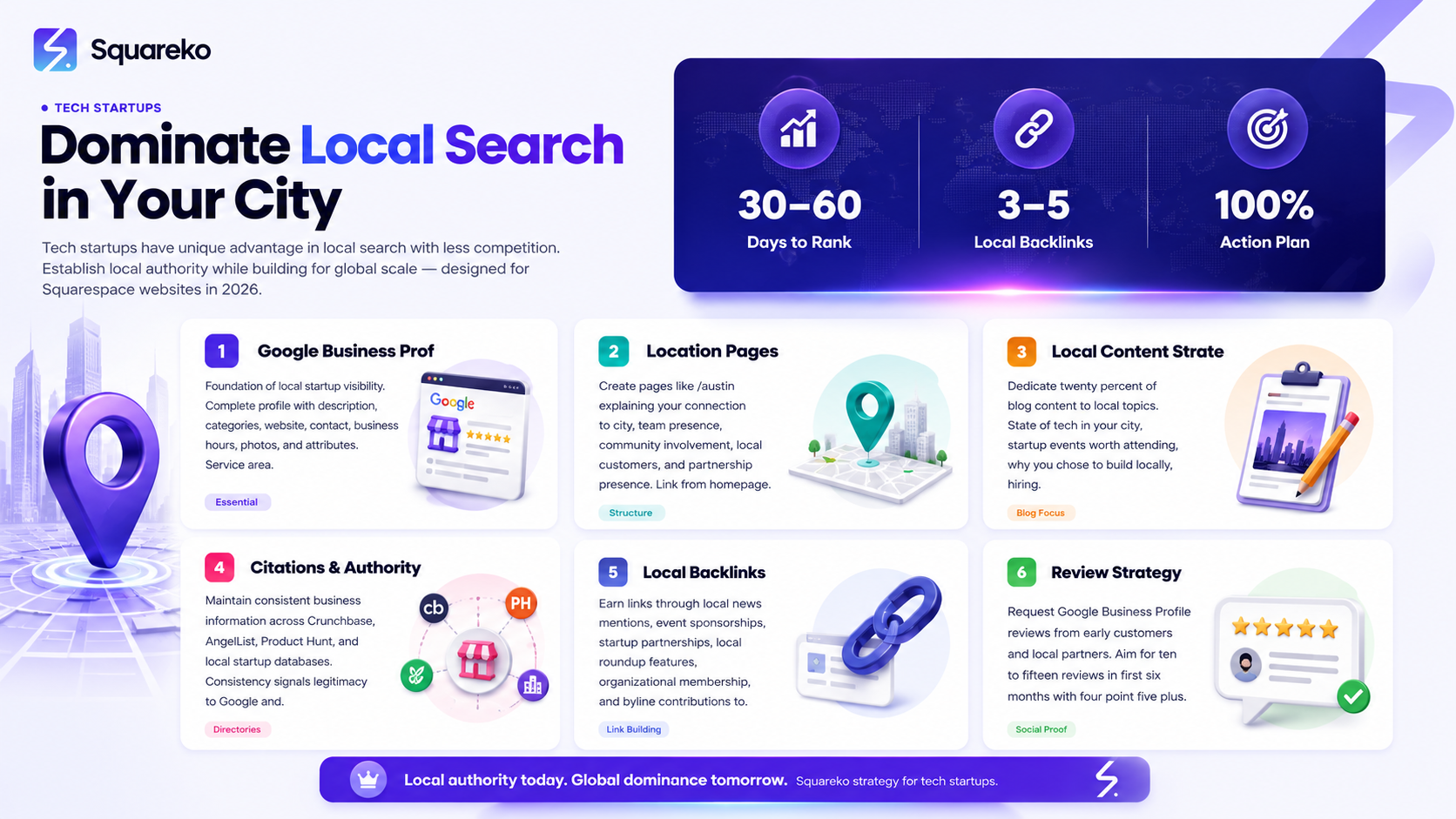
Your Google Business Profile (formerly Google My Business) is the foundation of local startup visibility. Skip this and you're essentially invisible in local search.
Creating and Verifying Your Profile
Go to business.google.com and create a profile for your startup.
Required information:
Business name
Business address
Phone number
Website (your Squarespace site)
Category (usually something like Software Company or Technology Company)
On the address question: Some startups operate fully remotely. You have two options: use your actual office address (if you have one), or mark yourself as service area business and specify the cities you serve.
If you're fully remote, use service area business. Enter the cities where you want to show up in search. This is less powerful than having a physical address, but it works.
Verification: Google will verify your address. If you provided a physical address, they mail a postcard. Wait for it, get the code, verify online. If you used service areas, verification is faster (usually by phone or email).
Filling Out Your Profile Completely
A complete profile ranks better than an incomplete one. Fill everything in:
Description: Write a 3-4 sentence description of your company. Include your key value prop and what you do.
[Company Name] builds marketing automation software for B2B SaaS teams. Our platform helps teams reduce time spent on repetitive tasks and focus on strategy. Founded in 2024, we're based in Austin with a remote team.
Categories: Select your primary category, then add secondary categories if relevant. Software Company + Technology Company are standard for startups.
Website and contact: Link to your Squarespace site. Make sure the URL is correct. Add your email and phone number.
Business hours: If you're a bootstrapped solo founder, just list typical business hours (like 9 AM - 6 PM Monday-Friday). This signals when you're available.
Photos: Upload 3-5 photos. Show your product (screenshots), your team, your workspace (if you have one), or your event presence (if you've spoken at startup events).
Attributes: Add attributes that describe your business. Women-owned Founded by former [big company] employees, etc. Whatever differentiates you.
Optimizing for Local Keywords
Google lets you add Google Product Details. Use this to describe what you do in keyword-rich language.
Not: We make a cool tool
Better: Marketing automation platform for SaaS teams. Integrates with Slack, HubSpot, and Segment. Used by teams managing 500+ leads per month.
You've snuck in keywords (marketing automation, SaaS, Slack integration, HubSpot) that help Google understand what you do and match you to relevant searches.
Post Regular Updates
Your Google Business Profile has a posts feature. Use it monthly.
Post about:
Product updates relevant to your local market
Local events you're sponsoring or attending
Founder or team updates
Local hiring announcements
Posts get a 7-day visibility window, then decline. But fresh posts signal that your business is active.
Building Location Pages on Squarespace
If you operate in multiple cities or regions, dedicated location pages on your Squarespace site signal that you're serious about each market.
This is especially relevant for startups with founder or investor presence in multiple cities, or for companies planning regional expansion.
When Location Pages Matter
Create location pages if:
You have different product positioning for different cities (unlikely for tech startups, but possible)
You're planning to hire in multiple regions and want local visibility
You're a marketplace with specific regional user bases
You have regional partnerships or customers you want to highlight
If you're a purely global SaaS with a single team location, location pages add minimal value. Skip them and focus on global content.
Structure of an Effective Location Page
Create a page like /austin or /locations/austin with:
Headline: [Company Name] in Austin: [Specific Value Prop]
Trello for finance teams. Founded in Austin. Used by 500+ companies in Texas.
Paragraph: Explain your connection to the city. Do you have an office there? Was it founded there? Do you sponsor events? Do you hire there?
We founded [Company] in Austin in 2024. Austin's startup ecosystem inspired our product vision. We're still based here and actively hiring our first engineers.
Team presence: If you have team members in this city, introduce them by name and role.
Community involvement: Do you sponsor hackathons? Speak at local events? Support local nonprofits? Mention it.
We sponsor the Austin AI Startup Meetup and regularly speak at Austin Tech events.
Local customers or partners: If you have customers or partnerships in this specific city, mention them (with permission).
Used by Acme Corp, a logistics startup based in Austin, to manage their growing customer base.
Schema markup: This is technical, but Squarespace can handle it. Mark up your location pages with LocalBusiness schema so Google understands the connection between your company and the city.
Link from your homepage: Link to location pages from your main site, usually in the footer under Locations or About.
Local Content Strategy for Startups
Your blog is one of the most powerful tools for local SEO, and most startups treat it as a global distribution channel only.
Smart startups create both global and local content.
Global Content (80% of your blog)
These posts target national and international search. How to Choose a SaaS Platform for Your Growing Team or Marketing Automation Best Practices. They target big search volumes and broad audiences.
Local Content (20% of your blog)
These posts target your specific city. They rank in your region and signal local authority.
Examples:
The State of [Tech/SaaS/AI] in [Your City] — Interview 15-20 founders in your city. Write a report on trends they're seeing. Founders will love this and share it. You become known as the person who understands your local startup ecosystem.
[City] Startup Events Worth Your Time: Q1 2026 — Curate upcoming events, conferences, and meetups. Cover what you're planning to attend. Local founders will find this and bookmark it.
Why We Chose to Build in [Your City] — Explain your founding decision. Talk about the local advantages (talent, capital, specific problem you saw). This builds connection with local audiences.
[Your Company] is Hiring in [City] — Local SEO and recruiting combined. We're hiring our first 3 engineers in Austin targets people searching for jobs and startup companies in Austin simultaneously.
[City] Startup Funding Roundup: [Month] — Track startup funding announcements in your city monthly. Who raised? How much? Link to their sites. This builds reciprocal local authority.
How to Make Local Content Rank
These posts rank better locally if you:
Target hyperlocal keywords with your title or early in the post. [City] startup events or Austin SaaS funding.
Build backlinks from local sources. Local news, local startup lists, local newsletters. When local sites link to your content, Google weights that heavily for local rankings.
Use location-specific schema markup. Squarespace can automatically do this, but make sure your local blog posts are marked up with location data.
Link between local and global content. If you write a global post about marketing automation, link to it from your Austin-specific post about local SaaS trends. This passes ranking authority locally.
Citations and Local Authority
A citation is any mention of your business on the internet. Business directories, startup lists, venture capital databases, whatever.
Google uses citations to verify you're a real company and to determine your local authority.
Building Citations as a Startup
The main startup-relevant citations:
Startup databases:
Y Combinator companies (if you graduated)
Crunchbase (claim and verify your profile)
AngelList (create your company profile)
Product Hunt (launch your product, create your profile)
Local business directories:
Chamber of Commerce (if relevant to your field)
Local startup resources (your city's startup organization)
Startup aggregators for your region
Industry directories:
Software company directories
AI company databases
Whatever category your startup fits
Your profile information needs to be consistent across all citations:
Business name (exactly as written everywhere)
Address (if you have one)
Phone number
Website (your Squarespace domain)
Brief description
Inconsistency (especially in business name and address) signals to Google that something is wrong with your information, which hurts local ranking.
Building Citations Efficiently
Don't manually submit to 50 directories. Focus on the top 10-15 most relevant ones, filled out completely and consistently.
Quality of citation matters more than quantity. A citation on Crunchbase carries more weight than a citation on a random directory.
Building Local Backlinks
A backlink from a local source is a vote of confidence in your local importance.
How to Earn Local Backlinks
Get featured in local news. Press coverage is the gold standard. Even local industry coverage helps. Austin Startup [Your Company] Launches [Product] in the Austin Business Journal is valuable.
Sponsor local events or nonprofits. Sponsorship often comes with a website mention. Proud to be sponsored by [Your Company]. These aren't high-value links, but they're local signals.
Partner with local companies. If you integrate with another Austin startup's product, mention it on their site and yours. Mutual links signal relationships.
Get listed in local startup lists. Sites like 20 Austin Tech Startups to Watch or [Your City] AI Companies provide backlinks. pitch journalists who create these roundups.
Join local startup organizations or accelerators. These membership pages usually link to your site.
Contribute to local publications. Medium publications focused on your city or industry. Byline contributions come with author bio links.
The Backlink Strategy Specific to Startups
You're not competing on link authority with established companies. You're establishing local presence and relevance.
3-5 local backlinks from credible sources (news, partnerships, startup organizations) often outweigh dozens of random directory listings.
Reviews and Social Proof Locally
Google Business Profile rankings are heavily influenced by reviews. More reviews, better average rating, recent reviews—all matter.
Getting Local Reviews
Ask your local customers, partners, and investors to leave reviews on your Google Business Profile.
This is different from product reviews on Product Hunt or software review sites. These are Google Business Profile reviews, and they're weighted heavily for local ranking.
Make it easy: Send them a direct link to your Google Business Profile review section.
We'd love your feedback on Google. [Link to review page]
Don't incentivize reviews with anything of value (Google's rules). Just ask politely.
What to Do When You Get Negative Reviews
In the startup stage, it's rare but possible. Address it professionally.
Thank them for feedback. Ask them to contact you directly so you can understand the issue. Show that you care about feedback and problems.
Public response matters. It shows other potential customers that you take criticism seriously.
Building Review Volume
Aim for 10-15 reviews in your first six months. That's not many, but it signals activity and engagement.
Once you have 10+ reviews with 4.5+ average rating, your local ranking significantly improves.
Ready to Dominate Local Search?
Local SEO is often overlooked by tech startups chasing global scale. But winning locally while you're small is a strategic advantage that compounds. You establish authority in your region, attract founder attention, and build credibility that translates to global expansion.
If you're ready to build local SEO into your Squarespace site—whether you're setting up your Google Business Profile for the first time or building out location pages and local content strategy—Squareko can help you establish local presence. We've helped dozens of tech startups dominate local search while scaling globally. Let's make your startup impossible to miss in your city.
FAQs
-
No. You can use a service area approach and still rank well locally. You'll be slightly less visible than businesses with physical addresses, but you can absolutely dominate local search with a service area approach.
-
Usually 30-60 days for initial visibility, 3-6 months to establish consistent top 3 rankings. It's faster than global SEO because there's less competition.
-
Focus on the cities where your founders are based or where you're hiring. You can have service areas in multiple cities. Or build a national/global strategy instead of local.
-
Use Google Search Console to track local keywords that drive traffic. Use Google Analytics to track visitors from local searches. Monitor your Google Business Profile insights to see how many people found you locally and what they clicked.
-
No. One website with location pages works better than separate sites. Separate sites dilute your domain authority.
-
Significantly. More reviews (quantity), higher average rating (quality), and recent reviews (freshness) all improve local ranking. Aim for consistent flow of new reviews.
-
Yes. Local content establishes authority and builds backlinks, which improve your global ranking too. Plus, it makes you more credible with local investors and early customers.
-
Absolutely. Start a local blog series covering your city's startup ecosystem. Participate in local events (virtually if needed). Build relationships with local founders and companies. Visibility comes from relevance and participation, not just geography.

From custom website design to SEO strategy, we help businesses launch a site that looks professional and performs better.

Author Bio
I'm Walid Hasan, a Certified Squarespace Expert and Squarespace Circle Platinum Partner with over 12 years of hands-on experience designing and optimizing high-performing websites. Over the years, I've had the privilege of building more than 2,000 Squarespace websites for clients around the world, always focusing on clean design, strong user experience, and conversion-driven results.