Squarespace SEO for Tech Startups: Rank on Google and Get Discovered by AI
Why SEO Matters for Tech Startups
You're a new tech startup. You have no brand recognition. You have limited marketing budget. You need customers to find you.
Paid advertising (Google Ads, Facebook) works, but it's expensive. You pay every time someone clicks. If your customer acquisition cost is high, your runway shrinks fast.
Organic search (SEO) is different. You invest once in content and ranking, then you get traffic for months or years without paying per click. The payoff compounds.
For startups with months to achieve product-market fit, organic search is your most efficient customer acquisition channel.
Why 2026 Is Different
Search has fundamentally changed. It's no longer just Google. AI search is now a discovery path for 15-20% of tech-savvy users. ChatGPT users ask questions to Claude and ChatGPT and expect answers sourced from authoritative content.
This means your startup needs to rank on Google for people searching traditionally, AND be cited in AI search results for people asking ChatGPT what's the best tool for X?
Both are achievable simultaneously with the right content strategy. Most startups are focused on Google alone, leaving AI search discovery on the table.
The Timing Advantage
Right now (early 2026), most tech startups haven't optimized for AI search at all. This is your competitive advantage. You can establish authority with AI search engines while your competitors are still chasing Google alone.
Key Takeaways Squarespace SEO for Tech Startups: Rank on Google and Get Discovered by AI
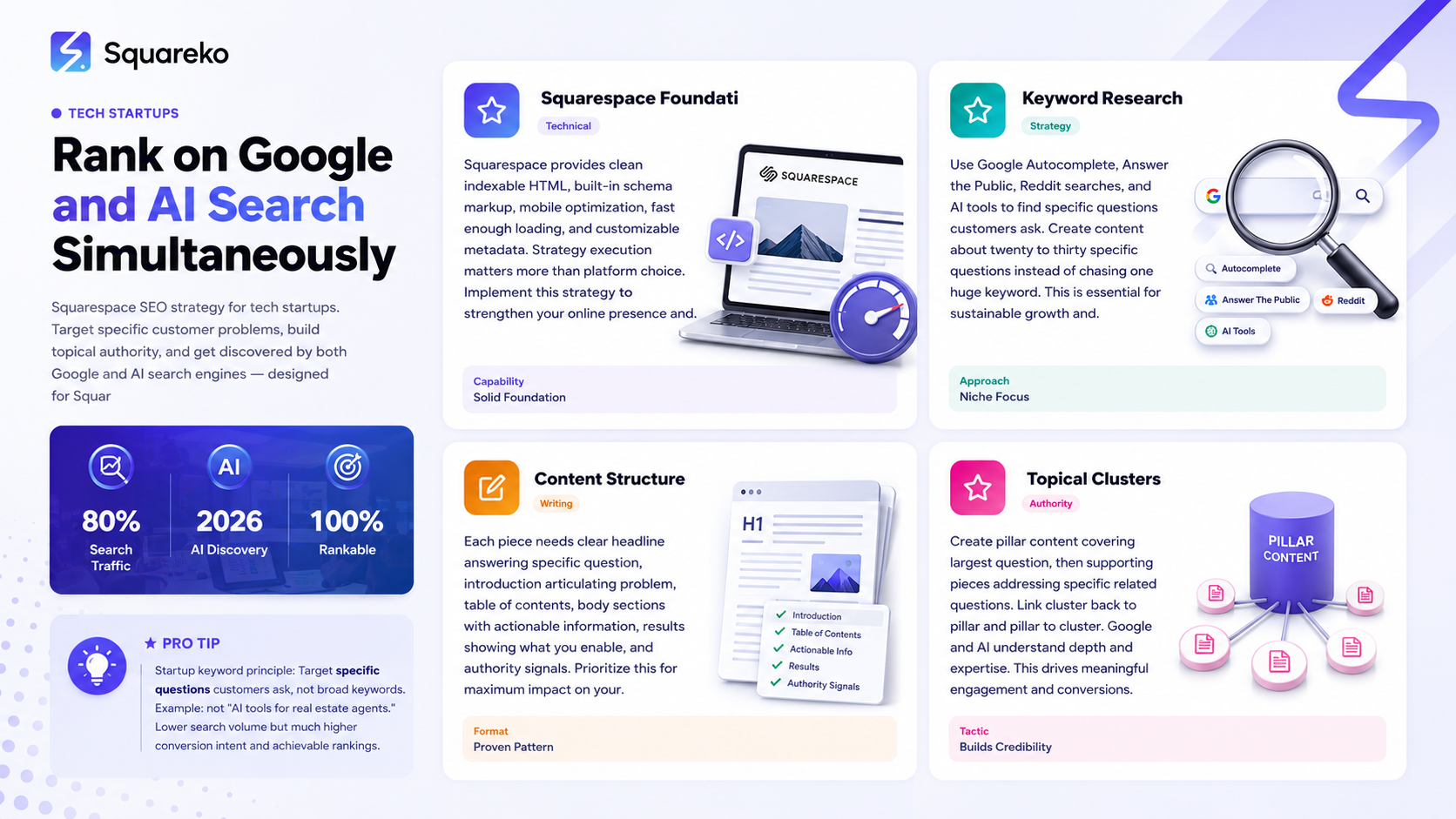
Tech startups can rank on Google and AI search simultaneously with the right content strategy
Squarespace provides solid SEO foundation, but strategy matters more than platform
Startup keyword approach differs from traditional SEO—targeting early adopters requires different thinking
AI search (ChatGPT, Perplexity, etc.) rewards authoritative, direct answers to specific questions
Content that works for both Google and AI search is content that solves real problems clearly
How Google and AI Search Actually Differ
Understanding the difference between how people use Google and how they use AI search will change how you create content.
Google Search Behavior
Google is about finding and filtering. Someone searches AI writing tools and Google returns a list of results. They browse, click, compare.
Google prioritizes:
Relevance: Does your page match the search query?
Popularity: How many high-authority sites link to you?
Authority: Are you known to be credible on this topic?
User experience: Does your site load fast? Is it mobile-friendly?
Google's reward is ranking in the first page of results. Get there and you get traffic.
AI Search Behavior
AI search is about getting answers. Someone asks Which AI writing tool is best for blog content? and Claude generates a response that synthesizes information from multiple sources.
AI systems prioritize:
Source quality: Is this information from credible, primary sources?
Specificity: Does this source provide detailed, nuanced information?
Current information: Is this recent? Has the world changed since this was published?
Direct answers: Does this source answer the specific question asked?
AI's reward is citation in an AI-generated response. Your content is mentioned as a source of truth on a topic.
The Tactical Difference
For Google, you're competing for ranking with hundreds of similar pages. You need to be slightly better or slightly more authoritative.
For AI search, you're competing for citation with a handful of sources. If you write the most comprehensive, specific answer to a specific question, you'll be cited.
This changes content strategy. Instead of trying to rank for everything, you choose specific questions and answer them better than anyone else.
Squarespace's SEO Foundation
Before strategy, let's establish that Squarespace provides everything a startup needs for SEO. It's not the fastest platform, but it's more than adequate.
What Squarespace Does Right for SEO
Clean HTML and indexing: Squarespace sites are indexed by Google properly. You don't have to worry about rendering issues or crawlability problems.
Built-in schema markup: Squarespace automatically applies schema markup to your content. This tells Google what your content is about at a structural level.
Mobile optimization: Squarespace templates are mobile-first. This matters because Google ranks mobile-friendly sites higher.
Fast enough: Squarespace sites load reasonably quickly. They're not the fastest possible, but they're in the acceptable range.
Customizable metadata: You can edit title tags, meta descriptions, and heading structure without coding.
What You Need to Do Yourself
Squarespace provides the foundation, but it doesn't do your strategy work.
Keyword research: You figure out what people are searching for.
Content creation: You write compelling, specific content about topics that matter.
Link building: You earn or build backlinks from relevant sources.
Authority building: You position yourself as a credible voice in your space.
None of this is Squarespace's job. These are your job.
Initial SEO Setup on Squarespace
Spend 30 minutes on this, then move on:
Site title and tagline: Clear, keyword-relevant. Marketing Automation for B2B SaaS Teams is better than Welcome to Our Site.
Meta descriptions template: Squarespace lets you set a default meta description that applies to pages you don't customize. Make it good. It's what Google shows under your title in search results.
Enable blog: If you don't have a blog, enable it. This is where you'll target long-tail keywords.
XML sitemap: Squarespace generates this automatically. Verify it exists at /sitemap.xml.
robots.txt: Squarespace handles this automatically. You shouldn't need to edit it.
Google Search Console: Add your Squarespace site and verify ownership. This is your direct line to Google about how your site appears in search.
Google Analytics: Link to your Squarespace site. You need data on what content drives traffic.
That's it. The foundation is set. Now the work begins.
Startup Keyword Research Strategy
Traditional SEO keyword research is about finding high-volume, low-competition keywords. That's useful for mature sites. For startups, the strategy is different.
The Startup Keyword Principle
You don't have authority yet. You can't compete on big, obvious keywords. Instead, you target specific questions that your ideal customer asks.
Not: AI tools (too broad, too much competition)
Better: AI tools for real estate agents (specific, less competition, higher buying intent)
How to Identify Startup Keywords
Start with your customer. Who are you building for?
If you're an AI tool for real estate agents, your customer is a real estate agent who's frustrated with a specific problem.
What question do they ask at the moment they realize they have that problem?
Real estate agents might ask:
How do I use AI to write property descriptions faster?
Best AI tools for creating real estate photos?
How do I automate client follow-up with AI?
These are specific questions that real people ask. They have lower search volume than AI tools (maybe 100-500 searches/month vs. 100k), but they have much higher conversion intent.
Tools for Startup Keyword Research
Google Search Console: If you have any traffic, see what queries drive your visits. Build on what's already working.
Google Autocomplete: Start typing a phrase. Google suggests common searches. AI tools for... and see what autocompletes. These are real, common queries.
Answer the Public: Shows questions people ask about a topic. What is [topic] How to [topic] Best [topic] etc.
Reddit: Search your category and see what questions people ask. Real language from real customers.
AI research (ChatGPT, Claude): Ask What questions do real estate agents ask about AI tools? Iterate on the answers.
Keyword tools (Ahrefs, SEMrush): If you have budget. If not, the above free methods work fine for startups.
The Keyword Strategy: Breadth Over Depth
Create content about 20-30 specific questions related to your problem space. Don't try to rank for one huge keyword.
A startup with good content about 30 specific questions will outrank a startup trying to rank for one massive keyword.
Content Strategy for Startups
Your content should accomplish two things: Rank on Google and get cited in AI search.
The Content Types That Work
How-to guides (ranks well on both):
How to Write Property Descriptions with AI (Google: people search how-to questions; AI: direct answer content)
Comparison guides (ranks well on both):
ChatGPT vs. Claude for Real Estate Marketing (Google: comparison intent is high-purchase intent; AI: answers the specific question)
Tutorials (ranks well on both):
Step-by-Step: Using AI to Follow Up with Real Estate Leads (Google: detailed content ranks; AI: educational content is authoritative)
Think pieces (ranks moderately on Google, highly on AI):
Why Most Real Estate Teams Aren't Using AI (And Why They Should) (Opinion content gets cited in AI responses because it provides perspective)
Case studies (ranks moderately on both):
How Acme Realty Doubled Their Lead Follow-up with AI (Google: social proof; AI: specific data)
The Content Structure That Wins
Each piece of content should have:
Clear headline that answers a specific question
How to Write 50 Property Descriptions in 1 Hour Using AI
Not: Using AI for Real Estate
Introduction (1-2 paragraphs) that articulates the problem clearly
Real estate agents spend 2-4 hours per week writing property descriptions. If you list 20+ properties, that's a massive time sink.
Table of contents (so Google and AI can understand structure)
Helps both humans and AI understand what's coming
Body sections with specific, actionable information
Step 1: Choose Your AI Tool
Step 2: Set Up Your Property Template
Step 3: Generate Your First Description
Results or outcome (what you get from following this)
You'll write 50 property descriptions in 1 hour, freeing 3-4 hours per week for actual selling
Authority signals (why you're credible)
I've worked with 50+ real estate teams implementing this process
This approach generates 20% more lead inquiries on average
This structure works for both Google and AI because it's well-organized and specific.
Content Volume and Frequency
Start with 4-8 core pieces of content. These are your pillar content pieces covering the biggest questions in your space.
Then publish one new post every two weeks. One post / two weeks means 26 posts per year, which is sufficient to establish authority in a specific niche.
This is sustainable for a small team and builds momentum over 12 months.
Technical SEO on Squarespace
Technical SEO is the foundation. Get this wrong and all your content fails to rank.
Core Technical Elements
Site speed: Squarespace's default speed is acceptable (loading in 2-3 seconds). This is good enough. Don't obsess. If you want to improve, compress images and avoid auto-playing video.
Mobile responsiveness: Squarespace handles this automatically. You don't need to do anything.
XML sitemap: Squarespace creates this automatically. Verify it works: go to yoursite.com/sitemap.xml. You should see a list of all your pages.
Robots.txt: Squarespace handles this. You don't need to touch it.
HTTPS/SSL certificate: Squarespace provides this automatically. You're secure.
Meta tags: Customize your site title, meta description, and page titles. These appear in Google search results.
For each blog post:
Title tag (50-60 chars): How to Write Property Descriptions with AI
Meta description (150-160 chars): Learn to write 50 property descriptions in 1 hour using AI tools. Step-by-step guide for real estate agents.
Heading Structure
Use headings correctly:
H1: One per page, your main title
H2: Major section headers (3-5 per post)
H3: Subsections under H2s (1-3 per section)
This hierarchy helps Google understand content structure and helps AI understand what's most important.
Internal Linking
Link from related content to related content.
If you write How to Use ChatGPT for Real Estate Marketing, link to it from your AI Tools for Real Estate Agents post.
These internal links:
Help Google understand relationships between content
Help readers find related information
Help AI understand topical clusters of content
Schema Markup
Squarespace applies schema automatically, but you can enhance it. For articles, make sure schema includes:
Headline
Description
Author
Date published
Date modified
This helps Google understand your content is current and authoritative.
Building Authority Through Topical Clusters
A topical cluster is a group of related content that together establishes authority on a topic.
Instead of writing scattered blog posts about different things, you create a core piece of content (pillar) and multiple supporting pieces (cluster).
Example Topical Cluster for Real Estate AI
Pillar: The Complete Guide to AI for Real Estate Agents
3000+ word comprehensive guide
Covers all major AI uses in real estate
Authoritative, foundational content
Cluster content (7-10 supporting pieces):
How to Write Property Descriptions with AI
Using AI for Lead Follow-up
Best AI Tools for Real Estate Marketing
ChatGPT Prompts for Real Estate Agents
How to Use AI Without Losing Personal Touch
etc.
Each cluster piece links back to the pillar. The pillar links to all cluster pieces.
Together, they signal to Google that you're deeply knowledgeable about AI for Real Estate Agents.
Why This Works for Startups
Topical clusters help you rank for everything in that cluster simultaneously. You don't have to pick between ranking for AI tools vs. ChatGPT for real estate vs. property description AI.
You create content about all of them, link them together, and Google understands they're related. You rank for all of them.
This is how startups compete with established players: depth of coverage in a specific niche instead of breadth across all niches.
AI Search Optimization Tactics
AI search is new enough that there's no standard SEO, but patterns are emerging about what gets cited.
What Gets Cited in AI Responses
Specific data: 47 real estate agents using this system vs. many agents use this
Original research: We surveyed 500 real estate agents and found that 73% struggle with property descriptions
Step-by-step instructions: AI cites content that provides clear, actionable steps
Comparative analysis: Tool A costs X, has Y features. Tool B costs Z, has W features.
Expert perspective: Your founder's 10 years in real estate gives you credibility that ChatGPT respects
Tactics That Increase AI Citations
Direct answers: Answer the specific question in your headline and first paragraph. AI doesn't have to infer.
Numbered steps: 5 Steps to... 7 Ways to... AI cites numbered content frequently.
Original data: Collect data from your customers or market research. Cite it. AI loves original sources.
Interviews with experts: Quote real people with relevant expertise. AI cites attributed quotes.
Detailed examples: Instead of this tool works, show exactly how it works with before/after examples.
Current information: Include publish date and update date. Fresh content gets cited more than old content.
The Practical Implementation
Write your content for humans first. Make it clear, specific, and helpful. The content that works best for humans also works best for AI.
Measuring What Matters
Most startups track the wrong metrics. You're not a big publisher. You don't care about pageviews. You care about conversions.
Metrics That Matter for Startups
Organic traffic to signup (not total traffic): How many people who found you via search signed up for your beta/product?
Keyword ranking progress: Track your top 10 keywords. Are you ranking higher each month?
AI search mentions: Do a quarterly search for mentions of your company/product in AI search results. Are more responses citing you?
Content engagement: Which blog posts drive the most signups? Double down on those topics.
Search traffic to conversion pages: A blog post is only valuable if it drives traffic to pages that convert. How to Use AI blog post is only valuable if readers then visit your pricing page.
Setting Up Measurement
Google Search Console: See which queries drive your traffic, your ranking position, and click-through rate.
Google Analytics: Track how many signups come from organic search. Use UTM parameters if needed.
Keyword rank tracker (free or paid): Track your ranking for your target keywords monthly.
Manual AI search checks: Every month, search your target keywords in ChatGPT/Claude/Perplexity. Note if you're cited.
That's it. You don't need complex analytics. You need to know: Are people finding you? Are they converting?
Ready to Rank Your Startup?
SEO is not magic. It's not a quick win. But it's the most efficient customer acquisition channel available to early-stage startups. You publish content, people find it, they become customers.
The difference between startups that win with organic search and those that don't is usually clarity of strategy, not execution quality. Most founders understand the basics. Few execute a coherent long-term strategy.
If you're ready to build SEO strategy for your startup on Squarespace—whether you're starting from scratch or optimizing existing content—Squareko can help you build a strategy that ranks on Google and AI search. We've helped dozens of tech startups establish organic discovery as their primary customer acquisition channel. Let's build something that grows without endless paid ads.
FAQs
-
Initial visibility (ranking for 1-2 keywords) typically takes 4-6 weeks. Significant traffic (top 3 rankings for multiple keywords) usually takes 3-6 months. Patience is the main ingredient.
-
Google. Google still drives 80%+ of search traffic. Get visibility on Google first. AI search follows naturally if your content is good.
-
Do what you can. One post/month is better than none. Consistency matters more than frequency. Three posts/month is better than zero posts/month for a year then ten posts/month.
-
Squarespace is fine. The platform matters less than strategy. A startup on Squarespace with good strategy will outrank a startup on WordPress with bad strategy.
-
Test them. Write content about them. See if you rank. If you rank but get zero traffic, you picked the wrong keywords. If you rank and get lots of traffic but zero conversions, the traffic doesn't match your product. Adjust.
-
DIY works if you're willing to learn and patient. Agencies accelerate things if you have budget. A startup's best move: DIY for 2-3 months, learn what works, then hire if you want to scale faster.
-
Local SEO targets geography ("AI tools in Austin"). Startup SEO targets customer problems ("AI tools for real estate agents"). They complement each other but serve different audiences.
-
Earn them by being useful. Press coverage, partnerships, relevant communities linking to you, guest posts on relevant sites. Don't buy them; it's against Google's rules.
From custom website design to SEO strategy, we help businesses launch a site that looks professional and performs better.

Author Bio
I'm Walid Hasan, a Certified Squarespace Expert and Squarespace Circle Platinum Partner with over 12 years of hands-on experience designing and optimizing high-performing websites. Over the years, I've had the privilege of building more than 2,000 Squarespace websites for clients around the world, always focusing on clean design, strong user experience, and conversion-driven results.