How Tech Startups Build Their Brand Identity on Squarespace Before They Have a Product
Why Brand Matters Before You Have a Product
Your startup exists in a fragile moment. You have an idea. You have conviction. You don't have customers, revenue, or product-market fit.
In this moment, brand is everything.
Brand is the story you tell about why you're solving this problem. It's the trust you build before you have proof. It's the signal you send that attracts aligned people and repels misaligned ones.
Without brand, you're invisible. With brand, you're a founder with vision worth paying attention to.
Key Takeaways
Brand identity before product launch communicates values, attracts aligned customers, and gives investors confidence
Founder credibility is often more valuable than product credibility early on
Your brand story should explain why you're solving this problem, not just what you're building
Mission-first positioning attracts early users who believe in your vision, not just those who need features
Squarespace makes it possible to build professional brand presence from day one without a product
The Dual Purpose of Early-Stage Brand
Your pre-product brand serves two audiences:
Investors looking for founders worth betting on. They don't invest in ideas. They invest in people. Your brand communicates whether you're thoughtful, credible, and capable.
Early customers looking for a founder who understands their problem. They don't buy products. They buy founders who get it. Your brand communicates whether you're worth trying.
The interesting part: building strong brand for both audiences happens simultaneously.
The Founder as Brand
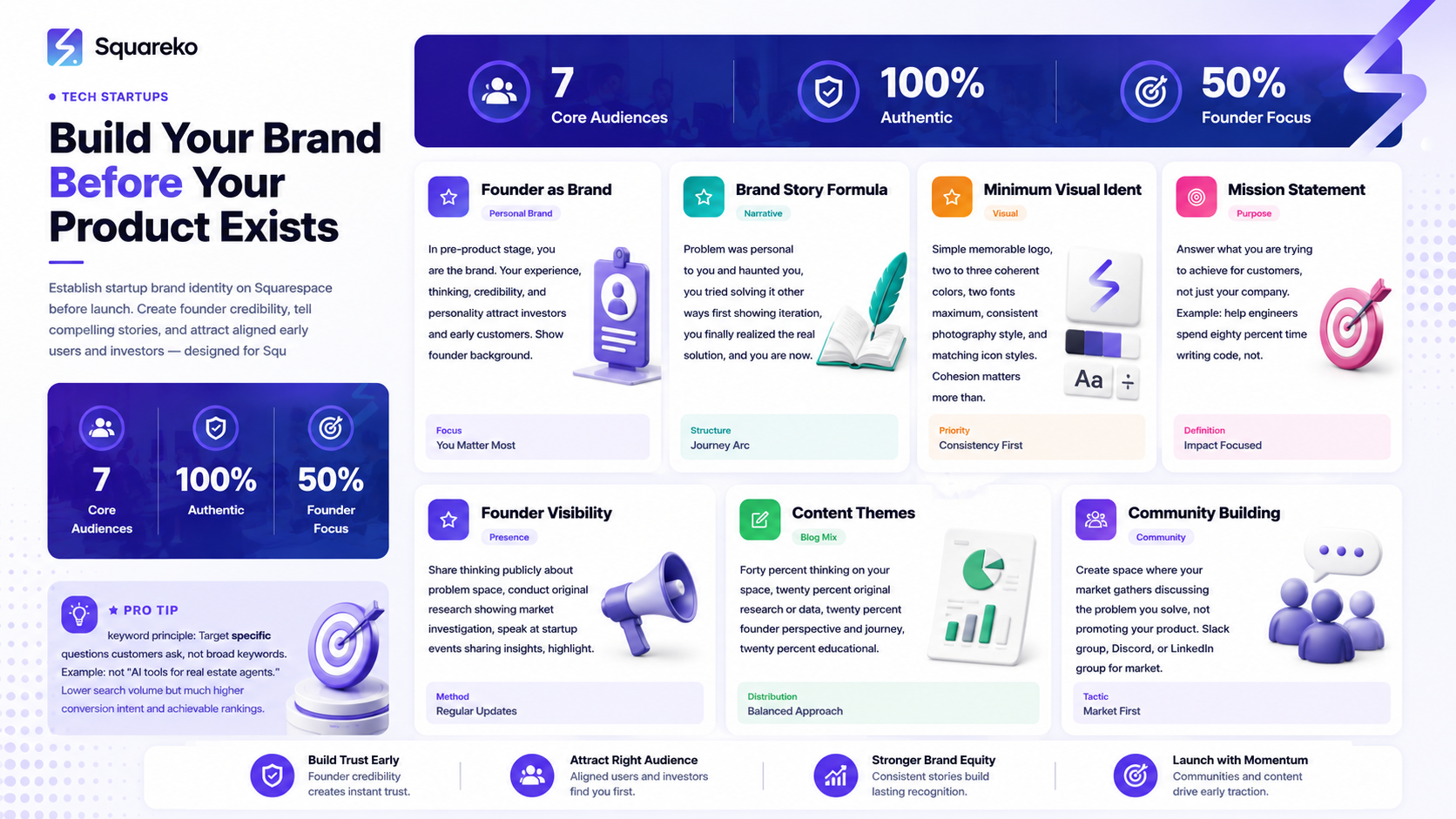
In a pre-product startup, you are the brand.
Not the company name. You. Your experience, your thinking, your credibility, your personality.
This is uncomfortable for some founders. You'd rather hide behind the company and let the product speak for itself. But early on, the product can't speak. You can.
Communicating Founder Credibility
Your website should answer: Why are you qualified to solve this?
Not in a resume way. In a here's why I understand this problem deeply way.
Examples:
I spent five years at Uber as a dispatch engineer. I watched us struggle with the exact problem I'm solving. That experience is why I'm building this.
I've been an AI researcher for 12 years. I've seen three companies try to solve this the wrong way. This is my third attempt because I finally understand what's missing.
I've run three D2C brands to $10M revenue. I know exactly what they need and what they're willing to pay for. That's what I'm building.
Each example connects your background directly to your problem and solution.
Showing Your Thinking
Investors and early customers want to see how you think. What do you believe about this market? What assumptions are you testing?
This is where a pre-product blog becomes powerful. Not about your product (you don't have one). About your thinking on the space.
Why the Next Wave of AI Tools Will Be Boring (your take on where excitement in AI is misplaced)
The $10B Problem Nobody Talks About (your specific framing of a pain point)
I Interviewed 100 Engineers About Their Biggest Complaint (original research on your customer problem)
This content serves two purposes: It attracts like-minded people who agree with your vision, and it repels people who don't. Both are good outcomes.
Creating Your Brand Story
Your brand story is not your biography. It's not your resume. It's the narrative of why this problem matters and why you're the right person to solve it.
The Components of a Compelling Startup Story
The problem was personal to you
I lost a $50M deal because of a single calculation error. Three people should have caught it. Nobody did. That's when I realized the real problem was visibility, not skill.
Personal problems are credible. You're not solving an abstract market problem; you're solving something that haunted you.
You tried to solve it other ways first
I thought the problem was tools. I built an internal tool. It didn't work. Then I realized the problem was process. I redesigned how our team worked. That helped, but there was a ceiling.
This shows you've thought deeply. You're not on your first hypothesis. You've iterated.
You finally realized the real solution
After two years of iteration, I realized the missing piece was AI. Not AI as a replacement. AI as a filter for what matters. That's what I'm building.
This is credible because you've earned your way to this insight through experience.
Telling Your Story on Your Site
Your homepage should tell this story in 2-3 paragraphs.
Section 1: The problem (personal or market context)
I spent five years in engineering leadership. I watched brilliant engineers lose 20 hours every week to context-switching between tools. That inefficiency costs companies billions annually.
Section 2: Why it matters
Context-switching isn't just a productivity problem. It's a retention problem. Engineers burn out. They leave. That's a huge cost.
Section 3: Why you're solving it
I finally realized that the solution isn't building another tool. It's unifying the workflow. That's what I'm building.
Section 4: What's coming
We're in private beta with 50 early teams. We're learning how to make this work, and we're launching a broader beta in Q2.
Done. You've told your story. You're credible. You're inviting people to be part of your journey.
Visual Identity on a Startup Budget
You don't need a $10k brand identity from a design agency. You need coherent, professional visual identity that reflects your values.
The Minimum Viable Brand Identity
Logo: Simple, memorable, works at small and large sizes. Spend $300-500 on Fiverr or 99designs. Don't overthink it.
Color palette: 2-3 colors that feel coherent. If your brand is serious and professional, dark blue + white. If it's playful, bright colors. If it's technical, minimalist + sharp.
Typography: Use two fonts max. One for headlines, one for body text. Squarespace makes this easy. Don't customize excessively.
Photography style: Either real photos of your team/product, or consistent stock photography style. Professional headshots, or authentic candid photos. Just pick one style and stick to it.
Icon style: If you use icons, make sure they match. Either all minimal line icons, or all filled icons, etc.
Cohesion Matters More Than Perfection
A coherent visual identity with imperfect design beats a scattered identity with perfect design.
If every element on your site uses the same color palette, fonts, and photography style, you look professional even if your logo wasn't expensive.
Building Your Brand on Squarespace
Squarespace makes this easy. Choose a template that matches your aesthetic. The template already has fonts, colors, and spacing that work together.
You're not starting from zero. You're customizing a coherent foundation.
Adjust:
Logo (upload in header)
Colors (change primary/secondary colors)
Fonts (choose from Squarespace's library)
Photography (upload your own images)
That's it. You've got professional brand identity.
Mission and Values on Your Site
Pre-product startups are often mission-driven. You're not just building a tool. You're trying to change how people work or think.
State this explicitly.
The Mission Statement
Your mission should answer: What are you trying to achieve? Not for your company. For your customers. For the world.
Not: Build the best engineering workflow tool
Better: Help engineers spend 80% of time writing code, not context-switching
The first is about your product. The second is about impact.
Values
If your startup has specific values, state them. Don't be generic.
Not: Innovation, Integrity, Customer Focus (every company says this)
Better: We believe engineers' time is their most valuable asset. We believe in transparent pricing. We believe in extreme simplicity.
Specific values attract aligned customers. Generic values repel everyone.
How to Present This on Your Site
Create a one-page section called Our Mission or What We Believe
We believe that engineers shouldn't spend their time managing tools. They should spend it building.
We're building [Product] to give engineers back 10+ hours per week. Not just because it's efficient. Because their time is valuable and limited.
We believe in transparency, simplicity, and actually listening to customers.
We're early. We're learning. We're not perfect. But we're committed to getting this right.
This tells investors and customers who you are, what you believe, and what they're signing up for.
Building Authority Before Launch
Your brand is nothing without credibility. You build credibility through:
Sharing Your Thinking Publicly
Write about your insights into the problem space.
Not: Our product does X
Better: Here's why every engineering workflow tool is getting this wrong
Public thinking builds audience and credibility.
Original Research or Data
Collect something nobody else has.
We interviewed 200 engineers about context-switching. Here's what we learned.
Original data is highly credible. It shows you're invested in understanding the problem.
Speaking and Visibility
Speak at startup events, industry meetups, or podcasts. Don't pitch. Share your thinking.
Here's what I'm learning about engineering productivity is more credible than Here's why you should try my product.
Advisor and Community Involvement
If you have advisors with credibility, mention them (with permission).
Advising us are Sarah, VP of Eng at [Company], and David, a founder of [Company].
Other credible people believing in you makes you credible.
Consistency
Post regularly. Respond to comments. Be present. Build trust through consistency over time.
Content Strategy for Pre-Product Branding
Your blog is your primary tool for building brand and authority before launch.
The Content Themes
Your thinking on the space (40% of posts)
Why Most Engineering Workflow Tools Are Designed by Non-Engineers
The Real Cost of Context-Switching (And Why Companies Ignore It)
Original research or data (20%)
We Interviewed 200 Engineers: Here's What We Learned About Productivity
Founder perspective and journey (20%)
Why I Left My Job to Build This
The Moment I Realized What Was Missing
Educational content for your market (20%)
How to Measure Engineering Productivity Without Destroying Culture
10 Red Flags You Have a Productivity Problem
Publishing Cadence
One post every two weeks. This is sustainable and builds momentum.
Don't announce posts coming soon. Just start posting. Make it normal.
Community Building Before Product
Your early brand is built on community. Not your company community. Your market community.
Creating a Place for Your Audience
You're not asking people to join your community. You're creating a place where people interested in this problem can gather.
Slack group, Discord, LinkedIn group, whatever matches your audience.
Don't talk about your product. Create a space for the community to talk about the problem.
Engineering Workflow Optimization community. AI for Real Estate community. Whatever.
Your job: Moderate, start conversations, amplify interesting threads.
What You Get
A list of people interested in this problem. These are your beta users. These are your first customers.
Ready to Build Your Startup Brand?
Brand before product is a superpower. It tells investors you're serious. It tells customers you understand them. It tells the market something is coming.
If you're ready to build your startup brand on Squarespace—communicating your story, building authority, and attracting early users before you launch—Squareko helps founders build credible, compelling brand presence. We've helped dozens of pre-product startups establish strong positioning that converts to customers and investment. Let's build something worth paying attention to.
FAQs
-
Focus on the company story, but make it personal. Your experience should explain why you're the right person to solve this. It's blended.
-
Tell the truth about your journey. Authenticity is more impressive than credential-dropping. "I've never worked in this space, so I talked to 100 people who have" is credible.
-
Little. Describe what you're building and why, but not features. "We're building a workflow tool that unifies your engineering tools into one interface" is enough. Full feature lists belong on post-launch marketing.
-
Yes. Make it easy for investors, customers, or interesting people to reach you. This is how great things start.
-
Through public thinking, research, conversations, and consistency. Shipping is one form of credibility. Demonstrating deep understanding is another.
-
Let them. Disagreement is proof you're saying something worth engaging with. Respond thoughtfully. This builds more authority, not less.
-
Every 2-3 weeks with a blog post. Monthly updates to the main site about progress. This keeps it feeling active.
-
No. Remove it or set expectations. "Pricing coming soon, estimated at $500/month for early users" is better than nothing, but wait until you're close.

From custom website design to SEO strategy, we help businesses launch a site that looks professional and performs better.

Author Bio
I'm Walid Hasan, a Certified Squarespace Expert and Squarespace Circle Platinum Partner with over 12 years of hands-on experience designing and optimizing high-performing websites. Over the years, I've had the privilege of building more than 2,000 Squarespace websites for clients around the world, always focusing on clean design, strong user experience, and conversion-driven results.