Squarespace for AI Startups in 2026: What Works and What Doesn't
Why AI Startups Need Special Positioning
AI is everywhere in 2026. Powered by AI is now baseline, not differentiating.
The strongest AI startups have shifted positioning: They're not selling AI anymore. They're selling the outcome that AI enables.
Your website either reflects this shift or it feels like you're five years behind.
Key Takeaways Squarespace for AI Startups in 2026: What Works and What Doesn't
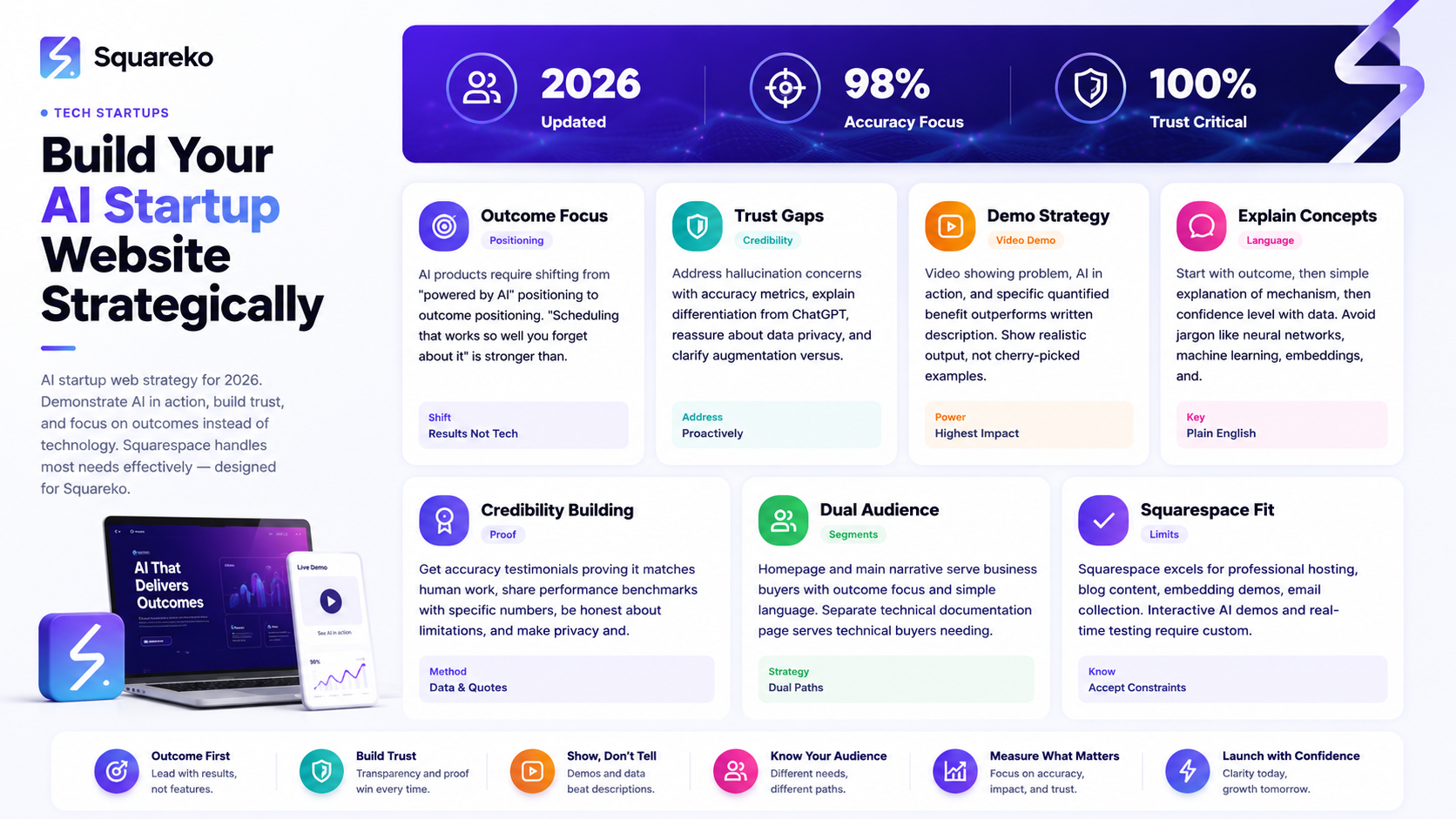
AI products require special attention to trust-building and complexity explanation—Squarespace can handle this well
Demo and visualization are more important for AI products than any copy—show what it does, don't just tell
AI startup positioning is shifting from powered by AI to AI-first design—your site needs to reflect this
Explaining AI concepts to non-technical buyers is your biggest website challenge—start with outcomes, not technology
Squarespace's limitations become apparent when you need to embed interactive AI experiences—know when to consider alternatives
The Positioning Shift in 2026
2023 positioning: We use AI to make scheduling better
2026 positioning: Scheduling that works so well you forget about it
The second version assumes AI. It focuses on outcome. It's stronger because every user already expects AI to be in the product.
Your website either reflects this understanding or it signals you're not current on your market.
The Trust Problem with AI Products
AI has a credibility problem. Not with technical founders. With everyone else.
There's skepticism. There's fear of hallucinations. There's uncertainty about AI safety. There's not-quite-articulated concern that AI might make mistakes in ways you can't predict.
Your website needs to address this directly or your conversion rates will suffer.
The Trust Gaps
Will this hallucinate? (for AI tools that generate content)
Your users are afraid your AI will confidently produce wrong information. Address this.
Our AI is trained on [specific data]. It doesn't make up sources. We ran internal tests on 1,000 documents and achieved 98% accuracy.
Specific, testable claims build trust. Vague claims (advanced AI technology) destroy it.
How is this different from ChatGPT?
Everyone wants to know. You need to answer clearly.
ChatGPT is general purpose. Our AI is trained specifically on real estate data. It understands real estate documents, terminology, and legal requirements in ways ChatGPT doesn't.
Specificity builds credibility.
What about my data privacy?
This is probably the biggest concern for enterprise customers.
Your data stays with you. We don't train on your documents. We don't sell your data. We don't use your documents to improve our models. [Link to detailed privacy policy]
Be explicit. Don't hide privacy details behind legal language.
Will this replace my team?
Some customers are scared. Some are hoping. Your positioning should address this.
This is designed to augment your team, not replace it. The intent is to free your team from routine work so they can focus on judgment calls and relationships.
Demonstrating AI in Action
The single best way to build credibility with an AI product is to show it working.
Not explain it. Show it. Working. With real examples.
Video Demo Strategy for AI Products
Your demo video should show:
The problem (10 seconds): Real human doing the task manually. Seeing them struggle or spend time makes the value proposition land.
The AI in action (40 seconds): User gives input. AI responds. Show the result. Does it work? Show realistic output, not cherry-picked examples.
The comparison (15 seconds): Doing this manually takes 2 hours. With our AI, it takes 30 seconds. Quantify the benefit.
Real output examples (15 seconds): Show multiple examples to prove consistency. If you only show one example, viewers assume it's cherry-picked.
The video should feel authentic, not overly produced. Real screenshots of your AI working, not slick motion graphics.
Before/After Visuals
Pair every AI feature with before/after visuals.
Before: Messy handwritten notes from sales calls
After: Structured, searchable call summary with key decisions highlighted
The visual difference is immediately obvious. It sells without words.
Interactive Demo (If Technically Possible)
If you can embed a lightweight interactive version of your AI product on your site, do it.
Try our AI on your own document. Paste text and see how it performs.
This removes doubt. Users who try it convert at much higher rates than those who only watch.
Squarespace doesn't natively support embedded interactive experiences easily. This might require custom code or integration with an external tool. More on this later.
Explaining Complex AI Concepts Simply
Your non-technical buyers don't care how your AI works. They care what it enables.
But sometimes you need to explain the AI concept itself because it's novel or confusing.
The Explanation Framework
Start with outcome, not technology: This AI learns how your team handles customer issues. Then it can respond to simple issues automatically, escalating complex ones to humans.
Then explain the mechanism simply: It reads every customer issue your team has handled. It identifies patterns. When a new issue comes in, it matches it to the most similar past issue.
Then build confidence: We test this on 100 past issues. It got 87% exactly right, 11% partially right (human can fix in seconds), 2% totally wrong.
Notice: You started with what it does, not how it works.
Avoiding Technical Jargon
Words that alienate non-technical buyers:
Machine learning
Neural networks
Large language models
Vector embeddings
Training data (use learning from your historical data instead)
Algorithm (use system or AI instead)
These words make sense to technical founders. To everyone else, they're jargon that suggests you're more interested in impressing than helping.
The Explanation Section Structure
Headline: Outcome-focused
Your AI learns your work. So it can handle the routine.
Paragraph 1: What it does
Our AI observes how your team handles [task]. It learns your patterns. When [situation] happens, it knows what to do next.
Paragraph 2: Why it works
Instead of following rigid rules, our AI learns from real examples. This works for edge cases and exceptions that rule-based automation can't handle.
Paragraph 3: How confident should you be?
We tested this on [number] real examples. Accuracy: [percentage]. When it's uncertain, it asks for human input.
Done. You've explained the concept without getting lost in jargon.
Building AI Product Credibility
AI products have an extra credibility challenge. Prospects are skeptical. You have to overcome that.
Social Proof for AI Products
Customer quotes matter more for AI than other product categories because customers are deciding whether to trust AI.
Get quotes about:
Accuracy: This AI understood our complex domain in ways generic tools don't
Reliability: We've been using it for six months. It's been consistently correct
Safety: We understand exactly what it's doing and why
Outcomes: This gave us 15 hours per week back
Accuracy testimonials are especially powerful: We compared its output against our manual process. It matched our work 94% of the time.
Data and Benchmarks
Share performance metrics openly.
Our AI achieves 92% accuracy on real estate documents, tested on 5,000+ documents.
It takes users an average of 10 minutes to understand the output, compared to 45 minutes for manual analysis.
Specific metrics build credibility. Great accuracy is marketing. 92% accuracy on 5,000+ test documents is data.
Transparency About Limitations
Be honest about what your AI can't do.
This AI works best for documents under 10,000 words. Longer documents lose accuracy.
It doesn't understand handwritten notes or images. Text-based documents only.
Honesty about limitations is more credible than hiding them. Users assume it's broken when it fails at unstated use cases.
Privacy and Safety Information
Make your privacy and security information obvious and prominent.
Link to it from your homepage. Explain your policies in plain language, not legal jargon.
Your documents are not used to train our models. We don't learn from your data. We only use industry datasets we've licensed.
The AI Startup Positioning Shift
The strongest AI startups in 2026 have moved beyond powered by AI positioning.
The Evolution
Generation 1 (2022-2023): We use AI to [make task easier]
Everyone was excited about AI. Positioning it as a feature was fine.
Generation 2 (2024): Our AI is [different because we trained it on X]
Positioning shifted to AI quality. Still focused on the AI itself.
Generation 3 (2025+): This [outcome] works so well now, it's almost magic
The best positioning doesn't mention AI at all. It focuses on the outcome being so good that the AI just fades into the background.
What Your Site Should Reflect
Your homepage should focus on outcomes, not technology.
Not: AI-powered customer support
Better: Customer support that answers 70% of questions without human involvement
The first is about technology. The second is about outcome.
If your positioning still heavily features AI, you're playing on a crowded field where everyone has AI. Better to position on what your AI uniquely enables.
Technical vs. Non-Technical Audience
AI startups often have two audiences with completely different information needs.
Technical buyers (engineers, heads of AI) want to know:
What model architecture?
How was it trained?
What performance metrics?
Can we fine-tune it on our data?
Business buyers (business leaders, operations, finance) want to know:
What problem does this solve?
What's the ROI?
How reliable is it?
How long is the implementation?
Your website needs to serve both without losing either.
The Dual-Path Strategy
Your homepage and main narrative serve the business buyer. Outcome focus. Simple language. ROI-focused.
Create a separate page (buried, but accessible) for technical details.
For technical teams: [Link to technical specification]
This page can include:
Model architecture details
Training data sources
Performance benchmarks
API documentation
Fine-tuning capabilities
Business buyers skip this. Technical buyers find it and trust you more because you're transparent about the details.
When Squarespace Limitations Matter
Squarespace is excellent for most tech startup websites. For some AI startups, limitations appear.
Where Squarespace Shines for AI Startups
Hosting a professional, fast-loading site
Hosting blog content and thought leadership
Embedding demo videos
Email collection for waitlists
Professional visual presentation
Where Squarespace's Limitations Appear
Interactive AI demos: If you want visitors to upload a document and get AI-generated output, Squarespace can't handle this natively. You'd need custom development or API integrations.
Real-time product testing: If your AI has real-time response (like a chat interface), embedding it on Squarespace is possible but cumbersome.
Complex integration workflows: If your site needs to talk to your product backend constantly, Squarespace becomes a constraint.
When to Consider Alternatives
If your core differentiator is the ability for visitors to test your AI on your site, you might need a custom website or a hybrid approach (Squarespace for branding + custom tool for demo).
For most AI startups, this can be solved with: Simple demo video + Request a live demo button + actual demo in a separate interface. This approach works fine on Squarespace.
Ready to Build Your AI Startup Site?
AI products need websites that build trust, explain complexity, and demonstrate value—all simultaneously. Squarespace can absolutely do this when your strategy is clear.
If you're building an AI startup website on Squarespace and need help with positioning, demo strategy, or trust-building architecture, Squareko specializes in AI startup web strategy. We've helped dozens of AI founders position their products, build credibility, and convert skeptical early users. Let's build something that makes your AI product unmissable.
FAQs
-
Probably not. Your outcome is more compelling than your technology. If your main headline is "AI-powered X," consider whether "X that actually works" would be stronger.
-
Embed a lite version of the product, pre-loaded with example data. Or offer a "book a demo" button that leads to a live walkthrough. Or record a realistic demo video. All work.
-
Absolutely. "We licensed data from [source] and trained our AI specifically on [domain]" is credible and differentiating. You don't need to hide your training approach.
-
Just enough so technical buyers understand you're credible. Full technical depth belongs on a separate technical documentation page.
-
Be honest about it. "Our AI is 94% accurate on real-world documents. For 6% edge cases, human review is recommended." Honesty builds more trust than hiding limitations.
-
If you can do it well, yes. If it requires a lot of engineering, no. A "request a live demo" button is perfectly fine.
-
Use language like "In active development with early users" or "Beta version—we're improving based on feedback." Honesty about stage builds more trust than pretending you're done.
-
Focus on the business outcome and the implementation process. Business buyers care about how long it takes to implement, how much training their team needs, and what ROI they'll see.

From custom website design to SEO strategy, we help businesses launch a site that looks professional and performs better.

Author Bio
I'm Walid Hasan, a Certified Squarespace Expert and Squarespace Circle Platinum Partner with over 12 years of hands-on experience designing and optimizing high-performing websites. Over the years, I've had the privilege of building more than 2,000 Squarespace websites for clients around the world, always focusing on clean design, strong user experience, and conversion-driven results.