How Tech Startups Use Squarespace to Showcase Case Studies and Early Customer Success
Why Case Studies Matter for Early Startups
Case studies are the closest thing to proof that your product works. For early startups with limited revenue and few public metrics, they're your most powerful marketing asset.
A case study is different from a testimonial. A testimonial is: This product is great. A case study is: Here's how they used this product. Here's what it enabled. Here's what changed.
Case studies work because they're credible. They're specific. They answer the question every prospect has: Is this real? Will it work for us?
Why Early Customer Stories Matter
You might think case studies belong later, when you have dozens of customers. Actually, early case studies are more powerful.
Why? Because they prove you work with real customers, not hypothetical ones. They prove your product can go live and deliver value, not just work in a demo.
One customer success story from a real company matters more than a hundred blog posts about why your solution is good.
Key Takeaways How Tech Startups Use Squarespace to Showcase Case Studies and Early Customer Success
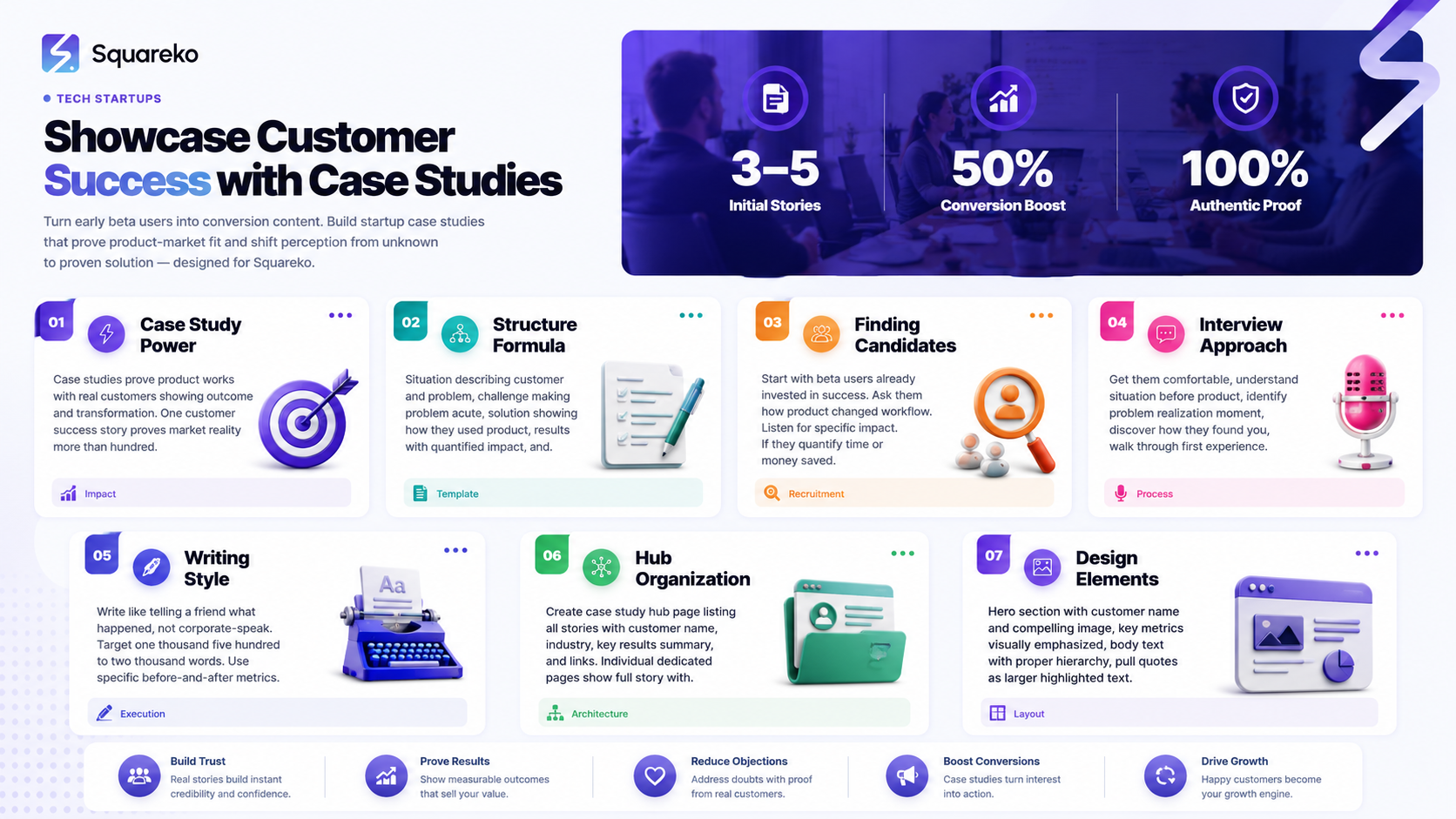
Case studies convert better than any other content type for B2B startups—build them early from beta users
The best startup case studies focus on outcome and transformation, not features
Starting a case study library with 3-5 stories is enough to shift perception from unknown startup to proven solution
Squarespace makes case study hosting, formatting, and linking straightforward without technical complexity
Early customer stories build investor confidence and attract next-wave customers simultaneously
The Psychological Impact
A founder reading about your startup has skepticism. You're pre-product or early-stage. You're unproven.
A case study flips the narrative. Suddenly there's a customer, a name, a company, a quantified result. Skepticism becomes belief.
For investors: A case study shows product-market fit signal early. For new customers: A case study shows that people like them chose this solution and it worked.
The Case Study Structure That Converts
The strongest case studies follow a simple structure:
Section 1: The Situation
Who was the customer? What problem did they face?
Acme is a 15-person real estate firm in Austin. They were handling 30+ property listings per month, but their marketing was taking 60+ hours per week.
You've set the stage. Readers see themselves in this description.
Section 2: The Challenge
What specifically made the problem acute? Why was it urgent?
They wanted to increase listings they could handle, but they were already at max capacity. Their bottleneck wasn't sales or listings. It was marketing time. Each property took 2-3 hours to photograph, describe, and market.
You're showing why the problem was painful. Why they needed to solve it.
Section 3: The Solution
What did they do? How did they use your product?
They used our AI to auto-generate property descriptions from MLS data. Instead of spending 45 minutes per property writing descriptions, they spent 5 minutes editing AI-generated ones.
You're showing the action. How the problem got addressed. Keep it specific.
Section 4: The Results
Quantified impact. What changed?
With those 40 minutes back per property, they could handle 50% more listings. In month one, they took on 8 new listings and generated $40k in additional revenue.
You've given the outcome. Specific. Measurable.
Section 5: The Perspective
A quote from the customer explaining why it matters.
Before this, I couldn't scale. Now I can actually take on as many listings as come in. The AI just works. — Sarah, Owner, Acme Real Estate
The quote is authentic. It comes from them, not you.
Finding Your First Case Study Customers
You can't have case studies without customers. Who do you ask?
Start with Your Beta Users
Your early beta users are your case study candidates. They've already taken a chance on you. They're invested in your success.
You don't need to ask them to be a case study. You ask them for feedback. In their feedback, you'll find story.
How has using our product changed your workflow?
Listen for specific impact. Specific change. Specific time/money saved.
If you hear: This saved me tons of time, follow up. Can you quantify it? Hours per week?
If they get specific, you have a potential case study.
Identifying Good Case Study Candidates
The best case study customers are:
Specific industry or role: Property management company is better than business professional
Quantifiable results: They achieved something measurable (time saved, revenue increase, quality improvement)
Early but not so early they might churn: If they just joined, they might leave. If they've been with you 3-6 months, they're solid
Enthusiastic about your product: They genuinely like you. They talk about your product positively
Willing to go public: Some early customers want to stay confidential. Find ones willing to be named
The Ask
Don't say: Can you be our case study? That sounds formal and creates resistance.
Say: Your story of doing [outcome] would help other [customer type] understand what's possible. Would you be open to doing an interview about your experience?
The second version is less formal. It positions it as helping others, not promoting your company.
Interviewing for Story Gold
A great case study is built on a great interview. Your job is to ask questions that reveal the story.
The Interview Structure
Opening: Get them comfortable. Not Tell me your story. Start with basics.
How long have you been using us? What does your role look like?
Background: Understand the situation before your product.
Before us, how were you handling [this task]? What was frustrating about that approach?
The problem moment: When did they realize they needed something?
Do you remember the moment you realized you needed a solution to this? What was happening?
Discovery: How did they find you?
How did you hear about us? What made you decide to try us?
The experience: What was it like using your product?
Walk me through using our product for the first time. What was easy? What was confusing?
Impact: What changed?
Since using us, what's different? How much time/money/effort have you saved? Can you put a number on it?
Perspective: Why does this matter?
If I told a friend in your position about you, what would you want them to know about your experience?
Recommendation: Would they recommend you?
Would you recommend us? What would you say?
Recording the Interview
Record it (with permission). Transcribe it. Pull direct quotes from the transcription. Real language from real people is more credible than paraphrased quotes.
Writing Case Studies That Sell
You have the interview. Now write the story.
The Writing Approach
Write like you're telling a friend what happened. Not corporate-speak. Human language.
Not: The customer utilized our platform to effectuate operational efficiency improvements.
Better: She was spending 60 hours a week on marketing. Now she spends 15. She got her life back.
The second version is human. It sells.
The Length
1500-2000 words is ideal. Long enough to tell a real story. Short enough that busy people read it.
Invest the time. A poorly written case study is worse than no case study.
The Structure in Writing
Follow the structure from earlier (Situation, Challenge, Solution, Results, Perspective). But write it as a narrative, not as sections with headers.
You're telling a story. The structure guides the story, but readers shouldn't notice the structure.
Using Data in Case Studies
Be specific. Use numbers. Before/after metrics are most powerful.
She was handling 20 listings per month. Now she handles 30.
The process used to take 2 hours per property. Now it takes 30 minutes.
In the first month, this freed up 15 hours per week.
The numbers prove the impact. They make the story believable.
Building a Case Study Hub on Squarespace
Your case studies need to live somewhere on your site. A case study hub makes them easy to find and share.
The Hub Structure
Create a page called /case-studies or /customer-stories
This page lists all your case studies. Show:
Customer name and company
Industry/role
Key results (one-line summary)
Link to full case study
As you add more case studies, this page grows. It becomes proof of adoption.
Individual Case Study Pages
Create a dedicated page for each case study.
URL: /case-studies/acme-real-estate or /customers/acme
Pages should include:
Full story (1500-2000 words)
Customer quote (highlighted)
Results metrics (visually emphasized)
Call to action (related to your product)
Link back to case study hub
Linking Strategy
Link to your case studies from:
Homepage (in results/social proof section)
About page
Product page (show real examples)
Blog posts (when relevant)
Your footer
Multiple internal links to case studies improve their ranking and visibility.
Designing Case Study Pages
Squarespace templates handle case study pages well. Here's what matters:
Visual Design Elements
Hero section: Customer name, company, industry. One compelling image (headshot of customer, their workspace, or product screenshot).
Key metrics callout: Highlight the top 3 results visually.
30% more listings handled 5 hours per week saved $40k additional revenue/month
Design these as large, readable callouts. They're the first things people notice.
Body text: Use proper heading hierarchy (H2 for sections, H3 for subsections). Make it scannable with short paragraphs.
Pull quotes: Extract 2-3 important quotes from the customer interview. Display them as highlighted, larger text. Quotes break up text and reinforce key points.
Visuals: Include 2-3 screenshots of your product in action (if showing product is helpful). Include photos of the customer if they're willing.
Results section: Use a table or visual elements to show before/after metrics side-by-side.
Mobile Readability
Make sure your case study pages are easy to read on mobile. Squarespace handles this automatically with good templates, but check it yourself.
Case Studies for Different Audiences
Different audiences care about different aspects of your case study.
For B2B SaaS
Investors want: ROI, timeline, implementation effort, retention
Buyers want: Will this work for us? What's the learning curve? Will our team adopt it?
Highlight:
Revenue impact or cost savings
Time to value (how long before they saw results)
Adoption story (how the team came around)
For Marketers/Content Tools
Emphasize: Time saved, quality improvement, ease of use
She went from 2 hours per piece to 30 minutes, with better quality output
For Enterprise
Emphasize: Security, integration, scalability, implementation partnership
Here's how we integrated with your existing systems. Here's how we managed the rollout.
For Developer Tools
Emphasize: Technical implementation, community impact, performance
Here's the architecture they built with us. Here's how it performs at scale.
Ready to Showcase Your Success?
Early customer success stories are the fastest way to shift perception from unknown startup to proven solution. Case studies work because they're credible, specific, and real.
If you're ready to build a case study strategy on Squarespace—interviewing early customers, writing stories that convert, and building a case study hub that impresses investors and buyers—Squareko can guide you through the process. We've helped dozens of startups turn their first few customers into marketing assets that drive exponential growth. Let's tell your story.
FAQs
-
One is better than none. Three is better than one. Aim for 3-5 before you put serious emphasis on case studies. After that, keep adding them.
-
Absolutely. Beta users are often your best case study subjects because they're invested and enthusiastic. Don't wait for paying customers.
-
If it's more than 2500 words, you're probably overwriting. 1500-2000 is ideal. Some people skim; make sure key results are visible even if they don't read the whole thing.
-
Not required, but you can offer a discount, free month, or feature request as thanks. Most early customers are just happy to help and get free marketing.
-
Respect it. An anonymized case study ("A 10-person real estate firm") still works, but not as well as naming them. It's less credible. Prefer named customers.
-
Update metrics annually if the customer is still using you and willing. Don't rewrite the story, but add "update: Six months in, they're now..." Follow-ups add credibility.
-
Yes, briefly. Link to them from your results/social proof section. Full case studies live on dedicated pages.
-
Use what you have. "We freed up 12 hours per week" is great even without revenue impact. Qualitative results ("She actually enjoys marketing now") work too, but quantified is stronger.

From custom website design to SEO strategy, we help businesses launch a site that looks professional and performs better.

Author Bio
I'm Walid Hasan, a Certified Squarespace Expert and Squarespace Circle Platinum Partner with over 12 years of hands-on experience designing and optimizing high-performing websites. Over the years, I've had the privilege of building more than 2,000 Squarespace websites for clients around the world, always focusing on clean design, strong user experience, and conversion-driven results.