Storytelling for Kids Brands: How Squarespace Helps You Connect with Parent Buyers
Introduction
Parents don't buy products—they buy values, safety, and belonging. This is the fundamental truth behind every successful kids brand. When a parent selects your clothing line, educational toy, or wellness product, they're making a statement about who they are and what they believe in. Your kids brand storytelling strategy must acknowledge this reality, moving beyond product features to speak directly to the parent who sees your brand as an extension of their parenting identity.
Kids brand storytelling on Squarespace helps you communicate this deeper narrative through a platform designed for visual clarity and emotional connection. Whether you're sharing a founder's personal journey, articulating your sustainability mission, or building a community of like-minded parents, the stories you tell become the bridge between your product and the parent's sense of purpose. This guide explores the essential framework for authentic kids brand storytelling and shows you exactly how to implement it on Squarespace to connect with parent buyers.
Key Takeaways
Parents respond to values-driven storytelling that aligns with their parenting philosophy and identity
A complete kids brand story includes your founding moment, mission, values, community, and measurable impact
Your Squarespace About page should centre the founder or founding team as relatable parents, not corporate entities
Safety, sustainability, and child development philosophy are the three emotional pillars parents expect to understand
Ongoing storytelling through your Squarespace blog and email nurtures trust and transforms customers into advocates
Visual storytelling—photography, design, and colour psychology—must align with your narrative at every touchpoint
Parent communities built around shared values become your most powerful marketing asset
Why Storytelling Matters for Kids Brands
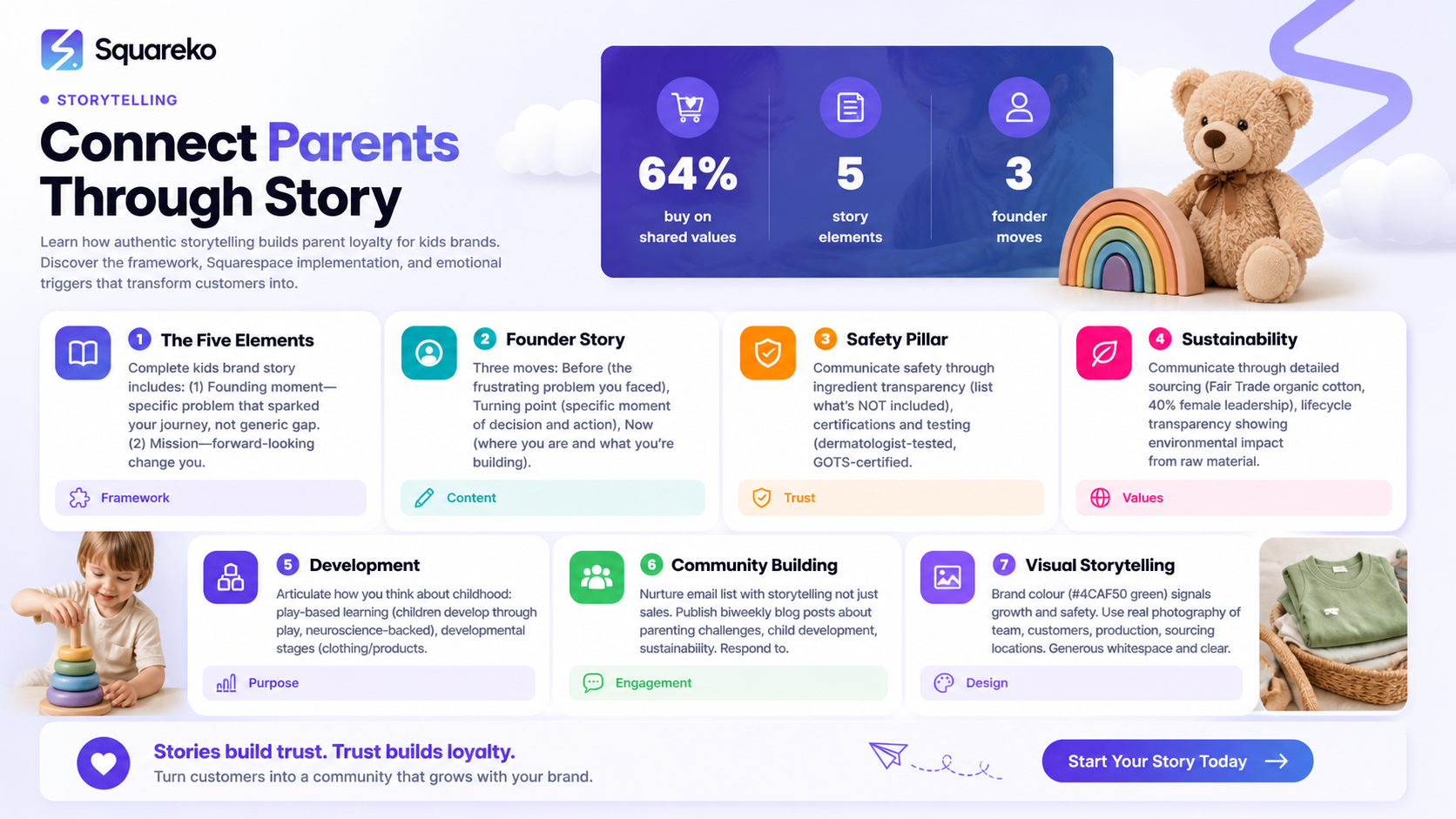
The kids market is crowded. There are hundreds of clothing brands, thousands of toy makers, and countless parenting products competing for attention. Yet some brands rise above the noise whilst others fade despite offering superior products. The difference often comes down to story.
Parents are decision-makers making purchases that affect their children's lives. This responsibility weighs heavily. They research, compare, read reviews, and seek reassurance that the brands they support align with their values. A parent buying from your sustainable fashion line isn't just interested in quality fabric—they want confirmation that their choice matters, that they're raising environmentally aware children, that they're part of something larger.
This is where storytelling transforms your marketing from transactional to relational. When parents understand your founder's personal journey—perhaps you became a children's product designer after struggling to find safe, eco-friendly options for your own child—they see themselves in your story. They recognise the same frustrations, values, and aspirations that drive your business. This emotional recognition builds loyalty that discounts and promotions cannot replicate.
Research consistently shows that 64% of consumers make purchases based on shared values. For parent buyers of kids products, this figure is even higher. They're not simply buying for themselves; they're voting on behalf of their children's wellbeing and the world they'll inherit.
The Kids Brand Story Framework
A complete kids brand story contains five essential elements. Miss any one, and your narrative feels incomplete. Include all five, and you have a compelling reason for parents to choose you.
1. The Founding Moment
Every great brand story begins with a specific moment—often a problem, frustration, or observation that sparked the founder's journey. This isn't about being established in 2019 or winning an industry award. It's about the human moment that made the business necessary.
Perhaps you couldn't find clothing that celebrated your child's cultural identity. Maybe you watched your autistic son struggle with sensory issues whilst wearing standard kids' clothing. Or perhaps you recognised that every educational toy on the market was either toxic or boring—there had to be a better way.
The founding moment is visceral and specific. It's not I saw a gap in the market. It's My daughter had eczema so severe that getting her dressed was traumatic until I formulated a soap so gentle it changed everything.
2. Your Mission
Your mission describes the change you're working toward. It's forward-looking and parent-centred, not product-centred. A weak mission is Make the best toys for children. A strong mission is Give every child the freedom to play authentically and develop confidence in who they are.
Notice the difference? The second speaks to parent values—freedom, authenticity, confidence. It's not about toys; it's about childhood thriving. This mission becomes the lens through which parents evaluate every decision you make.
3. Core Values
Values are the principles that guide your choices. For kids brands, the most emotionally resonant values typically include: safety, authenticity, sustainability, inclusivity, play-based learning, or family wellbeing.
Be specific about what each value means in practice. Sustainability is vague. We use only GOTS-certified organic cotton and plastic-free packaging because we believe children deserve to grow in a world we're actively protecting is clear, emotionally grounded, and action-oriented.
4. Community
Parents don't want to feel like isolated consumers. They want to know other parents share their values. Your community might be your social media followers, email subscribers, or a formal parents' group. Regardless of structure, highlighting the community of like-minded parents becomes a brand asset.
This transforms your marketing from buy our product to join a movement of parents who care about X, Y, Z. Belonging is a powerful purchase driver.
5. Impact
Parents want to know their purchase makes a tangible difference. Impact might be environmental (trees planted per purchase), social (percentage of profits donated to a cause), developmental (children's outcomes improved), or communal (support for other parents).
Quantify impact where possible. We donate 5% of profits to organisations supporting neurodivergent children is more powerful than We support neurodiversity.
Writing Your Founder Story for Squarespace
Your Squarespace About page is where parents get to know you. This is not a résumé or corporate biography. It's your invitation to be human.
Structure Your Founder Story in Three Moves
Move 1: The Before (The Problem)
Start with what made you frustrated or concerned. I spent three years searching for children's sunscreen that didn't contain chemicals I couldn't pronounce. I wasn't alone. Every parent in my community faced the same choice: expose our kids to conventional products or feel paranoid about beach days.
This opening works because parents immediately see themselves. They've experienced this frustration.
Move 2: The Turning Point (Your Moment)
Describe the specific moment or decision that sparked action. When my son developed a rash from sunscreen, I taught myself cosmetic chemistry. I spent fourteen months testing formulations in my kitchen. My family became my quality assurance team—sometimes reluctantly.
This demonstrates commitment and authenticity. You didn't outsource to a manufacturer; you solved the problem yourself first.
Move 3: The Now (The Mission)
Conclude with where you are and what you're building. Today, [Brand Name] protects thousands of children. We've created a community of parents who believe in transparency, safety, and joy. Every product we make is tested on people who matter most—our own children and yours.
Key Principles for Founder Stories on Squarespace
Be radically honest. Share a real struggle, not a polished difficulty. Parents can smell inauthenticity immediately.
Centre your identity as a parent first. Your professional credentials matter less than your credibility as someone who understands children's needs. I'm a mum of three who discovered... beats With 15 years of marketing experience...
Slow the work. Parents respect founders who got their hands dirty. Mention the kitchen testing, the failed prototypes, the learning journey.
Highlight who you're serving, not how important you are. The story isn't about your success; it's about solving your customers' problems.
Use a photograph that feels genuine. Squarespace's design flexibility allows you to display a candid photo of yourself with your own children, not a stock image. Parents connect with reality.
Three Emotional Pillars: Safety, Sustainability, and Development
Parents evaluate kids brands through three primary emotional filters. Understanding and addressing each builds trust.
Safety: The Foundation
Safety is non-negotiable for parent buyers. They need certainty that your product won't harm their child. This goes beyond compliance; it's about demonstrating a safety-first philosophy baked into every decision.
On your Squarespace website, communicate safety through:
Ingredient transparency: List what's in your product and, crucially, what's not. "Free from parabens, phthalates, and PVC" reassures because parents understand these terms. If they don't, consider a linked glossary explaining why each matters.
Testing and certifications: Dermatologist-tested, GOTS-certified, and toxicology tested" aren't marketing—they're evidence of rigor. Display certificates and test results.
A safety story: Share the specific protocols you follow. Every batch is tested for heavy metals, pesticide residue, and allergens before shipping demonstrates that safety isn't accidental; it's engineered.
Accessibility: Make safety information easy to find. A cluttered FAQ or buried fine print suggests you don't prioritise transparency.
Sustainability: The Value Alignment
Eco-conscious parents see purchasing decisions as moral choices. They're willing to pay more for brands that align with their environmental values—but only if the commitment is authentic and specific.
Communicate sustainability through:
Detailed sourcing information: We partner with Fair Trade organic cotton farms in India where 40% of staff are women in leadership roles" is far more compelling than "ethically sourced.
Lifecycle transparency: Show the environmental impact of your product from raw material to end-of-life. Squarespace's design flexibility allows infographics and visual breakdowns that make this clear.
Tangible commitments: By 2025, 100% of our packaging will be compostable gives parents a specific goal to believe in.
Ongoing education: Use your Squarespace blog to explain why sustainability matters for children's futures. This deepens the emotional connection.
Child Development Philosophy: The Framework
Educational toy brands, children's clothing companies, and parenting product makers all benefit from articulating an explicit child development philosophy. This tells parents how your brand thinks about childhood.
For example:
Play-based learning philosophy: Children learn through play. That's not trendy—it's neuroscience. We design toys that spark curiosity, solve problems, and celebrate failure as a learning opportunity.
Developmental stage alignment: We create clothing that grows with children's bodies and capabilities. Our 3-5 range supports the active, curious stage where kids are learning independence. Our 6-8 range celebrates friendship and identity formation.
Neurodiversity inclusion: We design for all children, including those with autism, ADHD, or sensory sensitivities. Our clothing is seam-free, tag-free, and designed with input from neurodivergent children and their families.
When parents understand your developmental philosophy, they see your products as tools for raising the children they envision.
Building Community as a Brand Asset
The most successful kids brands recognise that the parent community becomes the brand asset. These aren't just customers; they're advocates, advisors, and co-creators.
Why Community Matters
A parent who feels part of a community is more likely to recommend your brand, forgive minor missteps, and stay loyal through new product launches. Community creates belonging—a need that transcends rational price comparison.
Building Community on Squarespace
Email list as foundation: Your Squarespace email marketing tool should nurture subscribers with ongoing storytelling, not just sales. Share parenting insights, child development research, or behind-the-scenes product development stories.
Squarespace blog for connection: Weekly or biweekly blog posts about parenting challenges, child development milestones, or sustainability topics invite engagement. In the comments section, you'll notice parents sharing their own stories. Respond thoughtfully. These conversations become community.
Social proof integration: Squarespace allows you to display customer testimonials and reviews prominently. For kids brands, these should highlight values alignment. This brand gets my concerns about chemicals" is more powerful than Great quality.
Exclusive parent groups: Consider a private Facebook group or email list for your most engaged customers. Share early product launches, solicit feedback, and celebrate parenting wins together.
Co-creation opportunities: Invite your community into product development. We're designing our new sleep range. What challenges do parents face with bedtime routines? This transforms customers into collaborators.
Using Squarespace Blog for Ongoing Storytelling
Your Squarespace About page tells your founding story once. Your blog tells your story continuously, deepening parent trust over time.
Blog Topics That Drive Loyalty
Instead of product-focused posts (Five Ways to Style Our New Collection), write parent-centric posts (Raising Confident Kids: How Clothing Choices Support Identity Development).
Parenting insight posts: Share expert perspectives on child development, emotional intelligence, or family wellbeing. These position your brand as a thinking partner, not just a product seller.
Behind-the-scenes narratives: Show your team at work. Feature team members and their own children. Meet Sarah, Our Head of Product, and Why She Redesigned Our Baby Range for Sensory Safety invites human connection.
Customer impact stories: Share detailed stories of how your product made a difference. How Our Eczema-Safe Soap Changed Bedtime for a Family demonstrates real-world impact.
Values in action: When you make a decision rooted in your values, explain it. "Why We're Switching to Plastic-Free Packaging (and Why It Took Us Two Years)" demonstrates values-driven leadership.
Educational content: Write about topics parents actually research. "Understanding Sensory Processing: Why Some Children Need Special Clothing" serves parents whilst subtly positioning your sensory-friendly line.
Squarespace Blog Best Practices for Kids Brands
Consistency: Publish biweekly or monthly. Sporadic posting suggests you're not committed to the community.
Searchability: Use keywords naturally in blog titles and headers so parents researching parenting topics discover your content.
Visual storytelling: Include authentic photographs of real families, not stock images. Squarespace's image optimization ensures fast loading.
Email integration: Allow visitors to subscribe to your blog directly. These subscribers become your most engaged email list.
Comment moderation: Enable comments but set clear community guidelines. Respond to every comment during the first week—parents notice.
Visual Storytelling: Design Choices That Reinforce Your Narrative
Your Squarespace design doesn't just display products; it tells your story through every visual choice.
Colour Psychology for Kids Brands
Your brand colour (#4CAF50 green) signals growth, safety, and nature—perfect for brands emphasising sustainability or natural development. Ensure this colour appears consistently throughout your Squarespace site: hero images, buttons, accent elements, and typography.
Photography That Builds Trust
Stock images undermine storytelling. Real photographs of real children, real families, and real production environments build credibility. Squarespace's gallery features allow you to showcase:
Your team in action
Customer families using your products
Production and quality control processes
Sustainable sourcing locations
Whitespace and Clarity
Cluttered websites suggest confusion. Parents are overwhelmed enough; your Squarespace design should offer clarity and calm. Use generous whitespace, clean typography, and logical information hierarchy.
Inclusive Design
Your visual storytelling should reflect the diversity of families you serve. Feature children of different ethnicities, body types, abilities, and family structures. Squarespace's accessibility features ensure your site serves all visitors, including those with visual impairments or reading difficulties.
Video Storytelling
Squarespace's video integration allows you to embed founder interviews, product demonstrations, or customer testimonials. Video humanises your brand in ways text cannot.
Frequently Asked Questions
-
Your About page should tell your founder story in three moves: the problem that frustrated you (the "before"), the specific moment you took action (the turning point), and where you are now with your mission. Centre yourself as a parent first—this builds credibility with other parents. Share why you created your brand with enough emotional honesty that readers feel your genuine care for their children. Include a professional photograph of yourself, ideally with your own children. Describe your core values (safety, sustainability, development philosophy) in concrete terms, not vague promises. Finally, make your community visible—show testimonials, share metrics about impact, and invite readers to join your movement. Your About page should answer the question: "Why should I trust you with my child?"
-
Start with a genuine problem you faced as a parent. Be specific: "I couldn't find a water bottle my three-year-old could use independently without spilling all over himself" is stronger than "There was a gap in the market." Then describe the moment you decided to solve it—did you research endlessly, test prototypes, partner with manufacturers? Share the learning journey, including setbacks. This demonstrates commitment and authenticity. Finally, reveal where you are now and what you're building. Use Squarespace's About page template to structure your narrative, include a candid photograph, and make your story scannable with subheadings. Consider a 500–700-word About page that parents can read in three minutes. You might also create a longer version accessible via a "Full Story" link for deeply interested visitors.
-
Parents respond most powerfully to stories that affirm their parenting identity and values. They feel relief when a brand solves a problem they've struggled with—"I'm not alone in this frustration." They feel pride when a brand shares their values—"This company thinks like I do about sustainability." They feel trust when a founder demonstrates genuine care and transparency—"This founder is a real parent who understands my concerns." They feel belonging when they see a community of like-minded parents—"I'm not raising my child alone." They feel purpose when they understand impact—"My purchase makes a measurable difference." Storytelling that activates these emotions—relief, pride, trust, belonging, purpose—will outperform rational product messaging every time.
-
Lead with confidence, not qualification. Instead of "We're proud to announce our product is paraben-free," say "We've never used parabens. Here's why they matter to us." Share your testing and certification details matter-of-factly, as evidence of your baseline commitment rather than special accomplishment. On your Squarespace site, create a dedicated Safety page linking to test results, certifications, and ingredient explanations. Consider a video of your quality control process—transparency builds trust more effectively than claims. Invite parent questions and respond thoroughly. When a parent trusts your openness, defensive language becomes unnecessary.
-
Communities transform customers into advocates. A parent who feels part of a community shares your brand with friends, forgives mistakes, and remains loyal despite competitors. Beyond customer lifetime value, communities provide invaluable feedback for product development and content creation. Your Squarespace blog comments and email list reveal the questions parents are actually asking, the challenges they're facing, and the changes they want to see. Communities also create network effects—when one parent recommends you to another, trust is pre-established. Finally, communities buffer against market volatility. During economic downturns, communities sustain brands because the relationship is values-driven rather than transactional.
-
Your core story—founder journey, mission, values—can remain relatively stable. However, ongoing storytelling through your Squarespace blog should be consistent. Publish biweekly or monthly content addressing parent interests and showcasing your values in action. Annually review your story to ensure it reflects current reality. Did your mission evolve? Have your values deepened? Are there new community wins to celebrate? Update your About page and key messaging pages to reflect growth. Your story is alive; it should evolve as your brand matures.
-
Feature testimonials that highlight values alignment, not just product quality. A testimonial saying "Great product, fast shipping" doesn't differentiate you. A testimonial saying "This brand finally gave me peace of mind about chemicals in my child's clothing. I feel like I'm parenting in alignment with my values" demonstrates the emotional connection you're building. Feature photographs of customers alongside their testimonials when possible. Squarespace's testimonial blocks allow you to showcase multiple voices—aim for diversity in family structure, ethnicity, and parenting philosophy. Update testimonials seasonally so they feel current. Consider a dedicated "Customer Stories" section featuring longer, more detailed impact stories beyond simple testimonials.
Ready to Build Your Kids Brand Website with Squarespace?
Your kids brand story is powerful, but it only matters if parents can discover it and experience it beautifully. That's where a thoughtfully designed Squarespace website becomes essential.
A great kids brand site doesn't just sell products; it invites parents into a values-driven community. It tells your founder story with emotional authenticity. It communicates safety, sustainability, and developmental philosophy through both words and design. It uses the Squarespace blog to deepen relationships over time, transforming one-time buyers into lifelong advocates.
The good news: you don't need to build this alone. At Squareko, we specialise in building Squarespace websites for kids brands that prioritise storytelling and parent connection. We understand the emotional triggers that drive purchasing decisions. We know how to structure your About page, design your blog, integrate your brand colours, and optimise your site for search engines—all whilst keeping the focus on authentic, values-driven storytelling.
Whether you're launching your first kids brand or redesigning an existing site to tell your story more powerfully, Squareko.com can help. Visit squareko to explore our portfolio of kids brand websites and book a consultation with our team. Let's build a website that doesn't just reflect your values—it activates them.

From custom website design to SEO strategy, we help businesses launch a site that looks professional and performs better.

Author Bio
Written by the Squareko Team | squareko
I'm Walid Hasan, a Certified Squarespace Expert and Squarespace Circle Platinum Partner with over 12 years of hands-on experience designing and optimizing high-performing websites. Over the years, I've had the privilege of building more than 2,000 Squarespace websites for clients around the world, always focusing on clean design, strong user experience, and conversion-driven results.