AI Search Strategy for Children's Product Brands on Squarespace in 2026
Introduction
Parents today are turning to AI assistants like ChatGPT, Google Gemini, Perplexity, and Bing Copilot to find children's products—asking conversational questions about age-appropriate toys, safe clothing, educational tools, and gifts. If your children's product brand isn't optimised for how AI systems evaluate and recommend websites, you're missing out on this rapidly growing search channel. An effective AI search strategy for children's product brands on Squarespace in 2026 means structuring your website content, metadata, and safety signals in ways that AI assistants can understand, trust, and cite when recommending your products to parents. This guide shows you exactly how to make your Squarespace website visible and credible to AI search systems while building genuine trust with parents who rely on these tools.
Key Takeaways
AI assistants use schema markup, review signals, and safety certifications to evaluate children's products—not traditional SEO alone
Product schema with ageRange, material, and safety certification fields is essential for AI recommendation systems
Parent-focused FAQ content and expert positioning directly influence whether AI systems cite your brand
Safety certifications and compliance information displayed on-page are critical trust signals for AI evaluation
A structured, transparent approach to product information increases visibility across ChatGPT, Gemini, Perplexity, and other AI platforms
Regular review collection and parent testimonials strengthen your brand's credibility in AI-assisted search results
How Parents Use AI Assistants to Find Children's Products
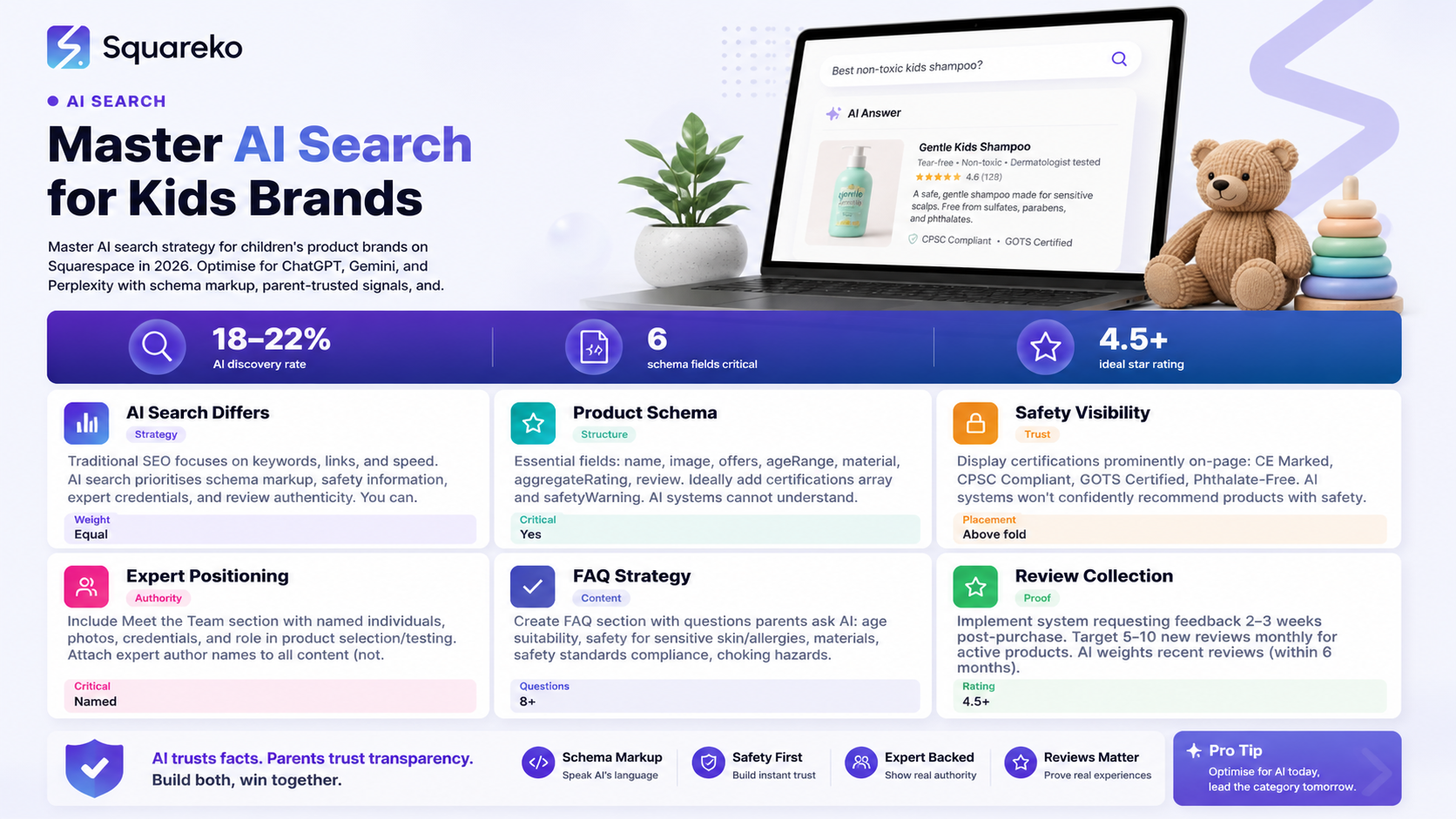
The way parents search for children's products has fundamentally changed. Instead of typing "best toddler shoes," they're now asking ChatGPT: "I need durable, non-slip shoes for my 2-year-old who's learning to walk. What brands would you recommend that are eco-friendly?" Or asking Gemini: "What educational toys are safe for babies with sensitive skin and allergies?"
These conversational, occasion-based queries are different from traditional keyword searches. Parents expect nuanced, contextual answers that consider age, safety, materials, values, and specific needs. AI assistants pull from multiple sources—including your website—to construct these recommendations. However, they don't simply rank websites by authority; they evaluate the quality of information, the presence of safety details, review credibility, and expert positioning.
Why This Matters for Your Brand
When an AI system encounters your Squarespace website, it's looking for specific signals:
Structured data that clearly identifies what ages a product suits
Safety certifications prominently displayed and machine-readable
Expert content from named individuals who can vouch for product quality
Transparent information about materials, manufacturing standards, and compliance
Authentic parent reviews that demonstrate real-world satisfaction
FAQ sections that answer the exact questions parents are asking AI assistants
Without these elements, your Squarespace site may rank well in traditional search but remain invisible to AI recommendation systems.
Understanding AI Search vs. Traditional SEO
Traditional SEO optimises for keyword rankings and link authority. AI search optimisation is fundamentally different. Where Google's algorithm prioritises domain authority and backlinks, AI assistants prioritise information quality, structured clarity, and trust signals.
Key Differences
Traditional SEO focuses on:
Keyword density and placement
Backlink quantity and quality
Page load speed and Core Web Vitals
Click-through rate from SERPs
AI Search optimisation focuses on:
Schema markup completeness and accuracy
Explicit safety and compliance information
Named expert credentials and transparency
Parent-verified reviews and testimonials
FAQ content that directly answers user intent
Consistent, detailed product information across your site
Why Schema Markup Is Critical
AI systems cannot "read" your website the way humans do. They rely on structured data—schema markup—to understand what information you're presenting. For children's products, this means using Organisation for Economic Co-operation and Development (OECD)-aligned Product schema that includes fields like:
ageRange (e.g., "3-5 years")
material (e.g., "organic cotton, BPA-free plastic")
safety certifications (e.g., "CE certified", "CPSC compliant")
Review aggregates with verified purchase signals
Without this markup, AI systems may mention your product generally, but they cannot confidently recommend it to parents seeking age-appropriate or safety-certified options.
Product Schema Markup for Children's Items
Schema markup is the language AI assistants use to understand your products. For children's items on Squarespace, you'll want to implement a comprehensive Product schema that goes beyond basic pricing and availability.
Essential Fields for Children's Products
{
  "@context": "https://schema.org/",
  "@type": "Product",
  "name": "SafeGlow Organic Cotton Baby Blanket",
  "description": "Hypoallergenic organic cotton baby blanket, perfect for newborns and sensitive skin",
  "sku": "SG-BLANKET-001",
  "brand": {
    "@type": "Brand",
    "name": "SafeGlow Kids"
  },
  "image": "https://yoursite.com/images/safeflow-blanket.jpg",
  "offers": {
    "@type": "Offer",
    "price": "34.99",
    "priceCurrency": "GBP",
    "availability": "https://schema.org/InStock"
  },
  "aggregateRating": {
    "@type": "AggregateRating",
    "ratingValue": "4.8",
    "ratingCount": "127",
    "bestRating": "5",
    "worstRating": "1"
  },
  "review": [
    {
      "@type": "Review",
      "author": {
        "@type": "Person",
        "name": "Emma Thompson"
      },
      "reviewRating": {
        "@type": "Rating",
        "ratingValue": "5",
        "bestRating": "5",
        "worstRating": "1"
      },
      "reviewBody": "Perfect for my newborn. So soft and breathable. Best purchase ever.",
      "datePublished": "2025-11-15"
    }
  ],
  "ageRange": "0-12 months",
  "material": "100% organic cotton, GOTS certified",
  "gtin13": "1234567890128",
  "certifications": [
    {
      "@type": "Thing",
      "name": "GOTS Certified",
      "url": "https://www.global-standard.org/"
    },
    {
      "@type": "Thing",
      "name": "OEKO-TEX Standard 100",
      "url": "https://www.oeko-tex.com/"
    }
  ],
  "safetyWarning": "Not suitable for children under 36 months due to button choking hazard. Meets all UK toy safety standards (BS EN 71-1:2014+A2:2020)"
}
How to Implement in Squarespace
Squarespace doesn't have a built-in schema editor, but you can add schema markup in two ways:
Via Code Blocks: Insert JSON-LD code blocks in your product page custom code section
Via Squarespace's Native Fields: Use title, description, price, and image fields—Squarespace automatically generates basic Product schema from these
For detailed Product schema with safety certifications and ageRange fields, you'll need to add custom code. Most children's brands benefit from working with a Squarespace specialist (like the Squareko Team) to implement comprehensive schema without breaking site functionality.
Why Each Field Matters to AI
ageRange: Allows AI to match products to specific age groups when parents ask age-specific questions
material: Enables AI to identify allergen-friendly or eco-friendly options
certifications: Provides verifiable trust signals that AI systems can cite
aggregateRating and review: Show real parent satisfaction, which AI systems weight heavily
safetyWarning: Demonstrates transparency and compliance awareness
Building Trust Through Safety Certifications and On-Page Signals
AI systems have strong incentives to avoid recommending products with safety concerns. They scrutinise how you present safety information, certifications, and compliance details. If these elements are hidden in footer links or buried in product descriptions, AI systems may not consider them credible signals.
What AI Systems Look For
On-page safety signals:
Clearly visible safety certifications (e.g., "CE Marked", "CPSC Compliant", "BSI Kitemark")
Explicit age range recommendations
Material transparency (e.g., "BPA-free", "lead-free paint", "GOTS-certified organic cotton")
Manufacturing standards (e.g., "Made in the EU under strict quality controls")
Allergen information (e.g., "Contains no latex, no peanut processing")
Compliance statements linked to relevant regulations (UK Toy Safety Regulations 2011, CE marking requirements, etc.)
Implementation on Squarespace
Create a dedicated "Safety & Compliance" section on each product page or category page:
🛡️ Safety & Compliance
✓ CE Marked – Meets EU toy safety standards (EN 71-1:2014)
✓ CPSC Compliant – Tested and approved by U.S. Consumer Product Safety Commission
✓ GOTS Certified – Organic textiles from seed to final product
✓ Phthalate-Free – No harmful chemicals in plastic components
✓ Age Recommendation: 3+ years (not suitable for children under 3 due to small parts)
For full safety documentation, download our Safety Data Sheet or view our Manufacturing Standards page.
Building Named Expert Presence
AI systems give weight to named experts associated with content. Consider creating a "Meet Our Team" section where product specialists, quality advisors, or founders are introduced with:
Full name and professional credentials
Photo
Brief bio emphasising safety or quality expertise
Their role in product selection or testing
For example:
Dr. Sarah Mitchell | Child Development Consultant"I personally review every toy and product we launch to ensure it meets developmental milestones and safety standards. With 10 years in child psychology, I know what parents really need."
This transparency signals to AI systems that your brand has genuine expertise, not just marketing claims.
FAQ Content Strategy for AI Extraction and Citation
AI assistants often extract FAQ content directly when answering user questions. If your FAQs match the exact phrasing of questions parents are asking AI, your brand becomes a cited source.
FAQ Questions Parents Ask AI Assistants
Create FAQ sections that directly address:
"What age is this product suitable for?"
"Is this product safe for children with sensitive skin / allergies?"
"What materials is this product made from?"
"Does this product meet UK / EU safety standards?"
"Are there any choking hazards or safety concerns?"
"How do I clean / care for this product?"
"Is this product eco-friendly or sustainably made?"
Best Practices for AI-Friendly FAQs
Use conversational language that matches how parents actually ask questions
Be specific rather than vague (e.g., "GOTS-certified organic cotton" not "natural materials")
Include certifications and standards (CE mark, CPSC, British Standards, etc.)
Provide age ranges clearly (e.g., "Suitable for ages 2-5 years")
Address safety concerns head-on (e.g., "This product contains small magnets. Not suitable for children under 8 due to swallowing hazard. Meets CPSC standards for magnetic toy safety.")
Link to supporting documentation where possible (e.g., "Download our full safety data sheet here")
Example FAQ Structure
Q: How do I know if this toy is safe for my 3-year-old?
A: Our SafeGlow Building Blocks are specifically designed for children aged 3+.
They are CE-marked under EU toy safety standards (EN 71-1:2014) and CPSC-tested.
Each piece is larger than 5cm to prevent choking hazards. All paint is non-toxic
and BPA-free. We recommend adult supervision during play. Download our full safety
certification document for complete details.
Q: What certifications does this product have?
A: Our products carry the following certifications:
- CE Mark (EU toy safety compliance)
- CPSC approval (US safety standard)
- GOTS certification (organic textiles)
- Phthalate-free testing (third-party verified)
- FSC-certified sustainable wood (where applicable
Visit our Certifications page for downloadable documentation.
Review Strategy and Social Proof for AI Recommendation Systems
AI systems treat verified, authentic parent reviews as one of the strongest trust signals. When recommending your children's products, they often cite specific reviews to justify their suggestions. A robust review strategy isn't just about customer satisfaction—it's part of your AI search visibility.
How AI Systems Evaluate Reviews
AI assistants look for
Verified purchases: Reviews from customers who actually bought the product
Detailed feedback: Specific mentions of product features, durability, safety, materials
Star ratings: Aggregate ratings (ideally 4.5+ for children's products)
Recency: Recent reviews (within last 6 months) carry more weight
Variety: Reviews from different customer demographics and use cases
Authenticity signals: Reviewer names, photos, and natural-sounding language
Building a Review Collection Strategy
Automate review requests: Send email prompts 2–3 weeks after purchase asking customers to share their experience
Make reviews easy: One-click rating and review links (Squarespace integrates with Trustpilot, Judge.me, and others)
Incentivise honest feedback: Offer small discounts on future purchases for written reviews (but never pay for positive reviews)
Highlight detailed reviews: Showcase longer, more specific reviews on product pages
Respond to all reviews: Thank parents for positive reviews and thoughtfully address concerns in negative ones
Capture specific safety feedback: Encourage parents to mention safety features, age-appropriateness, and durability in their reviews
Example Review Prompt Email
Subject: How did Product Name work for your child?
Hi
We hope you and Child Name are loving Product Name! We'd love to hear about your experience. Could you take a minute to leave a review? Parent feedback helps other families find products that are safe and perfect for their children.
Specifically, reviews mentioning age-appropriateness, safety, and durability help other parents make confident choices.
Kids Brand AI Search Readiness Checklist
Use this checklist to assess whether your Squarespace children's product website is fully optimised for AI search visibility:
Product Information
Every product page includes ageRange in schema markup (e.g., "3-5 years", "6+ years")
Material information is explicit and structured (e.g., "100% organic cotton, BPA-free")
Safety certifications are listed on-page, not hidden in documents
Each product has an AggregateRating with 10+ verified reviews
Product schema is implemented (either Squarespace native or custom JSON-LD)
Safety warnings are clear and match relevant standards (EN 71, CPSC, etc.)
Trust & Expertise Signals
Your brand has a "Meet the Team" or "About Us" section with named experts
At least one team member has credentials or experience in child safety or product development
Your company information (address, contact details) is visible and verifiable
Privacy policy explicitly addresses data collection from parents and children
Terms of service include age-appropriate usage guidelines
Content Strategy
You have a dedicated FAQ section with 8+ questions about safety, age-appropriateness, and materials
FAQ answers directly address parent concerns and include certification details
Blog content includes parent-focused guides (e.g., "How to Choose Safe Toys for Toddlers")
Expert author names are attached to all content (not anonymous)
You've published at least 2–3 detailed product guides or safety comparisons
Review & Social Proof
Your products have an average rating of 4.5+ stars
You collect and display 5+ reviews per popular product
Reviews mention specific safety features, age-appropriateness, or material quality
You respond to reviews publicly (especially addressing safety concerns)
Your review platform displays verified purchase badges
Compliance & Safety
All relevant UK/EU toy safety certifications are displayed on product pages
Age recommendations are clearly stated for every product
Allergen and material warnings are comprehensive
Your site includes a dedicated "Safety & Certifications" page
Manufacturing standards and sourcing information are transparent
Technical SEO
Your Squarespace site has fast Core Web Vitals (mobile-first performance)
XML sitemap includes all product pages and certification documents
Schema validation (use Google's Rich Results Test) shows no errors
Internal linking connects related safety documentation and FAQs
Frequently Asked Questions
-
ChatGPT and other AI assistants don't have a direct submission system like Google Search Console. Instead, focus on the signals they use to evaluate websites: comprehensive Product schema with safety details, authentic parent reviews, expert positioning, and transparent compliance information. Ensure your Squarespace website includes clear ageRange, material, and certification data in structured formats. Write detailed FAQ content that answers specific questions parents ask. When your website has strong trust signals, AI systems are more likely to cite you when recommending children's products. There's no shortcut—it's about building genuine credibility through transparency and expertise.
-
At minimum, use Product schema with these essential fields: name, image, offers (price and availability), ageRange, material, aggregateRating, and review. Ideally, add certifications as structured data and include safetyWarning fields. If selling from a Squarespace store, native schema is generated automatically, but you'll likely need custom JSON-LD code to include ageRange and certification details. We recommend working with a Squarespace specialist to ensure schema is correctly implemented without breaking your site. Validation tools like Google's Rich Results Test can confirm your schema is working properly.
-
Parents ask AI assistants conversational, context-rich questions: "What's the best teething toy for a 4-month-old who doesn't like plastic?" or "I need non-toxic art supplies for my 5-year-old with eczema." Rather than keyword searches, they're seeking personalised recommendations that consider age, safety, materials, allergies, and values. AI systems then search indexed websites for matching products, prioritising those with explicit ageRange data, safety certifications, and authentic reviews. If your Squarespace site has this information clearly structured, you're far more likely to be recommended. Parents trust these suggestions because they assume AI has vetted safety and quality—so your job is to make trust signals obvious.
-
Traditional SEO optimises for keyword rankings and link authority—it's about getting your website to rank for search terms. AI search optimisation focuses on providing structured, transparent information that AI systems can understand, evaluate, and confidently cite. Where traditional SEO prioritises backlinks and keyword placement, AI search prioritises schema markup completeness, safety signal visibility, expert credentials, and review authenticity. You can rank well in Google but remain invisible to ChatGPT if you don't have proper schema and safety information. Both matter in 2026, but they require different approaches.
-
AI systems know that recommending unsafe products is catastrophic for their reputation and user trust. They actively look for safety certifications and compliance information when evaluating children's products. If your website mentions certifications only in buried PDFs or small print, AI systems can't confidently cite your brand. When you display certifications prominently on-page (e.g., "CE Marked", "CPSC Compliant", "GOTS Certified"), include them in schema markup, and link to verification documents, AI systems treat your brand as trustworthy and safe. This directly increases the likelihood of recommendation.
-
Implement an ongoing review collection system that requests feedback 2–3 weeks after purchase. Aim for at least 5–10 new reviews per month for active products. AI systems give more weight to recent reviews (within the last 6 months), so consistent collection is more valuable than a large backlog of old reviews. Respond to reviews publicly and promptly, especially to address safety concerns. Update your product pages to feature your most recent, most detailed reviews. This signals to AI systems that your brand is actively managed and parent-focused, not dormant.
-
For children's product brands, working with a Squarespace specialist can accelerate your AI visibility significantly. While Squarespace provides basic schema generation, comprehensive Product schema with ageRange, certifications, and safety details typically requires custom implementation. A specialist can ensure your site structure supports AI search signals, implement schema correctly, and audit your pages for compliance visibility. However, you can start independently by adding FAQ content, displaying safety certifications clearly, collecting reviews, and ensuring your product descriptions are detailed and transparent. As your brand grows, professional support becomes increasingly valuable.
Ready to Build Your Kids Brand Website with Squarespace?
An effective AI search strategy for children's products requires thoughtful structuring of product information, transparent safety signals, authentic parent engagement, and expert positioning. If you're building or redesigning your Squarespace website for children's products in 2026, these principles will help you reach parents wherever they search—whether that's Google, ChatGPT, Gemini, or other AI platforms.
The Squareko Team specialises in building high-performance Squarespace websites for children's brands, from product schema implementation to expert content strategy. We understand the unique requirements of selling to safety-conscious parents and know how to position your brand as trustworthy across both traditional search and emerging AI channels. Whether you need help auditing your current site's AI readiness or building a new Squarespace presence from scratch, we're here to help your kids brand thrive.

From custom website design to SEO strategy, we help businesses launch a site that looks professional and performs better.

Author Bio
I'm Walid Hasan, a Certified Squarespace Expert and Squarespace Circle Platinum Partner with over 12 years of hands-on experience designing and optimizing high-performing websites. Over the years, I've had the privilege of building more than 2,000 Squarespace websites for clients around the world, always focusing on clean design, strong user experience, and conversion-driven results.