Squarespace vs Webflow for SaaS Companies in 2026: Which Platform Wins?
The Real Question Behind This Comparison
When SaaS founders ask Squarespace or Webflow? they're usually asking a more specific question: Which platform will help me launch fastest, look the most professional, and attract trial users without requiring a developer I don't have?
That framing changes the answer. Because the platforms are not equivalent in what they demand from you, and the gap between what you need and what each platform requires is often the deciding factor.
This comparison is specifically focused on SaaS company use cases — not e-commerce, not personal portfolios, not enterprise sites. If you're building a SaaS marketing site in 2026, this is the breakdown you need.
Platform Overview for SaaS Use Cases
Squarespace is a fully managed, all-in-one website platform built for professional quality without requiring code. In 2026, Squarespace 7.1 with Fluid Engine provides genuine layout flexibility — significantly more than its predecessors. For SaaS companies, it handles: homepage with product showcase, pricing page, feature pages, blog, about, and contact — all the core marketing site needs.
Webflow is a professional website building platform that generates clean HTML, CSS, and JavaScript through a visual interface. It's built for designers and design-minded developers who want full creative control. For SaaS companies, Webflow's strengths include: complex, bespoke design layouts, powerful CMS for large content libraries, and technical SEO flexibility.
Both platforms have hosted the marketing sites of successful SaaS companies. The question is which one fits YOUR team at YOUR stage.
Key Takeaways Squarespace vs Webflow for SaaS Companies in 2026: Which Platform Wins?
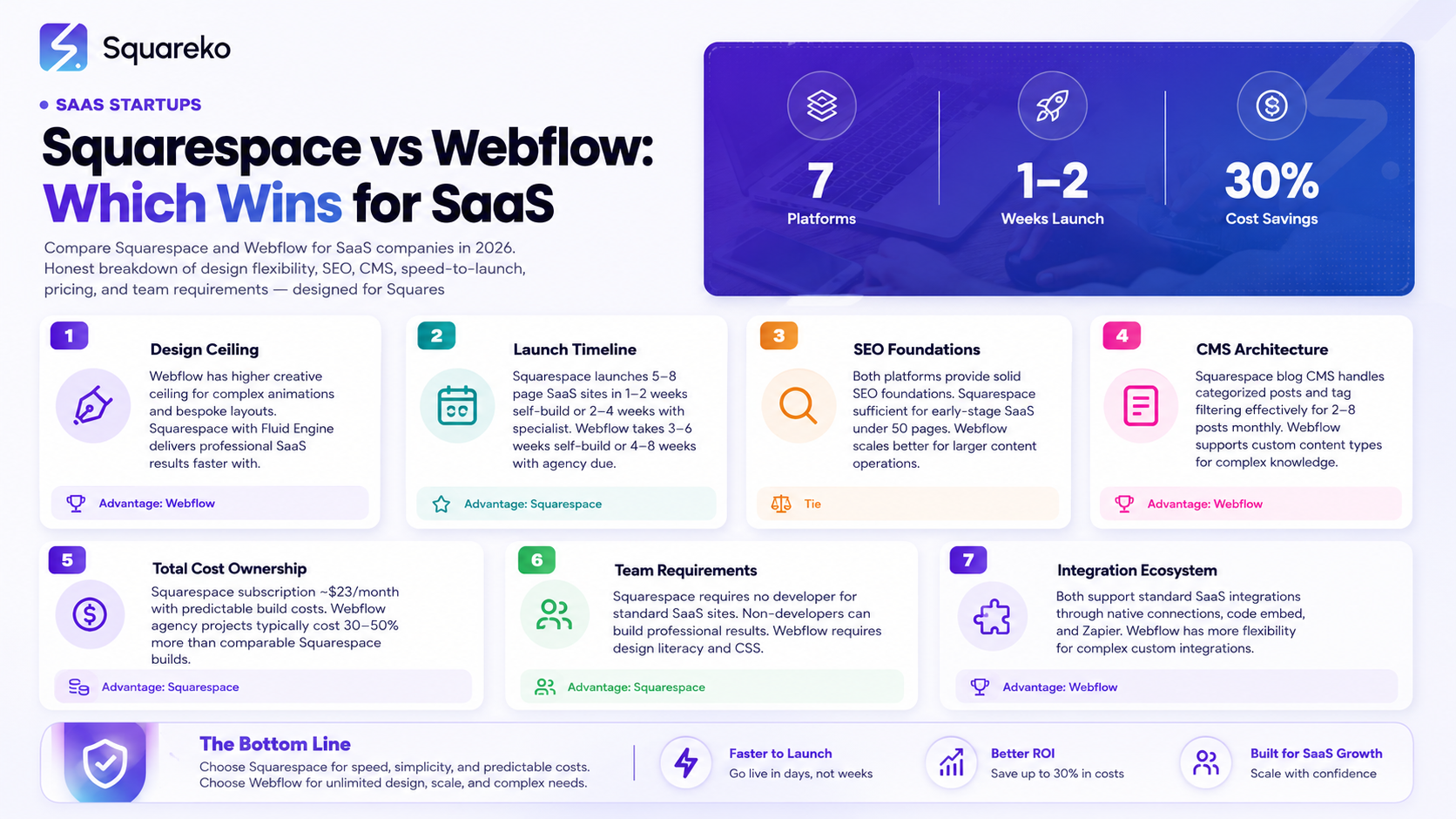
Both Squarespace and Webflow can build effective SaaS marketing websites — the right choice depends on your team's capabilities and priorities
Squarespace wins on speed-to-launch, ease of maintenance, and cost efficiency — critical advantages for early-stage SaaS startups
Webflow wins on design ceiling, CMS flexibility for large content archives, and technical SEO control
For most SaaS startups without a dedicated designer or front-end developer, Squarespace is the more practical choice in 2026
Working with a specialist (like Squareko for Squarespace) eliminates most of the design quality gap between the two platforms
Design Flexibility: What Can You Actually Build?
What Squarespace Can Build for SaaS
With Fluid Engine, a skilled Squarespace designer can build:
Full-screen hero sections with product UI screenshots or video backgrounds
Feature showcase sections with alternating text/image blocks
Pricing tier tables with visual hierarchy
Testimonial sliders and review grids
Integration logo showcases
Animated scroll sections (with custom CSS)
FAQ accordions
Multi-column comparison sections
The honest limitation: very complex interactions (multi-step animations, interactive product demos, advanced hover states) require custom code. They're achievable, but they add complexity and can be fragile with platform updates.
For the SaaS homepage structures that convert well, Squarespace handles everything you need.
What Webflow Can Build for SaaS
Webflow can build everything Squarespace can, plus:
Complex keyframe animations without custom code
Custom cursor interactions
Scroll-triggered animation sequences
Genuinely bespoke layout structures that deviate significantly from any template
CMS-driven dynamic pages at scale
The gap in creative ceiling is real — but it's only relevant if you have the design talent to use it. A Webflow site built without strong design expertise often looks worse than a well-configured Squarespace site.
Design verdict: Webflow has a higher ceiling. Squarespace delivers reliable, professional results faster. For most SaaS startups, the Squarespace ceiling is sufficient and the reliability advantage is significant.
SEO Capabilities for SaaS Marketing Sites
SEO is a primary traffic channel for most SaaS companies — especially at early stages when paid acquisition budgets are limited. Platform SEO capabilities matter.
Squarespace SEO for SaaS
Squarespace 7.1 provides: automatic XML sitemap, SSL, CDN hosting, mobile responsiveness, meta field controls, clean URL structures, and code injection for schema markup. For most SaaS marketing sites with 20-100 pages, this is sufficient technical SEO infrastructure.
The limitation: advanced redirect management, custom HTTP header control, and bulk meta tag operations are less flexible than Webflow. For SaaS sites at scale (hundreds of pages), this matters more.
Webflow SEO for SaaS
Webflow provides more granular SEO control: CMS-level meta template generation, precise redirect management, custom header injection, and clean server-side rendered HTML that search engines crawl reliably. For SaaS companies running large content operations (resource libraries, documentation, hundreds of blog posts), Webflow's SEO architecture scales better.
SEO verdict: For early-stage SaaS sites (under 50 pages), Squarespace is sufficient. For larger content operations, Webflow provides more flexibility. Both are significantly better than a poorly-optimized custom build.
CMS and Content Architecture
Content marketing is a primary growth channel for SaaS companies. The CMS capabilities of each platform matter increasingly as your content library grows.
Squarespace CMS
Squarespace's blog and portfolio CMS handles: categorized blog posts, author profiles, scheduled publishing, tag filtering, and media-rich post layouts. For a SaaS company publishing 2-8 posts per month, this is more than sufficient.
The limitation: Squarespace's CMS doesn't support relational content structures. You can't build blog posts tagged with integration X automatically appear on the Slack integration page. For complex content architectures, this is a real constraint.
Webflow CMS
Webflow's CMS is genuinely powerful. It supports custom content types, multi-reference fields (a blog post can reference a product feature, which references a use case), template generation for dynamic pages, and bulk content operations. For a SaaS company with a large knowledge base, use-case pages, or customer story collections, Webflow's CMS handles depth that Squarespace cannot.
CMS verdict: Squarespace is adequate for most early-stage SaaS content needs. Webflow is better for complex, large-scale content architecture. Make this decision based on your 12-month content plan, not just today's needs.
Speed to Launch
For SaaS startups, time-to-market matters. Every week your site isn't live is a week of missed SEO compounding, user feedback, and conversion learning.
Squarespace: A 5-8 page SaaS marketing site can launch in 1-2 weeks with content ready (self-build), or 2-4 weeks with a Squarespace specialist like Squareko. All infrastructure (hosting, SSL, CDN, sitemap) is handled automatically.
Webflow: The same scope typically takes 3-6 weeks self-build for someone with strong design skills, or 4-8 weeks with a Webflow agency. The additional time reflects Webflow's steeper learning curve and more complex design decision space.
Speed verdict: Squarespace is meaningfully faster to launch. For SaaS startups in competitive markets, this timeline advantage can translate directly to market position.
Pricing and Total Cost for SaaS Startups
Don't compare subscription costs alone — compare total cost of ownership including design/build time.
Squarespace
Business plan: ~$23/month (billed annually). Build with Squareko: one-time project investment + subscription. No hosting fees, plugin costs, or surprise infrastructure costs.
Webflow
Site plans: $23-39/month depending on CMS needs. Enterprise content sites: higher. Agency build fees: typically 30-50% higher than comparable Squarespace builds due to longer build time. Total first-year cost for a Webflow site built by an agency is typically $2,000-5,000+ more than a comparable Squarespace project.
Cost verdict: Squarespace is more cost-efficient for most SaaS startups. The subscription is comparable; the build cost and time are lower.
Developer and Team Requirements
Squarespace
No developer required for standard SaaS site builds. A motivated non-developer can build a professional SaaS marketing site. A Squarespace specialist can produce agency-quality results. Marketing team members can make content updates and page changes independently after launch.
Webflow
Requires comfort with design concepts and some understanding of CSS/layout principles to use effectively. Building with Webflow without design background typically produces poor results. Ongoing maintenance may require a designer for non-trivial changes. Non-designers often struggle with Webflow's power — it's the kind of tool where the ceiling is high but the floor is variable.
Team requirement verdict:Squarespace has a much lower skill floor. For SaaS startups without a front-end designer on the founding team, Squarespace removes significant operational friction.
Integrations with SaaS Tools
SaaS companies typically connect their marketing site to: CRM (HubSpot, Salesforce), marketing automation (Mailchimp, ActiveCampaign), analytics (Google Analytics 4, Mixpanel), customer support (Intercom, Zendesk), and their own product for trial signups.
Both Squarespace and Webflow support these integrations primarily through:
Native integrations (fewer, but zero-configuration)
Code embed/injection (universal — if a tool provides a script tag, it works)
Zapier/Make (for workflow automation between platforms)
For standard SaaS tool integrations, both platforms handle everything you need. The difference is that Webflow's code injection is more flexible for complex cases, while Squarespace's native integrations (Mailchimp, HubSpot, Google Analytics) require zero technical knowledge.
Integration verdict: Tie for standard use cases. Webflow has an edge for complex custom integrations.
The Verdict: Which Platform for Your SaaS?
Choose Squarespace if: You're an early-to-mid stage SaaS startup that needs a professional marketing site launched quickly, without a dedicated designer or developer, at a predictable cost. You're planning to run the site with a small team and update it regularly without developer support. You want conversion-optimized design without months of build time. Squarespace with Squareko delivers this reliably.
Choose Webflow if: You have a dedicated front-end designer who knows Webflow or is willing to invest time learning it. You're planning a large content archive (100+ pieces) with complex CMS relationships. Your brand identity requires animations and interactions that push beyond Squarespace's native capabilities. You have a 6-12 month runway before you need to be live.
For most SaaS startups reading this: Squarespace is the right answer. The design quality gap has narrowed significantly with Fluid Engine. The time and cost advantages are real. And working with a specialist like Squareko eliminates the but Squarespace looks templated concern entirely.
Build Your SaaS Site on Squarespace With Squareko
Squareko specializes in Squarespace for SaaS companies. We deliver professional SaaS marketing websites that launch in 2-4 weeks, built on proven conversion architecture.
FAQs
-
For most SaaS startups, Squarespace is the better choice — faster launch, lower cost, no developer required. Webflow is better for SaaS companies with a dedicated designer and complex content architecture needs. The decision should be based on your team's capabilities and timeline, not on theoretical platform ceiling.
-
Yes, in specific scenarios — primarily when content architecture becomes very complex (hundreds of relational content pieces) or when brand design requires very advanced animations. Most SaaS companies operate within Squarespace's capabilities for 2-4 years before reaching these limits, if they reach them at all.
-
Webflow offers more technical SEO flexibility, but Squarespace's SEO foundations are solid for most SaaS sites. The primary SEO differentiator between platforms is content quality and strategy — not technical platform capabilities. A Squarespace site with a strong content strategy will significantly outrank a Webflow site with poor content.
-
Subscription costs are similar. Build costs differ significantly — Webflow agency projects typically cost 30-50% more than comparable Squarespace projects due to longer design and build time. Total first-year cost (build + subscription) is usually $2,000-5,000+ higher for Webflow.
-
Webflow has a steeper learning curve than Squarespace. Non-technical founders can learn it, but it typically takes significantly longer to produce a professional result. Many Webflow tutorials target designers — the platform assumes design literacy. Most non-technical SaaS founders produce better results faster with Squarespace.
-
For early-stage SaaS startups: Squarespace (with professional design) or Webflow (with a designer). For enterprise SaaS: Webflow, headless CMS, or custom build. For solo founders and small teams: Squarespace. The "best" platform is the one your team can execute well within your timeline and budget.
-
Yes, but it requires a rebuild — content can be migrated but the design and structure must be rebuilt from scratch on Webflow. This is a meaningful investment. Choose your platform thoughtfully at the start based on your 12-24 month roadmap. Platform switching is a cost, not a zero-effort upgrade path.
-
Yes. Squarespace supports CSS customization, JavaScript code injection (site-wide and per-page), and HTML code blocks. This enables custom animations, third-party integration embeds, schema markup implementation, custom pricing toggles, and other SaaS-specific functionality beyond the native editor's capabilities.

From custom website design to SEO strategy, we help businesses launch a site that looks professional and performs better.

Author Bio
I'm Walid Hasan, a Certified Squarespace Expert and Squarespace Circle Platinum Partner with over 12 years of hands-on experience designing and optimizing high-performing websites. Over the years, I've had the privilege of building more than 2,000 Squarespace websites for clients around the world, always focusing on clean design, strong user experience, and conversion-driven results.