Squarespace vs Shopify for Beauty and Fashion Brands: The Definitive 2026 Verdict
Introduction
Choosing the right e-commerce platform is one of the most critical decisions a beauty or fashion brand owner will make. Squarespace and Shopify remain the two dominant platforms vying for your attention, yet they serve markedly different business needs and aesthetic preferences. Whether you're launching a luxury skincare line, a fashion boutique, or a beauty salon with online services, the platform you select will shape your customer experience, operational efficiency, and bottom line for years to come. In this definitive guide, we'll examine how Squarespace compares to Shopify specifically for beauty and fashion brands, cutting through the marketing noise to give you clarity on which platform genuinely suits your business goals.
Key Takeaways Squarespace vs Shopify for Beauty and Fashion Brands: The Definitive 2026 Verdict

Design & Aesthetics: Squarespace offers superior pre-built templates specifically optimized for beauty and fashion; Shopify requires more customisation to achieve comparable visual impact
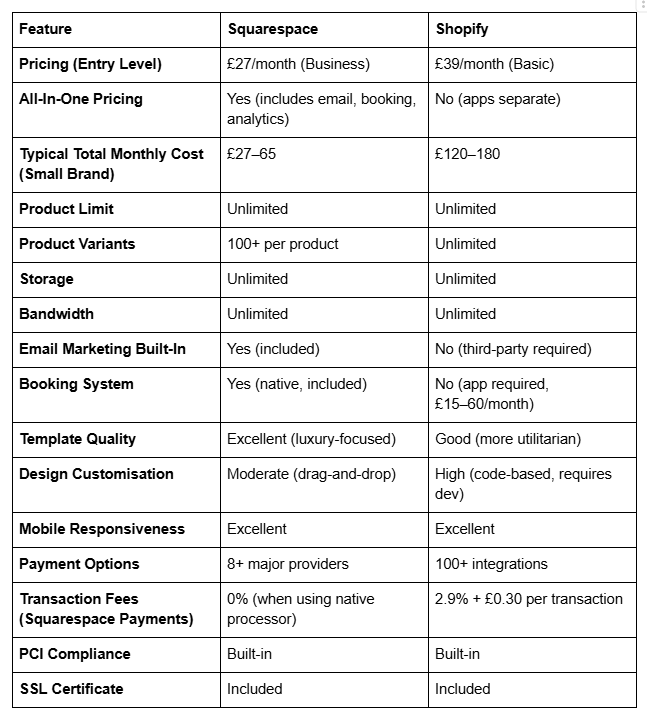
Pricing Structure: Squarespace's all-in-one pricing includes email marketing and booking features, whilst Shopify's lower base costs hide significant app expenses
Ecommerce Capabilities: Shopify scales better for brands with 200+ SKUs; Squarespace excels for curated collections and smaller to medium-sized catalogues
Booking & Services Integration: Squarespace's native booking system is purpose-built for salons and service-based beauty businesses; Shopify requires third-party apps
SEO & Content Marketing: Both platforms are SEO-capable, but Squarespace integrates content marketing tools more intuitively
Total Cost of Ownership: Squarespace typically costs less overall for small-to-medium brands when factoring in all necessary features; Shopify becomes more cost-effective at scale (500+ products)
Best for Beauty & Fashion: Squarespace wins for boutiques, salons, and luxury brands under £5,000 monthly revenue; Shopify wins for high-volume DTC brands and complex inventory needs
The Definitive Verdict: Which Platform Wins?
Before diving into specifics, understanding the fundamental philosophy of each platform is essential. Squarespace was designed as an all-in-one website builder where ecommerce, email marketing, analytics, and booking systems live under one roof. Shopify, by contrast, is ecommerce-first—it excels at selling products but treats everything else as an add-on via the app ecosystem.
For beauty and fashion brands, this distinction matters enormously. A beauty salon owner needs booking functionality without paying for three separate subscriptions. A luxury fashion boutique needs stunning visuals without needing to code custom CSS. A skincare brand needs integrated email marketing to drive repeat purchases. Squarespace bakes these essentials in; Shopify makes you assemble them Lego-style.
The platforms also attract different user types. Squarespace appeals to brand-conscious entrepreneurs who view their website as a brand asset, not just a sales channel. Shopify attracts growth-focused sellers willing to invest in apps and integrations to maximise conversion rates and transaction volume.
Design Quality and Template Excellence
Here's where Squarespace truly distinguishes itself for beauty and fashion brands. Walk through any Squarespace template gallery and you'll notice the aesthetic coherence—templates are designed with luxury retail and lifestyle brands in mind. Typography is sophisticated, spacing is generous, and image galleries are optimised for visual storytelling. A beauty brand launching on Squarespace can select a template, add product photography, and look established within days.
Shopify templates, conversely, often feel more utilitarian. Many free and budget-tier themes appear dated or generic. The platform's app-heavy architecture means design customisation frequently requires external designers, custom code, or premium theme purchases (£200–400+). For a founder with £2,000 to invest in their site, that gap matters.
That said, Shopify does offer premium themes like Prestige and Empire that rival Squarespace's best designs. But you'll pay £300–400 upfront, then face ongoing customisation costs. With Squarespace, design excellence is included at every price tier.For fashion boutiques specifically, Squarespace's carousel galleries, video backgrounds, and lookbook features create the immersive shopping experience customers expect. Beauty brands benefit from Squarespace's ability to showcase before-and-after imagery, ingredient transparency, and brand storytelling without technical debt.
Ecommerce Features and Product Management
When it comes to raw ecommerce functionality, both platforms handle the fundamentals competently. Product pages, variants, inventory tracking, and payment processing work well on both. The differences emerge at scale and complexity.
Squarespace Strengths:
Simplified product management suited to boutiques with 10–300 SKUs
Elegant product page templates that prioritise visual storytelling
Strong discount and sale management tools
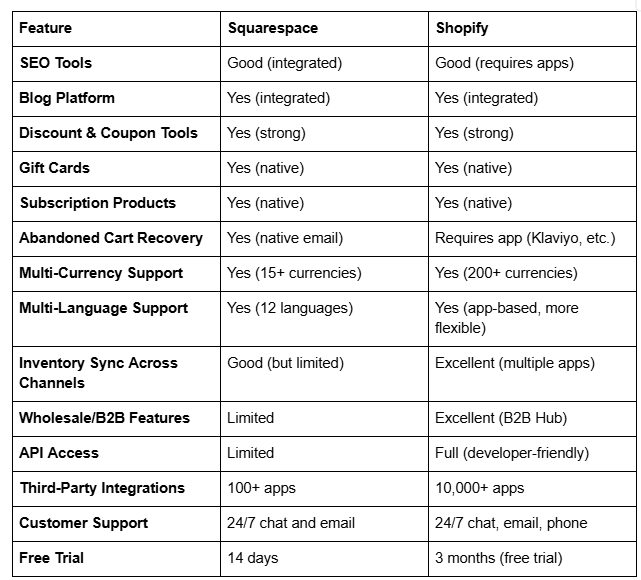
Excellent built-in email marketing for abandoned cart recovery (no additional app needed)
Native gift card and subscription product types
Shopify Strengths:
Unlimited product variants and SKU capacity without performance degradation
Advanced inventory management across multiple warehouses
Sophisticated wholesale and B2B features via the B2B Hub
Superior bulk editing and CSV import/export tools
Larger app ecosystem for custom product types and automation
For a beauty boutique with 50 SKUs or a fashion boutique with 150 items, Squarespace's product management is intuitive and complete. For a high-volume skincare brand managing 400+ SKUs across multiple suppliers and distribution channels, Shopify's tools become essential.
A critical distinction: Squarespace charges transaction fees on some payment methods (2% on card payments if you don't use Squarespace Payments), whilst Shopify charges 2.9% + £0.30 per transaction universally. For a £50 order, Shopify costs you £1.75; Squarespace costs you £1.00 with Squarespace Payments. Scale this across 10,000 annual orders and the difference becomes substantial.
Pricing: Breaking Down the True Costs
This is where many platforms mislead entrepreneurs with headline pricing that doesn't reflect reality.
Squarespace Plans (2026):
Personal: £12/month – basic features, no advanced ecommerce
Business: £27/month – full ecommerce, email campaigns, booking (ideal starting point)
Commerce Basic: £33/month – improved analytics, priority support
Commerce Advanced: £65/month – abandoned cart recovery, advanced reports
Shopify Plans (2026):
Starter: £5/month – limited (single sales channel, no standard dashboard)
Basic: £39/month – full ecommerce, 2 staff accounts
Standard: £105/month – advanced features, 5 staff accounts
Premium: £399/month – custom reporting, 15 staff accounts
The headline comparison favours Shopify's £39 entry point versus Squarespace's £27. But factor in reality:
Hidden Shopify Costs:
Email marketing app (Klaviyo, Omnisend): £20–50/month
Booking app (Acuity Scheduling, Bookify): £15–50/month
Advanced analytics app (if needed): £10–30/month
Premium theme (if not using free option): £300–400 one-time
Multiple apps for inventory, reviews, wish lists, etc.: £30–100+/month
Actual Shopify Total for a Beauty Boutique: £39 + £45 (email + booking) + £40 (additional apps) = £124+/month (not including theme)
Squarespace All-In-One:
Business plan: £27/month
Includes: ecommerce, email campaigns, booking system, unlimited products, analytics, no transaction fees on Squarespace Payments
Actual Squarespace Total: £27/month (genuinely all-in)
This is why Squarespace's total cost of ownership is typically 40–60% lower for small-to-medium beauty and fashion brands. You're not assembling a toolkit; you're using a purpose-built platform.
However, Shopify's advantage emerges at higher volumes. For a brand generating £50,000+ monthly revenue with 500+ SKUs requiring complex fulfillment automation, Shopify's transaction fee model (2.9% + £0.30) becomes more economical than Squarespace's 3% rate on some payment methods, and the app ecosystem becomes an investment that pays dividends in operational efficiency.
Booking and Service Scheduling
For beauty brands offering services—haircuts, consultations, facials, beauty coaching—booking functionality is non-negotiable. This is where Squarespace's all-in-one approach genuinely shines.
Squarespace's native booking system includes:
Calendar management and staff scheduling
Automated confirmation and reminder emails
Service duration and pricing customisation
Client intake forms and questionnaires
Integration with the main website (no redirects)
Payment collection for bookings
Capacity management and double-booking prevention
All of this is included in the Business plan (£27/month) with no additional cost.
Shopify offers no native booking system. You must integrate a third-party app like Acuity Scheduling (£15–60/month), Bookify (£29–149/month), or another solution. These apps work adequately but introduce friction: your customers book through an external portal, data doesn't always sync reliably, and you're managing yet another platform.
For a salon owner or beauty consultant selling services alongside products, Squarespace saves significant time and money whilst providing a superior customer experience. This is the single biggest differentiator for service-based beauty businesses.
SEO, Marketing, and Customer Acquisition
Both platforms are SEO-capable, but they approach content marketing and customer acquisition differently.
Squarespace SEO Advantages:
Integrated blogging platform with powerful SEO tools
Native email marketing allows newsletter content to drive repeat traffic
Automatic XML sitemaps, structured data, and meta tag control
Built-in analytics show traffic sources, customer behaviour, and conversion funnels
Integrated social media scheduling and posting
Better for content-driven brands (beauty tutorials, fashion styling guides)
Shopify SEO Advantages:
Larger app ecosystem for advanced SEO optimisation
Better suited for paid ads integration (Facebook, Google, TikTok)
Stronger connection to influencer and affiliate marketing platforms
More granular control over product data feeds for comparison shopping
For a beauty brand building audience through tutorials and educational content, or a fashion boutique using blog content for organic reach, Squarespace's integrated tools are more efficient. For a brand investing heavily in paid advertising (Facebook ads, Google Shopping, TikTok commerce), Shopify's app ecosystem offers more sophistication.
Both platforms have made strides in social commerce integration. Squarespace now allows Instagram Shopping integration, whilst Shopify leads with TikTok Shop and advanced multi-channel selling. For brands where TikTok is a primary channel, Shopify has the edge.
Feature Comparison Table
The right platform depends entirely on your business model, growth trajectory, and priorities. But we can be very specific about which platform wins for each beauty and fashion niche:
Beauty Salon or Service-Based Beauty Business: Squarespace Wins
If you're offering haircuts, facials, massages, or beauty consultations alongside retail products, Squarespace is the clear choice. The native booking system alone justifies the decision—your clients book directly on your website, receive automated reminders, and you manage everything from one dashboard. Combined with Squarespace's superior visual design and lower total cost, there's no contest. You'll save £50–100/month compared to Shopify + booking app, and your website will look more polished from day one.
Examples: Independent salon owner, freelance makeup artist, beauty coach, wellness practitioner
Luxury or Boutique Fashion Brand (Under 200 SKUs): Squarespace Wins
For fashion brands with carefully curated collections, Squarespace's design excellence and simplicity are unmatched. Your product photography is your marketing, and Squarespace's template gallery and styling tools make those images sing. You won't struggle with complexity, your costs stay predictable, and your site looks expensive. The total cost of ownership is roughly half of Shopify's true cost.
Examples: Independent fashion designer, luxury accessories brand, independent clothing boutique, pre-made or made-to-order fashion
High-Volume DTC Skincare or Beauty Brand (200+ SKUs): Shopify May Suit
If you're running a direct-to-consumer skincare brand with multiple product lines, seasonal collections, wholesale accounts, and aggressive growth targets, Shopify's app ecosystem and scalability become invaluable. Yes, you'll spend more on apps, but the platform's flexibility, bulk operations tools, and wholesale capabilities will save you time and support higher transaction volumes. Your payment processing becomes more economical at scale.
Examples: Skincare brand with 10+ product lines, multi-brand beauty retailer, supplement or wellness brand with high SKU count
Fashion Brand with Heavy Paid Advertising (Instagram, TikTok, Google): Shopify May Suit
If your customer acquisition strategy relies on paid ads across Instagram, TikTok, and Google Shopping, Shopify's deeper integration with ad platforms and dedicated apps for ad management offer advantages. The platform's reporting is more granular for paid channel attribution, and the larger developer community means custom integrations are more readily available.
Examples: Fast-fashion brand, trend-driven fashion commerce, heavy digital advertising spend
Hybrid Approach: Squarespace for Presence + Shopify for Scale
Some brands start on Squarespace for the design and booking features, then migrate to Shopify when they reach £50,000+ monthly revenue and need advanced inventory management or wholesale capabilities. This is a valid strategy—Squarespace serves as a beautiful, functional foundation, and you migrate when complexity demands it.
-
For small businesses in beauty and fashion, yes—Squarespace typically offers better value and a faster path to a professional-looking site. You get ecommerce, email marketing, booking, and analytics all included from £27/month, whereas Shopify's true cost approaches £120+ when you factor in essential apps. For small businesses with limited budgets and modest complexity, Squarespace's all-in-one approach reduces both costs and decision fatigue. However, if your small business has a complex product catalogue or relies heavily on paid advertising, Shopify's ecosystem may justify the higher cost. The decision hinges on your specific needs rather than size alone.
-
Squarespace can handle modest-to-high volume beautifully—up to around 200–300 products. Many established beauty brands run on Squarespace successfully. However, if you're managing 500+ SKUs with complex inventory across multiple warehouses, multi-supplier fulfillment, and complex discount structures, Shopify's tools become more appropriate. Squarespace also charges 3% transaction fees on some payment methods, which becomes expensive at very high transaction volumes (10,000+ orders monthly). That said, for boutique beauty brands, skincare startups, and established indie brands, Squarespace handles volume perfectly well.
-
For a fashion boutique with under 200 SKUs prioritising visual presentation, Squarespace wins decisively. The platform's template quality is specifically designed for fashion retail, featuring stunning image galleries, lookbook functionality, and sophisticated styling tools. Your clothing will look more expensive and desirable on Squarespace. Additionally, the lower total cost and all-in-one approach mean you're not distracted by app management—you can focus on inventory, styling, and customer experience. If your boutique has 400+ SKUs or you're building a multi-brand operation, Shopify becomes more practical.
-
Most beauty and fashion brands do not. Squarespace's feature set is genuinely comprehensive for 95% of small-to-medium brands. The "advanced features" Shopify promotes (wholesale accounts, complex inventory sync, custom product types via API) are valuable only if you're operating at significant scale or managing complex B2B relationships. For a beauty boutique, a fashion brand, or a salon, Squarespace's features are more than sufficient. You're likely better served investing in marketing and customer experience than paying for unused advanced features.
-
Squarespace includes email marketing (campaigns, automated sequences, abandoned cart recovery) at every paid tier, whilst Shopify requires a separate app like Klaviyo (£20–50/month). For beauty and fashion brands, this is significant because repeat purchase and customer retention are critical—beauty customers repurchase regularly, and fashion customers benefit from styling emails and seasonal campaigns. Squarespace's integrated email system means you're naturally building an email list and automating follow-ups. With Shopify, email marketing is optional (you can choose not to), which leads many new sellers to neglect it. Squarespace's inclusion means your retention workflows start from day one.
-
Shopify has significantly stronger integrations with enterprise systems (NetSuite, SAP, custom ERPs) via its API and third-party partners. Squarespace's API is more limited, and integration with legacy systems requires custom development. If you're operating with sophisticated inventory or accounting systems, Shopify's developer-friendly architecture is more suitable. Most small beauty and fashion businesses manage inventory manually or with simple systems like spreadsheets or Shopify-native tools, so this isn't a limiting factor. However, if you're managing inventory across physical retail locations, warehouses, and online channels, Shopify's integrations provide more flexibility.
-
With Squarespace, using Squarespace Payments (their native processor) means zero transaction fees—you only pay the monthly subscription. If you choose Stripe, PayPal, or another processor, Squarespace charges 3% + £0.20 per transaction on top of the processor's fees. With Shopify, regardless of which payment processor you use, you're charged 2.9% + £0.30 per transaction. For every £100 order: Squarespace Payments costs nothing extra; Stripe/PayPal via Squarespace costs £3.20; Shopify costs £3.19. At scale, Squarespace Payments is the most economical option.
Ready to Build Your Beauty or Fashion Website on Squarespace?
If this guide has convinced you that Squarespace aligns with your vision and business model, the next step is moving from comparison to creation. Squarespace's intuitive builder means you can have a functional, beautiful site live within weeks—not months. Whether you're a beauty salon owner ready to add online booking, a fashion designer launching your first collection, or a skincare entrepreneur building a DTC brand, Squarespace removes the technical barriers between your vision and reality.
The right platform isn't just about features—it's about enabling you to focus on what matters: your products, your customers, and your brand story. Squarespace does that exceptionally well for beauty and fashion businesses. You'll spend less time managing apps and integrations, and more time building relationships, creating content, and growing revenue.
If you'd like expert guidance on building your beauty or fashion brand on Squarespace, the team at Squareko.com specialises in designing custom, conversion-focused websites for beauty salons, fashion boutiques, skincare brands, and lifestyle businesses. We've helped dozens of beauty and fashion entrepreneurs in the UK launch and scale their online presence on Squarespace, and we understand the specific needs of these industries. Contact Squareko today for a free consultation on your project.

From custom website design to SEO strategy, we help businesses launch a site that looks professional and performs better.

Author Bio
Written by the Squareko Team | Squarespace Web Design Specialists | squareko.com
The Squareko team has designed 150+ Squarespace websites for beauty, fashion, wellness, and lifestyle brands across the UK. We bring deep expertise in ecommerce platform selection, design implementation, and conversion optimisation. This guide reflects real-world experience helping beauty salon owners, fashion boutiques, and skincare entrepreneurs make the right platform choice.