
Squarespace SEO for Wellness Coaches: Rank on Google and AI Search in 2026
Introduction
If your wellness coaching website isn't showing up on Google, it's invisible. Potential clients can't find you. You're missing enrolments that should be yours. But ranking for wellness coaching keywords is different from ranking for other business services. Google scrutinises health claims heavily. And now, with AI search taking off in 2026, you need to think beyond traditional SEO to "AI-optimised" content that gets recommended by ChatGPT, Perplexity, and Claude when someone asks for a wellness coach.
This guide covers everything: how to find high-intent wellness keywords that convert to clients, how to avoid YMYL pitfalls, how to build E-E-A-T that Google respects, and how to optimize your Squarespace website so you rank both in traditional search and AI recommendations.
Key Takeaways
Wellness keyword landscape has four intent types: informational (awareness), commercial (consideration), local (geographic), and transaction-specific (decision) — your content strategy must address all four
YMYL (Your Money, Your Life) applies heavily to wellness — Google won't rank health content without strong E-E-A-T signals, credentials, and proper disclaimers
E-E-A-T stands for Expertise, Experience, Authoritativeness, Trustworthiness — for wellness coaches, this means credentials (ICF/UKIHCA), evidence-based approach, testimonials, and scope clarity
Squarespace SEO basics (title tags, meta descriptions, H1 structure, internal linking) matter but are only the foundation — content quality and topical authority matter more
AI search optimisation (GEO/AEO) requires answering specific questions your target market asks — AI systems crawl your content to answer user queries; structured, clear content ranks better
Blog content drives 70-80% of search visibility for wellness coaches — your blog is your SEO engine
The Wellness Keyword Landscape
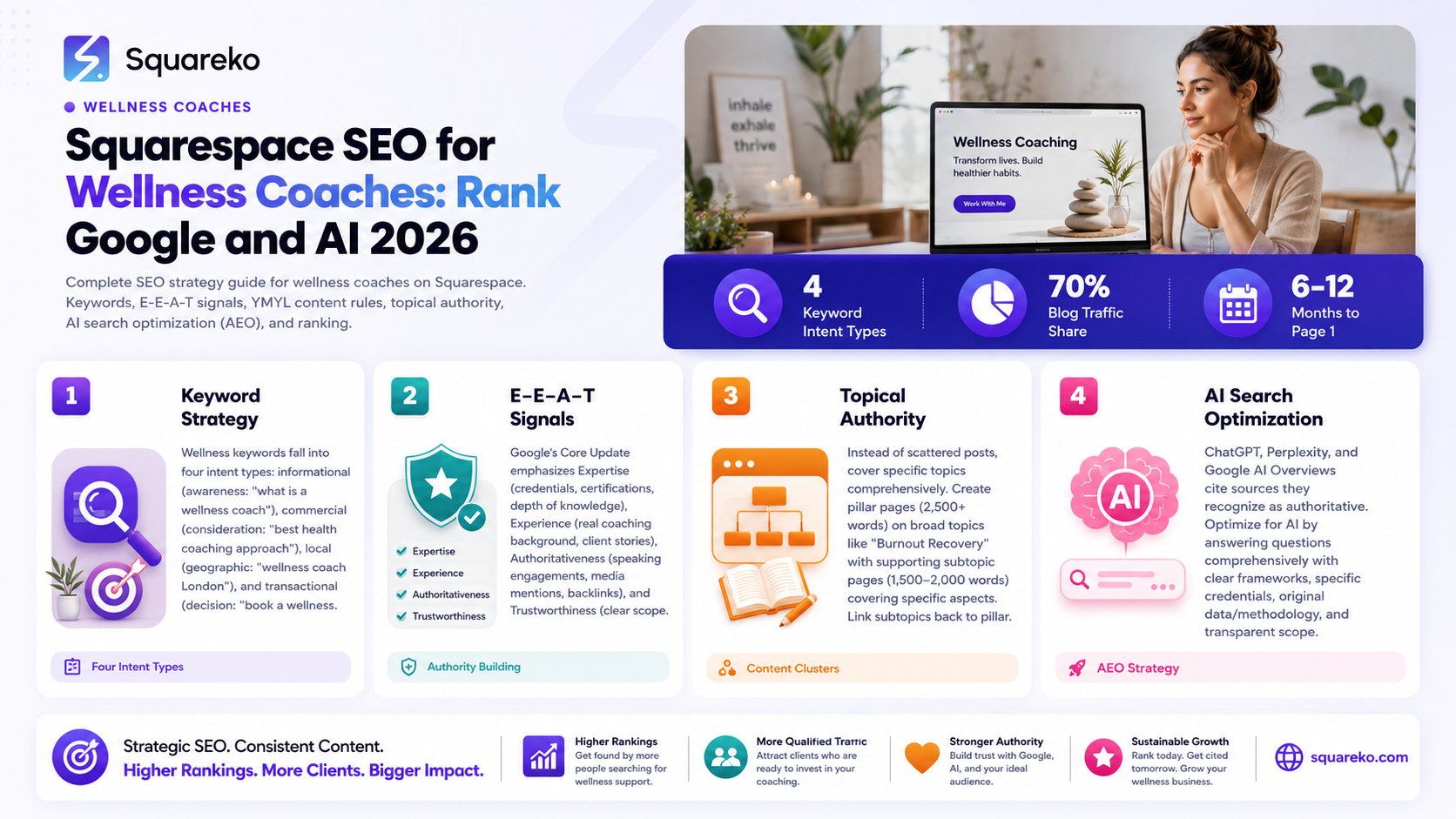
Wellness coaching keywords fall into four intent categories. Understanding each helps you build a strategy that captures the full funnel.
Type 1: Informational Keywords (Awareness Stage)
What they are: People searching to learn, not buy.
Examples:
"what does a wellness coach do"
"how to recover from burnout"
"signs of chronic stress"
"nutrition and energy levels"
"best practices for sleep hygiene"
Search volume: High (5,000–50,000+ searches/month in UK).
Competition: Medium-to-high (but lots of content is generic/low-quality).
Your opportunity: Create educational blog posts that answer these questions comprehensively. Rank for high-volume informational keywords, then use email capture and internal links to funnel people toward your coaching offer.
Example post: "How to Recover from Burnout: A 4-Step Framework" (2,500 words, comprehensive guide, email capture at bottom).
Type 2: Commercial Keywords (Consideration Stage)
What they are: People considering hiring a coach; comparing options.
Examples:
"health coach vs. nutritionist"
"wellness coaching benefits"
"how to choose a health coach"
"best health coaching approach"
"certified health coach"
Search volume: Medium (1,000–10,000/month).
Competition: Medium (other coaches, coaching platforms).
Your opportunity: Position your methodology as superior. Create comparison content ("Why Habit-Based Coaching Works Better Than Willpower") that positions you against competitors.
Example post: "Health Coach vs. Therapist: Which One Do You Need?" (1,500 words, clear scope definitions, positioning).
Type 3: Local Keywords (Geographic Intent)
What they are: People looking for a coach in their specific area
Examples:
"wellness coach London"
"health coach near me"
"burnout recovery coach Manchester"
"nutrition coach UK"
"integrative health practitioner London"
Search volume: Low-to-medium (100–2,000/month depending on location).
Competition: Low (fewer coaches competing locally).
Your opportunity: Rank easily if you optimise for local + create location-specific content. Even if you work online, you can rank locally.
Example strategy: "Wellness Coach in London" page + blog posts addressing London-specific content ("Managing Stress in London's Corporate Culture").
Type 4: Transactional Keywords (Decision Stage)
What they are: People ready to take action — book a call, buy a programme.
Examples:
"book a wellness coach"
"wellness coaching programmes"
"health coach discovery call"
"nutrition coaching online"
"hire a health coach"
Search volume: Low (100–1,000/month, but highly qualified).
Competition: High (every coach is optimising for these).
Your opportunity: These keywords convert best, but they're hardest to rank for. Target them with your main conversion pages (homepage, about, programme pages). Support them with internal links from informational content.
Building a Balanced Keyword Strategy
Most wellness coaches focus only on transactional keywords and miss huge opportunities. The winning strategy targets all four:
70% of content: Informational blog posts (awareness)
15% of content: Commercial/comparison posts (consideration)
10% of content: Local content (geographic)
5% of content: Conversion pages (transactional)
This creates a content engine that drives consistent traffic while building topical authority.
YMYL and Why Health Claims Matter
YMYL stands for "Your Money, Your Life." Google applies high scrutiny to content that affects people's health, finances, or wellbeing because misinformation causes real harm.
Wellness coaching is YMYL. Google won't rank wellness content without strong E-E-A-T signals.
How to Avoid YMYL Penalties
1. Don't make unsubstantiated medical claims
❌ Bad: "This programme reverses insulin resistance" ✓ Good: "This programme supports blood sugar management through habit and nutrition knowledge"
The first is a medical claim you can't prove. The second is wellness positioning.
2. Include evidence-based references
When you mention nutrition, sleep, or stress, back it up:
"Studies show stress increases cortisol, which affects sleep. [Link to study or meta-analysis]"
"Research from [institution] indicates that habit formation takes an average of 66 days."
Don't overdo it — you're writing for humans, not academics — but show that your claims have evidence behind them.
3. Distinguish coaching from therapy
Include a clear disclaimer:
"I am a health coach, not a therapist. My role is to support behaviour change and wellness optimisation. If you have a diagnosed mental health condition or are in mental health treatment, please continue working with your therapist. Coaching and therapy are complementary, not substitutes."
4. Include scope of practice statements
On every major page:
"This programme is not a substitute for medical care, therapy, or treatment. Please consult your healthcare provider before making significant changes based on this content."
This isn't just legal protection — it builds trust. Clients respect clear boundaries.
E-E-A-T for Wellness Coaches
Google's Core Update guidance emphasises E-E-A-T for health/wellness content. Here's how to build it for your coaching practice.
Expertise
Show that you know your field deeply.
On your website:
Credentials section with logos (ICF, UKIHCA, AFPA, NBHWC)
Certification details and accreditation number
Training background and hours of study
Relevant education/degree if applicable
In your content:
Reference scientific research, not just anecdotes
Explain complex topics clearly (sign of true understanding)
Show awareness of nuance (no oversimplification)
Example: A post on stress recovery that mentions HPA axis dysregulation, nervous system regulation, and adaptogens — showing depth without losing readers.
Experience
Show that you've actually done this, not just studied it.
On your website:
"5+ years coaching experience"
"300+ clients"
"Specializing in [specific niche]"
Client testimonials with specific transformation stories
In your content:
Share case studies (anonymised)
Mention patterns you've noticed with clients
Reference your own methodology/framework
Show how you've evolved your approach
Example: "In my first year of coaching, I focused on nutrition alone. I found 30% of clients still struggled with behaviour change. Then I studied nervous system science and shifted my approach. Now 70% see lasting results because I address the underlying physiology, not just the diet."
Authoritativeness
Be recognised as a leader in your niche.
On your website:
Speaking engagements ("Featured speaker at UKIHCA Conference 2024")
Features in media or publications
Professional association membership
Author of published work or guides
Contributions to industry discussions
In your content:
Cite peer-reviewed research
Reference other experts (shows you know your field)
Take positions on trends (show critical thinking)
Create original frameworks/methodologies
Off-site:
Get mentioned in other reputable wellness websites
Contribute guest posts to established blogs
Build professional network visibility
Trustworthiness
Make people feel safe with you
On your website:
Professional photo (real, warm, approachable)
Clear contact information
Transparent pricing
Genuine client testimonials (not generic praise)
Honest scope limitations
GDPR compliance statements
Clear refund/cancellation policies
In your content:
Be honest about what's hard ("This requires consistency")
Acknowledge where you're not the expert ("For medical nutrition questions, consult a registered dietitian")
Update old content when information changes
Correct mistakes publicly
Example: "This approach works for 70% of my clients. For the remaining 30%, we've found [alternative approach] works better. If you're in that group, we'll pivot."
Squarespace SEO Setup
Squarespace handles a lot of SEO automatically, but there are settings you need to configure.
Page-Level Setup
For every important page (home, about, programmer, blog posts):
1. Title Tag (shown in search results, browser tab)
Length: 50-60 characters
Include primary keyword early
Make it compelling (you're competing for clicks)
Example: "Wellness Coach London | Burnout Recovery | Sarah Hayes Coaching"
2. Meta Description (shown under title in search results)
Length: 150-160 characters
Include primary keyword if natural
Make it descriptive and benefit-driven
Use a CTA if appropriate
Example: "Specialised burnout recovery coaching for London professionals. 1:1 coaching, group programmes, and corporate workshops. Book a discovery call."
3. H1 (main page heading)
Should match or closely align with title tag
Only ONE H1 per page
Example: "Burnout Recovery Coaching for London Professionals"
4. H2/H3 hierarchy
Use to structure content logically
Include variations of your keyword naturally
Example H2s: "What Burnout Recovery Coaching Involves," "How I Work," "Results My Clients See"
5. URL slug
Keep short and descriptive
Use hyphens, not underscores
Example: /blog/burnout-recovery-coaching-london (good)
Example: /blog/burnout_recovery_coaching_2024 (less ideal)
6. Internal linking
Link to related pages and posts
Use descriptive anchor text, not "click here"
Example: "Read my guide on stress management strategies"
Site-Level Settings (Squarespace)
1. Go to Settings > Search Results
Verify your site title and tagline
Add a meta description for your homepage
2. Go to Settings > Basic > Advanced
Enable HTTPS (Squarespace does this by default)
Check your site URL is correct
3. Enable SSL Certificate (Squarespace does this automatically)
4. Submit Sitemap to Google
Squarespace auto-generates: yourdomain.com/sitemap.xml
Go to Google Search Console
Add your sitemap
5. Verify in Google Search Console
This is critical for monitoring rankings, clicks, impressions
Set it up immediately
Squarespace SEO Settings Per Page
In Squarespace editor:
Click on a page
Go to Settings (gear icon)
Click "SEO"
Fill in:
Page title (title tag)
Meta description
URL slug
Focal keyword (optional, but good to note)
On-Page Optimisation for Wellness Content
Beyond basic setup, here's how to optimise your content for ranking.
Keyword Placement
Primary keyword should appear in:
H1 (once)
First 100 words of content
At least one H2 (naturally)
Meta description (if space allows)
Semantic keywords (variations of your primary keyword) should appear naturally throughout:
Primary: "wellness coach London"
Semantic: "health coach London," "wellness coaching London," "London wellness practitioner"
Don't stuff keywords. Write for humans first. Keywords flow naturally.
Content Depth
Google favours comprehensive content. Aim for:
Informational blog posts: 1,500–2,500 words
Comparison/commercial posts: 1,500–2,000 words
How-to guides: 2,000–3,500 words
Programme sales pages: 1,500–2,500 words
But length alone doesn't rank you. Depth and specificity do.
Bad: "Stress is bad. Here are 5 ways to reduce stress." (700 words of generic advice)
Good: "Chronic Stress and Nervous System Dysregulation: A 4-Step Recovery Framework" (2,200 words covering HPA axis, specific techniques, case studies, research citations)
Readability and User Experience
Google's Core Web Vitals measure page speed and experience. Squarespace handles most of this, but:
Keep paragraphs short (2-4 sentences)
Use subheadings liberally
Add images (break up text, improve engagement)
Use lists (bullet points, numbered steps)
Include bold text to highlight key phrases
These aren't just SEO — they improve actual user experience, which correlates with ranking.
FAQ and Schema Markup
Include FAQs on your pages and add FAQ schema:
<!-- Please remove the commented script wrapper and add this schema inside a proper <script type="application/ld+json"> tag. -->
{
  "@context": "https://schema.org",
  "@type": "FAQPage",
  "mainEntity": [
    {
      "@type": "Question",
      "name": "What does a wellness coach do?",
      "acceptedAnswer": {
        "@type": "Answer",
        "text": "Answer here..."
      }
    }
  ]
}
FAQs:
Improve user experience
Create opportunities for featured snippets
Signal authority to Google
Building Topical Authority
Instead of scattered blog posts, Google prefers websites with deep expertise in specific topics. This is called "topical authority."
How to Build Topical Authority
Pick one or two core topics and cover them comprehensively.
Example Topic Clusters:
Topic: Burnout Recovery
"What Is Burnout? Signs and Symptoms" (pillar)
"Burnout vs. Depression: Key Differences" (subtopic)
"How Chronic Stress Affects Sleep" (subtopic)
"Nervous System Regulation Techniques" (subtopic)
"Corporate Wellness Programmes for Burnout Prevention" (subtopic)
"Burnout Recovery Coach vs. Therapist" (subtopic)
All of these link back to the main pillar. This cluster shows Google you're an authority on burnout recovery.
Topic: Habit Formation and Behaviour Change
"Why Willpower Fails (And What Actually Works)" (pillar)
"How Habits Form: The Science" (subtopic)
"Identity-Based Habits vs. Goal-Based Habits" (subtopic)
"Habit Stacking: Build New Routines Effortlessly" (subtopic)
"Breaking Bad Habits: A Framework" (subtopic)
Internal Linking for Topical Authority
Link strategically:
Create a pillar page (comprehensive guide on your main topic)
Create subtopic pages (deep dives on specific aspects)
Link from subtopic pages back to pillar
Link from blog posts to pillar pages
Build a content hub that shows interconnectedness
This signals to Google that you own this topic.
AI Search Optimisation (GEO/AEO)
Google is moving toward AI search (SGE). ChatGPT, Perplexity, and Claude are gaining market share. To rank in AI search, you need to think differently.
How AI Search Works
When someone asks ChatGPT "What's the best wellness coach approach for burnout?", the AI crawls relevant websites and synthesises an answer. Your content either gets included in that synthesis (wins visibility) or doesn't.
AI systems prefer:
Clear structure — numbered lists, step-by-step breakdowns
Specific frameworks — not generic advice, but your actual methodology
Evidence — citations, research, credentials
Direct answers — say what you mean early
Optimizing for AI Search (AEO)
1. Answer the core question immediately
Don't bury your answer after 3 paragraphs.
❌ Bad: "Stress is something everyone experiences. Let me tell you a story about a client... [300 words later] Here's the answer..."
✓ Good: "Burnout recovery requires three elements: nervous system regulation, belief restructuring, and behaviour change. Here's how each works..."
2. Use numbered lists and frameworks
AI loves structure.
❌ Bad: "There are several ways to manage stress. You might try meditation, exercise, breathing..."
✓ Good: "The 3-Step Stress Recovery Framework:
Nervous system regulation (vagus nerve activation)
Belief restructuring (challenge thought patterns)
Behaviour change (implement new routines)"
3. Include specific, actionable information
❌ Bad: "Sleep is important."
✓ Good: "Adults need 7-9 hours of sleep per night. Consistent sleep timing (same bedtime/wake time within 30 minutes) improves sleep quality by 40% according to [study]."
4. Cite your methodology
AI systems mention your approach when it's specific and well-documented.
❌ Bad: "I use a holistic approach to health coaching."
✓ Good: "My Nervous System-First Coaching Model prioritises HPA axis function before addressing behaviour. Research shows stress dysregulation undermines willpower by 60%, so we stabilise your nervous system first."
5. Include expert credentials and citations
AI mentions whether you're qualified to speak on this topic.
"I'm ICF-certified with 5 years of health coaching experience"
"Research shows [finding]. Here's the study: [link]"
"According to UKIHCA guidelines..."
GEO (Generative Engine Optimisation)
GEO is optimising content specifically for AI recommendations. The goal: When someone asks an AI "recommend a wellness coach for burnout," your name comes up.
How to get recommended by AI:
Be specific and distinctive — "I specialise in burnout recovery for corporate professionals using nervous system science" > "I'm a wellness coach"
Build online presence — mention on podcasts, LinkedIn, industry publications. AI systems reference publicly available information about you.
Create searchable content — blog posts and guides that AI pulls from to answer questions
Cite scientific research — AI trusts sources with evidence
Be credentialed — ICF, UKIHCA, AFPA certification signals authority
Contribute to industry conversations — speak, publish, participate in recognized professional forums
Technical SEO for Squarespace
Squarespace handles most technical SEO automatically, but here's what to monitor:
Core Web Vitals
Google measures three metrics:
Largest Contentful Paint (LCP) — How fast does the main content load?
Target: Under 2.5 seconds
Squarespace: Usually good, but compress images
First Input Delay (FID) — How responsive is the page?
Target: Under 100ms
Squarespace: Usually good
Cumulative Layout Shift (CLS) — Does the page jump around as it loads?
Target: Under 0.1
Squarespace: Usually good, avoid auto-playing video
How to Improve Core Web Vitals on Squarespace
Compress images before uploading (use TinyPNG or similar)
Limit video embeds above the fold
Minimise external scripts (rarely needed)
Use Squarespace's native features rather than custom code
Check your scores in Google Search Console (Speed section) or Google PageSpeed Insights.
Mobile Optimisation
Squarespace is mobile-first. But ensure:
Mobile viewport is set (Squarespace does this)
Buttons/links are large enough (48px minimum)
Text is readable (16px minimum font)
Forms aren't cramped (stack vertically on mobile)
Test on actual mobile devices, not just browser simulation.
Content Strategy That Ranks
Here's a 12-month content strategy for a wellness coach wanting to rank and build authority.
Months 1-3: Foundation (Blog Launch)
Focus: Establish topical authority
Content (1 post/week, 1,500+ words each):
"What Does a Wellness Coach Do?" (informational, high volume)
"Signs You Need a Health Coach" (awareness, emotional resonance)
"Health Coach vs. Therapist" (commercial, positioning)
"How to Choose a Wellness Coach" (commercial, decision support)
"The Nervous System and Stress: A Science Primer" (pillar, deep dive)
"Burnout Recovery: A 4-Step Framework" (pillar, transformation focused)
"Why Willpower Fails" (commercial, positioning)
"Sleep, Stress, and Wellness" (topical, supportive)
"Building Healthy Habits: The Real Science" (pillar, evergreen)
"Nutrition and Energy: Why Diets Fail" (commercial, positioning)
"Wellness Coaching for Busy Professionals" (local/commercial, niche)
"How to Find a Wellness Coach in [Your City]" (local, transactional)
Goal: Establish topical authority, capture awareness-stage traffic, build email list.
Months 4-6: Expansion (Topical Authority Building)
Focus: Deepen topical clusters, start ranking for commercial terms
Content (1-2 posts/week):
Create sub-topics under your pillars
Link between related posts
Update and refresh month 1-3 posts
Target seasonal/trending topics
Internal linking: Create hub pages linking all related posts
Email: Start nurturing email sequences for each pillar topic
Months 7-12: Scaling (Conversion & Reputation)
Focus: Rank for commercial/transactional keywords, optimise conversion
Content:
Continue topical expansion
Create conversion-focused pages linked to your blog
Refresh high-performing posts
Add video content (YouTube links to boost authority)
Off-site:
Guest posts on established wellness blogs
Podcast appearances
LinkedIn thought leadership
Monitoring:
Track keyword rankings (free tool: Google Search Console)
Monitor traffic sources
Measure blog-to-discovery-call conversion
Refine topics based on data
Monitoring and Optimisation
Don't set-and-forget your SEO.
Tools to Monitor
Free:
Google Search Console (rankings, clicks, impressions, issues)
Google Analytics 4 (traffic sources, user behaviour, conversions)
Google PageSpeed Insights (Core Web Vitals)
Paid (optional, if scaling):
SEMrush, Ahrefs (keyword research, competitor analysis)
Ubersuggest (keyword volume, difficulty)
Quarterly Review
Every three months, review:
Top traffic sources — What keywords drive most traffic?
Top conversion sources — Which blog posts lead to discovery calls?
Underperforming content — What could you improve?
New opportunities — What keywords are close to ranking?
Let Squareko Optimise Your Wellness Website
SEO is essential for wellness coaching businesses — it's how prospects find you. But it requires consistent strategy, quality content, and ongoing optimisation.
At Squareko, we specialise in helping wellness coaches build SEO-optimised Squarespace websites. We conduct keyword research specific to your niche, create a content strategy that ranks, set up Squarespace SEO properly, and ensure your website builds topical authority over time.
We've helped burnout recovery coaches, nutrition specialists, integrative health practitioners, and group wellness programme facilitators rank on Google and get recommended by AI search.
Frequently Asked Questions
-
Expect 3-6 months to see initial ranking movement, 6-12 months to rank on page 1, and 12+ months to reach top 3 positions for highly competitive keywords. Local keywords rank faster (4-8 weeks). Consistency matters more than speed.
-
Both, but start with local if you're new to SEO. "Wellness coach London" is easier to rank for than "best wellness coach UK." Once you rank locally, expand to regional/national.
-
Google Search Console (free) shows what you're already ranking for. Google Keyword Planner (free, requires Google Ads account) shows search volume. Ubersuggest (£10-15/month) is affordable for small agencies. Ahrefs/SEMrush (£75+/month) if you scale.
-
Technically yes, but it's hard. Your about, programme, and home pages can rank, but blogs capture 70% of search visibility for wellness because they address awareness-stage keywords. You need blog content.
-
Both. Long-tail keywords (4-5 words: "burnout recovery coaching for professionals") are easier to rank for and more specific. Short-tail (1-3 words: "wellness coach") are harder to rank for but have higher volume. Target long-tail first, then expand.
-
No. Squarespace SEO is nearly equivalent to WordPress. The differences are minimal. Squarespace is actually better for most small coaching practices because it handles technical SEO automatically, whereas WordPress requires plugins.
-
Important but not essential. If you have 10-15 quality backlinks from established wellness sites, that helps. But for a local wellness coach, ranking is 70% content quality, 20% technical SEO, 10% backlinks.
-
SEO targets Google's traditional algorithm (ranking for keywords). AEO targets AI search engines (getting cited in ChatGPT/Claude responses). AEO is newer and emphasises clear frameworks, citations, and expert credentials. Both matter in 2026.
Build an SEO-Optimised Wellness Coaching Website That Ranks
Ranking on Google isn't optional for wellness coaches. It's how your practice grows. But SEO requires the right strategy, quality content, and ongoing optimisation.
At Squareko, we combine Squarespace expertise with wellness business knowledge to build websites that rank and convert. We handle keyword research, content strategy, technical setup, and ongoing optimisation so you focus on coaching.
From custom website design to SEO strategy, we help businesses launch a site that looks professional and performs better.

About the Author
Walid Hassan is the founder of Squareko,
I'm Walid Hasan, a Certified Squarespace Expert and Squarespace Circle Platinum Partner with over 12 years of hands-on experience designing and optimizing high-performing websites. Over the years, I've had the privilege of building more than 2,000 Squarespace websites for clients around the world, always focusing on clean design, strong user experience, and conversion-driven results.
