Local SEO for Wellness Coaches on Squarespace: Attract Clients in Your Area
Introduction
Most wellness coaches think "SEO is too competitive. I'll focus on social media." Then six months in, they're paying for ads to fill discovery calls that should be coming from Google for free. Local SEO changes that equation. In your city, you're competing with maybe 3-5 other wellness coaches, not thousands. You can rank locally in weeks, not months.
This guide walks you through exactly how to optimise your Squarespace website for local search — so when someone in your area searches "wellness coach near me" or "health coach London," you show up. We'll cover Google Business Profile optimisation, local keyword strategy, citations and directories, the unique challenge of online-only coaches, and how to build local partnerships that drive referrals.
Key Takeaways
Google Business Profile is the most important local SEO tool — optimising it properly can rank you on Google Maps and local search within weeks
Local keywords are far less competitive than national — "wellness coach London" is easier to rank for than "best wellness coach UK"
Online-only coaches can still rank locally — you optimise for local intent while clarifying you work online; many people search for local coaches even if they work with them remotely
Citations and local directories build authority — listings on Yelp, Waze, and niche wellness directories signal to Google that you're a real, established local business
Local partnerships (gyms, yoga studios, corporate wellness) drive referrals and build SEO signals — Google recognises these connections and improves your local ranking
Client reviews are critical for local ranking — more reviews and higher rating directly improve local search visibility
How Local SEO Works
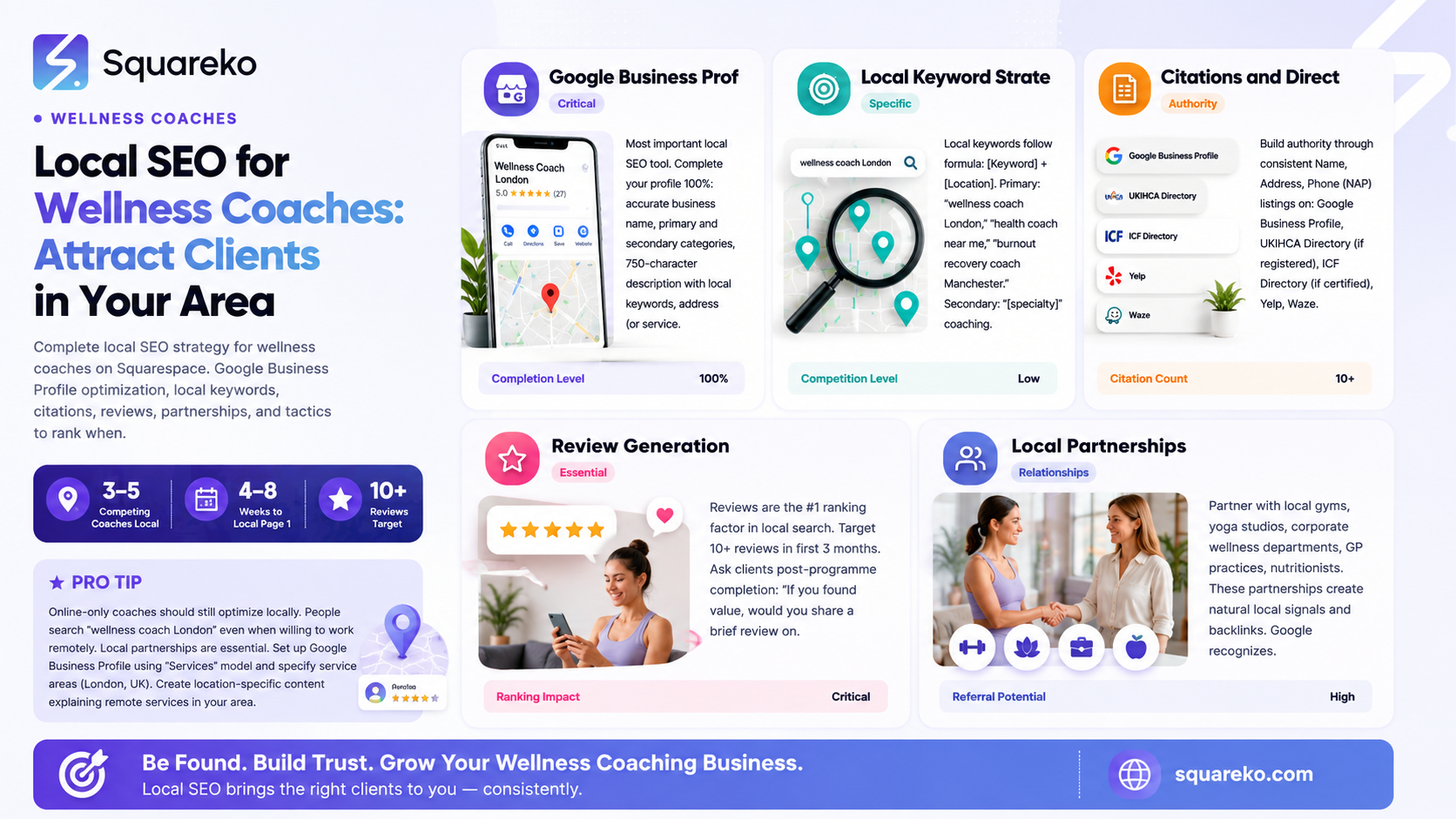
Local search is different from organic search. When someone searches wellness coach on Google, the algorithm ranks billions of pages globally. When someone searches "wellness coach London," the algorithm has a different goal: show them businesses near them, right now.
Google uses three signals to determine local ranking:
Relevance — Does your business match what they're searching for?
Distance — How far away are you from their search location?
Prominence — How well-known and trusted is your business?
You can't control distance (if they're in Manchester and you're in London, you won't rank). But you can absolutely control relevance and prominence.
Why Local SEO Is Essential for Wellness Coaches
Reason 1: Less competition
National wellness keywords: "health coach" gets 50,000 searches/month in the UK with 1,000+ competing coaches. Impossible for a solo coach to rank.
Local keywords: "wellness coach London" gets 500-1,000 searches/month with maybe 10-15 coaches competing. You can rank.
Reason 2: Higher intent
Someone searching "wellness coach London" is ready to work with someone local. They're not browsing; they're shopping for a coach. Conversion rate is 3-5x higher than national searches.
Reason 3: Faster results
Local ranking happens in 4-8 weeks with proper optimisation. National ranking takes 6-12 months. If you need to fill your programme soon, local is where to focus.
Reason 4: Builds authority in your area
Ranking locally makes you visible in your community. Referrals come naturally. People recommend you. Your reputation grows locally first, then you can expand.
Google Business Profile Optimisation
Google Business Profile is the single most important local SEO tool. If you don't have one, create it today. If you have one but it's incomplete, fix it immediately.
Step 1: Create or Claim Your Google Business Profile
Go to google.com/business and search for your business.
If it exists: Claim it (Google sends verification via postcard or phone).
If it doesn't exist: Create it.
Step 2: Complete Your Profile (100% Completion)
Google rewards complete profiles with higher local ranking. Fill every field:
Business Name
Use your actual business name
Example: "Sarah's Wellness Coaching" or "Sarah Hayes Health Coach"
Don't keyword stuff: "Sarah's Health Coach Wellness Coaching" is wrong
Category (most important) Choose primary category carefully:
"Health Coach" (most accurate for wellness coaches)
"Life Coach" (if you focus on life transitions)
"Wellness Program" (if you run group programmes)
Add 3-5 secondary categories:
"Coaching Center"
"Nutritionist"
"Stress Management"
Description (750 characters) Write a compelling description that includes keywords naturally:
"Sarah is an ICF-certified health coach specialising in burnout recovery for London professionals. She works 1:1 with clients using nervous system science and habit psychology to create lasting behaviour change. Sarah's approach combines stress resilience coaching, sleep optimisation, and nutrition science. She offers discovery calls, 6-week group programmes, and ongoing 1:1 coaching.
This description:
Includes keywords naturally ("health coach," "London," "burnout recovery," "stress")
Shows credentials (ICF-certified)
Explains what you do specifically
Mentions offerings
Address If you work from home or only online, you have options:
Option 1: Your home address (if you conduct discovery calls from your office)
Enter your real address
Select "Serves area" in coverage area settings
Set service radius (e.g., 10 miles from London postcode)
Option 2: Workspaces or shared offices (if you have a physical presence)
Enter the address of the co-working space or clinic
Clarifies you have a physical space
Option 3: Online-only (if you work entirely online)
Don't enter a specific address
Google will let you set "Service area" to cover clients you serve online
See the "Online-Only Coaches" section below for details
Phone Number Use your business phone number, not personal. If you use a personal number, that's fine, but list it as your business contact.
Website Link to your Squarespace website. This is critical — Google crawls your site to verify your business details.
Hours Set your availability hours. If you don't have a physical office, set hours when you're available for discovery calls/coaching.
Service Area (if you're online-only or travel to clients) Select "Serves areas" and add the locations you serve
"London" (city)
"South East England" (region)
"UK-wide" (if you work nationally)
Photos (critical) Upload 10-20 high-quality photos:
Professional headshot (clear, warm, professional)
Your office/workspace
Lifestyle photos (if relevant to your coaching)
Client testimonial graphics (results, transformations)
Your credentials (certification badges, diplomas)
Quality matters. Blurry phone photos hurt ranking. Invest in a professional headshot.
Videos (if you have them) Upload welcome video, introduction, or client transformation. Videos boost engagement significantly.
Attributes (fill completely)
Languages you speak
Accepts online appointments (YES)
Accepts credit cards (if relevant)
Wheelchair accessible (if applicable)
Step 3: Manage Posts and Updates
Google Business Profile has a "Posts" feature. Use it:
Monthly posts (2-4 per month):
Announce new programmers
Share a tip or insight
Highlight a client success (anonymized)
Promote a blog post
Example post: "New 6-Week Burnout Recovery Programmer starting March 15. Last 3 spots available. Book your discovery call →"
Posts stay visible for 7 days, then disappear but the engagement counts toward your profile authority.
Step 4: Reviews (The Game-Changer)
Reviews are the most important ranking factor in local search. More reviews + higher average rating = higher local ranking.
Why reviews matter:
Direct ranking signal (Google trusts customer feedback)
Trust signal (potential clients see other people's positive experiences)
Content (Google crawls review text, which helps ranking)
Target: 10+ reviews in your first 3 months. Then aim for 1-2 new reviews monthly.
See the "Reviews and Reputation Management" section below for strategy.
Local Keyword Strategy
Local keywords follow a simple formula: [Keyword] + [Location]
Core Local Keywords
Primary (highest priority):
"wellness coach [your city]" — e.g., "wellness coach London," "health coach Manchester"
"health coach near me"
"[Your specialty] coach [your city]" — e.g., "burnout recovery coach London," "nutrition coach Manchester"
Secondary:
"[Specialty] coaching [your city]"
"best wellness coach [your city]"
"online wellness coach [your city]" (if you work online)
"holistic health practitioner [your city]"
Long-tail local:
"wellness coach for burnout [your city]"
"health coach for busy professionals [your city]"
"stress management coaching [your city]"
Keyword Research for Your Area
Use Google Keyword Planner (free):
Go to Google Ads > Keyword Planner
Search: "wellness coach [your city]"
Review search volume and competition
Identify which variations have volume in your area
Example: If you're in London and search "wellness coach London," you might find 500/month volume. "Wellness coach Manchester" might be 200/month. Prioritise the keywords with actual search volume in your location.
Where to Use Local Keywords
1. Google Business Profile
Description
Service areas
Posts
2. Your Squarespace Website
Location/About page: "Wellness Coach in London"
H1: "Burnout Recovery Coaching for London Professionals"
Local blog posts
Footer with location
3. Local Directory Listings
Business name / description
Service area descriptions
Building Citations and Local Presence
Citations are mentions of your business (name, address, phone number) on other websites. They're a trust signal and a ranking factor.
High-Priority Local Directories
Google-Owned / Critical:
Google Business Profile (done above)
Google Maps (auto-populated from GBP)
Wellness/Health Directories:
UKIHCA Directory (UK Institute of Health Coaching)
If you're UKIHCA-registered, list yourself
Major trust signal for UK health coaches
ICF Directory (International Coaching Federation)
If you're ICF-certified, list yourself
Prestigious, improves authority
AFPA Directory (American Fitness Professionals and Associates)
If certified, list yourself
Wellness.com / Wellness Directories
General wellness practitioner directories
Get listed in your city
LinkedIn Local Business Pages
Create a company page for your practice
Use local keywords in description
Link to your Squarespace site
Review Directories:
Yelp (create free business account)
Add photos, description, hours
Major trust signal (lots of reviews)
Waze (add your business)
Links to Yelp reviews
Seen by 100+ million drivers
TripAdvisor (if offering local packages or retreats)
Search "health coaches" in your city
Create a profile
Facebook / Instagram Local Business Pages
Free to set up
Improves local presence
Links back to your website
Citations Best Practice
When creating citations, ensure Name, Address, Phone (NAP) consistency:
Always use the same business name
Always use the same address (or consistently use online-only designation)
Always use the same phone number
Inconsistencies confuse Google and hurt ranking.
Example:
GBP: "Sarah Hayes Health Coaching"
Yelp: "Sarah Hayes Wellness Coaching"
LinkedIn: "Sarah H. Health Coach"
This inconsistency weakens your local signal. Keep it identical.
Squarespace Setup for Local Search
Your website should signal to Google that you're a local business.
Local Page / Location Page
Create a dedicated page for your location(s):
URL: /wellness-coach-london or /london
Content:
H1: "Wellness Coach in London"
300-500 words explaining your presence and service area
Local keywords naturally integrated
Photo of you or your office
Testimonials from local clients
Local landmarks you serve ("Serving clients across Central London, Canary Wharf, and South London")
Local Schema (see below): Ensure your location page has LocalBusiness schema
Blog Posts with Local Intent
Write location-specific blog content:
"Managing Stress in London's Corporate Culture"
"Nutrition for Busy London Professionals"
"Burnout Recovery: A London-Specific Guide"
These posts:
Rank for local keywords
Build topical authority in your area
Link back to your main location page and services
Footer Local Signals
Include in footer:
Your location/city prominently
Local landmarks or neighborhoods you serve
Phone number with local format
Local Schema Markup
Schema markup is structured data that tells Google what your website is about. For local businesses, use LocalBusiness schema.
LocalBusiness Schema
Add this to your location page (or homepage) in Squarespace Code Injection:
<!-- Please remove the commented script wrapper and add this schema inside a proper <script type="application/ld+json"> tag. -->
  {
  "@context": "https://schema.org",
  "@type": "LocalBusiness",
  "name": "Sarah Hayes Wellness Coaching",
  "image": "https://yoursite.com/photo.jpg",
  "description": "ICF-certified health coach specialising in burnout recovery and stress resilience coaching in London.",
  "address": {
    "@type": "PostalAddress",
    "streetAddress": "123 Main Street",
    "addressLocality": "London",
    "addressRegion": "England",
    "postalCode": "SW1A 1AA",
    "addressCountry": "GB"
  },
  "telephone": "+44 20 1234 5678",
  "url": "https://yoursite.com",
  "priceRange": "£97 - £297",
  "areaServed": {
    "@type": "City",
    "name": "London"
  },
  "sameAs": [
    "https://www.facebook.com/yourpage",
    "https://www.linkedin.com/company/yourpage"
  ]
}
Reviews and Reputation Management
Reviews are the #1 ranking factor in local search. More reviews + higher rating = higher ranking.
How to Ethically Collect Reviews
Method 1: Direct Email After Completion
After a client completes a programme or series of sessions:
Email subject: "How was your experience?"
Email body: "Hi [Name], I'd love to hear your experience working together. If you found value, would you consider sharing a brief review on Google? It helps other people find their way to coaching. [Link to Google review]"
Key: Make it easy. Provide the direct link.
Method 2: QR Code or NFC Card
Create a QR code linking directly to your Google review. Hand it to clients after sessions or include in email follow-ups.
Method 3: Post-Discovery-Call Sequence
Send email 1 day after discovery call: "Thanks for taking time to chat. Would you leave a quick review of our call?"
(Only email people who might have had a positive experience — don't mass-mail every prospect.)
Method 4: LinkedIn or Facebook Reviews
If someone leaves you a LinkedIn recommendation, ask if they'd also review you on Google. People are more likely if they've already done it once.
What to Ask For in Reviews
Don't ask for 5-star reviews. Ask for honest feedback:
"If you'd be willing, I'd love a review on Google sharing your experience. What changed for you? What did you appreciate about working together?"
Good reviews mention:
Specific transformation ("I've more energy and clearer focus")
Your approach ("She taught me about my nervous system, not just given me rules")
Credentials/professionalism ("Professional, knowledgeable, warm")
Bad reviews that don't help:
"Great coach!" (too vague)
5-star with no text (Google deprioritizes these)
Responding to Reviews
Respond to every review, good or bad.
For 5-star reviews: "Thank you so much, Sarah! I'm thrilled you're feeling the shift. It was wonderful working with you. Hope to see you again soon."
For 3-4 star reviews: "Thanks for the feedback. I'm glad [specific thing they mentioned] helped. If there's anything I could have done differently, I'd love to hear it. Feel free to reach out anytime."
For 1-2 star reviews: Don't be defensive. Address the concern professionally.
"Thanks for taking the time to share. I'm sorry the programme didn't meet your expectations. I'd genuinely like to understand what didn't work so I can improve. Would you be willing to chat? [Contact info]"
Google shows your response to potential clients. Thoughtful, professional responses build trust.
Target: 10+ Reviews in First 3 Months
If you have no reviews and launch local SEO, aim for 10 in your first 90 days. This signals to Google that you're an active, trusted local business.
Monthly target after that: 1-2 new reviews.
Local Partnerships and Directories
Partner with local businesses to build authority and drive referrals.
Partnership Types
1. Gyms and Fitness Studios
Offer: 10% affiliate commission on client referrals
You: Provide a one-page flyer they can share with members
Benefit: Wellness coaching complements their services
2. Yoga Studios
Offer: Partner discount (yoga + coaching bundle)
You: Cross-promote via email / website
Benefit: Same target audience
3. Corporate Wellness
Offer: Lunch-and-learn workshops, group coaching, corporate packages
You: Work with HR departments in your area
Benefit: Recurring revenue, multiple client referrals per deal
4. GP Practices / Healthcare Clinics
Offer: Patient referral (GPs can recommend coaching for lifestyle support)
You: Work within scope (don't claim to treat medical conditions)
Benefit: Trusted referral source, authority boost
5. Nutritionists / Dietitians
Offer: Complementary services (they handle nutrition; you handle behaviour)
You: Cross-refer clients
Benefit: Holistic client experience
Local Directories and Wellness Platforms
Register on wellness-specific directories:
Mindbody (wellness booking platform)
Register your practice
Clients can book through Mindbody
Improves discoverability
Treatwell (UK health and wellness booking)
List your services
Handle bookings through their platform
Local visibility boost
Wellnicity (corporate wellness)
If you offer corporate coaching, list here
B2B opportunities
Local chamber of commerce
Join your local chamber
Get listed in business directory
Network and partnership opportunities
Healthlynked or local health directories
Search your area and register
The Challenge: Online-Only Coaches
Many wellness coaches work entirely online. Does local SEO still apply? Absolutely.
Why Online Coaches Should Optimise Locally
Reason 1: People search locally even for online services
Someone searches "wellness coach London" because they want a London coach, even if it's remote. They might want someone who understands their local context, timezone, or culture.
Reason 2: Referral sources are local
Even if you work online, local referral partners (gyms, yoga studios, corporate) are still in your geographic area. Local partnerships drive business.
Reason 3: Lower competition locally
You're competing with 5-10 coaches in your area, not 1,000 nationally.
Local SEO Strategy for Online-Only Coaches
1. Google Business Profile
Option A: Use your home address (less common for online coaches) Option B: Use a commercial address if you have one (even if just meeting clients there occasionally) Option C: Use "Services" model in GBP
To set up GBP for online-only:
Create profile
Select "Serves areas" instead of "has a physical address"
Set service areas: your city, region, country as applicable
In description, note: "Online health coaching serving clients across London and the UK"
2. Keywords
Use location keywords that signal online:
"Online wellness coach London"
"Virtual health coach UK"
"Remote nutrition coaching [your city]"
But also use local keywords:
"Wellness coach London" (some people search this even for online)
3. Location Page
Still create a location page explaining your service area:
"I work with clients across London and the UK via online coaching. Whether you're in Central London, Manchester, or Glasgow, we can work together via Zoom. Serving professionals, parents, and anyone seeking sustainable behaviour change and wellness transformation."
4. Local Partnerships
Even more important for online coaches:
Partner with local gyms (they send you clients)
Partner with corporate HR departments (they book your workshops)
Build local referral relationships
5. Local Schema
Use LocalBusiness schema with service area, not physical address:
<!-- Please remove the commented script wrapper and add this schema inside a proper <script type="application/ld+json"> tag. -->
{
  "@context": "https://schema.org",
  "@type": "LocalBusiness",
  "name": "Sarah Hayes Wellness Coaching",
  "description": "Online health coach serving clients across London and UK",
  "url": "https://yoursite.com",
  "telephone": "+44 20 1234 5678",
  "areaServed": [
    {
      "@type": "City",
      "name": "London"
    },
    {
      "@type": "Country",
      "name": "GB"
    }
  ],
  "priceRange": "£97 - £297"
}
Ready to Dominate Local Search
Local SEO is the fastest path to qualified clients for most wellness coaches. In your area, you're not competing with 1,000 coaches — you're competing with 5-10. Your Google Business Profile, local keywords, reviews, and partnerships can get you ranking in 4-8 weeks.
At Squareko, we help wellness coaches optimise for local search on Squarespace. We set up your Google Business Profile properly, create local keyword strategy, build local citations, and integrate local schema so you rank when someone nearby searches for a wellness coach.
We've helped burnout recovery coaches, nutrition specialists, integrative health practitioners, and stress resilience coaches dominate local search in their areas.
Frequently Asked Questions
-
With proper Google Business Profile optimisation and 5-10 initial reviews, you can rank on page 1 of local results in 4-8 weeks. National keywords take 6-12 months. Local is significantly faster.
-
Yes. People search for local coaches even when working with them remotely. Local partnerships (gyms, yoga studios, corporate) are still in your geographic area. Plus, local keywords are far less competitive.
-
You can rank with 0 reviews if you have a complete Google Business Profile. But 5-10 reviews dramatically improve ranking. 10+ reviews puts you ahead of most competitors. After that, 1-2 new reviews monthly maintains your position.
-
Use "Services" model in Google Business Profile. Select "Serves areas" and specify the cities/regions you serve. Many online-only coaches rank this way.
-
Google Business Profile is most important for local ranking. Yelp is secondary but still helps. Focus on getting Google reviews, but Yelp reviews help too.
-
Yes. More citations = more authority. But ensure your NAP (Name, Address, Phone) is consistent across all listings. Inconsistencies hurt ranking.
-
Yes. Partnerships with local businesses create natural backlinks and local signals. Google recognises these connections. Plus, they drive direct referrals, which matter more than SEO.
-
Local search shows 3-5 results prominently. But Google displays different results based on the person's location, reviews, and search term. With proper optimisation, you can rank even in competitive areas. Start with long-tail keywords ("wellness coach for burnout London") which are less competitive.
Rank Locally and Fill Your Wellness Coaching Practice
Local SEO is the fastest, most reliable way to attract qualified clients in your area. Stop paying for ads when you can rank for free on Google Maps.
At Squareko, we help wellness coaches optimise for local search. We set up your Google Business Profile, create local keyword strategy, build citations, manage reviews, and integrate local schema so you rank when people search for wellness coaches in your area.
From custom website design to SEO strategy, we help businesses launch a site that looks professional and performs better.

About the Author
Walid Hassan is the founder of Squareko,
I'm Walid Hasan, a Certified Squarespace Expert and Squarespace Circle Platinum Partner with over 12 years of hands-on experience designing and optimizing high-performing websites. Over the years, I've had the privilege of building more than 2,000 Squarespace websites for clients around the world, always focusing on clean design, strong user experience, and conversion-driven results.