How to Sell Wellness Coaching Programmes and Online Courses on Squarespace
Introduction
Scaling a wellness coaching business means moving beyond 1:1 sessions. Group programmers, digital courses, self-paced modules, subscription memberships — these create revenue that doesn't depend on your hourly availability. But selling them requires a different setup than a discovery-call funnel.
This guide walks you through everything you need to know about selling digital coaching programmers on Squarespace: setting up payment infrastructure, choosing between one-time purchases and subscriptions, structuring your content, and integrating email marketing to drive programmer launches. If you want scalable income from your expertise, this is where that starts.
Key Takeaways
Squarespace Commerce handles one-time programmer sales and payment plans — no external e-commerce platform needed
Member Areas lock content behind login, allowing you to deliver video lessons, worksheets, and ongoing resources securely
Subscription/membership models create recurring revenue — clients pay monthly for ongoing access, stability you can count on
Programmer pricing strategy matters more than platform choice — price too low and you undermine your value; price too high and you lose buyers
Email marketing integration is essential for programmer launches — coordinated campaigns drive enrolments and fill spots
Clear legal disclaimers and scope of practice statements protect you and set client expectations
Scaling Beyond 1:1: Why Programmers Matter
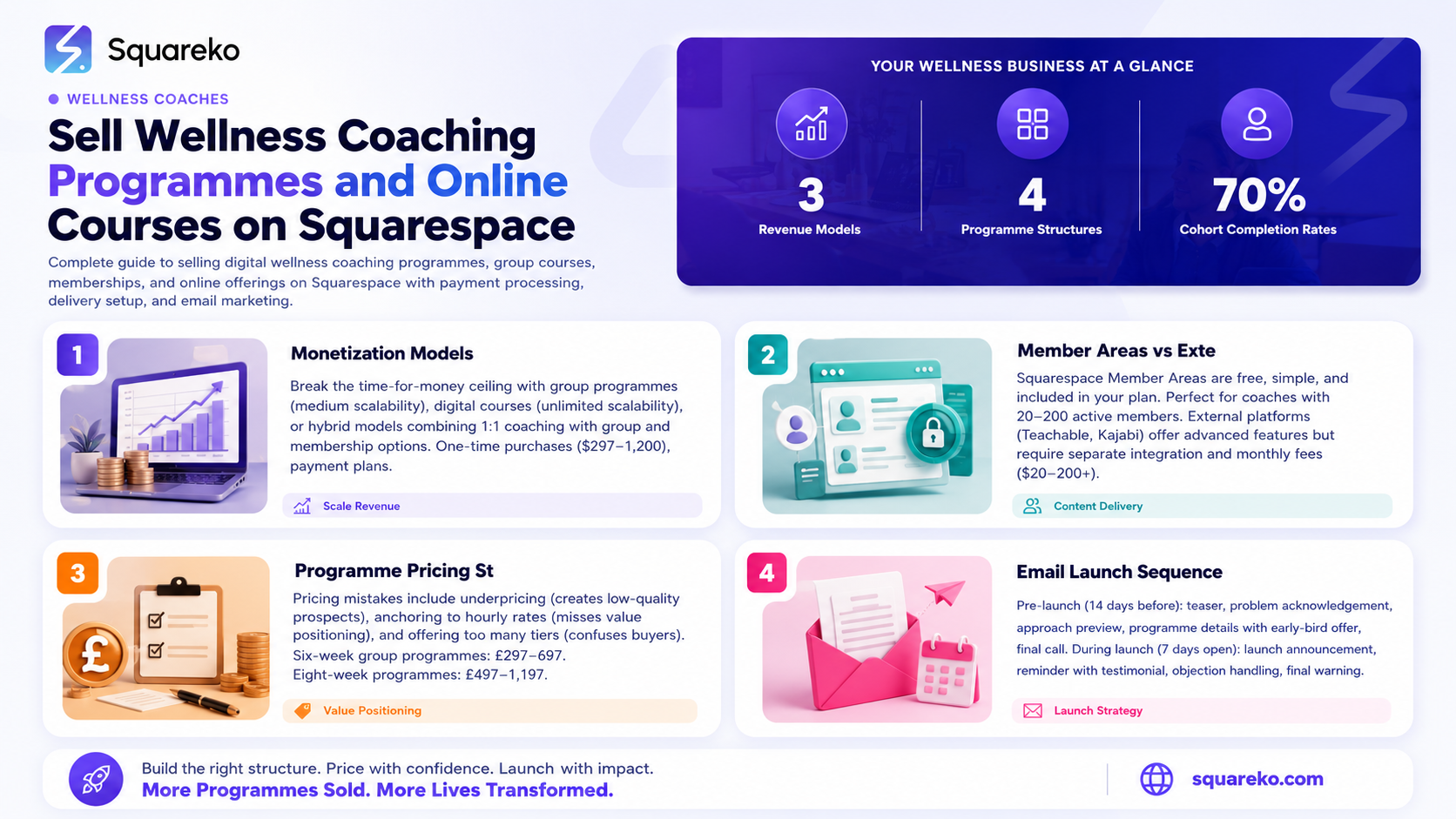
When your income is purely based on your hourly availability, you've hit a ceiling. You have 40 billable hours a week. Even at £150/hour, that's £7,500 per week. Most wellness coaches can't command premium rates on 1:1 coaching alone.
But when you package your expertise into group programmers, digital courses, or membership communities, you break the time-for-money equation.
The Three Revenue Models
1:1 Coaching (Time-Bound)
Income: Limited by your availability
Scalability: Low
Leverage: Your personal time
Example: £150/hour × 30 hours/week = £4,500/week
Group Programmers (Semi-Scalable)
Income: £297 × 15 clients = £4,455 per 6-week programmer cycle
Scalability: Medium (you can handle 15-20 clients in a group)
Leverage: Your time is concentrated; more clients, same effort
Example: Three group programmers running per year = £13,365/year plus 1:1 revenue
Digital/Self-Paced Courses (Highly Scalable)
Income: £97 × 50 clients = £4,850 per launch (100% passive after creation)
Scalability: Unlimited (no cap on enrolments)
Leverage: You create once, sell infinite times
Example: Three launches per year + ongoing evergreen sales = £15,000–£30,000/year passive revenue
Most successful wellness coaches use all three: 1:1 for premium clients who want intensive support, group programmers for people wanting community and accountability, and digital courses for people wanting affordable access to your methodology.
Choosing Your Monetization Model
Before you set up anything on Squarespace, decide what you're actually selling.
Model 1: One-Time Purchase Group Programmer
What it is: Clients pay once, get access for the duration of the programmer (typically 6-12 weeks).
Best for: Cohort-based courses, structured programmers with defined start/end dates, seasonal offerings.
Price point: £297–£1,200 depending on duration, group size, depth.
Platform setup: Squarespace Commerce (one-time purchase) + Member Area (content delivery).
Example: "The 8-Week Nutrition Reset" — clients enrol, join the cohort, do the programmer together, then it ends.
Model 2: Payment Plans
What it is: Clients pay in installments rather than upfront (e.g., three payments of £299 instead of £897).
Best for: Higher-priced programmers (£600+), making programmers accessible without a large upfront investment.
Price point: Same as one-time purchase, just split across payments.
Platform setup: Squarespace Commerce (payment plan option available).
Psychology: People are more likely to buy a £800 programmer if they can pay £270/month for three months than if they see the full £800 price tag.
Model 3: Subscription Membership
What it is: Clients pay monthly for ongoing access to your content, community, and support.
Best for: Ongoing coaching, content libraries, communities, membership-based coaching (like a "coaching club").
Price point: £29–£97/month depending on what's included.
Platform setup: Squarespace Member Areas with recurring charges (subscription).
Example: "The Wellness Collective" — £47/month, members get monthly group coaching calls, resource library, community forum, email support.
Model 4: Hybrid (1:1 + Group + Membership)
What it is: Offer multiple ways to work with you at different price points.
Best for: Coaches with established practices wanting to meet clients where they are.
Setup: Multiple Squarespace products with different access levels.
Example: Discovery call (free) → Group programmer (£497) → VIP 1:1 coaching (£2,000) + optional Membership add-on (£37/month).
Structuring Your Online Programmer
How you structure your programmer affects completion rates, perceived value, and how satisfied clients are.
Structure 1: Cohort-Based (Live Group)
Duration: 6-12 weeks, specific start date.
Delivery: Live weekly group calls + asynchronous content (videos, worksheets).
Access: Expires after programmer ends, though you might offer lifetime access to recorded calls.
Ideal for: Transformation-focused programmers, communities, accountability-based coaching.
Weekly structure:
Monday: Video lesson (15-20 min) + worksheet
Wednesday: Live group call (90 min) with Q&A
Friday: Resource post (article, recipe, template)
Content per module:
1 instructional video (15-25 min)
1 worksheet or workbook
1-2 supplementary resources
1 group coaching call recording
Structure 2: Self-Paced Course
Duration: Lifetime access (or you specify, e.g., "90 days of access").
Delivery: Recorded videos, downloadable resources, no live interaction.
Access: Immediate, self-directed learning.
Ideal for: Foundational content, broad audiences, passive income.
Module structure:
Intro video
3-5 core video lessons (12-20 min each)
Downloadable workbook/guide
Quiz or reflection prompts
Resources list
Structure 3: Hybrid (Self-Paced + Group)
Duration: 6-8 weeks, self-paced core + live group calls.
Delivery: Recorded videos done at your own pace + one live group call per week.
Access: Expires after programmer period, then transitions to on-demand.
Ideal for: Best of both — flexibility of self-paced, community of live group.
Weekly:
Self-paced lesson (video + worksheet) available from Monday
Live group call Wednesday evening (optional attendance, recorded if you miss)
Reflection prompt due Friday
Which Structure Converts Best?
Cohort-based: Highest completion rates (60-70%) because of accountability and community. Requires active facilitation.
Self-paced: Lower completion rates (20-30%) because no accountability, but lower facilitator effort.
Hybrid: Moderate completion rates (40-50%) with balanced effort and community.
Setting Up Squarespace Commerce for Programmer Sales
Squarespace Commerce is built into Squarespace and makes selling digital products simple — no external platform needed.
Step 1: Create a Product
Go to Commerce > Products
Click "Add Product"
Enter product details:
Title: "The 6-Week Burnout Recovery Programmer"
Description: Your full sales copy (see POST 02 for sales page structure)
Price: £597
Product category (optional): "Programmers" or "Coaching"
Decide on delivery method:
Digital file (if you're selling downloadable PDF workbooks)
Product variants (if you have tiered pricing: Basic for £397, Premium for £597)
Quantity limits (if you want to cap enrolments — e.g., "Only 12 spots available")
Set payment options:
One-time purchase (£597)
OR recurring charge (£199/month)
OR payment plan (3 × £199)
Step 2: Set Up Member Area Access
If you're delivering content via Member Area (recommended for anything with video or ongoing access), link the product purchase to Member Area access.
Go to Member Area > Settings
Create access tiers (e.g., "Programmer Enroled," "VIP Member")
Link each product to an access tier:
When someone purchases "The 6-Week Burnout Recovery Programmer," they automatically get "Programmer Enroled" access
This automatically grants them access to gated content once they complete purchase and log in.
Step 3: Customise Product Page
Squarespace generates a product page automatically, but you want to customise it to look like part of your brand, not a generic "shop."
Create a custom product page using your template's design
Embed your full sales copy (see POST 02 for the arc: headline, problem, approach, what's included, outcomes, etc.)
Add customer testimonials specific to this programmer
Include FAQ section addressing specific programmer questions
Add the commerce buy button prominently
This feels more like a landing page than a shop, which converts better for coaching programmers.
Step 4: Email Receipt Automation
When someone purchases, Squarespace sends an automatic receipt. You can customise the email to include:
Warm welcome message — "You're in! Here's what happens next..."
Member Area login details — "Click here to access your programmer"
Welcome video link — Set expectations, introduce yourself
First week's lesson — Start momentum immediately
FAQ or next steps — What should they do first?
This is your first touchpoint after purchase. Make it warm and clear.
Member Areas vs. External Platforms
Squarespace Member Areas are built-in, simple, and included with your plan.
External platforms (Teachable, Kajabi, Thinkific) are specialised for course delivery but require separate integration and fees.
Squarespace Member Areas: Pros and Cons
Pros:
No extra cost (included in your Squarespace plan)
Simple setup, no learning curve
Members log in once to access coaching content + community + everything else
Email integration works natively
Cons:
Limited quiz/assessment features
No built-in student progress tracking
Community features are basic (no threaded discussions)
If you scale to 1,000+ members, you might want more robust platform
Best for: Wellness coaches with 20-200 active members/clients.
External Platforms (Teachable, Kajabi, Thinkific): Pros and Cons
Pros:
Advanced features (quizzes, progress tracking, detailed analytics)
Robust community/discussion boards
Certificates, badges, gamification
Dedicated customer support
Cons:
Monthly cost (£20–£200/month depending on platform)
Separate login for students (they don't see your main website)
Extra integration step (Squarespace + Teachable)
Steeper learning curve
Best for: Coaches at scale (500+ members), heavily course-dependent business model, or wanting advanced student engagement features.
Our Recommendation
Start with Squarespace Member Areas. They're free, they're simple, and they're perfect for wellness coaches launching their first few programmers. If you eventually need advanced features, you can migrate to an external platform.
Pricing Your Wellness Programmers
Pricing is psychology and positioning, not just math.
Pricing Mistakes Wellness Coaches Make
Mistake 1: Underpricing
Charging £197 for a 6-week programmer because "that's what competitors charge"
This trains your market to expect low price, attracts deal-seekers not committed clients, and makes it hard to raise prices later
Underpriced programmers have poor completion rates
Mistake 2: Not anchoring to value
Charging based on your hourly rate (e.g., "6 weeks × 5 hours = 30 hours × £100 = £3,000")
Clients don't pay for your time on group programmers; they pay for transformation and access to community
A group of 12 people × £597 = £7,164 for 6 weeks of your time. That's reasonable. But charging £100/hour doesn't reflect that
Mistake 3: Price confusion
Offering too many price tiers (Basic, Professional, Premium, VIP) confuses buyers
Stick to one or two clear options
Pricing Framework for Wellness Programmers
For 6-week group programmers: £297–£697
Lower end: foundational content, smaller group (8-12), lower barrier to entry
Higher end: transformation-focused, intensive 1:1-in-group model, multiple calls per week
For 8-12 week programmers: £497–£1,197
Longer duration justifies higher price
More time for transformation
For self-paced courses: £97–£297
Lower price because no live facilitation
Shorter access window (lifetime vs. ongoing support)
For membership: £29–£97/month
Recurring model means price feels smaller (£47/month easier to justify than £564/year)
Include ongoing value: monthly calls, content updates, community
Pricing Strategy: Payment Plans Over Single Payment
Example: A 6-week group programmer could be:
Single payment: £597
OR 3 monthly payments: £199/month
Research shows the monthly option converts better. Why? Psychological barrier is lower. £199 feels more approachable than £597, even though the total is the same.
Offer both. Many people will choose single payment to feel "committed," and many will choose payments to feel it's more accessible.
Email Marketing and Programmer Launches
Email is how you fill your programmers. A coordinated campaign before launch can mean the difference between 3 enrolments and 15.
Pre-Launch Email Sequence (14 Days Before Enrollment Opens)
Email 1 (Day -14): Teaser
Subject: "Something's coming (and it's for you)"
Brief: Hint at your upcoming programmer without full details
Goal: Get people curious, start opening your emails
Length: 150-200 words
Email 2 (Day -10): Problem Acknowledgement
Subject: "[Specific Problem] is more common than you think"
Full: Share a client story that illustrates the problem your programmer solves
Goal: Build resonance; people see themselves
Length: 250-400 words
Email 3 (Day -7): Approach Preview
Subject: "How we solved [problem] (in 6 weeks)"
Full: Explain your methodology without the full pitch
Goal: Build trust in your approach
Length: 300-400 words
Email 4 (Day -4): Programmer Details + Early Bird
Subject: "Introducing: [Programmer Name] (+ £50 early-bird discount)"
Full: Complete programmer details, what's included, price, early-bird offer
Goal: Drive first enrolments
Include: Link to programmer sales page, Squarespace buy button
Length: 400-500 words
Email 5 (Day -1): Final Call
Subject: "Enrolment opens tomorrow (reserve your spot today)"
Brief: Urgency without aggression; link to programmer
Goal: Last push before official launch
Length: 150-200 words
During-Launch Sequence (7 Days Open)
Day 1: Launch announcement (you also announce on social, website banner, etc.)
Day 3: Reminder + testimonial
Day 5: Objection handling ("Is this right for me?" "Can I get a payment plan?")
Day 7: Final warning + decision deadline
Post-Launch Sequence
Day 1 after close: Thank you to enroled clients + welcome packet
Day 7: First lesson reminder + introduction to community
Upsell and Downsell Strategies
Every client is an opportunity for additional revenue.
Upsell (Client Buys More)
Discovery call → Group programme → 1:1 coaching upgrade
After someone completes your group programme, offer a pathway to 1:1 work:
"Loved the group programme? Let's take your transformation deeper with personalized 1:1 coaching (£3,000 for 6 weeks)"
Email: Send to group graduates only
Timing: Week 5 of programme (while momentum is high)
Conversion rate: 15-25% of group graduates
Membership add-on
After someone buys a course, offer membership for ongoing support:
"Course complete? Keep the momentum going with our £47/month Coaching Collective—ongoing calls, resources, and community"
Offer during post-course survey
Conversion rate: 20-30%
Downsell (Free/Cheap Option for "No" Buyers)
If someone doesn't buy your £597 programme, offer something smaller:
"Not quite ready? Join our free email series on [topic]"
OR "Start with our £97 foundational course before committing to the full programme"
This keeps them engaged; many will upgrade later
Legal Disclaimers and Scope of Practice
YMYL content requires clear legal positioning. This protects you and sets client expectations.
Essential Disclaimer Language
Include on your sales page, in programme materials, and in email communication:
"Important: Coaching vs. Medical Advice I am a certified health coach, not a doctor, therapist, nutritionist, or medical professional. My role is to support behaviour change and wellness optimisation within the scope of wellness coaching.
I do not diagnose, treat, or prescribe for any medical condition. If you have an existing health condition, are on medication, or are seeing a healthcare provider, please continue to do so and consult with them before making significant changes based on this programme.
If you experience a mental health crisis, please seek immediate professional help. This programme is not a substitute for therapy or mental healthcare."
Scope Specificity
Be clear about what your coaching covers and doesn't:
My scope as a health coach includes:
Supporting behaviour change around nutrition, movement, sleep, and stress
Identifying limiting beliefs about health
Accountability and habit formation
Education on wellness topics from established sources
My scope does NOT includes:
Medical diagnosis or treatment
Therapy or mental health treatment
Nutritional medical claims
Replacing medical care
Make this part of your welcome materials so clients understand the boundaries from day one.
Frequently Asked Questions
-
Yes, absolutely. Offer both as separate products. Your 1:1 offering links to discovery call booking; your group programme has a sales page and buy button. You can position 1:1 as premium/intensive and group as accessible/community-focused.
-
Self-paced courses: 20-30% completion. Cohort-based (live group) programmes: 60-70%. Hybrid: 40-50%. The difference is accountability. Live programmes with group accountability dramatically increase completion.
-
Video lessons: 12-20 minutes. Anything longer and engagement drops. Pair each video with a worksheet, reflection prompt, or resource to extend value beyond the video.
-
You don't need certification by law, but it's strongly recommended. ICF (International Coaching Federation), UKIHCA (UK Institute of Health Coaching), or AFPA certification builds credibility and protects you legally. Include your credentials on your sales page.
-
Yes, and many coaches do. You might offer "The Nutrition Reset" as a self-paced course (£97) and also run it as a cohort-based group programme (£497). Different people will choose different formats.
-
5-7 emails over 14 days pre-launch, then 4-5 during the open period. More than that and people unsubscribe. Less and people forget about it. Space them out (every 2-3 days) so you're present without being overwhelming.
-
Most of your clients will have card access. If you want to accept alternative payments (PayPal, bank transfer), you can use Squarespace's PayPal integration. You can also manually invoice clients and they pay via bank transfer, though this is less frictionless.
-
Set a clear refund policy (usually 7-14 days, full money-back, no questions asked). Make this visible before purchase. Most people refund if they enrol and realise it's not right for them. This is expected cost of doing business.
Ready to Scale Your Revenue
Selling digital programmes and courses is how you break the time-for-money ceiling. It's how a £100K coaching practice becomes £150K, then £200K+.
But success requires the right setup: clear pricing, strategic email marketing, integrated payments, accessible delivery, and legal clarity.
At Squareko, we help wellness coaches set up scalable revenue streams on Squarespace. We handle commerce setup, Member Area configuration, email integration, and sales page design so your programmes sell.

From custom website design to SEO strategy, we help businesses launch a site that looks professional and performs better.

About the Author
Walid Hassan is the founder of Squareko,
I'm Walid Hasan, a Certified Squarespace Expert and Squarespace Circle Platinum Partner with over 12 years of hands-on experience designing and optimizing high-performing websites. Over the years, I've had the privilege of building more than 2,000 Squarespace websites for clients around the world, always focusing on clean design, strong user experience, and conversion-driven results.