AI Search Strategy for Coaches and Educators on Squarespace: Get Found by Ideal Clients
Key Takeaways AI Search Strategy for Coaches and Educators
AI search platforms (ChatGPT, Perplexity, Gemini, Claude) are now part of how potential clients discover coaches — optimising for them is no longer optional
GEO (Generative Engine Optimisation) and AEO (Answer Engine Optimisation) are the strategic frameworks for AI search visibility
The fundamentals of AI search optimisation align significantly with good content creation — clear, specific, authoritative answers get cited
Entity prominence — how well AI systems know your name, business, and expertise — is becoming a key ranking factor
Coaches who build genuine topical authority through consistent content will naturally perform well in AI search environments
Three years ago, getting found online as a coach meant ranking on Google. Today, a growing proportion of your potential clients aren't just using Google — they're asking ChatGPT, Perplexity, Claude, or Gemini to recommend coaches, answer their questions, and guide their decisions. The search landscape has fundamentally shifted.
This isn't a reason to panic, and it's not a reason to abandon traditional SEO. It's a reason to build a smarter strategy — one that works for both traditional search engines and the AI platforms increasingly shaping how people discover services.
This guide explains exactly how coaches and educators can optimise their Squarespace websites to appear in AI-generated answers, become recommended by AI search platforms, and build the kind of digital presence that performs across every search environment in 2026.
How AI Search Engines Work (and Why It Matters for Coaches)
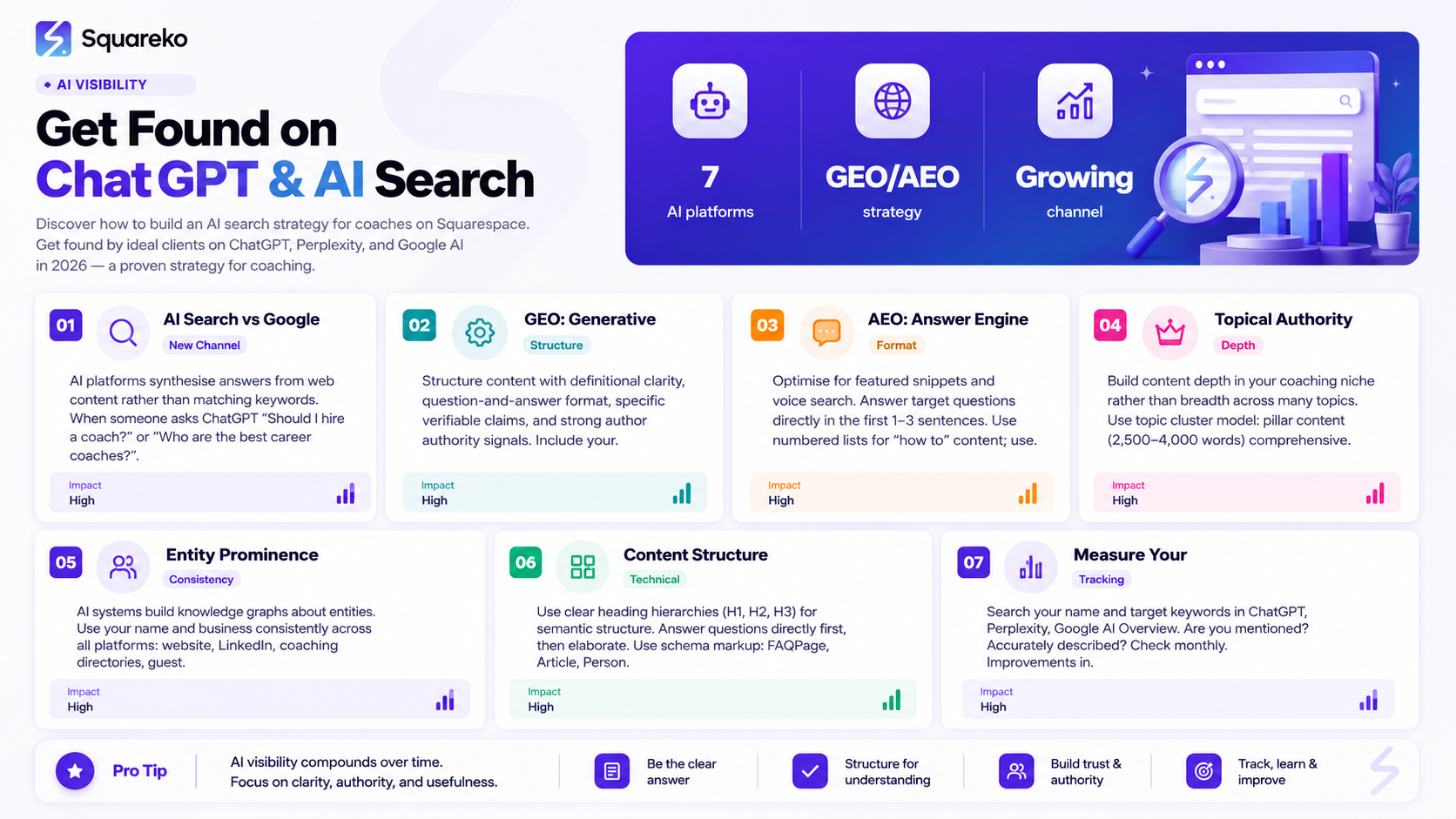
The Shift From Keyword Search to Conversational Discovery
Traditional Google search works on keyword matching — you type life coach for burnout, Google matches it to pages containing those words, and ranks results by relevance, authority, and other signals.
AI search is different. When someone asks ChatGPT I'm burned out and considering hiring a life coach — what should I look for?, the AI doesn't just match keywords. It synthesises an answer from its training data and (in tools like Perplexity) from current web results. It may recommend types of coaches, explain what to look for, and in some cases name specific coaches or businesses it has encountered in high-authority sources.
For coaches, this creates both an opportunity and a challenge:
Opportunity: If your content, credentials, and website are structured in ways that AI systems can easily read and cite, you can appear in AI-generated answers that reach clients who never would have found you through traditional search.
Challenge: AI search is less transparent than Google. You can't simply check your position for a keyword — you have to understand how AI systems select the content they reference and build a strategy around that.
What AI Search Platforms Look For
AI search platforms — particularly those that retrieve current web content (Perplexity, Bing AI, Google AI Overviews) — tend to favour content that:
Directly answers specific questions
Is written by identifiable, credentialed experts
Has been cited or referenced by other authoritative sources
Uses clear, structured formatting that makes answers easy to extract
Is specific rather than generic — AI systems prefer cited, concrete information over vague claims
These preferences align significantly with good SEO content — which is the good news. You're not starting from scratch. You're extending your existing content strategy.
GEO: Generative Engine Optimisation for Coaching Websites
Generative Engine Optimisation (GEO) is the practice of structuring your content and online presence to be favoured by AI language models when they generate responses.
Core GEO Principles for Coaches
Definitional clarity — AI systems respond well to content that clearly defines concepts. A blog post that explains what is somatic coaching? with a specific, quotable definition is more likely to be referenced by an AI system than a vague overview of the topic.
Structured question-and-answer format — AI systems that generate direct answers love content that's already in a Q&A format. Your FAQ sections, blog posts structured around specific questions, and even your service page copy framed as answers to client questions all contribute to this.
Specific, verifiable claims — Many coaches report improved client confidence is forgettable. A 2024 ICF Global Coaching Study found that 80% of coaching clients reported improved self-confidence is citable. Where you can support claims with specific data, research, or statistics, do so. It dramatically increases your quotability.
Author authority signals — Include your credentials, experience, and expertise prominently. A post attributed to Walid, Squarespace specialist and founder of Squareko with 10+ years of experience building coaching websites carries more authority in AI systems than an unattributed post. Make your author bio comprehensive and consistent across all content.
GEO for Coaching Service Pages
Your service pages can be GEO-optimised too. Frame your coaching philosophy and approach as direct answers to questions: How does [your name]'s coaching approach work? What results do [programme name] clients achieve? Who is [programme name] designed for? These framed answers give AI systems clear, quotable content about your services.
AEO: Answer Engine Optimisation for Coaches
Answer Engine Optimisation (AEO) focuses on optimising content to appear in featured snippets, voice search results, and AI-generated direct answers. For coaches, this primarily means:
Featured Snippet Optimisation
Google still shows featured snippets — short answer boxes that appear above regular search results. A coaching website that captures featured snippets for relevant questions gets massive visibility — and the content that wins featured snippets is also the content that AI systems tend to reference.
To win featured snippets:
Answer the target question directly in the first 1–3 sentences after the relevant heading
Aim for 40–60 word answers for concise featured snippets
Use numbered lists for how to questions (Google often features numbered steps)
Use bulleted lists for best of or types of questions
Follow the answer with deeper elaboration — the snippet shows the summary, but the page depth builds authority
Voice Search Optimisation for Coaches
Voice search queries tend to be longer and more conversational than typed searches. Hey Siri, what's the difference between a life coach and a therapist? is a voice search — and it maps directly to FAQ content on a coaching website. Structure your FAQs to answer these natural language questions, and you're simultaneously optimising for voice search and AI assistant queries.
Question-First Content Planning
The most effective AEO strategy for coaches is to plan content around the specific questions your ideal clients are asking — before they know they need a coach. Map these questions by stage:
Awareness stage: Why do I feel stuck in my career?, What is burnout and how do I know if I have it?
Consideration stage: What does a life coach actually do?, How is coaching different from therapy?
Decision stage: How do I choose a life coach?, What should I look for in a career coach?
Create dedicated content that answers each question specifically. That content serves both Google SEO and AI search visibility.
Building Topical Authority on Your Squarespace Site
Topical authority is the principle that search engines and AI systems reward websites that comprehensively cover a specific topic area over websites that cover many topics shallowly.
For coaches, this means: rather than publishing occasional posts on a variety of loosely related topics, build a content library that deeply covers your coaching niche. A career coach whose blog has 30 posts covering every angle of career change, job searching, negotiation, and professional development is seen as a topical authority on career coaching — which increases visibility across all related searches.
The Topic Cluster Model for Coaching Blogs
Structure your blog content as topic clusters:
Pillar content — a comprehensive guide that covers your main topic at length (2,500–4,000 words). For a career coach: The Complete Guide to Changing Careers in Your 40s.
Cluster content — shorter, more specific posts that each cover one aspect of the pillar topic and link back to it. How to handle career change imposter syndrome, Networking for career changers who hate networking, How to explain a career gap in interviews, and so on.
Internal linking — all cluster posts link to the pillar, and the pillar links to the clusters. This signals topical depth and authority to both Google and AI systems.
A Squarespace blog managed with this structure over 12–24 months can become a genuinely authoritative resource in your coaching niche — which has compounding benefits for both traditional SEO and AI search visibility. How to Build a Coaching Website on Squarespace That Books More Discovery Calls.
Entity Prominence: Getting AI Systems to Know Your Name
Entity prominence refers to how well-known your name and business are to AI systems. AI language models build knowledge about the world from the information they're trained on — which includes websites, articles, directories, social profiles, podcast transcripts, press mentions, and more.
If your name, business name, and coaching niche appear consistently across many authoritative sources, AI systems are more likely to include you in relevant generated answers. If you exist only on your own website, AI systems have little basis to reference you.
Building Entity Prominence as a Coach
Consistent name and business name — Use exactly the same name across all platforms. Walid at Squareko should appear the same way on your website, LinkedIn, ICF directory listing, press mentions, and podcast appearances.
Guest content and PR — Being quoted in industry publications, podcast interviews, and guest blog posts builds your entity signal. Even a few well-placed mentions in relevant, authoritative contexts can significantly increase your AI search visibility.
Social profiles and professional directories — Maintain active, complete profiles on LinkedIn, ICF's coach finder, and other relevant professional directories. These are sources AI systems draw from and link to.
Wikipedia, Wikidata, and knowledge bases — For more established coaches, a presence in structured knowledge bases (even in a small way, through mentions in relevant Wikipedia articles) contributes to entity recognition.
Consistency matters — The same messaging about who you help, what you specialise in, and what your approach is should appear consistently across all of these touchpoints. Inconsistency confuses AI knowledge graphs.
Structuring Your Squarespace Content for AI Extraction
How you structure your content matters as much as what you say. AI systems extract information more effectively from well-structured content.
Use Clear Heading Hierarchies
Squarespace's heading styles (H1, H2, H3) create semantic structure that AI systems read. Every major section of your blog posts should have an H2. Subsections within those sections should use H3. Don't use headings for decoration — use them to signal content structure.
Direct Answer First, Context Second
For any question-based section heading, answer the question directly in the first sentence or two. Elaborate after. This is the inverted pyramid structure — most important information first. AI systems are much more likely to cite a section that opens with a direct answer than one that builds slowly to the conclusion.
Use Schema Markup
FAQ schema, Article schema, and Person schema all help AI systems understand your content. FAQ schema tells AI systems which content is in Q&A format and is appropriate for featured snippet or direct answer use. Person schema establishes your name, credentials, and areas of expertise as structured data that AI systems can parse and reference.
Format Lists Clearly
When using bullet points or numbered lists, keep them parallel (same grammatical structure for each item) and specific. AI systems extract list content cleanly — a well-structured list on your coaching website can appear verbatim in an AI-generated summary.
Measuring Your AI Search Performance
AI search visibility is harder to measure than traditional SEO, but there are practical approaches.
Brand Name Queries in AI Search
Periodically search your name and business name in ChatGPT, Perplexity, and Google's AI Overview. What does each say about you? Are you mentioned at all? Are the mentions accurate and positive? This gives you a baseline sense of your current AI visibility.
Google AI Overviews for Your Target Keywords
Check whether your target keywords trigger AI Overviews in Google search. If they do, is your content in the featured answer? If not, what content is? Understanding what Google is citing in AI Overviews for your keywords tells you what type of content and structure is working for AI extraction in your niche.
Traditional Metrics as Proxies
Improvements in organic search traffic, featured snippet captures, and direct brand searches all correlate with improved AI search visibility. While you can't directly measure ChatGPT citations, a rising trend in these traditional metrics suggests your content is building authority that also benefits AI search presence.
Build an AI-Ready Coaching Website Before Your Competitors Do
Most coaches don't have an AI search strategy yet. That's a window of opportunity for coaches who move now — before their niche becomes saturated with AI-optimised content.
Squareko builds Squarespace coaching websites with AI search strategy built in from the start. Content architecture, schema markup, structured FAQ sections, entity optimisation — every site is built to perform in the search environment of 2026, not 2019.
FAQs
-
GEO stands for Generative Engine Optimisation — the practice of structuring your content and online presence to be favoured by AI language models when they generate responses. It matters for coaches because AI search platforms like ChatGPT, Perplexity, and Google AI Overviews are increasingly how potential clients discover services. Coaches with GEO-optimised content are more likely to appear in AI-generated answers when ideal clients ask for recommendations.
-
AEO (Answer Engine Optimisation) is focused on getting your content selected as the direct answer to a specific question — in featured snippets, voice search results, or AI-generated summaries. SEO more broadly is about ranking your pages for a variety of keywords. AEO is a subset of SEO with a specific focus on question-and-answer formatted content and structured data.
-
Not entirely — but AI search is taking a growing share of the "discovery" phase of the client journey. Many clients now use AI platforms to research coaching before they ever visit a website. Coaches who appear in AI-generated answers reach clients earlier in the decision process, before competitors even appear on the radar.
-
Search your name, your business name, and relevant coaching questions in ChatGPT, Perplexity, and other AI platforms. Are you mentioned? Are you described accurately? This informal audit gives you a baseline. For more systematic tracking, some SEO tools are beginning to track AI Overview appearances — keep an eye on your existing SEO tool's feature updates.
-
Yes. Squarespace allows custom code injection in the site header, where you add JSON-LD schema markup. Relevant schema types for coaches include FAQPage, Person, ProfessionalService, and Article. While more manual than WordPress + Yoast's automated schema, it's fully achievable on Squarespace and makes a real difference for both Google and AI search visibility.
-
Quality matters more than quantity, but consistency and depth are both important. A topic cluster with 10–15 interconnected, high-quality posts covering your coaching niche in depth will build more AI search authority than 50 thin, disconnected posts. Aim for at least one in-depth post per month, organised around topic clusters that cover your niche comprehensively over time.
-
Yes, but your visibility will be limited. AI search systems favour sources with depth and breadth of content about a topic. A coaching website with only a homepage, about page, and services page provides very little for AI systems to work with. A blog that builds topical authority is the primary mechanism for gaining AI search visibility beyond direct brand name searches.
-
The highest-impact actions in the shortest time: (1) add comprehensive FAQ sections to your key service pages with structured schema markup, (2) publish one well-structured blog post that directly answers a question your ideal clients are asking, and (3) update your online profiles (LinkedIn, coaching directories) with consistent, detailed descriptions of your specialty and approach. These three actions improve both AI search and traditional SEO simultaneously.
From custom website design to SEO strategy, we help businesses launch a site that looks professional and performs better.

Author Bio
I'm Walid Hasan, a Certified Squarespace Expert and Squarespace Circle Platinum Partner with over 12 years of hands-on experience designing and optimizing high-performing websites. Over the years, I've had the privilege of building more than 2,000 Squarespace websites for clients around the world, always focusing on clean design, strong user experience, and conversion-driven results.