Squarespace SEO for Therapists and Counsellors Rank in 2026
Introduction
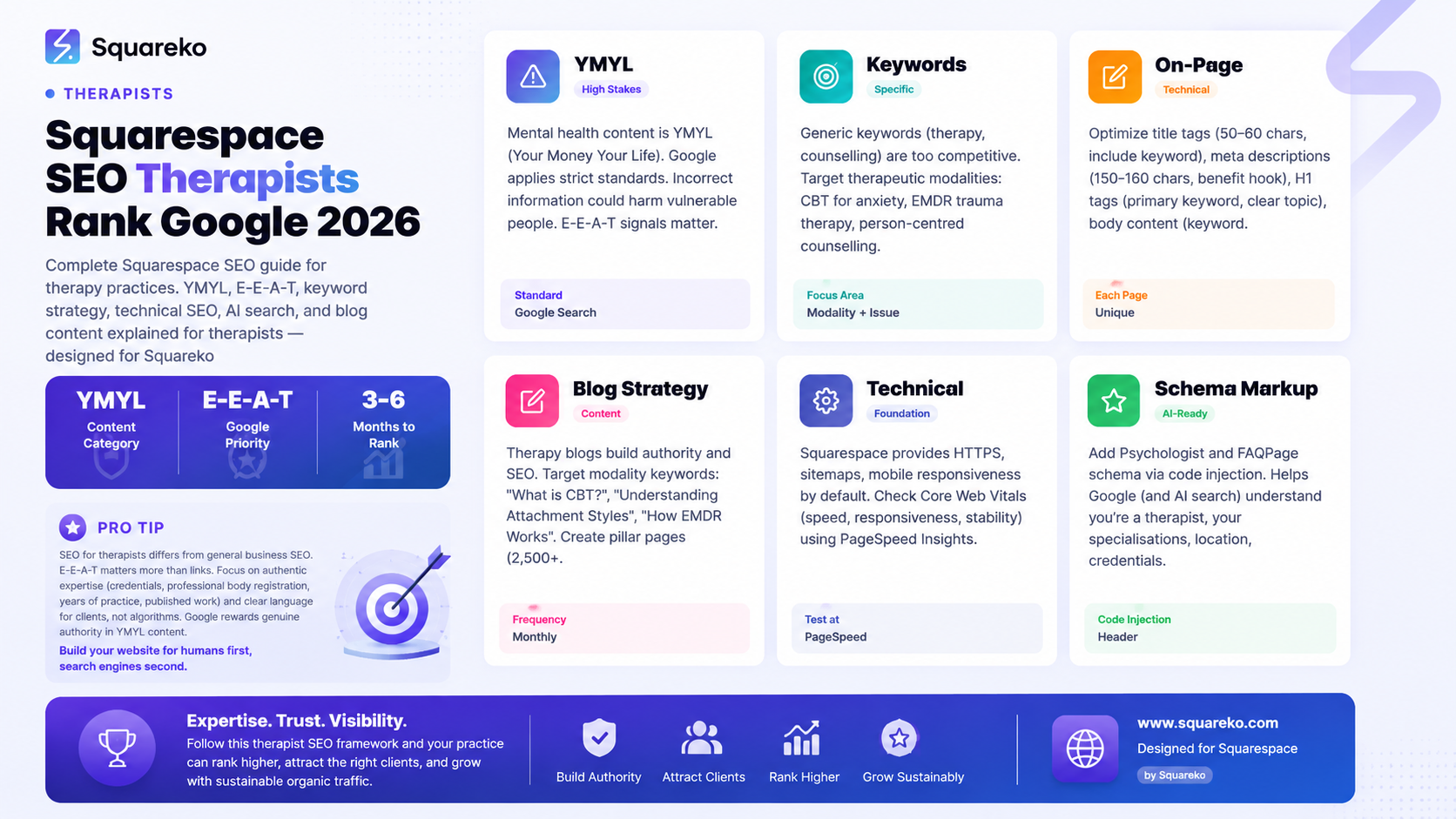
Ranking on Google has fundamentally changed. In 2026, the therapist or counsellor with the best website design not the most experienced, not the busiest, not the most qualified often appears first in search results. Google now prioritizes websites that feel trustworthy, load fast, and clearly demonstrate expertise. For therapists, this is both an advantage and a challenge. An advantage because a well-built Squarespace website can outrank poorly optimized competitor sites. A challenge because Google treats mental health content (YMYL: Your Money Your Life) with heightened scrutiny. This comprehensive guide covers Squarespace SEO specifically for therapy practices: keyword strategy for mental health, building E-E-A-T signals Google trusts, technical SEO on Squarespace, and how to get recommended by AI-powered search in 2026.
Key Takeaways
YMYL (Your Money Your Life) applies to all mental health content; Google requires high E-E-A-T: Experience, Expertise, Authoritativeness, Trustworthiness
Therapeutic modality keywords (CBT, EMDR, person-centred, psychodynamic, ACT) are your primary targets—more specific and convertible than generic "therapy" or "counsellor"
Squarespace's built-in SEO tools are solid (Core Web Vitals, XML sitemaps, redirects), but therapists must manually optimize title tags, meta descriptions, schema markup, and internal linking
Blog content for therapists must balance client education with avoiding diagnosis/prescriptive advice; pillar content on modalities (CBT explainers, trauma-informed care principles) ranks well
AI-powered search (2026+) recommends therapists based on specialized content, structured data, and demonstrated expertise; therapists with pillar content + FAQs + schema markup rank higher than those with static websites
YMYL and E-E-A-T: How Google Rates Therapy Websites
Google's Search Quality Rater Guidelines explicitly categorize mental health websites as YMYL. YMYL content is content that could significantly impact a person's life, happiness, health, or safety. Therapy websites fit this category completely: incorrect information could discourage someone from seeking help, or could promote harmful self-treatment instead of professional care.
Because YMYL content is high-stakes, Google applies much stricter standards to therapy websites than to, say, fitness blogs or business services sites. Google uses E-E-A-T to evaluate YMYL content.
E-E-A-T Explained for Therapists
Experience: Do you actually work with clients? Experience comes from running a therapy practice, not just studying therapy. Google wants to see that you've treated clients with the issues you're writing about. How do you demonstrate experience
Author bio mentioning years in private practice
Case examples (anonymized, ethical) showing you understand real problems
Mention of specific populations you work with ("I've worked with over 500 adults struggling with anxiety")
Content written in first person ("In my 12 years of practice, I've observed...")
Expertise: Are you formally qualified to give mental health advice? Formal credentials matter enormously for therapy websites. BACP accreditation, UKCP registration, psychology degree, specialized training these matter. Display them prominently.
Professional qualifications in author bio
List of relevant training and credentials on your website
Mention of professional body memberships
Links to credential-verifying organizations (BACP, UKCP, BPS)
Authoritativeness: Are you recognized as an authority by other mental health professionals? This comes from citations, backlinks, professional endorsements, and directory listings.
Listed on BACP, UKCP, psychology-specific directories
Links to your website from respected mental health organizations
Quotes or mentions of you in other professional contexts
Published articles or case studies (with consent)
Trustworthiness: Can clients trust that your information is accurate, confidential, and ethical? Trustworthiness for therapists is paramount.
Clear privacy policy explaining client confidentiality
Mention of supervision (shows you're accountable)
Explicit disclaimers where appropriate ("This is not emergency advice; seek immediate help if...")
Professional tone, no sensationalism
Regular updates showing your site is actively maintained
How Google Evaluates Your Website
Google's automated systems + human raters assess these signals. A therapy website with strong E-E-A-T signals will rank higher even if a competitor has more backlinks or older domain. A website with weak E-E-A-T signals will be deprioritized, even if it has good technical SEO.
The implication: for therapists, E-E-A-T is more important than traditional SEO tricks. Building genuine authority (credentials, training, professional affiliations) matters more than link-building schemes.
Squarespace SEO Fundamentals for Therapy Practices
Squarespace is a capable SEO platform. It includes:
HTTPS (security) ✓
Sitemap generation (automatic) ✓
Mobile responsiveness (all templates) ✓
Fast loading times (Squarespace's servers are optimized) ✓
Redirect management ✓
Schema markup support (via code injection) ✓
However, Squarespace doesn't automatically optimize everything. You must configure SEO elements manually.
Core SEO Settings on Squarespace
Go to Settings > Website > SEO
Add your domain (standard or custom)
Create an XML sitemap (Squarespace does this automatically; verify at yoursite.com/sitemap.xml)
Add your homepage title and meta description (see "On-Page SEO" section below)
Block search engines from private/test pages (Settings > Website > Advanced > SEO)
Connect to Google Search Console
Go to google.com/webmasters/tools
Add your Squarespace domain
Squarespace will provide a DNS verification method
Verify in Search Console
Monitor rankings, fix indexing issues, and view search queries
Search Console is essential for monitoring how your website performs in Google search. You can see:
Which keywords bring you traffic
Which pages rank (and where)
Click-through rate for your listings
Technical issues Google found
Connect to Google Analytics (GA4)
Create a GA4 property at google.com/analytics
In Squarespace, go to Settings > Analytics > Add Google Analytics ID
Paste your GA4 ID
Wait 24 hours for tracking to begin
GA4 shows you visitor behaviour: which pages they visit, how long they stay, whether they convert (book consultations)
The Mobile-First Indexing Reality
Google's crawler now indexes the mobile version of your website first. This means:
Your mobile design must be excellent (readable, fast, navigable)
Mobile page speed is critical (Google penalizes slow mobile sites)
Mobile-first layout affects ranking, not just user experience
Squarespace templates are mobile-first by default,but test your specific site at google.com/pagespeedsights to identify mobile speed issues.
Keyword Strategy: Therapeutic Modalities as Primary Targets
Therapy keyword strategy differs from general business SEO. Generic keywords like "therapy," "counsellor," or "therapist" are extremely competitive and low-intent. Specific keywords—therapeutic modalities (CBT, EMDR, person-centred therapy, psychodynamic therapy, ACT) paired with issues—are higher-intent and more convertible.
Primary Keywords for Therapists
Organize by therapeutic approach:
CBT (Cognitive Behavioural Therapy)
"CBT for anxiety"
"Cognitive behavioural therapy depression"
"CBT therapist city"
"How does CBT work?"
"CBT for panic attacks"
Psychodynamic Therapy
"Psychodynamic therapy for relationship issues"
"Psychotherapy for trauma"
"Psychodynamic counselling city"
"How does psychodynamic therapy work?"
Person-Centred Counselling
"Person-centred therapy for depression"
"Person-centred counselling city"
"What is person-centred therapy?"
Trauma-Informed Therapy
"Trauma-informed therapy"
"EMDR therapy"
"Trauma therapy [city]"
"Complex PTSD treatment"
Issue-Based Keywords
"Anxiety treatment options"
"Therapy for depression"
"Relationship counselling"
"Burnout treatment"
"Grief counselling"
Avoid Generic Keywords
"Therapy near me" (too generic, low conversion)
"Best therapist" (competitive, vague)
"Mental health help" (too broad)
Focus on specific modality + issue combinations. These rank faster, attract qualified clients, and have higher conversion rates.
Long-Tail Keywords
Long-tail keywords are longer, specific phrases:
"How to manage anxiety without medication"
"Cognitive behavioural therapy for health anxiety"
"Psychodynamic approach to relationship patterns"
These have lower search volume but much higher intent. Someone searching "cognitive behavioural therapy for health anxiety" is probably ready to book, not just researching.
On-Page SEO: Optimizing Every Therapy Website Element
Every page on your therapy website needs SEO optimization. Here's the checklist.
SEO Title Tag (Title Tag, Not H1)
The title tag appears in browser tabs and search results. Optimize it:
Include primary keyword
Keep it 50-60 characters
Make it compelling
Be specific
Examples:
"CBT Therapy for Anxiety | [Your Name] London" (57 chars)
"Person-Centred Counselling for Depression | [City]" (54 chars)
"EMDR Trauma Therapy | Experienced Psychotherapist" (52 chars)
On Squarespace: Go to Pages > [Page] > Settings > Basic > SEO > Title
Meta Description
The meta description appears under your page title in search results. Optimize it:
Include primary keyword (but naturally)
Include a benefit or hook ("Book a free consultation")
Keep it 150-160 characters
Make it a compelling call-to-action
Example: "Struggling with anxiety? CBT-trained therapist in London. Specializing in panic attacks and health anxiety. Free initial consultation. Book now."
On Squarespace: Pages > [Page] > Settings > Basic > SEO > Description
H1 (Main Page Heading)
Your H1 should:
Include your primary keyword
Clearly state what the page is about
Be unique per page (don't repeat the same H1)
Example H1s:
"CBT for Anxiety: How Cognitive Behavioural Therapy Helps"
"Person-Centred Counselling for Depression and Low Mood"
"Trauma-Informed Therapy for PTSD and Complex Trauma"
On Squarespace: The page's main heading (usually the page title).
Body Content Optimization
Include your primary keyword in the first 100 words
Use semantic keywords naturally (synonyms, related terms)
Front-load important information; clients scan, not read
Use short paragraphs (2-3 sentences)
Use H2 and H3 subheadings for hierarchy
Bold key terms for scannability
Internal Linking
Link from relevant pages to other relevant pages. Example:
Your "Anxiety" page links to your "CBT" page
Your "About" page links to your services pages
Your blog posts link to relevant service pages
Internal links help Google understand your site structure and spread authority throughout your site.
Keyword Density and Readability
Include your keyword 2-4 times in a typical page (500-800 words). Don't force it. Google now penalizes keyword stuffing. Write for humans first, search engines second.
Blog Content Strategy for Therapists
A therapy blog builds authority, provides free value to clients, and improves SEO. But therapy blog content must balance education with ethics.
What Therapy Blogs Should Cover
Explanations of therapeutic approaches ("What is person-centred therapy?")
Mental health education ("Understanding anxiety: symptoms and causes")
Self-care and wellness tips ("5 grounding techniques for anxiety")
Modality-specific content ("How does EMDR work?")
Client stories (anonymized and consent-obtained)
Mental health news commentary
What Therapy Blogs Should NOT Do
Diagnose (never say "if you have these symptoms, you have depression")
Prescribe treatment ("You should definitely do EMDR")
Replace professional advice ("Try this instead of therapy")
Share graphic trauma narratives (can re-traumatize vulnerable readers)
Use sensationalism or fear-mongering
Blog Content for SEO
Target long-tail keywords and modality-specific searches:
"What is CBT? A Beginner's Guide" (target: "what is CBT")
"5 Grounding Techniques for Anxiety" (target: "grounding techniques anxiety")
"Understanding Attachment Styles in Relationships" (target: "attachment theory")
"How EMDR Works: A Complete Explanation" (target: "how does EMDR work")
Publish monthly, consistently. A blog with 12 quality posts written over a year outranks a blog with 50 posts written in one month then abandoned.
Pillar Content
Create pillar pages—comprehensive, long-form content on core topics. Example pillar pages:
"The Complete Guide to Cognitive Behavioural Therapy (CBT)"
"Person-Centred Therapy: Philosophy, Practice, and Evidence"
"Trauma-Informed Therapy: An In-Depth Guide"
Pillar pages are 2,500-4,000 words covering everything someone needs to know about a topic. They rank for competitive keywords and establish you as an authority.
Technical SEO on Squarespace
Technical SEO ensures Google can crawl, index, and rank your website properly.
Core Web Vitals
Google prioritizes websites with good Core Web Vitals:
Largest Contentful Paint (LCP): How fast your page loads. Target: under 2.5 seconds
Interaction to Next Paint (INP): How responsive your page is to clicks. Target: under 200 milliseconds
Cumulative Layout Shift (CLS): How stable your page layout is. Target: under 0.1
Check your website at google.com/pagespeedsights. is generally fast, but image optimization helps:
Compress images before uploading (use Squoosh or similar)
Don't upload gigantic photos (keep under 5MB)
Use modern image formats (WebP if supported)
SSL Certificate (HTTPS)
Squarespace automatically provides HTTPS. Verify your site shows a lock icon in the browser bar. HTTPS is a ranking factor and essential for client trust.
Mobile Responsiveness
Test your site on actual mobile devices, not just browser emulation. Use google.com/pagespeedsights mobile report to identify mobile issues.
Robots.txt and Sitemap
Squarespace automatically generates:
robots.txt (tells search engines which pages to crawl)
sitemap.xml (lists all pages for indexing)
You don't need to manually create these; verify they exist at:
yoursite.com/robots.txt
yoursite.com/sitemap.xml
Canonicalization
If you have duplicate content (same page accessible via multiple URLs), set a canonical tag telling Google which is the "main" version. Squarespace handles this automatically for most cases, but check if you have pagination or filtering that creates duplicates.
Schema Markup and AI-Powered Search
In 2026, AI-powered search is increasingly important. Google's AI search recommendations (appearing at the top of search results) show up when your content matches structured data.
Psychologist/Therapist Schema
Add this to your homepage via Code Injection (Settings > Advanced > Code Injection > Header):
<!-- Please remove the commented script wrapper and add this schema inside a proper <script type="application/ld+json"> tag. -->
{
  "@context": "https://schema.org",
  "@type": "Psychologist",
  "name": "Jane Smith",
  "description": "Accredited counsellor specializing in anxiety and trauma-informed therapy",
  "knowsAbout": ["Anxiety", "CBT", "Trauma", "PTSD", "Panic Disorder"],
  "serviceType": ["Psychotherapy", "Counselling", "Cognitive Behavioural Therapy", "Trauma-Informed Therapy"],
  "hasCredential": {
    "@type": "EducationalOccupationalCredential",
    "credentialCategory": "BACP Accredited Counsellor"
  },
  "telephone": "+44 20 XXXX XXXX",
  "email": "jane@example.com",
  "url": "https://yoursite.com"
}
This tells AI search engines exactly what your expertise is. When someone asks "recommend a trauma therapist in London," your structured data helps Google's AI recommend you.
FAQ Schema (Already Covered)
FAQ schema (which you should include on every page with FAQs) helps AI search understand your Q&A content and may appear in AI recommendations.
BreadcrumbList Schema
If your site has a clear hierarchy (Services > CBT > CBT for Anxiety), add breadcrumb schema:
<!-- Please remove the commented script wrapper and add this schema inside a proper <script type="application/ld+json"> tag. -->
{
  "@context": "https://schema.org",
  "@type": "BreadcrumbList",
  "itemListElement": [
    {"@type": "ListItem", "position": 1, "name": "Home", "item": "https://yoursite.com"},
    {"@type": "ListItem", "position": 2, "name": "Services", "item": "https://yoursite.com/services"},
    {"@type": "ListItem", "position": 3, "name": "CBT", "item": "https://yoursite.com/services/cbt"}
  ]
}
Frequently Asked Questions
-
3-6 months for local rankings, 6-12 months for competitive keywords. New websites start with zero authority, so Google ranks you lower initially. However, if you have strong E-E-A-T signals (credentials, professional affiliations), ranking can happen faster. Consistency matters: update your website regularly, publish blog content, build citations.
-
Only if you can commit to monthly posts. A blog with three old posts looks abandoned. But if you publish monthly, a blog dramatically improves your SEO and establishes authority. Consider starting small: one comprehensive pillar post per quarter, then add shorter posts as capacity allows.
-
Free tools are sufficient to start:
Google Search Console (free)
Google Analytics (free)
Ubersuggest or Semrush free tiers (for keyword research)
Paid tools (Ahrefs, SEMrush, Moz) are nice-to-have but not essential for new therapists.
Spend on content (good writing) and your website (professional design) before spending on SEO tools.
-
Backlinks (other websites linking to you) are important but secondary to E-E-A-T for therapy websites. Getting backlinks from respected mental health organizations or medical sites helps. But Google understands that therapy websites rarely get backlinks (we're not the kind of content people share). Focus on citations (directory listings) and strong E-E-A-T first.
-
Yes, because they're high-volume and high-intent. But also optimize for specific keywords ("anxiety therapist in [city]"). "Therapist near me" is good for local search, but someone searching "trauma-informed therapist near me" is more qualified. Target both generic and specific.
-
Very difficult unless you have significant domain authority, lots of backlinks, and exceptional content. It's usually better to rank for city-specific keywords ("anxiety therapist London," "anxiety therapist Manchester," "anxiety therapist Edinburgh"). You'll get more qualified clients and face less competition.
-
Monitor in Google Search Console:
Impressions: How many times you appear in search results
Clicks: How many people click your search result
Average position: Where you rank (position 1 is top result)
Click-through rate: Percentage of people who click your result
Target: improve impressions and clicks month-over-month. If you have 500 impressions but zero clicks, your title/meta description needs work.
-
Squarespace vs. WordPress is a common debate. Truth: Squarespace is good enough for 95% of therapists. You can rank well on Squarespace. WordPress offers more flexibility and customization, but requires more technical knowledge. Stick with Squarespace unless you have specific technical needs WordPress solves.
Start Ranking: Implement Your Squarespace Therapy SEO Strategy
SEO for therapists is both simpler and more complex than general SEO. Simpler because your competition is often poor at SEO; many therapists still have no website or neglected websites. More complex because YMYL content requires authentic expertise and genuine authority, not tricks.
The path forward is clear: build a strong website with excellent E-E-A-T signals (credentials, training, professional affiliations), optimize your pages for therapeutic modality keywords, publish regular blog content, and implement schema markup. Do this consistently for 6-12 months, and you'll rank.
If you're ready to build a Squarespace website optimized from the ground up for SEO and designed to rank for your ideal therapy clients, Squareko can help. We audit therapy websites for SEO, optimize on-page elements, implement schema markup, and develop content strategies tailored to your specialities. Visit squareko to book an SEO consultation and start ranking in 2026.

From custom website design to SEO strategy, we help businesses launch a site that looks professional and performs better.

About the Author
Walid | squareko
I'm Walid Hasan, a Certified Squarespace Expert and Squarespace Circle Platinum Partner with over 12 years of hands-on experience designing and optimizing high-performing websites. Over the years, I've had the privilege of building more than 2,000 Squarespace websites for clients around the world, always focusing on clean design, strong user experience, and conversion-driven results.