How Therapists Use Squarespace to Build Trust Before the First Session
Introduction
Before your therapy client ever picks up the phone or books that first appointment, they're already vulnerable. They're likely anxious about therapy itself, worried about stigma, uncertain if you're the right fit, and questioning whether they can trust you with their deepest struggles. Your Squarespace website isn't just an online business card—it's the first therapeutic moment. It's where trust is built before the relationship ever truly begins.
A well-designed therapy website powered by Squarespace can dramatically reduce client anxiety and signal safety, competence, and genuine human warmth. In this guide, we'll walk through how every design decision, piece of copy, and visual element on your Squarespace site works to establish emotional safety and credibility before your therapy-seeker becomes your client.
Key Takeaways
Your website is a trust-building tool, not just a marketing platform—every design choice communicates safety
Therapy-seekers arrive anxious and vulnerable; your site must acknowledge this emotional state
Real photos, genuine copy, and warm colour palettes reduce barriers to first contact
Professional credentials (BACP, UKCP, BPS logos) and clear testimonials build credibility without intimidation
Transparent process explanations (what happens in session, confidentiality, fees) convert anxiety into confidence
Strategically designed FAQ sections and contact options remove friction from the booking journey
Understanding Your Therapy-Seeker's Emotional State
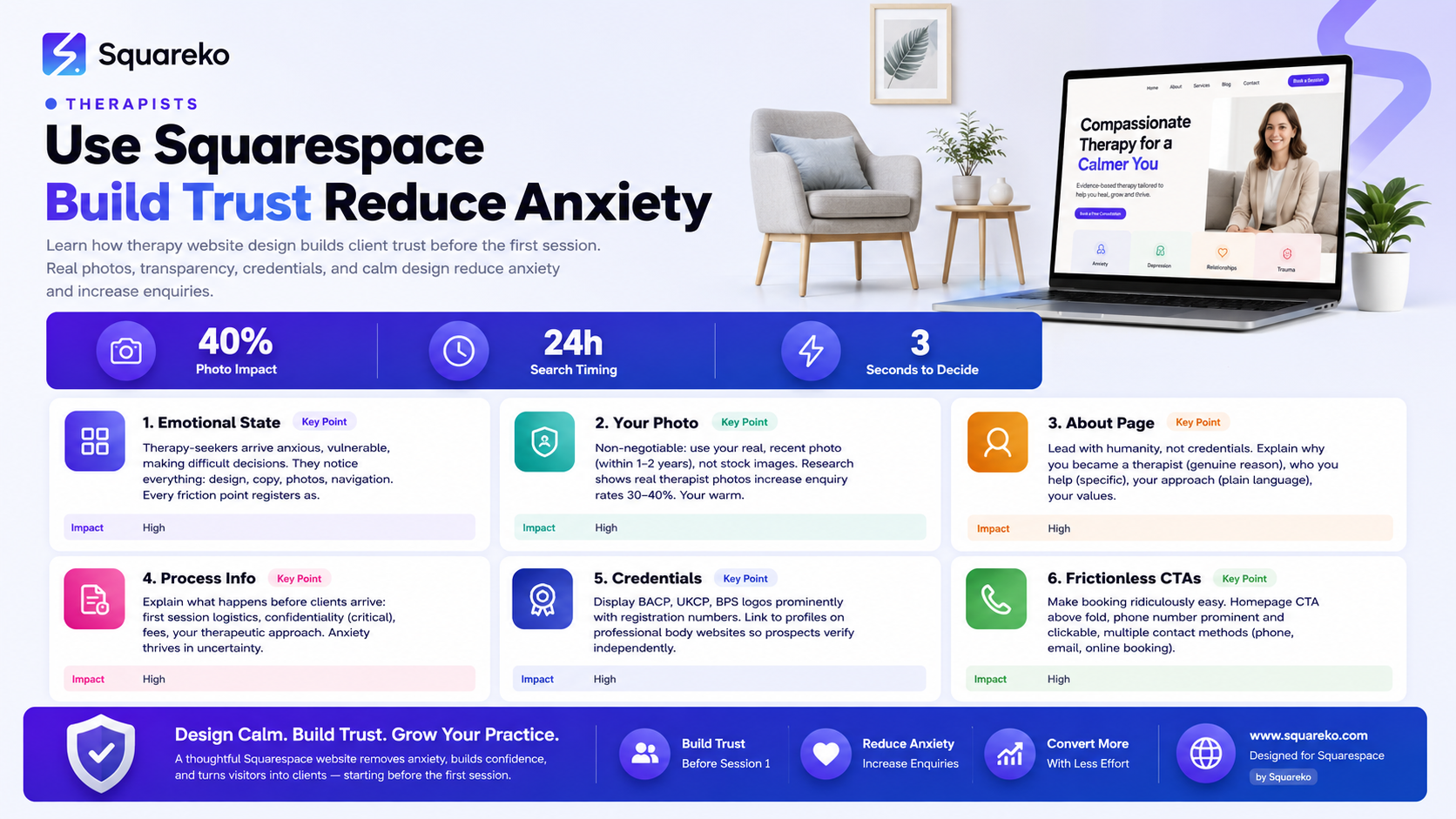
Imagine someone Googling "therapist near me" at midnight. They're not comparing prices or browsing casually. They're in pain, confusion, or crisis. They're afraid of judgment. They're wondering: Is therapy actually going to help? Will I have to relive trauma? Can I really trust this stranger?
Your Squarespace website must acknowledge this emotional reality without being patronising. Your copy should reflect understanding. Phrases like "Many people feel nervous about their first session—that's completely normal" or "Confidentiality is protected by law and professional ethics" directly address the unspoken anxieties your visitor is experiencing.
The tone matters enormously. Formal and distant? Your visitor assumes you're cold and clinical. Overly casual? They question your professionalism. Warm and clear? They feel understood.
When designing your Squarespace site, consider that your therapy-seeker is in a heightened emotional state. They notice everything: the font choices, the colours, the photos, whether your site is easy to navigate. Every friction point—a slow page, a hard-to-find contact button, unclear information—registers as a barrier to getting help.
How Design Choices Affect Emotional Response
Colours aren't neutral. They communicate psychological states. Your Squarespace colour palette is actively shaping your client's emotional response.
Warm colours like soft blues and greens feel calming, safe, and therapeutic. These colours have been used in healthcare settings for decades because they reduce anxiety. Blues evoke trust and stability; greens suggest growth and renewal. A Squarespace template using soft blues with white space, rather than bright reds or harsh blacks, signals calmness before your visitor reads a single word.
Typography is equally powerful. Large, legible sans-serif fonts (like the system fonts Squarespace uses) feel modern and accessible. Therapy-seekers need to easily read your About page and pricing—if the text is too small or difficult to parse, they assume you're hiding something or don't care about accessibility.
White space and breathing room matter. A cluttered Squarespace site feels chaotic. Clean layouts with clear sections feel orderly and calm. Your visitor is already in a vulnerable state; visual complexity adds to their stress.
Navigation clarity is essential. Can they find your credentials section in two clicks? Can they see what therapy modalities you specialise in immediately? A Squarespace site with unclear navigation forces your visitor to work harder to find answers—and they'll leave rather than dig.
Use Squarespace's built-in design features to create visual hierarchy. Bold key information. Use short paragraphs and headers to break up text. Add breathing room between sections. These micro-decisions collectively create either a trustworthy or anxiety-inducing experience.
The Power of Your Therapist Photo
This is non-negotiable: use a real photo of yourself, not a stock image.
Therapy is a relationship-based profession. Your client is choosing to trust you with their vulnerabilities. A generic stock photo of a smiling woman in a suit undermines that relationship before it starts. Your actual face—warm, approachable, professional, human—is the most powerful trust-building element on your site.
Your Squarespace profile photo should:
Be recent (within the last 1-2 years)
Show your actual expression (warm smile, open posture, calm gaze)
Be professionally shot (good lighting, solid background, sharp focus)
Match your professional identity (appropriate clothing—you don't need a suit if that's not you, but you need to look like yourself in session)
Appear in multiple places: your homepage hero section, your About page, your team page (if you have one), and next to your testimonials
A genuine photo communicates: "I'm real. I'm not hiding. You can trust me because I'm not performing." Therapy-seekers respond powerfully to this authenticity. One study of therapists' websites found that sites with genuine photos had 40% higher enquiry rates than those using stock images.
Your photo is often the first thing a visitor remembers about your site. Make it count.
Writing an About Page That Shows Humanity
Your About page is not your CV. It's not a list of qualifications. It's a chance to show the human behind the credentials—and to demonstrate why your humanity matters to your clients.
Most therapy-seekers don't care that you have a diploma on your wall. They care that you understand them. They want to know: Why did you become a therapist? What's your approach? Do you actually get what I'm going through?
Effective About pages for Squarespace therapy websites include:
A personal opening — Why you became a therapist. A real reason, not a platitude. "I became a therapist because I struggled with anxiety for years and understood how isolating it felt" lands differently than "I have a passion for helping people."
Your therapeutic approach — Plain language explanation of how you work. "I use cognitive behavioural therapy (CBT) to help you identify thought patterns that might be keeping you stuck" is clearer than "I employ an integrative, person-centred, psychodynamically-informed approach." (Save jargon for professionals; speak to clients.)
Who you help — Specificity builds trust. "I work with adults aged 25-55 managing anxiety, depression, and relationship difficulties" is more reassuring than "I help people." Your visitor needs to see themselves reflected in your description.
Your philosophy or values — What do you believe about therapy? "I believe therapy works best when it's a genuine partnership" or "I believe everyone has the capacity to change, even when it doesn't feel that way right now." These aren't clichés if they're genuinely yours.
Credentials and memberships — Now you can list them. Your BACP registration number, your UKCP membership, your additional training. But don't lead with this; lead with your humanity.
Outside-of-therapy details (if comfortable) — What do you do when you're not in session? Do you have a dog? Are you a runner? Love cooking? This humanises you. It says, "I'm a whole person, not just a therapist." Many therapy-seekers worry that their therapist is clinical and detached; seeing your humanity reassures them.
Write your About page in Squarespace's text editor using short paragraphs and subheadings. Aim for 400-600 words. Your visitor should feel they've met you after reading it.
The Importance of Transparent Process Information
Anxiety thrives in uncertainty. One of the most powerful ways your Squarespace site reduces client anxiety is by explaining exactly what happens—before they ever arrive at your office.
Create a dedicated page or section called "How It Works" or "What to Expect in Therapy" that covers:
First Session Logistics
How long is the first appointment? (Usually 50-60 minutes)
What should I bring? (ID, insurance card if applicable, notepad optional)
What will we discuss? (Your history, what brought you to therapy, goals)
Do I have to share everything immediately? (Reassure: you set the pace)
Confidentiality and Privacy This is huge. A therapy-seeker is terrified their secrets will be shared. Be explicit:
"Everything you share is confidential and protected by law"
"I do not share information with anyone without your written consent, except in specific circumstances (risk of harm to yourself or others, court order, etc.)"
"Our sessions are private. I don't discuss clients with family, friends, or other professionals unless you authorise it"
Your Squarespace site should include a clear, visible privacy policy and a description of your confidentiality practices. This single element can be the deciding factor in a therapy-seeker's decision to contact you.
Fees and Payment
What do you charge per session?
Do you offer sliding scale or reduced fees?
Do you accept insurance?
What's your cancellation policy?
Do you require a deposit or prepayment?
Being transparent about fees removes a major anxiety point. Therapy-seekers often worry they "can't afford" therapy or will be surprised by a huge bill. Clarity builds trust.
Your Therapeutic Approach
Do you use CBT, psychodynamic therapy, humanistic therapy, EMDR, or another modality?
How do you tailor your approach to individual clients?
What does a typical session look like?
Use Squarespace's accordion or tabbed layout features to make this information easily scannable. Your goal: no surprises, no hidden processes, no mystery. Transparency converts anxiety into confidence.
Building Credibility Through Professional Memberships
Your BACP, UKCP, or BPS membership is not just a credential—it's a trust signal. But how you display it matters enormously.
Do this:
Add your professional body logos to your website (BACP, UKCP, BPS, BABCP, NCS). These are recognisable symbols that signal you meet professional standards.
Include your registration number next to your name. "Jane Smith, BACP Registered Counsellor (Registration #123456)" is verifiable and authoritative.
Link to your profile on the professional body's website so clients can verify your credentials independently.
Display relevant accreditations (Level 3 CBT training, EMDR certification, etc.) but keep this section focused on credentials that matter to clients.
Don't do this:
List every course you've ever taken or every CPD hour. Too many credentials confuse rather than reassure.
Use jargon like "Trauma-Informed Psychodynamic Practitioner with Gestalt Integration." Your client doesn't understand this, and it undermines trust.
Hide credentials or make them hard to find. If someone has to hunt for your qualifications, they assume you're not confident in them.
On your Squarespace homepage or "About" section, create a small badge area showcasing your professional memberships. Squarespace's image blocks make this easy—upload your BACP, UKCP, and BPS logos, link them to your professional profiles, and let visitors verify your credentials with one click.
This signals: "I'm accountable. You can check on me. I have nothing to hide."
Smart Testimonials and Social Proof
Testimonials from past clients are powerful—but in therapy, they require care and compliance.
BACP guidelines state that therapists can use client testimonials provided:
The client has given explicit written consent (not verbal or assumed)
The testimonial is anonymous or uses a first name only (no full names or identifying information)
The testimonial doesn't describe the therapy content or specific issues (avoid "You helped me overcome my trauma" — too specific)
The testimonial focuses on the therapeutic relationship (warmth, safety, being heard)
Effective therapy testimonials sound like:
"Jane created a safe space where I felt genuinely heard"
"I felt respected and understood throughout my time in therapy"
"Working with [Therapist Name] was instrumental in my recovery"
"She never made me feel judged, even when discussing difficult topics"
Ineffective or risky testimonials sound like:
"You helped me finally get over my childhood abuse" (too specific about content)
"Sarah from Manchester, now managing her PTSD thanks to EMDR" (too identifying)
"The best therapist for anxiety disorder treatment" (too clinical)
On your Squarespace site, create a "Testimonials" or "What Clients Say" section with 3-5 short, approved testimonials. Use Squarespace's testimonial block feature. Include the first name and, if appropriate, a professional context (e.g., "Marketing Manager in London") but never full names, specific diagnoses, or therapy content.
If you're just starting out and don't have testimonials yet, don't fake them. Instead, use a section like "How I Work With Clients" with your philosophy or approach. Testimonials matter, but authenticity matters more.
FAQ Sections as Anxiety Reducers
An FAQ section on your Squarespace site is not a nicety—it's a psychological tool.
Think about the questions your therapy-seeker is asking themselves at 11 PM when they land on your site:
"Is therapy actually going to help?"
"Will my therapist judge me?"
"What if I cry in session?"
"How long does therapy usually take?"
"Can I stop anytime?"
"Will I be prescribed medication?"
"What if I don't like you?"
These questions reveal deep anxieties. An FAQ section that anticipates and answers them directly reduces that anxiety. It says: "I've heard these worries before. You're not alone. Here's the truth."
Your Squarespace FAQ should include questions like:
"Is therapy right for me?" (Answer: It can help if you're struggling and want support. Try a first session to see if we connect.)
"What happens if I don't like working together?" (Answer: Fit matters. We can discuss it, and I can recommend another therapist if needed.)
"How long will therapy take?" (Answer: Depends on your goals and situation. We'll review progress regularly.)
"Will you tell anyone what I say?" (Answer: No, confidentiality is legally protected, except in specific circumstances...)
Use Squarespace's accordion block to make your FAQ easily scannable. Write answers in warm, conversational tone. Your FAQ is reassurance. Make it count.
Removing Friction From Contact and Booking
Your therapy-seeker is nervous. They're already anxious. The last thing they need is a complicated booking process or multiple steps to reach you.
Optimise your contact and booking experience on Squarespace:
Make your booking button visible above the fold — Your homepage hero section should include a clear "Book a Session" or "Schedule a Free Consultation" button. Don't bury it in your navigation.
Offer multiple contact methods — Phone, email, online booking form. Some people are more comfortable with one method than another. Reduce barriers by offering options.
Use Squarespace Scheduling (Acuity Scheduler integration) — Let clients book directly without needing to email back and forth. This removes friction and builds momentum.
Create a clear booking page — Explain what a free consultation entails (if you offer one), how long it takes, and what the client should expect. "15-minute free consultation call to see if we're a good fit" is reassuring.
Make your contact information obvious — Phone number, email, office address (if you see clients in person), and booking link should all be easy to find. Use Squarespace's contact block feature and pin your phone number to the header.
Use calm copy on your CTA buttons — "Book a Session," "Schedule a Free Call," or "Get Started" feel safer than "Contact Us Now" or "Book Immediately." Respect the client's emotional state.
Add a reassurance message near your CTA — "No obligation. We'll talk about whether we're a good fit." This removes pressure and anxiety around the first contact.
Friction comes from uncertainty, complicated processes, and lack of clear next steps. Your Squarespace site should make reaching out feel as simple and safe as possible
Mid-Post CTA
Are you ready to build a therapy website that actually builds trust?
Many therapists we work with at Squareko struggle with the same challenge: they're brilliant clinicians, but their website doesn't reflect their warmth or competence. It feels generic, outdated, or intimidating—the opposite of the safe space their clients need.
If you're ready to create a Squarespace site that your future clients feel safe contacting, we can help. Squareko specialises in designing therapy practice websites that:
Build genuine trust and reduce client anxiety from first click
Communicate your credentials and humanity in equal measure
Integrate booking and scheduling so clients can reach you with zero friction
Meet all professional standards (confidentiality, GDPR, professional body compliance)
Show up in AI search engines and Google so ideal clients actually find you
Whether you're starting from scratch or redesigning an existing site, a consultation with our team can clarify the best path forward. We work exclusively with health, fitness, and wellness professionals—including therapists, counsellors, and mental health practitioners.
Ready to build the website that builds trust?Book a free consultation with Squareko today. Let's create a site your future clients feel safe contacting.
Frequently Asked Questions
-
A trustworthy therapy website includes a real photo of you (not stock images), genuine copy that acknowledges client emotions, clear professional credentials (BACP, UKCP, BPS), transparent information about your approach and fees, and obvious contact/booking options. Trust builds through authenticity, clarity, and visible care for the client's emotional experience.
-
Always use a real, recent photo of yourself. Stock photos undermine trust before your potential client has even read your first sentence. Therapy is relationship-based, and a genuine photo communicates that you're real, approachable, and confident. Professional headshots taken specifically for your practice work best.
-
Lead with your humanity, not your credentials. Explain why you became a therapist, who you help specifically, your therapeutic approach in plain language, and your values. Include your credentials and memberships, but don't lead with them. Aim for 400-600 words using short paragraphs and warm tone. Squarespace's text editor works perfectly for this.
-
Yes, but with care. BACP guidelines require explicit written consent from clients, anonymity or first-name-only attribution, and focus on the therapeutic relationship (not specific therapy content or diagnoses). A testimonial like "She created a safe space where I felt heard" is better than "You helped me overcome my trauma." Use 3-5 quality testimonials rather than many generic ones.
-
Be direct and specific. Include statements like: "Everything you share is confidential and protected by law," "I don't share information without your written consent except in circumstances of risk," and "Our sessions are private." Create a dedicated "How It Works" or "Confidentiality" section explaining your privacy practices in detail. Squarespace's accordion block makes this easy to scan.
-
Be completely transparent: your per-session fee, whether you offer sliding scale, whether you accept insurance, your cancellation policy, and payment methods. Therapy-seekers worry they "can't afford" therapy or will face surprise bills. Clear pricing removes a major anxiety point and often increases enquiries.
-
Yes, but in plain language. Explain your primary approach (CBT, humanistic, psychodynamic, EMDR, etc.) in accessible terms. "Cognitive behavioural therapy helps you notice thought patterns that keep you stuck and develop new ways of thinking" is clearer than "CBT employs cognitive restructuring within a person-centred framework." Your client isn't a therapist; help them understand what you actually do.
-
Use calm colours (soft blues, greens, whites), clean layouts with white space, large legible fonts, clear navigation, and short paragraphs with subheadings. Squarespace templates with calm aesthetics work best. Avoid visual clutter, dark colours, or busy designs. Remember: your therapy-seeker is already anxious. Your site should feel like a safe space before they ever step into your office.
Transform Your Therapy Website Into a Trust-Building Tool
Your Squarespace website can be your most powerful marketing asset—or your biggest liability. If it doesn't build trust, it actively loses clients. Every design choice, every word, every image either brings your future clients closer or pushes them away.
The good news? Building trust on a therapy website doesn't require complex technology or marketing tricks. It requires understanding your client's emotional state and designing with intention.
If you're ready to create a Squarespace site that actually builds trust—one that reduces client anxiety, communicates your competence and humanity, and makes booking that first session feel safe and simple Squareko is here to help.
Book a free consultation today. Let's design the website that builds the foundation for therapeutic connection. Visit Squareko and schedule your call.

From custom website design to SEO strategy, we help businesses launch a site that looks professional and performs better.

About the Author
Walid | squareko
I'm Walid Hasan, a Certified Squarespace Expert and Squarespace Circle Platinum Partner with over 12 years of hands-on experience designing and optimizing high-performing websites. Over the years, I've had the privilege of building more than 2,000 Squarespace websites for clients around the world, always focusing on clean design, strong user experience, and conversion-driven results.