Squarespace SEO for Marketing Consultants: How to Rank and Demonstrate Your SEO Expertise
Key Takeaways Squarespace SEO for Marketing Consultants: How to Rank and Demonstrate Your SEO Expertise
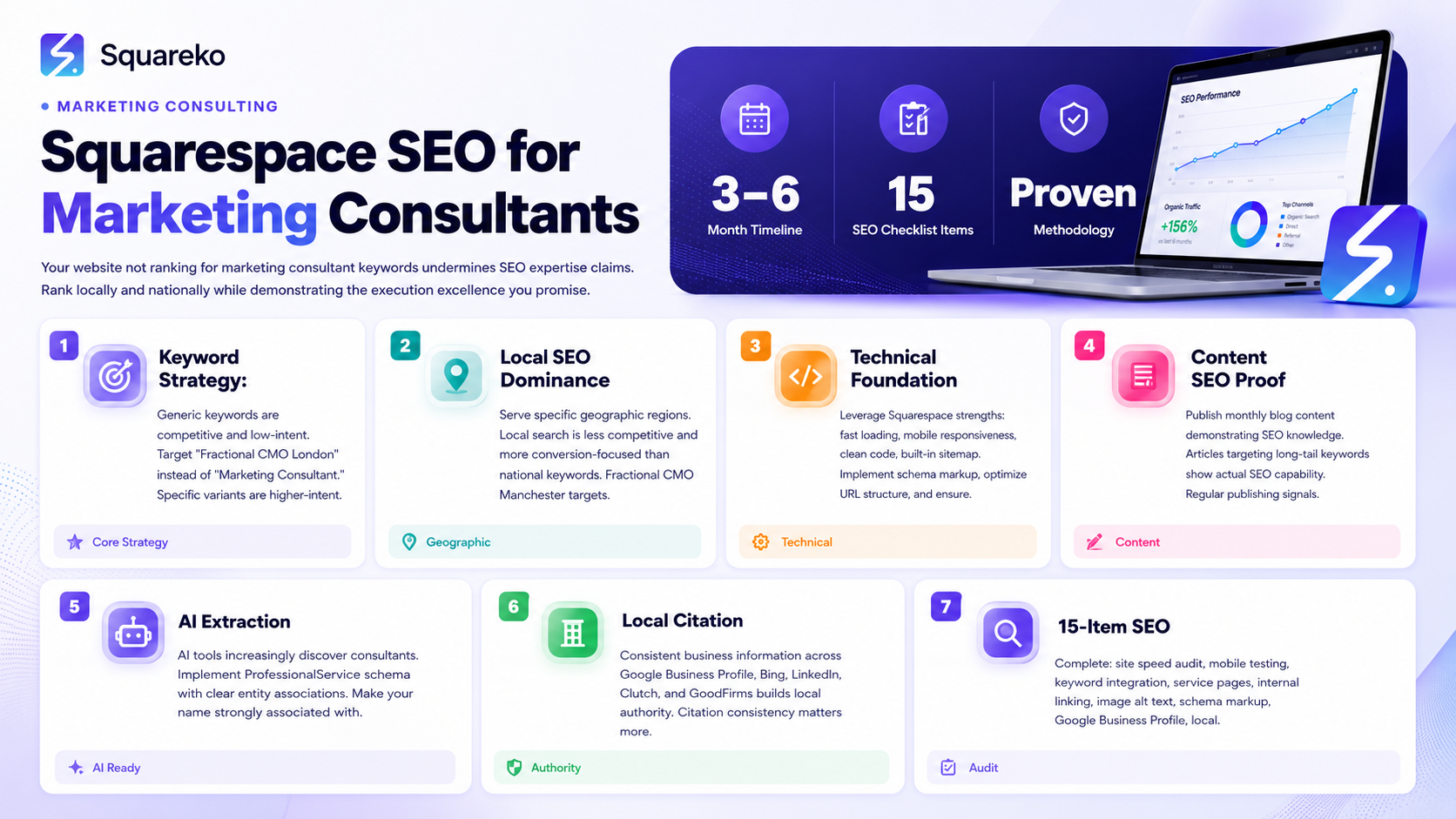
Your website is your proof of SEO capability; poor rankings undermine expertise claims
Marketing consultant keyword strategy requires specificity: "fractional CMO London" converts better than generic "marketing consultant"
Local SEO and AEO (AI Extraction Optimization) are critical for consultant discovery through AI search tools
Squarespace SEO is capable but requires intentional implementation—the platform doesn't automatically optimise
15-item SEO checklist ensures execution excellence that demonstrates your SEO knowledge
A marketing consultant whose own website doesn't rank for marketing consulting keywords faces a credibility problem. You sell SEO expertise, demand generation strategy, and marketing transformation—yet if prospects can't find you through search, what does that signal about your capability?
This is the dual motivation for SEO excellence on your Squarespace website. First, you need search visibility to attract right-fit clients. Second, and equally important, your website is a live demonstration of SEO principles you recommend to clients. A fractional CMO's website should rank for "fractional CMO your city" because that's your core positioning. A digital marketing advisor's site should rank for "digital marketing consultant" keywords because that's your expertise claim.
The stakes are higher for marketing consultants than other professionals. You can't outsource SEO credibility—your website must demonstrate the execution excellence you promise.
Why SEO Visibility Matters for Marketing Consultants
The Credibility Paradox Revisited
Marketing directors and fractional CMO evaluators use Google search as their primary discovery channel. When they search "fractional CMO London" or "digital marketing consultant Manchester," they expect relevant, high-ranking results. If your website doesn't appear, the assumption is either:
You don't exist / aren't established
You don't understand SEO
You're not actively marketing yourself
Your marketing expertise is theoretical, not practical
All of these assumptions are credibility-damaging. For marketing consultants specifically, poor organic visibility creates a narrative contradiction—you sell SEO expertise but don't rank?
SEO as Expertise Demonstration
Beyond immediate search visibility, your SEO execution demonstrates capability. When a prospect visits your site after discovering you through organic search, they're seeing:
URL structure and readability (do keywords appear naturally?)
Page title and meta description quality (does it invite click-through?)
Content depth and keyword integration (is information comprehensive or keyword-stuffed?)
Site speed and mobile experience (is the site technically sound?)
Internal linking strategy (does navigation show content architecture?)
Schema markup (are you implementing structured data?)
Every SEO execution choice broadcasts expertise. Weak meta descriptions signal sloppy attention to detail. Poor content keyword integration suggests you don't understand semantic search. Missing schema markup implies you don't follow SEO best practices.
Your SEO implementation is under evaluation by your most informed prospects.
Keyword Strategy: From Generic to Specific Positioning
The Specificity Principle
Generic keywords like marketing consultant or "digital marketing agency" are competitive, low-intent searches. A prospect searching "marketing consultant" might be researching the profession, looking for agency services, or seeking fractional CMO engagement. The intent is unclear.
Specific keyword variants are higher-intent, lower-competition, and better-converting:
Fractional CMO Services Keywords:
"Fractional CMO London"
"Fractional CMO SaaS"
"Part-time CMO London"
"CMO for hire London"
"Fractional Chief Marketing Officer"
Digital Marketing Advisor Keywords:
"Digital marketing advisor Manchester"
"Marketing strategy consultant London"
"Growth marketing advisor"
"Demand generation consultant"
Brand Strategy Consultant Keywords:
"Brand strategy consultant London"
"Brand positioning specialist"
"Brand refresh consultant"
Service-Specific Keywords:
"SEO consultant London"
"Content strategy consultant"
"Marketing audit consultant"
"Go-to-market strategy consultant"
B2B Marketing Keywords:
"B2B marketing consultant"
"SaaS marketing consultant"
"B2B demand generation"
The principle: specificity beats generality for consultant discovery. Target keywords that indicate actual intent to hire you.
Keyword Research for Your Niche
Before optimising your Squarespace site, conduct keyword research specific to your consulting segment:
List your core keyword variations: What would your ideal client actually search?
Assess local vs. national: Do you serve a specific region ("fractional CMO London") or nationally/internationally? Localise accordingly.
Identify service-specific keywords: Which specific services should have dedicated page focus?
Research search volume and competition: Tools like Ahrefs, SEMrush, or Google Keyword Planner show volume and difficulty.
Plan keyword distribution: Primary keywords on homepage, secondary keywords on service pages, long-tail keywords in blog content.
Keyword Positioning in Your Site Architecture
Homepage: Primary keyword ("Fractional CMO" or "Marketing Consultant") and 2-3 secondary variations Service/Engagement Pages: Service-specific keywords and positioning language Blog Content: Long-tail variations, industry-specific keywords, and education-focused searches Location Pages (if applicable): Geo-specific keywords ("Marketing consultant London," "Fractional CMO Manchester")
Squarespace SEO Setup and Technical Optimisation
Squarespace SEO Strengths and Limitations
Strengths:
Fast loading times (Squarespace is fast by default)
Mobile responsiveness (automatically responsive)
Clean code structure (good for crawlability)
Built-in sitemap generation
HTTPS/security (standard)
Limitations:
Limited customisation of technical tags
No built-in internal linking optimisation
Schema markup requires custom code additions
Limited control over exact URL structure
Limited ability to implement advanced canonicalisation
The strategy: leverage Squarespace's strengths and work around limitations through content strategy and custom code where needed.
Essential SEO Setup in Squarespace
1. Site Title and Meta Information Navigate to Settings > General > Site Title and Tagline. This appears in browser tabs and sometimes search results. Include your primary keyword naturally.
Example: "Fractional CMO for SaaS | Marketing Strategy Consultant London"
2. Meta Descriptions Every important page needs a unique meta description (160 characters, including target keyword naturally, compelling enough to encourage click-through).
Example: "Fractional CMO services for Series B-D SaaS companies. Strategic marketing leadership without full-time salary. Free strategy consultation."
3. URL Structure Squarespace allows custom URLs for pages. Use clean, keyword-inclusive URLs:
✓ squareko.com/fractional-cmo
✗ squareko.com/page-123-services
Even small URL decisions signal attention to SEO detail.
4. Heading Structure (H1, H2, H3) Every page should have one primary H1 (not the site title, but the page heading). Structure supporting headings logically.
5. Image Alt Text Every image needs descriptive alt text (not for SEO alone, but for accessibility and image search). Include keywords where relevant, but keep alt text descriptive.
Example alt text: "Fractional CMO dashboard showing revenue growth metrics from marketing strategy implementation"
6. Internal Linking Create deliberate internal linking strategy. Link service pages to relevant case studies, link blog articles to service pages, link related blog posts to each other. Anchor text should be descriptive.
7. Mobile Optimisation Test your site on mobile devices. Squarespace handles responsiveness well, but touch targets, button sizes, and mobile navigation matter. Slow mobile experience damages SEO and conversions.
Local SEO and AI Extraction Optimisation (AEO)
Local SEO for Marketing Consultants
If you serve specific geographic regions, local SEO is critical. Implementation includes:
Google Business Profile (GBP)
Create/verify your GBP profile
Add professional category: "Marketing Consultant" or "Advertising Service"
Add service areas: cities/regions you serve
Regular posts and updates show activity
Accurate business information and link to your Squarespace site
ProfessionalService Schema Implement structured data markup that identifies you as a marketing consultant with credentials and service area:
{
  "@context": "https://schema.org",
  "@type": "ProfessionalService",
  "@id": "https://yoursite.com",
  "name": "Your Name - Fractional CMO & Marketing Consultant",
  "image": "https://yoursite.com/image.jpg",
  "description": "Fractional CMO and marketing strategy consultant for SaaS companies",
  "url": "https://yoursite.com",
  "telephone": "+44 (your number)",
  "email": "contact@yoursite.com",
  "address": {
    "@type": "PostalAddress",
    "streetAddress": "Your Street",
    "addressLocality": "London",
    "postalCode": "SW1A 1AA",
    "addressCountry": "UK"
  },
  "areaServed": {
    "@type": "City",
    "name": "London"
  },
  "priceRange": "$$$$"
}
This schema helps Google understand your business structure, location, and service areas.
Local Citations Build consistent citations across relevant directories:
LinkedIn (complete profile with detailed service descriptions)
Clutch (consultant-specific directory)
Good Firms (service provider directory)
Industry-specific directories (if applicable)
Local chamber of commerce directories
Consistent business name, phone, and address across citations improve local authority.
AI Extraction Optimisation (AEO) for Consultant Discovery
Marketing directors increasingly use AI tools (ChatGPT, Claude, Perplexity) to discover consultants. These AI systems extract information from web content and sources. Optimisation means:
Clear Entity Association: Your name should be strongly associated with your service speciality and results.
On your site:
"Walid Hassan, Fractional CMO for SaaS companies"
"Fractional CMO with 15 years B2B marketing experience"
Links between your name, specific services, and demonstrated results
Campaign Results as Extractable Entities: AI systems extract concrete results and metrics.
Ensure your case studies clearly state:
Client context (industry, company size)
Specific outcomes (revenue growth, lead volume increase)
Your strategic contribution
Timeline and sustainability of results
Thought Leadership Association: AI systems consider thought leadership when evaluating expertise.
Build AI extractability through:
Published articles on marketing strategy topics
Speaking engagements and conference appearances (documented on your site)
Media mentions and press features (link to them or reference them)
Original frameworks or methodologies you've developed
Industry perspectives on emerging trends
Consistent Schema Markup: Structured data helps AI systems understand your expertise area.
Beyond Professional Service schema, consider:
{
  "@context": "https://schema.org",
  "@type": "Person",
  "name": "Your Name",
  "jobTitle": "Fractional CMO & Marketing Strategy Consultant",
  "image": "https://yoursite.com/your-photo.jpg",
  "url": "https://yoursite.com",
  "sameAs": ["https://linkedin.com/in/yourprofile", "https://twitter.com/yourhandle"],
  "knowsAbout": ["Fractional CMO Services", "B2B Marketing Strategy", "Demand Generation", "Growth Marketing", "Revenue Attribution"],
  "worksFor": {
    "@type": "Organization",
    "name": "Your Consulting Name"
  }
}
This helps AI systems understand your expertise scope and associations.
Content Strategy That Demonstrates SEO Expertise
Blog Content for SEO and Expertise Demonstration
Publishing regular blog content serves dual purposes: it builds your search visibility and demonstrates your SEO and marketing knowledge.
Content Topic Strategy:
Topics your ideal clients are searching for
Problems your consulting solves (and how to identify them)
Industry trends and perspectives
Methodologies and frameworks you use
Case study deep-dives into specific strategic challenges
Content Examples for Fractional CMO Positioning:
"How to Know When Your Company Needs a Fractional CMO (Instead of an Agency)"
"The Fractional CMO Vs. Hired Agency: Cost, Flexibility, and Strategic Depth Comparison"
"5 Signs Your Current Marketing Strategy Isn't Aligned With Revenue Goals"
"How to Structure Demand Generation for B2B SaaS Growth"
"Marketing Attribution: Moving From Vanity Metrics to Revenue Impact Measurement"
SEO-Smart Content Structure:
Primary keyword in H1 title
Secondary keywords in H2 and H3 headings
Long-form content (2,000+ words ranks better than thin content)
Internal links to relevant service pages and related articles
Meta description with keyword and compelling call-to-action
Publishing Frequency: Monthly minimum (13 articles/year), weekly if possible. Regular publishing signals activity and gives search engines fresh content to crawl.
FAQ Content and Featured Snippet Optimization
Marketing directors often search question-based queries:
"What does a fractional CMO do?"
"How much does a CMO cost?"
"When does a company need fractional CMO services?"
"How do I evaluate marketing consultant effectiveness?"
Create FAQ content that targets these questions. Squarespace can display FAQs, and FAQ schema markup helps your answers appear in search results.
The 15-Item SEO Checklist for Squarespace Consultant Sites
Use this checklist to audit and optimise your Squarespace website:
Technical Foundation (5 items)
1. Site Speed Audit: Test page load speed (Google PageSpeed Insights). Target <3 seconds. Optimise images and remove unnecessary scripts if needed.
2. Mobile Responsiveness: Test on multiple devices. Buttons, text, navigation should be easily accessible on mobile.
3. XML Sitemap: Confirm Squarespace is generating sitemap.xml automatically. Submit to Google Search Console.
4. Robots.txt: Verify Squarespace robots.txt isn't blocking search engines from indexing your content.
5. SSL/HTTPS: Confirm your site uses HTTPS (Squarespace does by default).
Content Optimization (5 items)
6. Primary Keyword Integration: H1 title, meta description, and first paragraph naturally include your primary keyword.
7. Keyword-Specific Service Pages: Each major service area has dedicated page optimized for relevant keywords (fractional CMO, digital marketing advisor, brand strategy, etc.).
8. Internal Linking Architecture: Service pages link to relevant case studies. Blog articles link to service pages. Related articles link to each other.
9. Image Alt Text: Every important image has descriptive alt text including relevant keywords where appropriate.
10. Content Depth: Main pages (homepage, service pages) have sufficient content depth (2,000+ words). Thin content doesn't rank well.
Schema and Structured Data (2 items)
11. Professional Service Schema: Implement schema markup identifying you as marketing consultant with service areas and contact information.
12. FAQ Schema (if applicable): If your site includes FAQ content, implement FAQ schema so answers appear in search results.
Local and Discovery Optimisation (3 items)
13. Google Business Profile: Create/verify and optimize GBP profile with accurate business information, service areas, and regular updates.
14. Local Citations: Consistent business name, phone, and address across LinkedIn, Clutch, Good Firms, and relevant directories.
15. Entity Association: Your name is clearly associated with your specific consulting service and demonstrated results throughout your site and content.
SEO Execution Timeline
Weeks 1-2: Complete the 15-item checklist. Identify gaps. Fix technical issues and implement schema markup.
Weeks 3-8: Optimise existing content (update meta descriptions, strengthen internal linking, improve keyword integration on primary pages).
Weeks 9-12: Begin publishing monthly blog content targeting long-tail keywords and FAQ questions your ideal clients are searching.
Months 4-6: Monitor search visibility growth. Adjust keyword strategy based on what's ranking, what's driving traffic, what's converting to consultations.
SEO is not immediate, but within 3-6 months of consistent optimization, you should see improvement in rankings for your target keywords.
Ready to build Squarespace SEO that actually demonstrates your marketing expertise? Squareko builds consultant websites that rank for your core keywords while executing the SEO principles that prove your capability. Your website should show that you can do what you promise.
Frequently Asked Questions
-
A: Typically 3-6 months for initial ranking improvement, particularly for local keywords like "fractional CMO [city]." High-competition generic keywords take longer. Consistency matters more than speed—regular content publishing and continuous optimisation show results faster than sporadic effort.
-
A: If you serve specific geographic regions or meet clients locally, prioritise local SEO (GBP, local citations, geo-specific keywords). If you serve clients nationally or internationally, focus on national and service-specific keywords. Most marketing consultants benefit from both.
-
A: The 15-item checklist is implementable by non-technical users. If SEO strategy and keyword research feel overwhelming, working with an SEO specialist is worth the investment. Squarespace's built-in SEO capabilities cover most needs.
-
A: No. Squarespace is fully SEO-capable. All-in-one platforms are often better for consultant sites because they handle technical SEO automatically (speed, mobile responsiveness, security). Your implementation strategy matters more than platform choice.
-
A: They're complementary. Local SEO targets traditional search discovery. AEO targets AI-powered discovery. Both require clear entity association (your name + service + results), but AEO emphasises structured data and thought leadership.
-
A: Track: search visibility for target keywords (through Google Search Console), organic traffic growth (Google Analytics), consultation requests from organic search, and which keywords are actually converting to client conversations. Vanity metrics (rankings alone) don't matter—conversion does.
From custom website design to SEO strategy, we help businesses launch a site that looks professional and performs better.

Author Bio
Written by the Squareko team,
I'm Walid Hasan, a Certified Squarespace Expert and Squarespace Circle Platinum Partner with over 12 years of hands-on experience designing and optimizing high-performing websites. Over the years, I've had the privilege of building more than 2,000 Squarespace websites for clients around the world, always focusing on clean design, strong user experience, and conversion-driven results.