How to Build a Fractional CMO Website on Squarespace That Attracts the Right Clients
Key Takeaways How to Build a Fractional CMO Website on Squarespace That Attracts the Right Clients
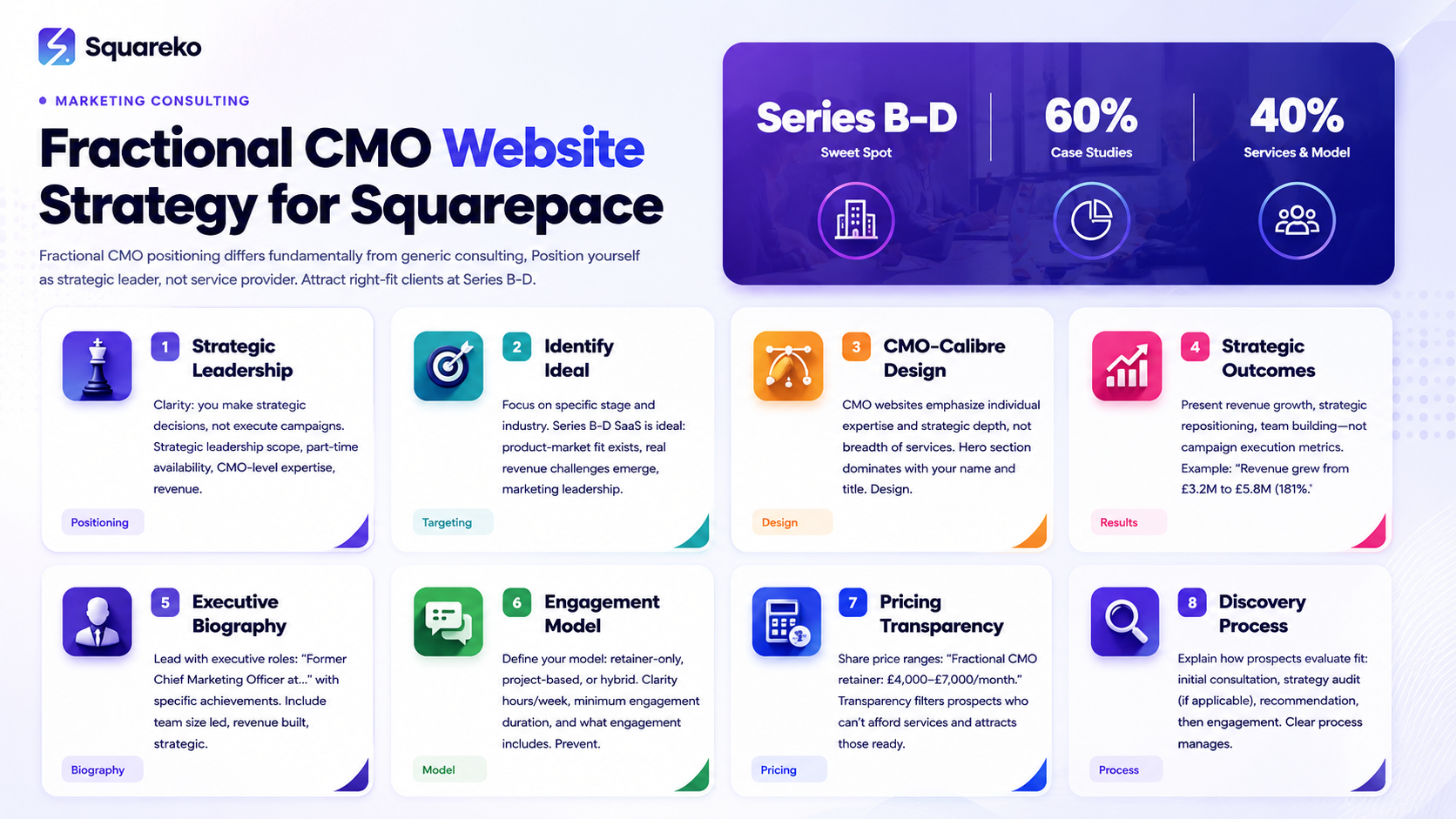
Fractional CMO positioning requires specificity: identify your target companies by stage, industry, and size
CMO-calibre website design differs from agency websites; executives expect different visual hierarchies
Campaign results must demonstrate strategic capability and revenue impact, not just tactical execution
Executive biography replaces generic "about" sections for fractional CMO positioning
Engagement model clarity prevents misalignment and attracts clients who want your specific offering (retainer, project, hybrid)
Fractional CMO positioning is fundamentally different from traditional consulting. You're not selling project-based services or hourly expertise. You're positioning yourself as a strategic marketing leader—CMO-calibre decision-making delivered on a part-time, retainer basis.
The difference between a generic marketing consulting website and a fractional CMO website is specificity. "Marketing services" is vague. "Fractional CMO for Series B to D SaaS companies" is precise. Generic positioning attracts tire-kickers and scope-creep conversations. Specific positioning attracts right-fit clients who understand exactly what fractional CMO engagement means.
Building a fractional CMO website on Squarespace requires distinct positioning choices: executive-level biography structure, CMO-calibre design sophistication, revenue attribution in campaign results, and explicit clarity about engagement model and investment.
The Fractional CMO Positioning Difference
Why Fractional CMO Positioning Matters
The term "fractional CMO" is growing in market familiarity, but many prospective clients still conflate it with:
Marketing consulting (project-based work)
Marketing agency (outsourced execution)
Marketing freelancer (part-time tactical support)
Your website's primary job is to clarify what fractional CMO engagement actually means in your specific context.
Fractional CMO positioning should communicate:
Strategic Leadership Scope: You're making strategic decisions about marketing direction, not executing campaigns
Part-Time Availability: You're committed to their growth, but not full-time employed
CMO-Level Expertise: You bring C-suite thinking and accountability
Revenue Accountability: You're measured on business outcomes, not activity
Specific Client Profile: You work with companies at specific stages (Series B-D, high-growth, scaling revenue)
The Positioning Statement
Most fractional CMOs need a positioning statement that appears prominently in their website hero section. This should be specific enough to attract right-fit clients and repel wrong-fit prospects:
✓ "Fractional CMO for Series B to D SaaS companies. Strategic marketing leadership for demand-driven growth without full-time CMO costs."
✗ "Marketing consulting and strategy services for growing companies"
The first is specific and positions the engagement clearly. The second is generic and indistinguishable from hundreds of other marketing consultants.
Identifying Your Ideal Fractional CMO Client
Client Segmentation for Fractional CMO Services
Different company stages and industries require different fractional CMO positioning. Your website should clarify which segment you specialise in.
By Company Stage:
Series A / Seed: Founders need marketing strategy but can't afford CMO salary. Often combined with fractional COO or business development roles.
Series A: First real growth phase. Need marketing leadership to establish demand generation and brand positioning.
Series B: Scaling revenue. Need fractional CMO to optimise marketing efficiency and ROI.
Series C-D: Growth stage. Need fractional CMO for marketing transformation, team building, and enterprise positioning.
Scale-Up Revenue Stage: High-growth (100%+ YoY). Need fractional CMO for marketing scaling and operational maturity.
By Industry:
B2B SaaS: Longest sales cycles, complex buyers, demand generation focus
B2B Services: Relationship-driven, thought leadership important, local/industry reputation critical
Professional Services: Brand and reputation paramount, intellectual capital key differentiator
Manufacturing/Heavy Industry: B2B, relationship sales, sometimes overlooked marketing opportunity
By Company Type:
Venture-backed: Growth-focused, performance marketing emphasis, investor expectations on GTM strategy
Bootstrapped/Profitable: Revenue efficiency important, sustainable growth over hypergrowth
Private Equity Owned: Exit-focused, margin improvement, platform company scaling
Specificity Exercise
Rather than "I work with growing companies," be more specific:
"I work as fractional CMO for Series B SaaS companies with £5M-25M ARR, typically in the HR Tech, Fintech, and MarTech spaces. I focus on companies with product-market fit seeking to scale revenue efficiently through demand generation strategy, sales enablement, and marketing team building."
This specificity attracts exactly the right companies and discourages those that don't fit. The conversation quality improves significantly.
CMO-Calibre Website Design vs. Agency Website Design
Design Distinctions That Signal Executive-Level Positioning
Agency websites emphasis:
Breadth of services
Team size and capabilities
Portfolio diversity
Project case studies
Fractional CMO websites should emphasis:
Strategic depth in specific areas
Individual expertise and credentials
Company stage and industry specialization
Strategic transformation outcomes
Visual Hierarchy for CMO Positioning
Primary Focus: Your name and title (Fractional CMO) should dominate the hero section, not service descriptions.
Example hero section for fractional CMO:
Your name
Fractional CMO for Series B SaaS
Demand generation strategy and
marketing team building for growth-stage
SaaS companies scaling from £5M to £25M ARR.
Schedule Strategy Consultation
Compare this to an agency hero section:
Agency Name
Marketing Services for Startups and Growth-Stage Companies
We deliver strategic consulting, paid advertising management, content marketing,
and brand development to help your company grow.
Get Started
The first positions a strategic leader. The second positions a service provider.
Design Elements for CMO-Calibre Positioning
Executive Photograph: A professional, approachable headshot signals credibility. CMO-level positioning should show the person, not just a logo.
Credential Display: Educational background, certifications, industry memberships, or notable experience should be visible. Not as a resume, but as credibility markers.
Strategic Framework: Fractional CMOs often have a proprietary framework or methodology. Display this prominently—it's intellectual capital that differentiates your thinking.
Revenue Impact Emphasis: Unlike agencies that emphasise activity (campaigns launched, content created), CMO websites emphasise outcomes (revenue growth, market share expansion, team building).
Executive Bio Style: Your "About" section should read like executive leadership biography, not consultant marketing copy. Include:
Professional background (previous roles, experience depth)
Why you chose fractional CMO engagement
Strategic philosophy and approach
Industries and company stages you specialise in
How engagement typically works
Design Restraint
CMO-calibre design often means restraint rather than feature-richness. Avoid:
Excessive animations or transitions
Gallery-heavy case study displays (reserve photos for strategic impact moments)
Service menu overload
Generic inspirational language
Instead, emphasise:
Clean typography and hierarchy
Strategic clarity and specificity
Professional imagery (you, clients if possible, strategic concepts)
Outcome-focused messaging
The design should signal sophistication and strategic thinking.
Campaign Results Presentation for Fractional CMO Services
Strategic Outcomes vs. Tactical Execution
Agency case studies emphasise execution: "Managed £500k paid advertising campaign, achieved 3.2% conversion rate."
CMO case studies emphasise strategic impact: "Repositioned go-to-market strategy, increased qualified lead volume 240%, reduced CAC by 35%, and enabled £2M revenue growth."
The difference is strategic scope and accountability.
The CMO Results Framework
Each fractional CMO case study should answer:
1. Strategic Challenge: What was the business situation when you engaged? What was the marketing problem?
Example: "Series B SaaS company with strong product but weak demand generation. Revenue growth had plateaued at £3.2M ARR despite market opportunity. CEO was concerned about GTM effectiveness and funding implications."
2. Strategic Approach: What was your specific recommendation? What strategic changes did you make?
Example: "Conducted GTM audit revealing misalignment between sales and marketing on qualification criteria. Restructured demand generation to focus on qualified SMB segment instead of enterprise (which required 18-month sales cycles). Built sales enablement programmer. Implemented attribution modelling."
3. Execution Timeline: Over what period did strategic shifts happen?
Example: "6-month engagement as fractional CMO (20 hours/week). First 2 months: strategy and planning. Months 3-6: implementation and team training."
4. Measured Outcomes: What happened to key metrics?
Example:
Qualified lead volume: increased 240% (from 45/month to 153/month)
Customer acquisition cost: decreased 35% (from £12,500 to £8,125)
Sales cycle length: decreased from 6 months to 3 months average
Annual recurring revenue: grew from £3.2M to £5.8M (81% growth over 12 months)
5. Outcome Attribution: What portion of outcomes were directly attributable to marketing strategy changes?
Example: "Growth was driven by improved lead quality and sales efficiency rather than lead volume alone. Sales team reported that new lead profile had 3x better qualification rate, reducing sales cycle and improving close rates. Marketing's responsibility: 60% of revenue growth (£1.56M of £2.6M growth)."
6. Sustained Impact: Are results ongoing?
Example: "Client has retained updated demand generation model and improved qualification focus. Revenue has continued to grow (now £7.2M ARR, 18 months post-engagement). Attribution shows sustained benefit from strategic shift."
Metrics That Matter to CMO Hiring Executives
CEOs and CFOs evaluating fractional CMO services care about:
Revenue impact (attributed to marketing strategy shifts)
Efficiency metrics (CAC reduction, CAC payback period improvement)
Growth rate (YoY revenue acceleration)
Team building (internal capability developed)
Strategic positioning (market positioning improvements)
Don't emphasise:
Campaign metrics alone (impressions, clicks, conversion rates)
Activity metrics (content pieces published, emails sent)
Vanity metrics (social followers, website traffic)
Focus on outcomes that affect business valuation and growth trajectory.
Executive Biography and Credentials Positioning
The Executive Bio vs. Consultant Biography
Consultant biography: "I have 12 years of experience in marketing strategy and have worked with 50+ clients across various industries..."
Executive biography: "Chief Marketing Officer at [Company] (2019-2023) where I built marketing function from startup to £15M ARR company, establishing demand generation, brand positioning, and marketing operations that contributed to £12M Series B funding. Previously VP Marketing at [Company] where I led go-to-market repositioning for enterprise B2B SaaS product line, resulting in 180% revenue growth."
The difference: specificity, outcomes, and credibility depth.
Elements of Strong Executive Biography
1. Title and Company History Lead with your most relevant executive role: "Former Chief Marketing Officer" or "VP Marketing, [Notable Company]"
2. Specific Achievements Include quantifiable outcomes from previous roles:
Revenue built or grown
Team size managed or built
Funding raised (if applicable)
Market positioning or competitive wins
3. Functional Depth Indicate the functional areas you've led:
"Built demand generation function from zero"
"Established brand positioning for enterprise expansion"
"Scaled marketing team from 2 to 12 across multiple functions"
4. Industry or Stage Specialization Clarify your expertise:
"Scaled marketing for Series B-D SaaS companies"
"Established B2B marketing functions for enterprise software"
"Led go-to-market repositioning for AI/ML products"
5. Relevant Education or Credentials Include education if from notable institutions, relevant certifications, or industry memberships.
6. Personal Statement Optional: brief statement of why you chose fractional CMO engagement rather than full-time employment.
Example: "I chose fractional CMO engagement because I work best as a strategic catalyst for growing companies—helping teams think systemically about growth, build scalable processes, and develop marketing capability. I prefer to work with 2-3 companies deeply rather than manage a large marketing department."
Professional Photography
Your executive biography should include a professional headshot. Quality matters. Avoid:
Overly formal corporate photography
Low-resolution or amateur photos
Photo that looks 10+ years old
Invest in professional photography (£200-400 for session with 10-20 edited headshots). The ROI is significant.
Engagement Model, Retainer Structure, and Investment Clarity
The Engagement Model Clarity Problem
Many prospective fractional CMO clients don't understand the difference between:
Fractional CMO retainer (ongoing strategic leadership)
Project-based marketing consulting (defined scope, defined timeline)
Marketing agency services (outsourced execution)
Your website should eliminate this confusion.
Engagement Model Options and Website Positioning
Option 1: Retainer-Only Model
Best for: Fractional CMOs who want predictable revenue and ongoing strategic relationships
Website positioning:
Monthly retainer: typically 15-25 hours/week strategic engagement
3-6 month minimum engagement (allows strategic depth)
Includes: strategy sessions, team leadership, decision-making, quarterly planning
Focused on: demand generation, go-to-market, team building, or specific functional area
Example pricing transparency: "Fractional CMO retainer: £4,000-£7,000/month depending on company stage, complexity, and strategic scope."
Option 2: Project-Based Model
Best for: Fractional CMOs who want flexibility and specific project focus
Website positioning:
Defined project scope (GTM audit, demand generation strategy, brand positioning, marketing team building)
6-12 week typical project timeline
Deliverables: strategy document, implementation roadmap, team training
Designed as foundation for potential ongoing retainer
Example: "Marketing strategy audit and GTM repositioning: £15,000-£25,000 depending on company size and complexity. Timeline: 8 weeks."
Option 3: Hybrid Model (Most Common)
Best for: Fractional CMOs who want flexibility within ongoing relationships
Website positioning:
Base retainer for ongoing strategic leadership (e.g., £4,000/month, 15 hours/week)
Project budget for implementation or special initiatives (e.g., £2,000/month additional capacity)
Flexibility to add or reduce project scope based on business needs
Minimum 3-6 month overall engagement
Example: "Engagement typically starts with base fractional CMO retainer (£4,000-£5,000/month, 15 hours/week) plus project capacity for strategic initiatives. Many clients add implementation projects (brand positioning, demand generation setup, sales enablement) as needs emerge."
Website Clarity Elements
Dedicated Engagement Page: Create a page explicitly titled "How It Works" or "Engagement Model" that explains:
What fractional CMO engagement includes
Your specific model (retainer, project, hybrid)
Typical engagement timeline
What success looks like
How you structure ongoing communication and accountability
Pricing Transparency: You don't need to publish exact prices, but price ranges build trust and set expectations.
Example ranges:
"Fractional CMO retainer: £4,000-£7,000/month"
"Marketing strategy and GTM repositioning project: £12,000-£20,000"
"Demand generation strategy and implementation: £15,000-£25,000"
Discovery Process Clarity: Explain how prospects evaluate whether fractional CMO engagement is right for them.
Example discovery process:
Initial consultation (30 minutes, free) — explore business situation, marketing challenges
Strategy audit (if applicable) — deeper dive into GTM and marketing effectiveness
Recommendation — proposal for specific engagement model and scope
Engagement — structured regular cadence and deliverables
Preventing Scope Creep
Clarity about your engagement model prevents the most common fractional CMO problem: scope creep where clients expect full-time CMO availability at part-time pricing.
Your website should explicitly state:
"Fractional CMO engagement is strategic leadership at 15-20 hours/week. For execution or tactical support beyond strategic leadership scope, projects are evaluated separately."
"Ongoing execution of campaigns is not included in fractional CMO retainer. We build internal capability and guide strategy; implementation is handled by your team or agency partners."
"Office hours and communication: specify your availability—e.g., 'Available for urgent matters via email, scheduled strategy sessions weekly or biweekly"
This clarity reduces misalignment and attracts clients who understand and respect the fractional CMO model.
Ready to build a fractional CMO website that positions you for right-fit client engagement?Squareko specialises in Squarespace websites for fractional CMOs that position your strategic expertise clearly, showcase campaign results that demonstrate business impact, and set engagement expectations that prevent scope creep.
Frequently Asked Questions
-
A: Partial transparency is better than complete secrecy. Publishing price ranges (e.g., "Fractional CMO retainer: £4,000-£7,000/month") sets expectations and filters out prospects who can't afford your services. Exact pricing can be determined in consultation based on specific scope.
-
A: You need concrete evidence of strategic marketing leadership at scale. This might come from: VP Marketing role at growth-stage company, leading demand generation transformation, building marketing teams, or scaling specific functional areas. If you lack executive-level experience, "marketing strategy consultant" or "marketing advisor" might be more honest positioning.
-
A: Series B-D is the sweet spot (£3M-£25M ARR). Series A is often too early (founder is chief marketer). Scale-stage (£25M+) often prefers full-time CMOs. Series B-D companies have product-market fit, real revenue, and marketing challenges—they're ready for serious strategic investment. Position specifically here.
-
A: Specificity. Define your niche by: company stage, industry vertical, functional speciality (demand generation, brand repositioning, team building), and specific methodology. "Fractional CMO for HR Tech SaaS companies focused on demand generation" is more differentiated than "fractional CMO for SaaS companies."
-
A: No. Solo fractional CMOs should position as individual expert. You can mention team members or partners you bring in for specific projects (designers, developers, content creators), but the primary positioning should be your individual strategic expertise.
-
A: Roughly 60% case studies and campaign results, 40% engagement model clarity, credentials, and service explanation. Case studies are your primary sales tool. Engagement model clarity prevents misalignment and attracts right-fit clients.
From custom website design to SEO strategy, we help businesses launch a site that looks professional and performs better.

Author Bio
Written by the Squareko team,
I'm Walid Hasan, a Certified Squarespace Expert and Squarespace Circle Platinum Partner with over 12 years of hands-on experience designing and optimizing high-performing websites. Over the years, I've had the privilege of building more than 2,000 Squarespace websites for clients around the world, always focusing on clean design, strong user experience, and conversion-driven results.