How Marketing Consultants Showcase Campaign Results and Client Outcomes on Squarespace
Key Takeaways How Marketing Consultants Showcase Campaign Results and Client Outcomes on Squarespace
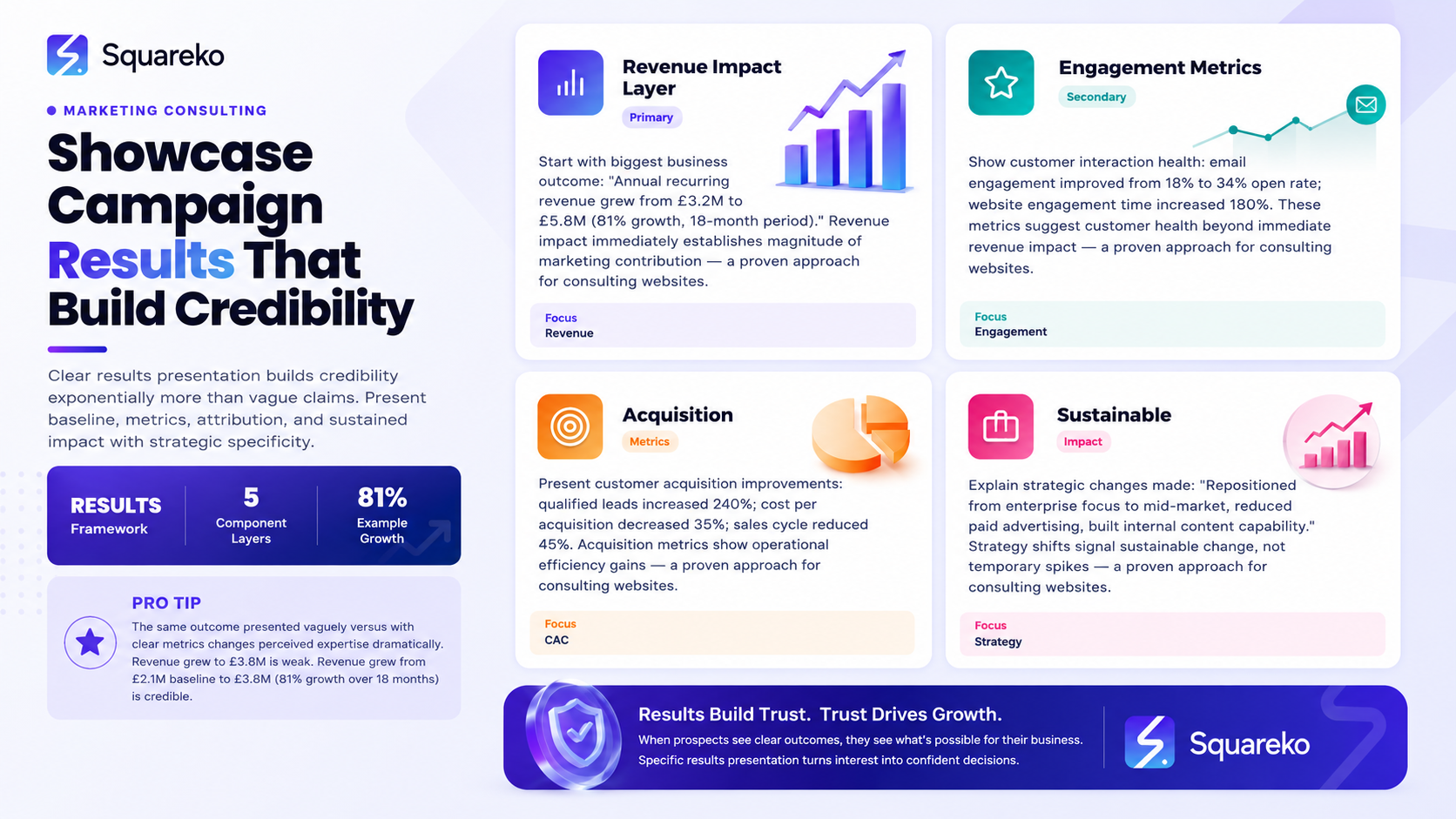
The RESULTS Framework (Revenue Impact → Engagement Metrics → Acquisition Metrics → Long-term Strategy Shift → Track Record Summary) structures case studies for credibility
Outcome metrics should match your consultant positioning: revenue impact for CMO positioning, lead volume for demand generation, ROAS for performance marketing
Baseline establishment (showing what metrics looked like before) is more credible than just reporting final metrics
Compliant performance claims require attribution honesty ("attributed to," "contributed to," "supported by") rather than unqualified claims
Visual hierarchy and data presentation matter as much as metrics themselves
The difference between a marketing consultant website that attracts the right clients and one that attracts nobody is often invisible. It's not design quality. It's how you present results.
A vague case study ("increased revenue") attracts sceptical prospects who assume you're hiding weak outcomes. A clear case study with specific metrics, baseline establishment, and outcome attribution attracts prospects who believe your results and see themselves in your case study.
Most marketing consultants underestimate how significantly results presentation affects credibility. An identical campaign outcome presented vaguely versus with clear metrics and attribution changes perceived expertise dramatically.
This guide provides a framework for presenting campaign results that builds credibility, attracts right-fit clients, and demonstrates your marketing knowledge through execution—not just assertion.
The RESULTS Framework for Case Study Structure
Five-Part Structure for Credibility
Each campaign result showcase should include these five elements:
1. Revenue Impact (or relevant primary outcome) 2. Engagement Metrics (supporting outcomes) 3. Acquisition Metrics (how did customer flow improve?) 4. Long-Term Strategy Shift (what changed in how they operate?) 5. Track Record Summary (sustainable results?)
Revenue Impact Layer
Start with the biggest business outcome that demonstrates marketing's contribution to the bottom line.
For fractional CMO positioning:
"Annual recurring revenue grew from £3.2M to £5.8M (81% growth, 18-month period)"
"Revenue per employee improved 45% through improved marketing efficiency"
"Enterprise revenue segment expanded from 5% to 35% of total revenue through strategic repositioning"
For demand generation consultants:
"Qualified pipeline increased from £500k/month to £1.8M/month (260% growth)"
"Annual contract value improved from £45k average to £67k average through improved lead quality"
For brand strategy consultants:
"Market position shifted from commodity player to premium provider, enabling 40% price increase with improved close rates"
"Brand awareness increased from 12% to 38% in target market within 12 months"
For content marketing consultants:
"Organic traffic increased 340%, contributing to 65% of lead volume (previously 15%)"
"Content marketing qualified leads increased from 8% to 42% of marketing-sourced leads"
The revenue impact layer immediately establishes magnitude. If you can show revenue grew because of your strategy, everything else is supporting evidence.
Engagement Metrics Layer
Engagement metrics show the health of customer interaction and satisfaction.
Examples:
"Email engagement rates improved from 18% open rate, 2.1% CTR to 34% open rate, 5.8% CTR through audience segmentation and content personalisation"
"Website engagement time increased 180% (from 1m 22s average to 3m 51s) through improved content hierarchy and user experience"
"Customer satisfaction scores improved from 6.8/10 NPS to 8.1/10 NPS through improved onboarding and customer success positioning"
"Sales conversation duration increased 35% (more strategic conversations, deeper exploration of fit) through improved qualification"
Engagement metrics are important because they suggest customer health beyond immediate revenue metrics. High engagement predicts retention and expansion revenue.
Acquisition Metrics Layer
Acquisition metrics show how the customer acquisition engine improved.
Examples:
"Qualified lead volume increased 240% (45/month to 153/month) through demand generation strategy shift"
"Cost per acquisition decreased 35% (from £12,500 to £8,125) through improved lead quality focus"
"Sales cycle length decreased 45% (from 6.2 months average to 3.4 months) through improved qualification and sales enablement"
"Close rate improved from 12% to 23% (qualified opportunity to customer) through better-qualified leads"
"Lead-to-customer timeframe improved 55% through automated nurturing and sales process alignment"
Acquisition metrics show operational efficiency. CMOs care about CAC (customer acquisition cost), CFOs care about payback period and efficiency ratios, sales leaders care about lead quality and cycle time.
Long-Term Strategy Shift Layer
Strategy shift demonstrates that results came from strategic direction changes, not temporary campaigns or one-off initiatives.
Examples of strategy shifts:
"Repositioned from enterprise-focused sales motion to mid-market focus, which proved more sustainable and scalable"
"Shifted demand generation from paid advertising heavy to inbound/content-driven, reducing acquisition cost while improving lead quality"
"Established marketing operations function and demand generation accountability, embedding marketing more closely with sales"
"Built internal content creation capability (hired marketing manager, created editorial process) rather than outsourcing all content"
"Shifted positioning from generic 'we're good at everything' to specialised 'we solve X problem for Y companies' positioning"
Strategy shifts matter because they signal sustainable change. Temporary campaign success is nice. Sustainable strategic change is transformational.
Track Record Summary Layer
Conclude with evidence that results are sustained or ongoing.
Examples:
"18 months after engagement ended, company has maintained improved demand generation model and continues to see qualified lead growth"
"Client has expanded marketing team from 1 person to 3, embedding the new strategy internally"
"3 years post-engagement, company has grown from Series B to Series C funding, with marketing now a core strategic function"
"Demand generation model has been refined through ongoing iteration, but core strategic shift remains in place"
Track record summary shows you didn't just create a temporary spike. Real strategic consulting has lasting impact.
Marketing-Specific Outcome Metrics
Matching Metrics to Positioning
Your positioning should determine which metrics you emphasise.
Fractional CMO Positioning emphasises:
Annual recurring revenue growth
Revenue growth attribution
Market share or segment expansion
Team building and capability development
Strategic positioning or repositioning
Examples: "£2.1M to £3.8M annual revenue (81% growth) attributed to demand generation strategy and sales process alignment"
Demand Generation Consultant emphasises:
Qualified pipeline growth
Cost per acquisition reduction
Lead volume increase
Lead quality metrics (qualification rate, sales-accepted lead rate)
Pipeline velocity (sales cycle improvement)
Examples: "Qualified monthly pipeline increased 260% (from £500k to £1.8M) with 35% reduction in cost per acquisition"
Brand Strategy Consultant emphasises:
Brand awareness metrics
Perception shift metrics
Market positioning metrics
Premium pricing ability
Differentiation in market
Examples: "Brand awareness increased 140% in target market; repositioning enabled 40% average price increase with improved close rates"
Growth Marketing Consultant emphasises:
Revenue growth from specific channels
CAC payback period
LTV:CAC ratio improvement
Retention and expansion metrics
Cohort performance improvement
Examples: "Organic channel revenue grew 320% YoY; CAC payback period improved from 14 months to 8 months; LTV:CAC ratio improved from 1.8:1 to 4.2:1"
B2B Marketing Advisor emphasises:
Account-based marketing results
Enterprise segment growth
Sales cycle efficiency
Deal size improvement
Sales enablement outcomes
Examples: "Enterprise segment revenue improved 185%; average deal size increased from £45k to £72k; sales cycle for enterprise deals decreased from 8 months to 5 months"
Metrics Hierarchy
Present metrics in order of importance to decision-makers:
For C-level and board focus: Revenue, growth rate, market position, strategic capability
For sales leader focus: Qualified lead volume, lead quality, sales cycle, close rates, deal size
For marketing leader focus: Channel efficiency, CAC, ROAS, content performance, team capability
For finance/CFO focus: Revenue attribution, CAC payback period, LTV:CAC ratio, efficiency ratios
Different stakeholders care about different metrics. Knowing your audience helps you prioritise what to show.
Baseline Establishment and Attribution Clarity
Why Baseline Matters
Saying "revenue grew to £3.8M" is meaningless without context. Revenue grew from what? Over what period?
Baseline establishment provides crucial context:
✗ Weak: "Revenue grew to £3.8M" ✓ Better: "Revenue grew from £2.1M to £3.8M (81% growth over 18 months)" ✓ Even better: "Revenue grew from £2.1M baseline (relatively flat previous 2 years) to £3.8M (81% growth over 18 months, primary growth acceleration occurring in months 4-18)"
The third example is strongest because it shows:
Clear starting point
Clear ending point
Timeline of when results appeared
Implicit demonstration that it's not natural growth (it was flat before engagement)
Attribution Language and Compliance
Performance claims must be truthful and defensible. Use specific attribution language:
Honest Attribution:
"Attributed to [specific strategy or change]"
"Contributed to [outcome]"
"Supported by [effort or change]"
"Enabled by [strategy]"
"From [specific initiative]"
Problematic Attribution:
"Caused [outcome]" (too absolute, hard to defend)
"Resulted in [outcome]" (too absolute, implies sole causation)
"Generated [outcome]" (implied causation without support)
Example of honest attribution: "Revenue grew from £2.1M to £3.8M (81% growth). Growth was attributed primarily to demand generation strategy shift (focusing on mid-market rather than enterprise) and improved sales qualification. Secondary contributors included brand repositioning (enabling 15% premium pricing) and sales enablement (reducing sales cycle by 35%). Conservative estimate: demand generation strategy contributed 55% of growth (£900k of £1.7M total growth), with remaining growth from improved pricing and sales efficiency."
This attribution is honest, specific, and defensible.
Multi-Contributor Transparency
Most business outcomes have multiple contributors. Your case study should acknowledge this:
✗ Weak: "We increased revenue 81%" ✓ Better: "Revenue increased 81%. Marketing strategy contributed approximately 55% of growth (through demand generation repositioning). Sales process improvements and pricing strategy contributed remaining 45%. Client's improved product roadmap execution and customer success improvements also supported growth."
This transparency actually builds credibility rather than damaging it. Prospects know business results come from multiple factors. Acknowledging that shows sophistication.
Client Context for Attribution Credibility
Provide enough client context that prospects can assess whether the case study is comparable to their situation.
Minimal context:
"SaaS company" (too generic)
Better context:
"Series B SaaS company, £2M ARR, HR Tech market, 3-year-old product, 8-person team"
Even better context:
"Series B SaaS company (£2M ARR at engagement start, £5.8M at end), HR Tech market, 3-year-old product with strong product-market fit in SMB segment, 8-person team, struggling with enterprise sales motion"
The third example gives prospects enough information to assess whether the case study is relevant to their situation.
Compliant Performance Claims Language
Advertising Standards Considerations
In regulated markets (UK ASA, EU, US FTC), marketing performance claims must be:
Truthful and not misleading
Substantiated with evidence
Not making absolute guarantees about future performance
Language to use:
"Contributed to [outcome]"
"Supported [outcome]"
"Resulted in [outcome] when combined with [other factors]"
"Average results: [metric] (individual results may vary)"
Language to avoid:
"Guaranteed to generate [outcome]"
"Will increase [metric] by [amount]"
"Proven to [outcome]"
Testimonial claims without substantiation
Specific Examples of Compliant vs. Non-Compliant Language
Non-Compliant: "Our demand generation strategy will increase your qualified leads by 300%"
Compliant: "Our previous client in a similar market segment experienced a 240% increase in qualified leads over 18 months through demand generation strategy implementation. Results will vary based on starting position, market, product, and execution."
Non-Compliant: "Increased revenue by 81%"
Compliant: "Revenue increased from £2.1M to £3.8M (81% growth). Growth was attributed to demand generation strategy shift (estimated 55% contribution), improved sales qualification and sales cycle reduction (estimated 30% contribution), and brand repositioning enabling premium pricing (estimated 15% contribution)."
Non-Compliant: "Guaranteed ROI of 3:1 on marketing investment"
Compliant: "Client achieved 3.2:1 ROAS (return on ad spend) for the first 12 months through improved audience targeting and conversion optimization. This specific result reflected their particular market, product positioning, and team execution. Average client ROAS ranges 2.1:1 to 4.8:1 depending on sector and starting position."
Third-Party Substantiation
For performance claims on your website (not testimonials, but your own claims about results), consider:
Case study documentation showing actual metrics
Client permission to reference results
Data showing the claimed metric (even if anonymised)
Documented evidence makes claims more credible and defensible.
Visual Campaign Results Showcase
Design Hierarchy for Results Presentation
Visual presentation of metrics matters as much as the metrics themselves.
Metric Prominence: Use typography, colour, and sizing to highlight key metrics.
Example visual hierarchy:
CLIENT NAME & INDUSTRY
LARGEST TEXT] £1.7M Revenue Growth (81% increase over 18 months)
SECONDARY METRICS in grid format
Qualified Pipeline: £500k → £1.8M (260% growth)
Sales Cycle: 6.2 months → 3.4 months (45% reduction)
Lead Quality: 12% close rate → 23% close rate (92% improvement)
Cost per Acquisition: £12,500 → £8,125 (35% reduction)
Before/After Visualisation: Use charts showing before/after metrics.
Example:
Bar chart showing revenue baseline vs. final metric
Line chart showing metric progression over engagement timeline
Dashboard-style presentation showing related metrics
Whitespace and Readability: Don't crowd metrics. Each metric should be readable and meaningful.
Campaign Results Page Structure
Organise your Squarespace portfolio by results category:
By Outcome Type:
Revenue Impact Case Studies
Lead Generation Case Studies
Brand Transformation Case Studies
Team Building and Capability Case Studies
By Client Segment:
SaaS Case Studies
B2B Services Case Studies
Professional Services Case Studies
Manufacturing Case Studies
By Strategy Type:
Demand Generation Results
Brand Repositioning Results
Go-to-Market Strategy Results
Sales Enablement Results
This organisation helps prospects find relevant case studies.
Video Case Studies
For maximum impact, consider video case studies:
3-5 minute client interview discussing the engagement, strategy, and results
Before/after metrics displayed visually
Client testimonial on specific results and working relationship
Video adds credibility because it features the actual client. A client willing to go on video has confidence in the results.
Metric Callout Boxes
Throughout your website, use metric callout boxes to draw attention to specific results:
┌─────────────────────────────────────┐
│ Previous Client Success │
│ ──────────────────────────────── │
│ Revenue Growth: 81% │
│ (£2.1M → £3.8M over 18 months) │
│ Qualified Pipeline Growth: 260% │
│ Sales Cycle Reduction: 45% │
└─────────────────────────────────────┘
These boxes break up text-heavy pages and make results scannable.
Case Study Integration Throughout Your Squarespace Site
Homepage Integration
Your homepage should prominently feature your strongest case study or key metrics.
Example homepage section:
Strategic Results From Recent Engagements
[Client Logo/Name] - Fractional CMO Engagement
Revenue grew from £2.1M to £3.8M (81% growth, 18 months)
Qualified pipeline expanded 260% through demand generation repositioning
[Client Logo/Name] - Demand Generation Transformation
Qualified leads increased 240% (45 → 153/month)
Cost per acquisition decreased 35% while improving lead quality
Service Page Integration
Link service descriptions to relevant case studies.
Example:
Demand Generation Strategy
Our approach to demand generation focuses on qualified pipeline
growth and CAC efficiency. Rather than maximising lead volume,
we optimise for lead quality and sales readiness.
Related Case Study: Client Name
- Qualified leads increased 240%
- Cost per acquisition decreased 35%
- Sales cycle reduced 45%
Dedicated Portfolio/Case Study Pages
Create dedicated case study pages with:
Client context and challenge
Strategic approach
Results and metrics (using RESULTS framework)
Specific outcomes and outcomes
Client testimonial (if available)
Call-to-action to discuss similar engagement
Internal Linking from Blog to Case Studies
Link blog articles to relevant case studies to show practical application of your thinking.
Example blog article:
Article: "How to Evaluate Demand Generation Effectiveness"
[Within article] "In a recent engagement with [Client Name],
we repositioned their demand generation approach, resulting in
240% qualified lead growth and 35% CAC reduction. Here's how we
identified the opportunity and executed the strategy..."
Link to full case study
Email Capture with Case Studies
Use specific case studies as lead magnets:
"Download Case Study: How Client Name Increased Qualified Pipeline 260% Through Demand Generation Repositioning"
Email capture gates can help build your prospect list while providing specific value.
Building Credibility Through Results Presentation
The Credibility Multiplier
Results presented clearly with baseline, attribution, and metrics build credibility exponentially. The same outcome—revenue growth of 81%—has vastly different credibility depending on presentation:
Weak Presentation: "Our engagement resulted in significant revenue growth" Moderate Presentation: "Revenue grew to £3.8M" Strong Presentation: "Revenue grew from £2.1M baseline (flat 2 years prior) to £3.8M (81% growth over 18 months), attributed primarily to demand generation strategy shift from enterprise to mid-market focus, which reduced CAC 35% while improving lead quality and close rates"
The third presentation takes the same outcome and makes it 10x more credible through:
Specific baseline and timeline
Clear attribution
Supporting metrics
Implicit evidence of sustainable strategy shift
Ready to showcase your campaign results in a way that attracts the right consulting clients?Squareko builds Squarespace websites for marketing consultants that present results with credibility, clarity, and client conversion focus. Your case studies should prove your capability.
Frequently Asked Questions
-
A: Yes. Create anonymised case studies with industry and company size identified, specific metrics shared, but client name and identifying details removed. Example: "Series B SaaS company in HR Tech, £2M ARR." This preserves client confidentiality while demonstrating results credibility.
-
A: Minimum 3-5 featured case studies (depending on recency and relevance). If you have more, organise by category (outcome type, client segment, strategy type) to help prospects find relevant examples. Quality matters more than quantity.
-
A: Feature your most recent results prominently. Include historical results as secondary examples. If all your strong results are old, it might be time to update your case studies. Recent results signal ongoing capability.
-
A: No. Only showcase results you're proud of and that demonstrate your capability. Failing forward is valuable (and can be mentioned in thought leadership), but your primary case studies should be success stories.
-
A: As specific as possible while remaining honest. Rather than "attributed to our strategy," say "attributed primarily to demand generation repositioning (estimated 55% of growth) with supporting contributions from sales efficiency improvements (30%) and pricing strategy (15%)." Specificity builds credibility.
-
A: Acknowledge the team effort. "Revenue growth resulted from coordinated effort including improved product positioning (product team), enhanced sales enablement (sales team), and demand generation strategy shift (marketing strategy—my contribution)." Transparency about contributions shows maturity.

From custom website design to SEO strategy, we help businesses launch a site that looks professional and performs better.

Author Bio
Written by the Squareko team,
I'm Walid Hasan, a Certified Squarespace Expert and Squarespace Circle Platinum Partner with over 12 years of hands-on experience designing and optimizing high-performing websites. Over the years, I've had the privilege of building more than 2,000 Squarespace websites for clients around the world, always focusing on clean design, strong user experience, and conversion-driven results.