How to Build a Technology Consulting Website on Squarespace That Wins Enterprise Clients
Enterprise buyers don't purchase consulting services the way consumers buy products. They conduct extensive research, evaluate multiple firms, and require extensive proof of capability before engaging. Your technology consulting website on Squarespace must be architected specifically for this sophisticated buying journey.
The difference between a consulting website that generates qualified leads and one that sits dormant isn't luck or budget—it's strategic design that accounts for how enterprise buyers actually evaluate consulting partners. This guide walks you through building a Squarespace website that wins enterprise contracts through trust architecture, credibility signaling, and intelligent content strategy.
Key Takeaways Build a Technology Consulting Website
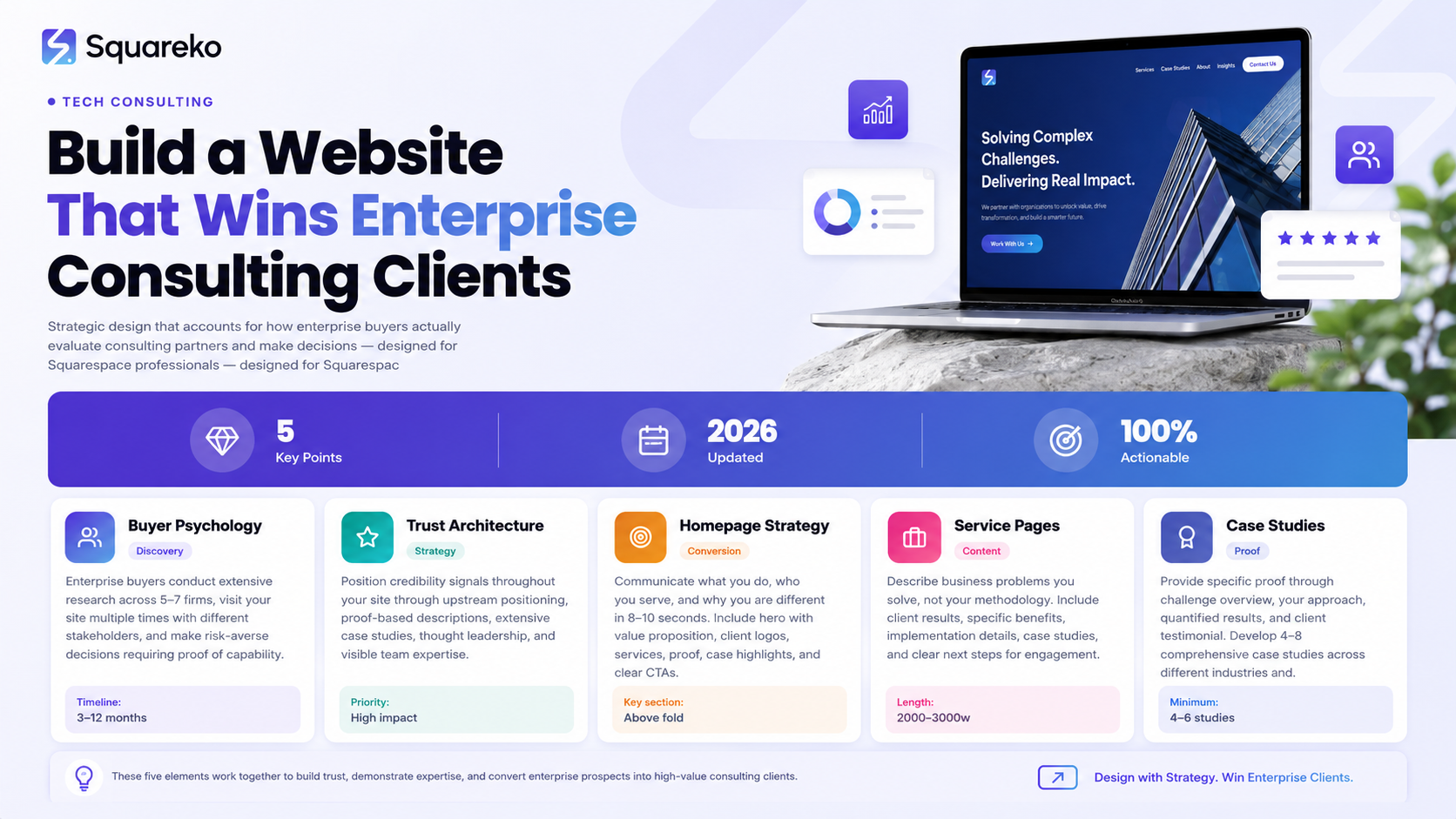
Enterprise buyers are risk-averse and proof-focused: Your website must extensively demonstrate capability through case studies, credentials, and client testimony
Trust architecture requires intentional design: Position your firm's credibility throughout your site through logical information hierarchy and strategic placement of proof elements
Case study pages are your highest-converting assets: Detailed case studies with specific metrics outperform generic service descriptions in enterprise buyer evaluation
Thought leadership positioning differentiates consulting firms: Publishing proprietary insights and research helps you stand out in competitive consulting markets
Contact and engagement processes must be friction-free: Enterprise buyers expect multiple paths to engagement—consultation forms, resource requests, and sales contact options
Understanding Enterprise Buyer Psychology
Enterprise procurement is fundamentally different from B2B small business purchasing. Companies with 500+ employees and multi-million-dollar IT budgets follow specific decision-making patterns that your website must address.
Enterprise Buyers Conduct Extensive Due Diligence
Enterprise buyers typically research 5-7 potential consulting partners before initiating direct conversations. They visit your website multiple times, often with different stakeholders (CFO, CTO, department head). Your site must accommodate repeat visits and provide different value at different visit depths.
Your initial visitors might spend 2-3 minutes assessing whether your firm is credible enough to warrant deeper investigation. Subsequent visitors might spend 15-20 minutes exploring service details and case studies. Your site architecture must serve both use cases.
Risk Minimization Drives Enterprise Decision-Making
Large-scale consulting engagements involve significant budget, time, and organizational impact. Enterprise buyers are risk-averse and seek firms that have proven success with similar organizations. They want evidence that you've solved their specific challenges repeatedly.
This means your website must prove capability through extensive case studies, client references, team credentials, and published research—not through sales copy that claims expertise.
Multiple Decision-Makers Require Different Content Paths
Enterprise procurement typically involves:
Procurement/IT Director: Evaluates technical fit and cost
CFO/Finance: Reviews ROI and budget impact
C-Level Executive: Assesses strategic value and leadership quality
Implementation Team: Evaluates operational feasibility
Your website must provide evidence that appeals to each stakeholder. Your case studies should include financial impact, technical details, and business outcomes. Your team pages should include executive visibility.
The Trust Architecture Framework
Trust architecture refers to the intentional placement of credibility signals throughout your website. Rather than hoping enterprise buyers find your proof elements, you strategically guide them to evidence of your capability.
Element 1: Upstream Credibility Positioning
Your homepage hero section and above-the-fold content should immediately establish that you're a credible, professional firm. This means:
Professional imagery: High-quality photos of your team, office, or client work—not stock photos
Recognizable client logos: Display logos of recognizable enterprise clients you've worked with (with permission)
Credential highlights: Serving Fortune 500 companies, 20+ years' experience, ISO certified
Awards and recognition: Industry awards, analyst recognition, media mentions
Element 2: Proof-Based Service Descriptions
Rather than describing your process, describe the outcomes you deliver. For each service offering:
Start with the client problem, not your solution
Explain specific benefits, quantified where possible
Reference case study examples showing this service in action
Include a clear next step, typically a consultation request or resource download
Element 3: Extensive Case Study Infrastructure
Case studies are your most valuable assets. Develop 4-8 comprehensive case studies covering:
Different industries (showing your breadth)
Different company sizes (showing your scalability)
Different challenges (showing your depth)
Quantified results (showing your impact)
Element 4: Thought Leadership and Published Authority
Enterprise buyers view consulting firms as sources of insight and innovation. Your website should demonstrate that you're current with industry trends and have proprietary knowledge:
Original research: Publish annual reports, surveys, or analysis
Thought leadership content: Share specific methodologies, frameworks, or approaches
Industry commentary: Analyze industry shifts and implications
Speaking credits: Highlight speaking engagements and conference presence
Element 5: Team and Leadership Visibility
Enterprise buyers want to know who will actually work on their project. Your website should include:
Executive bios: In-depth profiles of your leadership team
Consultant profiles: Highlight consultants who will lead engagements
Credentials and certifications: Display relevant qualifications
Background and expertise: Show specific experience relevant to your services
Structuring Your Consulting Homepage for Enterprise Impact
Your homepage has two functions: first-time conviction and subsequent visitor guidance.
Hero Section: Immediate Credibility
Your hero section (the first thing visitors see) should communicate:
Primary message: What you do and who you do it for, in plain language
We help enterprise companies accelerate digital transformation is better than We provide advanced technology advisory solutions
Secondary credibility signal: Quick proof that you're credible
Client logo section, or
Specific credential (Trusted by 200+ enterprise companies), or
Recognition statement (Inc. 5000 certified consulting firm)
Single clear CTA: Guide to your next conversion moment
Schedule a consultation or
Download our digital transformation guide or
View our latest research
Navigation and Information Hierarchy
Your main navigation should prioritize enterprise concerns:
Services/Solutions (what you do)
Case Studies/Work (proof you do it well)
About (who you are)
Resources/Insights (demonstrate thought leadership)
Contact/Consultation (clear engagement path)
Don't hide your contact information. Enterprise buyers expect to find multiple ways to engage: direct phone, consultation request form, email, LinkedIn.
Value Articulation Section
Below your hero, clearly articulate why enterprises choose your firm:
Specific outcomes you deliver (not features of your process)
Differentiation from competitors (what makes you different)
Client perspective proof (testimonials, case highlights)
Case Study Highlighting
Feature your strongest 2-3 case studies below your value section. For each:
Brief headline of the challenge or outcome
Visual element (client logo, relevant imagery)
Metrics (money saved, time reduced, revenue increased)
Link to full case study
Social Proof and Credibility Signals
Include a dedicated section for:
Client logos of recognizable enterprise companies
Awards and recognition (Gartner leader, Forrester Wave, industry awards)
Certifications relevant to your industry
Media mentions and press coverage
Employee statistics if impressive (200+ consultants, 12 offices globally)
Thought Leadership Positioning
Feature your recent thought leadership:
Latest research or report
Featured articles or publications
Speaking engagements
Original frameworks or methodologies
This demonstrates that you're not just executing projects—you're shaping industry direction.
Clear Conversion Pathways
Your homepage should have multiple conversion opportunities:
Above fold: Consultation request or primary CTA
Mid-page: Case study CTAs (See how we helped similar companies)
Resource section: Download guides, research reports, or assessment tools
Bottom: Clear contact information and secondary CTAs
Service Pages That Convert Enterprise Prospects
Your service pages are where enterprise prospects deep-dive into your specific capabilities. Each service page should follow this structure:
Service Page Structure
1. Service Overview (clear, benefit-focused)
Describe the business problem you solve, not your methodology
Avoid jargon; write for stakeholders who may not be deeply technical
Include client results and examples upfront
2. Who This Service Is For
Specific company profiles (by industry, size, challenge)
Describe the typical problems facing these organizations
Explain why this service matters for their type of company
3. What You Do (Your Approach)
Outline your methodology or process, but focus on outcomes
Include phases if relevant (discovery, implementation, optimization)
Explain your differentiated approach—why you do it differently than competitors
4. Case Study Examples
Include 2-3 case studies showing this service in action
If full case study pages exist, link to them
Include key metrics and client background
5. Implementation Details
Timeline expectations
Team composition
What clients should expect
Prerequisites or requirements
6. Results and Impact
Quantified outcomes from similar projects
Industry-specific metrics
Long-term benefits and ROI
7. Related Services
Link to other services frequently purchased together
Explain integration between services
Guide prospects toward comprehensive engagement
8. Clear Conversion CTA
Schedule a consultation button
Get a custom proposal option
Download service details resource
Multiple engagement options for different prospects
Case Study Pages That Win Contracts
Case studies are your most valuable tool for winning enterprise contracts. They provide specific proof that you've solved similar challenges successfully.
Comprehensive Case Study Structure
1. Overview Section
Client name and industry
Company size and scope
Relationship timeline
Project scope (budget and team size if you can share)
2. The Challenge
Specific business problem the client faced
Impact on the business (revenue loss, inefficiency, risk)
Why they couldn't solve it themselves
What was at stake
3. Why They Chose Us
What our firm brought to the situation
Our unique advantages for this specific challenge
Team members assigned to the project
Our differentiated approach
4. Our Approach and Methodology
Phases of engagement
Key activities and milestones
How we solved the specific challenge
Obstacles overcome and how
5. Results and Impact
Specific, quantified outcomes:
Revenue impact
Cost savings
Efficiency improvements
Risk reduction
Timeline improvements
Business context for why these results matter
Long-term benefits beyond initial engagement
6. Client Testimonial
Quote from key stakeholder (executive ideally)
Their name, title, and company
Specific praise related to outcomes achieved
Optional: short video testimonial if available
7. Service Tags
Which services were included in this engagement
Link to related service pages
Suggest other services the client now uses
8. Related Case Studies
Link to similar case studies in same industry or addressing same challenge
Link to case studies showing complementary services
Case Study Content Guidelines
Be specific: Reduced operational costs by $2.3M annually beats Significantly reduced costs
Use business language: Improved revenue per transaction by 18% resonates more than Enhanced algorithmic efficiency
Quantify wherever possible: Timeline improvements, cost savings, revenue impact, efficiency gains
Make it relatable: Enterprise buyers want to see results from companies similar to theirs
Balance between proof and brevity: Comprehensive but scannable
Authority Positioning Through Content
Enterprise consulting is as much about thought leadership as delivery capability. Your website should position your firm as an authority in your space.
Original Research and Publications
Publish original research that demonstrates insight:
Annual reports on industry trends (IT spending, digital transformation progress, security concerns)
Survey-based research with quantified findings
Market analysis reports
Proprietary frameworks or methodologies
Benchmarking data from your client work (anonymized)
Thought Leadership Articles
Publish regular articles that address enterprise challenges:
Industry trend analysis: What's happening in your space and why it matters
Problem exploration: Deep dives into specific challenges (securing remote work, managing cloud costs)
Case study insights: Lessons learned from recent projects without violating client confidentiality
Best practices guides: Proven approaches to solving common problems
Speaking and Event Presence
Highlight your team's speaking credentials:
Conference presentations
Panel discussions
Industry association leadership
User group presentations
Webinar appearances
Create a Speaking or Events section showcasing where your team appears.
Media Coverage and Press
Feature media mentions and press coverage:
Articles in business publications
Analyst firm recognition
Awards and recognitions
Interview features
Podcast appearances
Lead Generation and Engagement Strategy
Enterprise buying cycles are long (3-12 months). Your website should accommodate multiple engagement touchpoints.
Consultation Request Forms
Create simple, straightforward consultation request forms:
Keep it brief: Name, email, company, brief description of challenge
Optional fields: Industry, company size, budget, timeline
Clear expectations: State response time (We'll contact you within 24 business hours)
Specific CTAs: Schedule a 30-minute consultation feels more concrete than Contact us
Lead Magnet Resources
Offer valuable free resources that capture contact information:
Assessment tools: Help prospects self-evaluate their situation
Industry reports: Share research you've published
Best practices guides: Solve a specific problem for free
ROI calculators: Help them understand potential benefit
Checklists and templates: Provide immediate practical value
Newsletter Subscription
Build a newsletter for thought leadership:
Regular insights on industry trends
Case study and lesson learning features
Upcoming speaking and event presence
Research and publication announcements
Blog and Content Archive
Maintain a blog or insights section with:
Regular publication schedule (monthly minimum)
Searchable archive
Topic categorization
Related post linking
Building Your Site Structure on Squarespace
Recommended Squarespace Site Architecture
Homepage
├── Services
│ ├── Service 1
│ ├── Service 2
│ └── Service 3
├── Case Studies
│ ├── Case Study 1
│ ├── Case Study 2
│ ├── Case Study 3
│ └── View All / Filtered Gallery
├── About
│ ├── Company Story
│ └── Team
├── Resources
│ ├── Latest Research/Reports
│ ├── Blog/Insights
│ ├── Speaking Engagements
│ └── Media Mentions
├── Contact/Consultation
└── Assessment/Lead Magnet
Squarespace Implementation Details
For case studies: Use Squarespace's portfolio gallery feature or create custom pages for comprehensive case studies. Consider both a filterable gallery view and deep-dive detail pages.
For services: Create service pages using Squarespace's built-in sections. Use columns for methodology breakdowns, testimonials for case highlights, and clear CTAs.
For blog/resources: Use Squarespace's native blog functionality with strong category organization, related post linking, and newsletter signup integration.
For forms: Use Squarespace's form builder for consultation requests and lead magnets. Connect forms to your CRM (HubSpot, Pipedrive, etc.) for automated lead routing.
Frequently Asked Questions
-
We recommend at least 4-6 comprehensive case studies covering different industries and challenge types. Enterprise buyers want to see breadth of experience and proof across multiple contexts. Quality matters more than quantity—better to have three exceptional case studies than ten superficial ones.
-
Yes, but strategically. Blog content helps establish thought leadership and improves SEO visibility. However, blog content alone typically generates fewer enterprise leads than comprehensive case studies and consultation-focused pages. Use blog to establish authority; use case studies and consultation forms to generate leads.
-
There's no magic number, but most enterprise-focused consulting homepages work best as long-form pages (2000-4000 pixels vertically). This allows room for hero section, social proof, service highlights, case study examples, thought leadership, and multiple CTAs without feeling cluttered.
-
Very important. Enterprise buyers want to know who will actually work on their projects. Create individual profiles for your consulting team, particularly senior consultants and project leads. Include credentials, experience, and areas of expertise.
-
Yes, and most enterprise consulting firms do. Enterprise projects are typically custom-scoped, so posting fixed prices creates more problems than solutions. Instead, guide prospects toward consultation calls where you can understand their needs and provide custom proposals.
-
Create a two-tiered approach: publish case studies with publicly available client information (company size, industry, general results), then offer a detailed report or appendix for prospects willing to sign an NDA. This allows you to share more detail with qualified leads while protecting client confidentiality.
-
Minimum: a consultation request form. Additional useful forms include assessments, resource downloads, and newsletter signups. Each form should have a specific purpose and clear next-step communication. Avoid long forms—better to qualify through conversation than force upfront disclosure.
-
Review case studies quarterly for accuracy and relevance. Add new case studies every 6-12 months if possible. Update service pages annually or when your offerings change. Thought leadership content should be published regularly (blog at least monthly). Overall content freshness signals to both search engines and enterprise prospects that you're current and active.
Call to Action
Building a Squarespace website that wins enterprise clients requires more than templates and content—it requires strategic architecture that accounts for how enterprise buyers actually evaluate consulting partners. At Squareko, we specialize in designing consulting websites that establish authority, guide complex buyer journeys, and convert enterprise prospects into clients.
If you're ready to transform your consulting website into a client acquisition machine, schedule a consultation with our team to discuss your current site and opportunities for improvement.
From custom website design to SEO strategy, we help businesses launch a site that looks professional and performs better.

Author Bio
I'm Walid Hasan, a Certified Squarespace Expert and Squarespace Circle Platinum Partner with over 12 years of hands-on experience designing and optimizing high-performing websites. Over the years, I've had the privilege of building more than 2,000 Squarespace websites for clients around the world, always focusing on clean design, strong user experience, and conversion-driven results.