How to Build a Marketing Consulting Website on Squarespace That Demonstrates Expertise and Attracts Clients
Key Takeaways How to Build a Marketing Consulting Website on Squarespace That Demonstrates Expertise and Attracts Clients
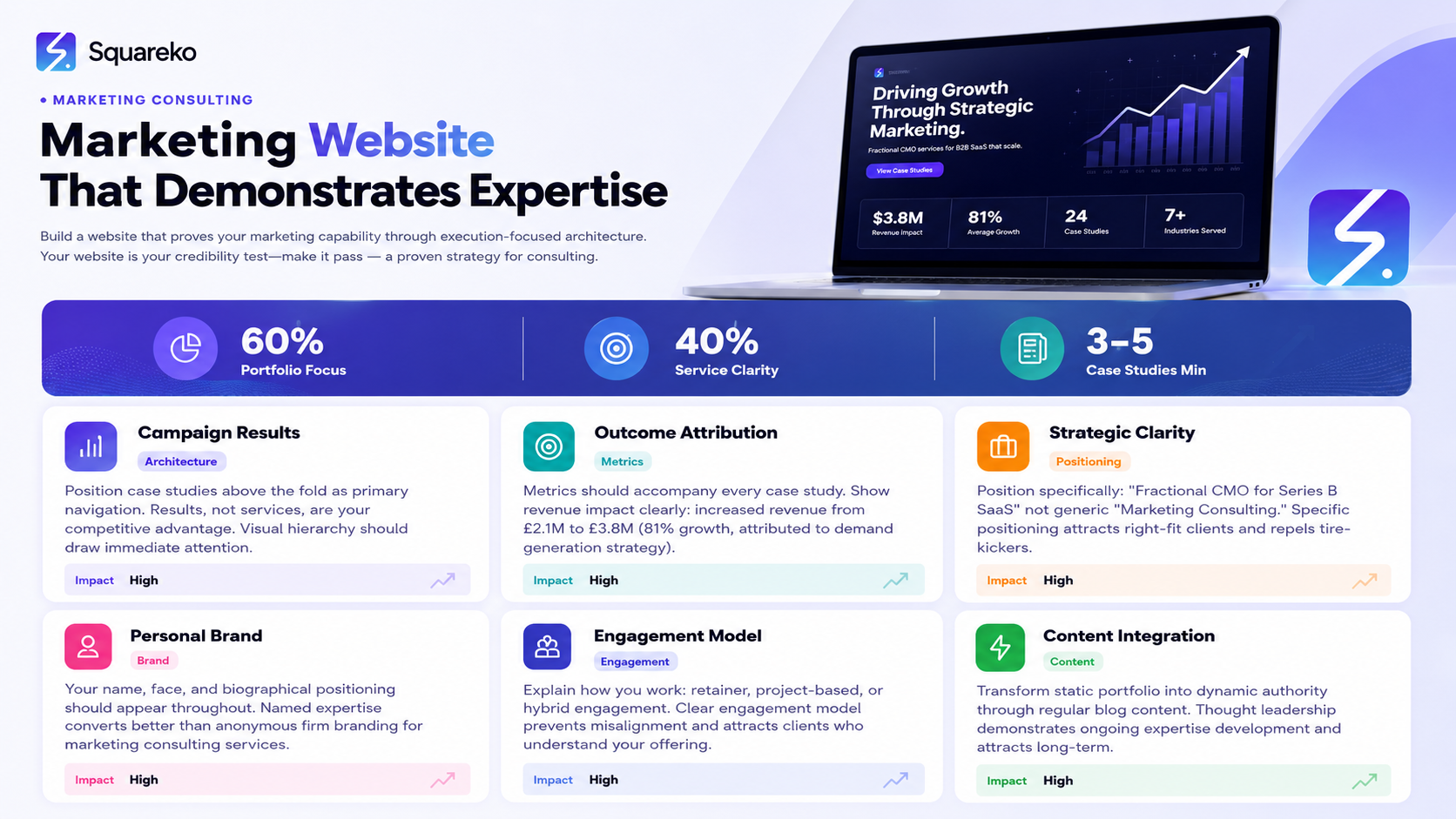
Your website IS your proof of capability—design and conversion strategy signal expertise more loudly than testimonials
Website architecture should demonstrate campaign results visibility, conversion principle execution, and strategic clarity without needing explanation
Marketing consultants need "campaign results showcase" architecture, not "service description" architecture
Personal brand clarity (you as the expert) converts better than anonymous firm positioning for marketing consulting
Content integration transforms static portfolios into dynamic expertise demonstrations that attract long-term consulting relationships
Marketing consultants face a unique credibility paradox. You sell expertise in conversion optimization, campaign strategy, and demand generation—yet your website is the first place prospects evaluate whether your expertise is real or theoretical.
A marketing consultant whose website doesn't convert is a contradiction. A fractional CMO whose website fails to demonstrate strategic sophistication undermines their value proposition before a conversation even begins. The stakes are higher for marketing consultants than almost any other professional service because your website isn't just a sales tool—it's a live audit of your capability.
The difference between a marketing consulting website that attracts right-fit clients and one that generates tire-kickers is rarely the design aesthetic. It's the intentional architecture that demonstrates marketing excellence through execution rather than assertion.
The Credibility Challenge: Website as Proof of Capability
Why Marketing Consultants Can't Hide Behind Beautiful Design
A lawyer's website needs to look trustworthy. A consultant's website needs to look effective. This distinction is crucial because marketing directors and CMOs evaluating your services will unconsciously apply marketing principles to your website.
They'll notice:
Whether the call-to-action placement follows conversion best practices
Whether the visual hierarchy directs attention to outcomes, not ego
Whether page load speed demonstrates technical competence
Whether the mobile experience shows responsive thinking
Whether the copy reflects strategic positioning or vague generality
Every design choice broadcasts a message about your consulting capability. A cluttered homepage with equal visual weight on "Services," "About," and "Case Studies" signals confused positioning. A hero section focused on your philosophy rather than client results signals theoretical rather than execution-focused consulting.
The Execution Audit
Prospects are running a live audit. They're thinking:
"If this marketing consultant's own website doesn't convert, how will they optimise mine?"
"If the hero section wastes space on philosophy rather than demonstrating results, what does that say about their strategic clarity?"
"If the case studies lack specific outcome metrics, does this consultant actually measure campaign performance?"
Your website isn't just a sales channel. It's a performance demonstration.
Architecture Principles: Demonstrating Expertise Through Execution
The Results-First Website Architecture
Marketing consulting websites should follow a specific visual hierarchy:
Priority 1: Campaign Results Visibility Your most compelling case studies should be visible above the fold or as the primary navigation destination. Results aren't supporting evidence—they're the core argument for working with you.
Priority 2: Outcome Metrics and Attribution Metrics should accompany every case study. Not "increased revenue" but "increased revenue from £2.1M to £3.8M (81% growth, attributed to demand generation strategy)." This demonstrates:
Commitment to measurable outcomes
Confidence in attribution language
Understanding of metrics that matter to decision-makers
Priority 3: Strategic Clarity Your positioning should be specific, not generic. Rather than "Marketing Strategy and Execution," position as "Fractional CMO for Series B to D SaaS companies" or "Demand generation strategy specialist for B2B software." This clarity attracts right-fit clients and repels tire-kickers.
Priority 4: Personal Brand Prominence Your name, face, and biographical positioning should be visible throughout the site. Named expertise converts better than anonymous firm branding for marketing consulting. Prospects want to know who specifically they're hiring.
Priority 5: Engagement Model Clarity How do you work? Retainer, project, hybrid? This clarity prevents misalignment and attracts clients who want your specific engagement model.
The Information Architecture Decision
Most websites make a binary architecture choice: Portfolio-first or Service-first.
Portfolio-First Architecture: Case studies, client results, and outcome demonstrations are primary navigation destinations. Messaging around "how we work" is secondary.
Best for: Fractional CMOs, brand strategists, campaign specialists
Advantage: Attracts clients who believe in your results
Risk: Can feel portfolio-heavy for those still evaluating whether to engage
Service-First Architecture: Service descriptions, engagement models, and methodology are primary navigation. Case studies support those descriptions.
Best for: Consulting practices offering multiple distinct services
Advantage: Helps prospects understand service breadth
Risk: Can feel generic; doesn't differentiate from other consultants
Hybrid Architecture (Recommended for most marketing consultants): Campaign results are visually primary, with clear service/engagement pages explaining scope and methodology.
Campaign Results Showcase: Building the Results-First Website
Results Presentation Framework
Each campaign result showcase should include:
Client Context: Industry, company size, challenge scope. This helps prospects identify if the case study is relevant to their situation.
Strategic Approach: What was your specific intervention? What did you recommend and why? This demonstrates strategic thinking, not just execution.
Results and Metrics:
Primary outcome (revenue growth, lead volume increase, brand awareness lift)
Secondary outcomes (engagement rate improvement, cost per acquisition reduction)
Timeline (how long to see results?)
Sustained impact (are results ongoing?)
Outcome Attribution: This is where many marketing consultants fail. Attribution language matters:
✓ "Revenue grew from £2.1M to £3.8M over 18 months; attributed to demand generation strategy implementation and sales process alignment"
✗ "Revenue grew significantly as a result of our engagement"
The first is credible and specific. The second sounds like a consultant hiding measurement weakness.
Compliance and Realistic Claims
Marketing consultants must be careful with performance claims. Your website should reflect:
Attribution Honesty: Clearly indicate what portion of results you claim responsibility for. Did you grow revenue alone, or did improved sales execution contribute?
Baseline Establishment: Explain what metrics looked like before engagement. Percentage growth is more credible when baseline is established.
Outcome Persistence: Indicate whether results were sustained or temporary. Honest case studies note when results required ongoing strategic effort.
Industry Specificity: Note which results apply to which industries. A demand generation strategy that worked for SaaS might not translate to manufacturing.
This isn't weakness it's the kind of transparency that attracts clients who understand marketing complexity.
Visual Hierarchy for Results
Your website design should draw attention to results through:
Large metric displays (revenue growth percentages, lead volume increases)
Before-and-after comparisons (visual charts showing strategic impact)
Client testimonials emphasising outcome satisfaction
Outcome category organisation (revenue results, brand awareness results, lead generation results)
Personal Brand Clarity vs. Service Description
The Named Expert Advantage
Marketing consultants with named personal brands convert better than anonymous firms. This is particularly true for fractional CMO services where clients are hiring strategic leadership, not outsourcing tactics.
Your website should clearly position:
Who you are (name, professional photo)
What specifically you specialize in (fractional CMO for SaaS, brand strategy for professional services, demand generation for B2B)
Your background and relevant experience
Your specific methodology or approach
Prospects want to know they're hiring you, not a firm.
Personal Brand Integration
This doesn't mean the website needs to be a personal blog. Integration means:
Hero Section: Your name and specific positioning (not "Marketing Consulting Services")
About Section: Your professional background, why you focus on your specific niche, your consulting philosophy
Bio Integration: Your name, credentials, and photo appear throughout—not just on an "About" page
Thought Leadership: Recent articles, speaking engagements, or media mentions that demonstrate expertise
Personality: Your writing voice should reflect your consulting style. If you're strategic and data-focused, copy should reflect that. If you're creative and brand-focused, copy should show that too.
When Anonymous Firm Positioning Works (Rarely)
The only scenario where anonymous firm positioning works better: if you're running a large agency with multiple consultants and you want to position the firm as the expertise rather than individuals. But for solo practitioners, fractional CMOs, or small consulting teams, named personal brand is stronger.
Conversion-Focused Design That Demonstrates Conversion Knowledge
Conversion Principle Execution
Your website should demonstrate conversion principles through execution, not description. This means:
Call-to-Action Clarity
Clear, specific CTAs ("Schedule a strategy consultation" not "Contact us")
Multiple CTA opportunities throughout the site (top of page, within content, end of page)
Consistent link color and styling so CTAs stand out
Trust Signals
Client logos or case study names (if you can share them)
Specific results and metrics (numbers build credibility)
Professional team photos (if applicable)
Credentials and experience summary
Page Load Speed
Squarespace sites load quickly, but image optimization matters
Slow load times signal technical incompetence to prospects
Page speed is also an SEO ranking factor (which marketing consultants should understand)
Mobile Optimization
Most website traffic is mobile; your site must be mobile-first
Button sizes, touch targets, and mobile navigation must be intuitive
Squarespace handles responsive design well, but content decisions matter
Friction Reduction
Contact forms should be minimal (3-5 fields, not 15)
Email signups should ask for email only (you can segment later)
Unnecessary friction signals that you don't understand conversion psychology
The Meta-Audit
Every decision broadcast expertise. A slow homepage signals technical negligence. Broken internal links signal disorganization. Vague service descriptions signal unclear thinking.
Prospects are running this meta-audit unconsciously. Attention to conversion detail is your most powerful credibility signal.
Content Integration: From Static Portfolio to Dynamic Authority
Moving Beyond Portfolio
A static case study portfolio is good. A dynamic content hub with regular insights is better. Content integration transforms your website from a brochure into a positioning platform.
Blog Integration
Regular articles on your consulting niche (monthly minimum, weekly optimal)
Topics should reflect client challenges and strategic frameworks you use
Quality matters more than quantity—one excellent article beats four mediocre ones
Thought Leadership
Speaking engagements (conference panels, webinar appearances)
Media mentions (press features, industry publication bylines)
Original research or frameworks you've developed
Resource Library
Downloadable guides on topics relevant to your consulting
Email capture tool (build your consulting prospect list)
Segmented by consulting speciality (fractional CMO resources, brand strategy resources, etc.)
Email Integration
Newsletter or regular insights email
Positions you as thought leader
Builds direct relationship with prospects before consultation
Content Strategy for Consultant Websites
Most successful marketing consultant content strategies follow this framework:
80/20 Principle: 80% of content should be genuinely valuable (strategic frameworks, industry insights, methodology explanation). 20% should position your consulting directly.
Client Challenge Focus: Content should address problems your ideal clients face, not philosophies you believe in.
Consistent Publishing: Monthly content minimum. Quarterly is better. Weekly is ideal if you have writing support.
Repurposing: Turn each article into:
LinkedIn post
Email to your list
Social media thread
Speaking point for consultations
This multiplies the value of content effort.
Website Elements That Undermine Expertise
Beyond architecture, specific elements signal weakness:
Vague Positioning: "Marketing consulting and strategy" vs. "Fractional CMO for B2B SaaS" — the second converts better
Generic Testimonials: "Great to work with!" vs. "Increased our annual revenue by £1.2M through demand generation strategy" — metrics matter
Missing Results Attribution: Case studies without outcome metrics or baseline establishment
Poor Writing Quality: Typos, weak paragraph structure, or unclear messaging undermine expertise credibility
Outdated Content: A blog with the most recent post from 2023 signals inactivity
Broken Links: Internal or external links that lead to 404 pages signal disorganisation
Slow Load Times: Pages taking more than 3 seconds to load signal technical incompetence
Each of these is fixable, but the presence of any signals weakness to discerning prospects.
Ready to build a marketing consulting website that demonstrates expertise through execution?Squareko specialises in Squarespace websites for marketing consultants that convert the right-fit clients through results-focused architecture and conversion-principle execution. Your website should prove your capability, not just describe it.
Frequently Asked Questions
-
A: Yes, if you have permission. Named case studies with specific metrics are far more credible than anonymous results. If clients need anonymity, create case studies with industry and company size identified, specific metrics shared, but client name and identifying details removed.
-
A: For fractional CMOs and strategy consultants, aim for 60-70% portfolio/case study visibility and 30-40% service/engagement clarity. Results should be primary; service descriptions should be supportive.
-
A: Highlight metrics that matter to your ideal clients: revenue growth (for CEOs/founders), lead volume increase (for sales leaders), engagement improvement (for brand/content focus), ROAS or cost per acquisition (for performance marketing focus).
-
A: Portfolio and case studies should be current (no case studies older than 2-3 years as primary examples). Blog content should be published at least monthly. Regular updates signal ongoing activity and expertise development.
-
A: Yes, if you're comfortable. Named personal brands with professional photos convert better than anonymous expertise. A headshot doesn't need to be glamorous—professional and approachable is better than corporate formal.
-
A: Position yourself as the lead consultant/strategist, but clearly indicate team members who deliver work. This creates clarity (they know who they're hiring strategically) while showing you have execution support.
From custom website design to SEO strategy, we help businesses launch a site that looks professional and performs better.

Author Bio
Written by the Squareko team,
I'm Walid Hasan, a Certified Squarespace Expert and Squarespace Circle Platinum Partner with over 12 years of hands-on experience designing and optimizing high-performing websites. Over the years, I've had the privilege of building more than 2,000 Squarespace websites for clients around the world, always focusing on clean design, strong user experience, and conversion-driven results.