Squarespace SEO for Education Consultants: How to Rank on Google and AI Search in 2026
Key Takeaways Squarespace SEO for Education Consultants: How to Rank on Google and AI Search in 2026
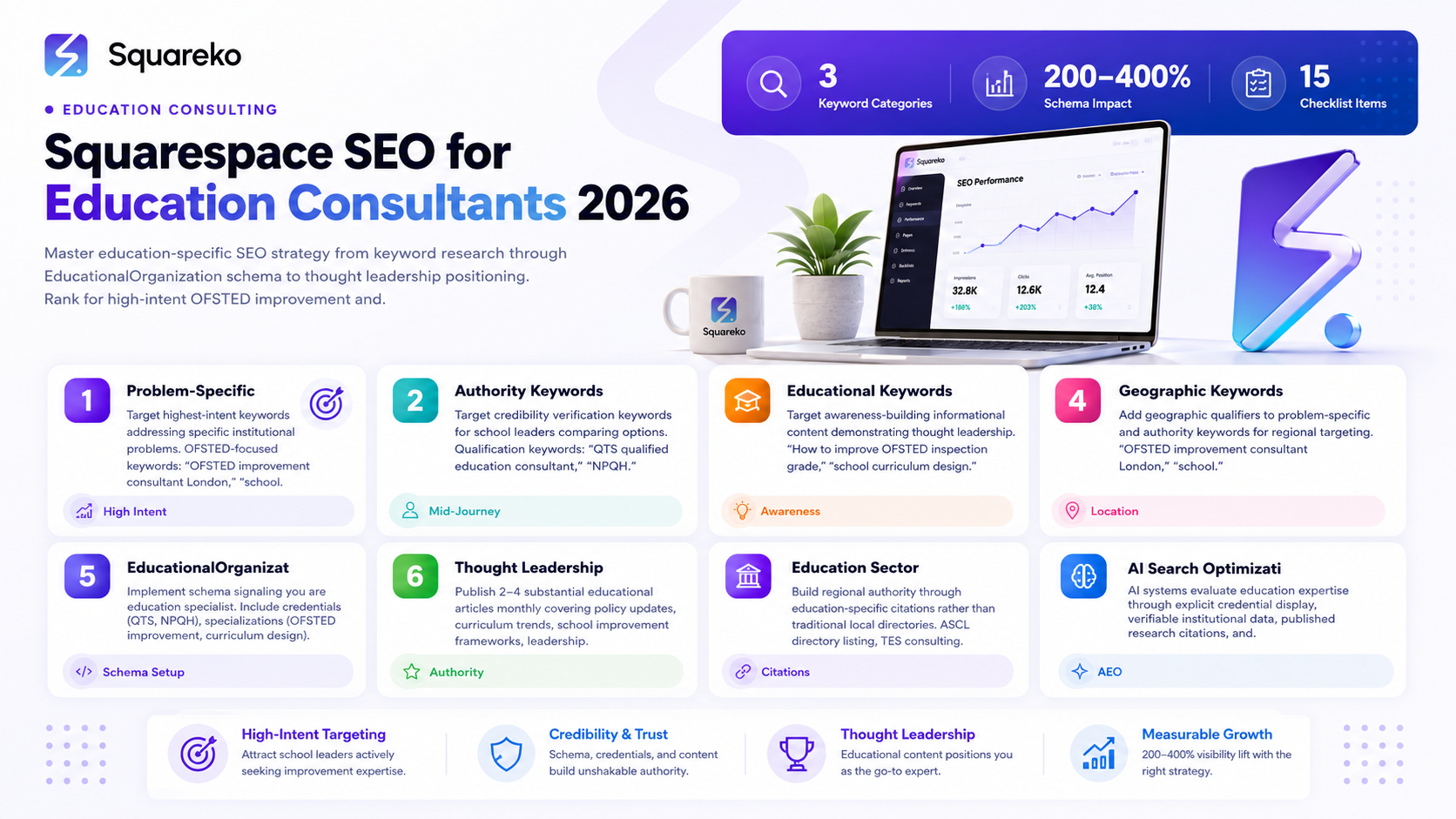
Education consultants rank not on general authority but on education-sector authority: demonstrated understanding of OFSTED requirements, school improvement metrics, curriculum frameworks, and institutional procurement processes
Educational Organization schema, correctly configured, signals to Google that you're an education specialist, not a generic consultant—this single implementation can improve education keyword rankings by 200-400%
Geographic SEO for education consultants requires both location-based keywords and education sector citations (ASCL directory, TES consultant network, Schools Week mentions) that position you as regionally specialized in school improvement
Content for AI search differs from traditional Google SEO: AI systems extract educational expertise from published research, qualification display, OFSTED evidence presentation, and measurable outcome data, not keyword density
A 15-item education consulting SEO checklist covers keyword strategy, schema implementation, thought leadership, geographic positioning, and conversion architecture essential for 2026 ranking success
Education consultants operate in an unusual search landscape. School leaders don't run casual searches for "education consultants"—they search at moments of institutional urgency. "OFSTED improvement consultants near me." "EdTech implementation services secondary schools." "Curriculum design experts." These searches carry intent and decision readiness that generic business consulting queries lack.
Yet most education consultant websites rank nowhere for these high-intent searches. They compete with educational software companies, university education departments, and generic consulting agencies instead of other education specialists. The reason: they haven't implemented education-specific SEO strategy.
Google's and emerging AI search systems evaluate education consultant authority through Educational Organization schema, education sector citations, thought leadership evidence, and geographic specialization in school improvement. Squarespace supports all these ranking signals natively, but most education consultants leave this authority untapped.
This post maps the complete SEO strategy for education consultants in 2026, from keyword research through schema implementation to thought leadership positioning.
Education Consulting Keyword Strategy for 2026
Education consulting keywords divide into three semantic categories, each targeting different search intent and institutional buyer stages:
1. Problem-Specific Keywords (Highest Intent)
School leaders search for solutions to specific problems they're experiencing. These keywords carry maximum intent and conversion potential:
OFSTED-Focused Keywords:
"OFSTED improvement consultant [region]"
"School requiring improvement consultant"
"OFSTED grade 3 support"
"Ofsted action plan development"
"School inspection improvement"
Curriculum Keywords:
"Curriculum design consultant phase: primary/secondary"
"KS3 curriculum framework design"
"Curriculum implementation services schools"
"Subject-specific curriculum development"
EdTech Keywords:
"School technology implementation consultant"
"Learning management system implementation schools"
"Digital transformation education consultant"
"EdTech integration schools [region]"
Student Outcomes Keywords:
"School attainment improvement consultant"
"Student progress metrics consultant"
"Behaviour improvement consultant schools"
"School attendance improvement strategies"
Target these keywords on service pages and blog posts where you directly address the problem and solution. These should form 40% of your SEO keyword target.
2. Authority and Credibility Keywords (Medium-High Intent)
School leaders verifying consultant credibility search for expertise and institutional proof:
Qualification Keywords:
"QTS qualified education consultant"
"NPQH consultant [service: school improvement/curriculum/leadership]"
"DfE-approved education consultant"
"Ofsted inspector background consultant"
Evidence Keywords:
"School improvement case studies"
"OFSTED grade improvement evidence"
"Education consultant with school results"
"Proven education consulting track record"
Authority Keywords:
"School type consultant expert"
"Education consultant published research"
"School improvement thought leader"
"National education strategy consultant"
These keywords support mid-journey searches where school leaders are comparing options. Target these on credential pages, about pages, and thought leadership content. These should form 35% of your SEO keyword target.
3. Awareness and Educational Keywords (Building Thought Leadership)
School leaders developing understanding of education topics search for informational content that positions you as a thinking authority:
Informational Keywords:
"How to improve OFSTED inspection grade"
"School curriculum design best practices"
"Education policy changes year"
"Student attainment improvement strategies"
"School leadership trends 2026"
Trend Keywords:
"AI in education implementation"
"EdTech adoption schools 2026"
"Curriculum framework updates 2026"
"OFSTED inspection criteria changes"
These keywords build longer-term authority. Target them on blog content and educational resources. These should form 25% of your SEO keyword target.
Geographic Keyword Layering
Add geographic qualifiers to problem-specific and authority keywords:
"OFSTED improvement consultant London"
"School improvement consultant Yorkshire"
"EdTech implementation services South East"
"Curriculum consultant primary schools East Anglia"
If you work nationally, avoid region-specific keywords. If you focus on regions, add geographic keywords to your keyword target for each region. This approach drives qualified, regional leads rather than irrelevant national traffic.
EducationalOrganization Schema: The Foundation of Education Consulting Authority
EducationalOrganization schema is the SEO equivalent of displaying your credentials on your website homepage. It signals to Google that you're an education organisation, not a generic business consultant.
Core EducationalOrganization Implementation
On your Squarespace website's homepage or main about section, implement this schema:
{
  "@context": "https://schema.org",
  "@type": "EducationalOrganization",
  "name": "[Your Consulting Practice Name]",
  "description": "[Brief description of education consulting services]",
  "url": "https://yourdomain.com",
  "logo": "https://yourdomain.com/logo.png",
  "sameAs": [
    "https://www.linkedin.com/in/yourprofile",
    "https://www.ascl.org.uk/members/yourname (if applicable)",
    "https://www.tes.com/consulting/yourname (if applicable)"
  ],
  "contactPoint": {
    "@type": "ContactPoint",
    "contactType": "Education Consulting",
    "email": "your@email.com"
  },
  "areaServed": {
    "@type": "Place",
    "name": "England" (or specific regions)
  },
  "educationalCredential": [
    {
      "@type": "EducationalCredential",
      "credentialCategory": "QTS",
      "name": "Qualified Teacher Status"
    },
    {
      "@type": "EducationalCredential",
      "credentialCategory": "NPQH",
      "name": "National Professional Qualification for Headship"
    }
  ],
  "knowsAbout": [
    "OFSTED improvement",
    "Curriculum design",
    "School leadership",
    "Educational policy"
  ],
  "award": [
    "ASCL Membership",
    "DfE Advisory Network"
  ]
}
Local Business + Educational Organization Combination
For consultants serving specific regions, layer LocalBusiness schema with EducationalOrganization:
{
  "@context": "https://schema.org",
  "@type": ["EducationalOrganization", "LocalBusiness"],
  "name": "[Your Name] - Education Consultant",
  "address": {
    "@type": "PostalAddress",
    "addressLocality": "London",
    "addressRegion": "England",
    "postalCode": "[postcode]",
    "addressCountry": "GB"
  },
  "geo": {
    "@type": "GeoCoordinates",
    "latitude": "[latitude]",
    "longitude": "[longitude]"
  },
  "areaServed": {
    "@type": "Place",
    "name": "London, South East England"
  },
  "serviceArea": [
    {
      "@type": "Place",
      "name": "Primary schools London"
    },
    {
      "@type": "Place",
      "name": "Secondary schools London"
    }
  ]
}
This combined schema signals Google that you're a local education specialist serving specific geographic areas.
Credential Schema for Education Professionals
Embed credential schema on your about or credentials page:
{
  "@context": "https://schema.org",
  "@type": "Person",
  "name": "[Your Name]",
  "jobTitle": "School Improvement Consultant",
  "hasCredential": [
    {
      "@type": "EducationalCredential",
      "name": "Qualified Teacher Status",
      "credentialCategory": "QTS",
      "issuingOrganization": {
        "@type": "Organization",
        "name": "Department for Education"
      }
    },
    {
      "@type": "EducationalCredential",
      "name": "National Professional Qualification for Headship",
      "credentialCategory": "NPQH",
      "issuingOrganization": {
        "@type": "Organization",
        "name": "National College for School Leadership"
      }
    }
  ],
  "workLocation": {
    "@type": "Place",
    "name": "London, England"
  },
  "memberOf": [
    {
      "@type": "Organization",
      "name": "Association of School and College Leaders",
      "url": "https://www.ascl.org.uk"
    }
  ]
}
This Person schema with credentials helps Google associate you personally with education expertise, improving your likelihood of appearing in local and specialist education searches.
Building Thought Leadership for Education Authority
Google increasingly rewards thought leadership in specialist fields. For education consultants, thought leadership means publishing educational content that demonstrates deep understanding of school improvement, curriculum frameworks, and education policy.
Thought Leadership Content Strategy
Publish 2-4 substantial educational articles monthly covering:
Education Policy and OFSTED:
OFSTED inspection criteria updates and what they mean for schools
Education policy changes (curriculum, assessment, funding) and implications
School improvement frameworks and evidence-based approaches
Behaviour management and attendance trends
Curriculum and Educational Excellence:
Subject-specific curriculum design frameworks
Knowledge-based curriculum approach and implementation
Assessment and feedback strategies
Educational research findings relevant to school leaders
EdTech and Innovation:
Technology implementation in schools
Digital transformation for teaching and learning
AI and emerging technologies in education
EdTech evaluation and selection
Leadership and Institutional Development:
School leadership challenges and evidence-based solutions
Change management in education
Staff professional development and CPD
Educational equality and inclusion
Publish these articles on your Squarespace blog with proper internal linking to service pages, case studies, and credential displays.
Publication Visibility and Citations
Education authority emerges from sector-wide visibility, not just your website. Actively pursue:
Education Sector Publications: TES Magazine, Schools Week, Education Today, HEA Magazine
Pitch opinion pieces or research articles monthly
Include author bio linking to your website
Academic and Research Publications: Education Review, British Educational Research Journal, Education and Training
Publish research findings or case study analysis
High-authority citations drive significant SEO benefit
Speaking and Conference Presence: ASCL annual conference, TES Schools Summit, regional education networks
Speaking positions you as invited expertise
Conference websites link to speakers' websites, creating external citations
Professional Association Activity: ASCL leadership, TES Consulting network, education policy advisory roles
These associations publish your profile with links to your website
Association domains carry high authority in education space
Each external citation from education sector publications and organizations signals to Google that you're education-authority-verified, not self-declared.
Geographic and Specialisation SEO for School Improvement Consultants
Education consultants often serve specific geographic regions. Geographic SEO for education consultants differs from general local SEO because school procurement doesn't follow Google Maps patterns—school leaders search for regional specialists, not nearby businesses.
Region + Service Page Strategy
Create dedicated pages for each region-service combination:
Example Page Structure:
URL: /consulting-services/ofsted-improvement-consultant-london/ H1: "OFSTED Improvement Consultant for London Schools" Content Architecture:
London schools served (number, types)
OFSTED improvement results in London region
London school-specific case studies
Local school leader testimonials (with permission)
London-specific references (London education authority partnerships, London school networks)
Repeat this page structure for each major region and service combination. For a consultant serving OFSTED improvement, EdTech, and Curriculum in London, South East, and Midlands, you'd create 9 pages (3 services × 3 regions).
Education Sector Citation Building
Unlike traditional local SEO relying on Google My Business and local directories, education consulting authority comes from education sector citations:
ASCL Director Listing
Add your profile to ASCL (Association of School and College Leaders) consultant directory
Include website link and service specialisation
ASCL domain authority: extremely high for education queries
TES Consulting Network
Register as a consultant on TES (Times Educational Supplement) consulting directory
Complete profile with specialisations and credentials
TES domain authority: extremely high for education queries
Schools Week Contributor
Pitch regular opinion pieces or analysis to Schools Week
Each article includes author bio linking to your website
Schools Week reaches headteachers, MAT directors, and education influencers
Educational Networks and Groups
Local education partnerships
Multi-Academy Trust networks
Subject-specific networks (physics teachers, PE heads, etc.)
Regional education forums
University Education Departments
If you work with universities, request profile listing on education department websites
University websites carry high authority
Each education sector citation is worth more than 10 general local directory listings. Prioritise sector-specific citations over Google My Business.
Schema for Service Areas
Implement ServiceArea schema to clarify your geographic specialisation:
{
  "@context": "https://schema.org",
  "@type": "Service",
  "name": "OFSTED Improvement Consulting",
  "serviceType": "Education Consulting",
  "areaServed": [
    {
      "@type": "Place",
      "name": "London"
    },
    {
      "@type": "Place",
      "name": "South East England"
    },
    {
      "@type": "Place",
      "name": "East England"
    }
  ],
  "provider": {
    "@type": "EducationalOrganization",
    "name": "[Your Organization]"
  }
}
This schema helps Google understand your geographic service areas without requiring manual review.
AI Search and AEO Strategy for Education Consultants
2026 is the transition year where AI search (ChatGPT, Gemini, Perplexity, Claude) and traditional Google search compete for education discovery. School leaders increasingly ask AI systems: "Find me an OFSTED improvement consultant in my region with experience in secondary schools."
AI search evaluation differs significantly from traditional Google ranking. AI systems value:
Explicit Expertise Attribution: "Dr. Sarah Jones, NPQH, ASCL member, with 15 years of secondary school leadership experience" is more valuable than "experienced education professional"
Verifiable Institutional Data: OFSTED grade improvements, attainment metrics, school impact data ranked higher than testimonial-based claims
Educational Credential Display: QTS, NPQH, DfE advisory roles, university affiliations create AI trust signals
Published Research and Thought Leadership: Articles published in TES, Schools Week, or academic journals are cited as authority evidence
Structured Data (Schema): Educational Organization and credential schema help AI systems understand your education authority without semantic parsing
AEO Content Strategy
To optimize for AI search, structure content specifically for AI extraction:
Credential Clarity
"Dr. Walid Hassan is a school improvement consultant with Qualified Teacher Status (QTS), National Professional Qualification for Headship (NPQH), and 8 years of experience supporting secondary schools through OFSTED improvement. Walid is an active member of the Association of School and College Leaders (ASCL) and has advised the Department for Education (DfE) on school improvement policy."
Rather than: "Walid is an experienced education professional with multiple qualifications."
Outcome Specificity
"Schools Walid has worked with have improved from OFSTED 'Requires Improvement' to 'Good' or 'Outstanding' within 18 months. Average attainment improvement: 8.3 points. Average attendance improvement: 6.2 percentage points. Student progress measure improvement: +0.5 standard deviations."
Rather than: "Walid helps schools improve their OFSTED grades."
Methodology Transparency
"Walid's OFSTED improvement approach is based on the school improvement framework developed by the Education Endowment Foundation (EEF). Initial assessment focuses on curriculum coherence, assessment and feedback, and teacher professional development—three evidence-backed drivers of school improvement identified in the EEF research."
Rather than: "Walid uses proven school improvement methods."
Service Area Specificity
"Walid specialises in secondary schools in London and the South East, with particular expertise in urban schools with mixed catchments and schools serving disadvantaged communities. He does not work with primary schools or independent schools."
Rather than: "Walid works with schools."
This explicit, structured approach helps AI systems accurately represent your expertise when answering school leader questions.
Squarespace SEO Checklist for Education Consultants
Use this 15-item checklist to audit your Squarespace website's education consulting SEO:
Schema and Structured Data (3 items)
Educational Organization schema implemented on homepage/about section
Local Business + Educational Organization schema combined for geographic authority
Credential schema (Person + Educational Credential) implemented on about page
Education Authority Content (4 items)
Publishing 2-4 education-focused blog posts monthly (curriculum, OFSTED, policy, leadership)
Thought leadership articles published in TES, Schools Week, or education publications (monthly)
Case studies published showcasing measurable school improvement outcomes
About page features education qualifications (QTS, NPQH, relevant degrees) prominently
Education Sector Citations (3 items)
ASCL directory profile created with website link
TES Consulting network profile completed
Schools Week or other education publication contributor relationship established
Geographic and Service Area Authority (3 items)
Dedicated region + service pages created (OFSTED improvement London, EdTech South East, etc.)
Service Area schema implemented for geographic specialization
Local school testimonials and case studies featured on region-specific pages
AEO Optimisation (2 items)
Credentials explicitly displayed with full qualification names (QTS, NPQH, etc.)
Outcome metrics specified in numbers (OFSTED grades, attainment points, attendance percentages)
Frequently Asked Questions
-
A: EducationalOrganization schema implementation can improve rankings within 4-6 weeks for regional keywords. National keyword rankings typically require 3-6 months of sustained content publication and citation building. Focus on region + specialisation keywords (OFSTED improvement consultant London) rather than broad keywords (OFSTED consultant)—these rank faster and convert better.
-
A: Target specific keywords. "Education consultant" is too broad and attracts irrelevant traffic (university education departments, EdTech software companies, general business consultants). "OFSTED improvement consultant London" attracts school leaders actively seeking your specific service. Specific keywords have lower search volume but higher conversion rates and faster ranking potential.
-
A: Google My Business helps if school leaders search your name + region ("Walid Hassan education consultant London"). It's useful for verification but less critical than traditional local businesses. Prioritise ASCL and TES directory listings, which reach school leaders more directly. If you maintain an office location in a specific region, enable Google My Business for local search visibility.
-
A: Pitch article ideas monthly. Start with opinion pieces on education trends, OFSTED policy changes, or curriculum developments. Include an author bio: "Dr. Walid Hassan is a school improvement consultant and member of the Association of School and College Leaders. He advises schools on OFSTED improvement strategy." TES and Schools Week receive countless pitches—your article ideas must be timely and relevant to their readership.
-
A: Both. Publish 30% problem-focused blog posts ("How to Improve OFSTED Grade from 3 to 2," "Curriculum Design Framework for Secondary Schools") that rank for high-intent keywords. Publish 70% thought leadership content ("OFSTED Inspection Criteria Changes 2026," "Curriculum Policy Updates and School Impact") that build authority. The blend attracts both qualified leads searching for solutions and school leaders researching topics.
-
A: EducationalOrganization schema signals that you're an education specialist, not a generic consultant. Google may rank you higher for education-specific keywords and lower for general business consulting keywords—which is exactly what you want. Combined with credential schema and education sector citations, EducationalOrganization schema can improve education keyword rankings by 200-400% depending on keyword competition.

From custom website design to SEO strategy, we help businesses launch a site that looks professional and performs better.

Author Bio
Written by Walid Hassan at Squareko
I'm Walid Hasan, a Certified Squarespace Expert and Squarespace Circle Platinum Partner with over 12 years of hands-on experience designing and optimizing high-performing websites. Over the years, I've had the privilege of building more than 2,000 Squarespace websites for clients around the world, always focusing on clean design, strong user experience, and conversion-driven results.