How to Build an Education Consulting Website on Squarespace That Attracts Schools and Institutions
Key Takeaways Build an Education Consulting Website on Squarespace That Attracts Schools and Institutions.
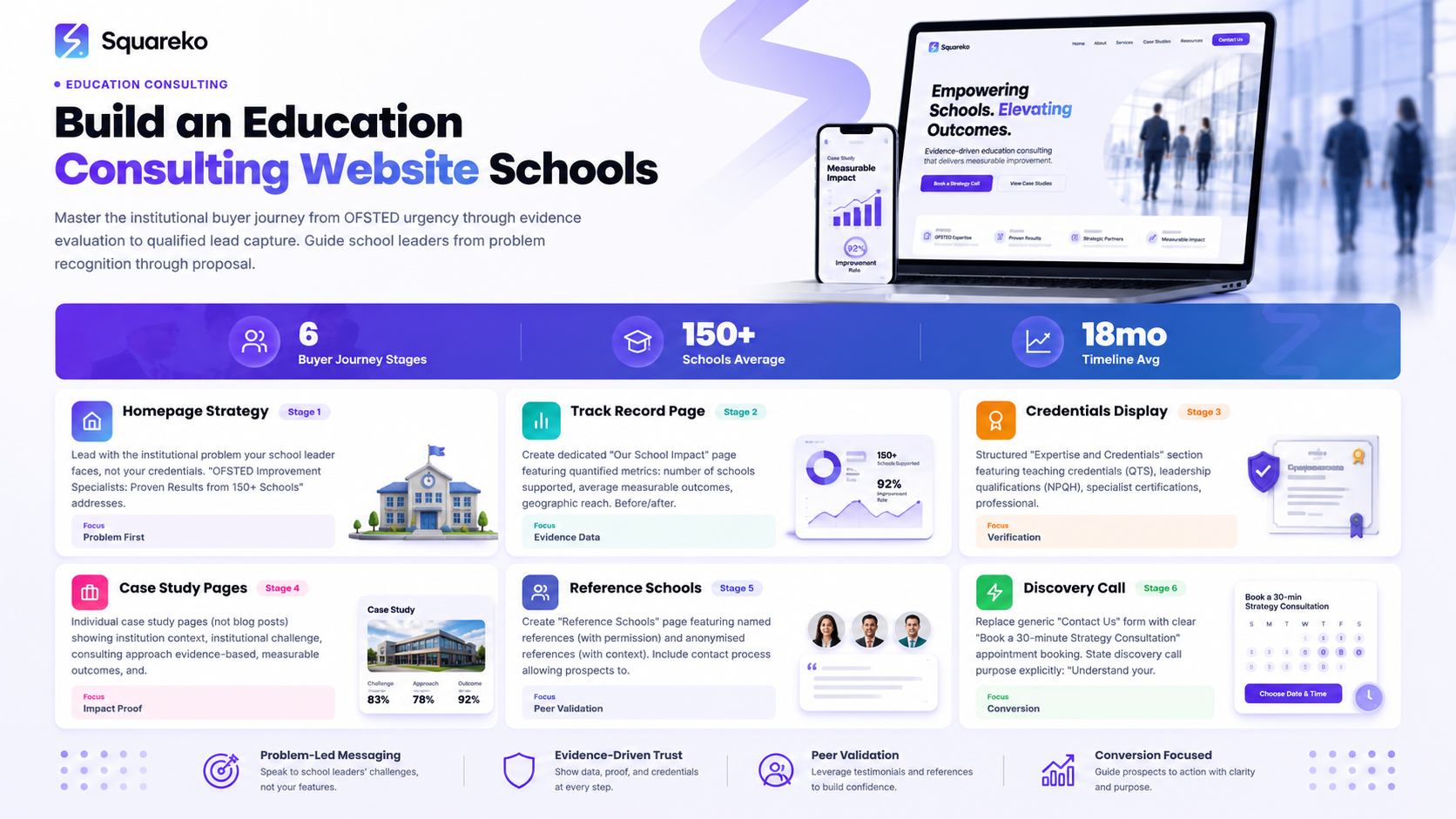
School leaders and MAT directors follow a predictable institutional buying journey: OFSTED Urgency → Track Record Verification → Accreditation Confirmation → Case Study Evidence → Reference School Validation → Proposal Request
Your homepage must immediately address the primary institutional urgency (OFSTED improvement, EdTech implementation, curriculum transformation) within the first fold
OFSTED evidence display, measurable student outcome metrics, and institutional case study architecture are non-negotiable website components for school-focused consultants
Qualified lead capture focuses on institutional gatekeepers (headteachers, MAT directors, governors) using discovery call positioning rather than generic contact forms
Squarespace's native capabilities support this institutional buyer journey through structured case study pages, credential display, and appointment booking integration
School leaders and MAT directors search for education consultants under acute institutional pressure. An OFSTED "requires improvement" notice creates urgency. A curriculum implementation deadline looms. A technology transformation needs specialist guidance. These institutional buyers don't browse consulting websites casually—they arrive with specific problems and limited time to evaluate solutions.
Most education consulting websites fail because they treat institutional buyers like general consumers. They use vague positioning, hide credential evidence, obscure case study data, and require multiple clicks to understand basic service offerings. School leaders abandon these sites quickly, concluding the consultant isn't serious about their specific institutional challenges.
Effective education consulting websites on Squarespace guide institutional buyers through a predictable journey: from problem recognition, through evidence evaluation, to qualified lead capture. This post maps that journey and shows how to architect your Squarespace website to address each stage.
Understanding the School and Institutional Buyer Journey
Education consulting operates through institutional decision-making, not individual consumer choice. A headteacher cannot unilaterally hire a consultant; they must justify the decision to governors, senior leadership teams, and finance committees. A MAT director evaluating EdTech implementation must present options to principals across multiple schools.
This institutional context shapes the entire buyer journey:
Problem Recognition: OFSTED urgency, curriculum deadline, technology transformation need
Internal Consensus Building: Headteacher presents problem to governors or SLT, establishes need for external support
Consultant Evaluation: Search for specialists, website evaluation, evidence gathering
Internal Stakeholder Alignment: Headteacher or MAT director circulates consultant information to governors, finance, relevant staff leaders
Reference Validation: Governors or fellow headteachers contact reference schools
Proposal and Agreement: Formal proposal submitted, terms negotiated, engagement contracted
Your Squarespace website must support this institutional journey. School leaders need evidence they can present to governors. Governors need peer validation from other schools. Finance committees need clear scope and investment justification.
Stage 1: OFSTED Urgency and Problem Recognition
A headteacher receiving an OFSTED "requires improvement" notice faces institutional urgency. Within days, they must develop an improvement action plan. Within months, they must demonstrate progress. Your website's first impression must address this acute pressure.
Homepage Architecture for Institutional Urgency
Your Squarespace homepage should open with a headline directly addressing the primary institutional problem:
For School Improvement Consultants: "OFSTED Improvement Specialists: Proven Results from 150+ Schools Moved from 'Requires Improvement' to 'Good' or Better"
For EdTech Implementation Specialists: "Schools and MATs: Technology Implementation Without Disruption. 40+ Successful Deployments Across Primary and Secondary"
For Curriculum Consultants: "Curriculum Transformation for Primary and Secondary Schools: Framework Design and Staff Development from Experienced Educators"
Avoid generic positioning ("Education consulting solutions," "Expert school advisory," "Institutional transformation"). School leaders have already identified the problem—your headline should confirm you solve that problem.
Above-the-Fold Evidence Display
Within the first section (no scrolling required), display:
Primary Credentialing: Your name, QTS/NPQH/relevant qualification, years of experience
Key Impact Metric: "150+ Schools Improved" or "38-month Average Inspection Grade Improvement" or your most compelling statistic
Institutional Trust Signal: ASCL membership, DfE advisory role, government-commissioned project, Ofsted inspector background
Clear Call to Action: "Book a Free Strategy Consultation for Your School" (not "Contact Us")
Use Squarespace's native image blocks or comparison sections to make these signals visually prominent. School leaders arriving via urgent search should immediately see evidence that you solve their specific problem.
Stage 2: Track Record and Evidence Verification
Once a headteacher or MAT director identifies your potential, they verify your track record. This isn't casual browsing—they're mentally presenting your credentials to governors. Your website must make this evaluation effortless.
Dedicated Track Record Page
Create a page titled "Our School Impact" or "Our Track Record" featuring:
Quantified Impact Metrics
Number of schools worked with (150+ schools, 40+ primary schools, 20+ MATs)
Average measurable outcomes (1.5-grade average Ofsted improvement, 8-point average attainment gain)
Geographic reach (currently supporting schools in 12 regions)
Outcome Data Display
Before/after Ofsted grades (chart format showing inspection grade distribution)
Attainment improvements (percentage of schools achieving expected progress gains)
Behaviors and attendance metrics (average improvement percentages)
Timescale (how long improvements typically take)
Institutional Sector Evidence
Number of primary schools worked with
Number of secondary schools supported
Multi-Academy Trust implementations
Special education settings (if applicable)
Use Squarespace's native table and comparison block features to present this data clearly. School leaders will screenshot or share this evidence with governors—make it visually professional and easy to communicate.
Publications and Thought Leadership
For consultants with published research, speaking engagements, or policy advisory roles, create a "Thought Leadership" or "Research and Articles" section displaying:
Academic publications or research monographs
Education sector articles (TES, Schools Week, HEA publications)
Conference presentations or speaking engagements
Policy advisory roles (DfE, Ofsted, local authority)
Government-commissioned reports
This evidence signals that your methodology isn't proprietary guesswork—it's grounded in research and validated by institutional scrutiny.
Stage 3: Accreditation and Credential Confirmation
School governors conduct due diligence. They confirm QTS status, verify NPQH credentials, confirm institutional affiliations. Your website must make this verification frictionless.
Credentials Display Architecture
Create a structured "Expertise and Credentials" section featuring:
Teaching Credentials: QTS, relevant degree(s), initial teacher training provider
Leadership Qualifications: NPQH, NPQL, other relevant leadership development
Specialist Certifications: EdTech platform certifications, curriculum framework training, assessment expertise
Professional Association Memberships: ASCL (school leadership), TES (teaching), HEA (higher education), BACP (if appropriate)
Regulatory Affiliations: DfE advisory roles, Ofsted inspector background, exam board partnerships, university advisory positions
Third-Party Badges: Google Partner, Microsoft Educator, Apple Distinguished Educator (if applicable)
Use Squarespace's image block feature to display official certification badges from recognized bodies (NPQH logo, ASCL member badge, etc.). Governors recognize these visual signals and trust verified credentials more than text claims.
Reference Contact Information
Below credentials, include a statement like: "All credentials verified. References from schools and institutions available on request." This simple line confirms you welcome verification and have nothing to hide—a powerful trust signal for cautious institutional buyers.
Stage 4: Case Study Evidence and Measurable Outcomes
Governors want evidence that you deliver measurable results. Generic testimonials aren't enough—they need concrete outcome data they can understand and believe.
Case Study Page Architecture
Create individual case study pages (not blog posts) for 3-5 representative school partnerships. Each should follow this structure:
1. Institution Context (2-3 sentences)
"Secondary academy in London, 1,200 students, mixed urban catchment, previously in special measures for curriculum design"
2. The Institutional Challenge (problem-specific)
"Ofsted's previous report identified a fragmented curriculum lacking clear progression. Senior leadership recognised the need for a coherent curriculum framework aligned to the EBacc and national curriculum requirements. The challenge was designing a new curriculum while maintaining staff morale and minimising disruption to teaching and learning."
3. Your Consulting Approach (evidence-based, not proprietary jargon)
"Over a 6-month period, we collaborated with subject leaders to develop a coherent KS3-4 curriculum framework using research-backed principles of spaced retrieval and cumulative review. We delivered 12 CPD sessions for staff, provided template lesson planning support, and embedded formative assessment strategies."
4. Measurable Outcomes (specific, institutional)
"Within 18 months, Ofsted inspection moved from 'Requires Improvement' to 'Good' with explicit praise for 'an ambitious, well-sequenced curriculum.' Student progress measures improved by 8 points on average. Staff satisfaction with curriculum clarity increased from 42% to 89% in post-engagement survey."
5. Sustainability (proof the change lasted)
"Three years post-engagement, the school maintains the curriculum framework with annual refinement. New subject leaders receive framework training as part of induction. The school has become a hub school supporting other institutions with curriculum design."
Anonymisation Strategy
If schools request anonymity, replace school names with descriptive identifiers: "Secondary school in the South East, 1,100 students, urban mixed catchment." This preserves privacy while maintaining credibility through specific context and outcome metrics.
Institutional Relevance
Feature case studies representing different school contexts your target buyers might relate to:
Primary school case studies (if you work with primary)
Secondary school case studies
MAT-wide transformation case studies
Special education settings (if applicable)
Urban and rural contexts (if relevant)
School leaders mentally match themselves to similar contexts—showing diverse impact demonstrates your versatility and institutional range.
Stage 5: Reference Schools and Peer Validation
Institutional buyers trust peer validation most. Once a school leader has narrowed the field to 2-3 potential consultants, they contact reference schools asking direct questions: "Would you hire them again? What went well? What could have been different?"
Reference School Strategy
Create a structured "Reference Schools" or "School Partners" page featuring:
Named References (with permission)
School name
School type (primary, secondary, academy, trust)
Headteacher or senior leader name and contact information (email)
What the consultant helped with
Anonymised References (for schools requiring confidentiality)
School descriptor (secondary school in London, primary academy trust in Midlands)
Senior leader role
What the consultant helped with
Permission to contact directly (with email form)
Peer Network Display
If you're a member of professional networks (ASCL peer groups, curriculum networks, EdTech councils), mention these. School leaders in these networks understand peer validation.
Reference Request Process
Make reference contact effortless. Use Squarespace's contact form to capture:
Asking school's name and role
Reference school they want to contact
Specific question or conversation topic
You then facilitate the introduction, ensuring reference schools have context and your asking school receives authentic feedback.
Stage 6: Proposal Request and Qualified Lead Capture
By this stage, the school leader has verified your credentials, reviewed impact evidence, confirmed reference validation, and internally built consensus with governors or their SLT. They're ready to request a proposal. Your website's lead capture must match this institutional context.
Discovery Call vs. Generic Contact Form
Education consulting websites often bury a generic "Contact Us" form expecting prospects to fill out basic information. School leaders don't have time for this friction. Instead, create a clear "Book a Strategy Consultation" call-to-action leading to:
Appointment Booking Integration
Use Squarespace's native appointment booking or Calendly integration
Offer 30-minute discovery call slots (school leaders value concrete time commitments)
Clearly state the discovery call purpose: "Understand Your School's Challenge and Explore Whether We're the Right Fit"
Pre-Booking Information Capture (minimal)
School name (required)
Your name/role (required)
Email and phone (required)
Brief description of current challenge (optional)
Preferred date/time window (required)
Confirmation Email Clarity
Confirm the specific challenge you'll discuss
Outline what the discovery conversation will cover
State the next step (proposal timeline, decision process)
Provide consultant direct contact information
Proposal-Stage Messaging
Create a "Next Steps" or "How We Work" page detailing:
Discovery Consultation: Understand challenge, discuss approach, assess fit (30 minutes)
Proposal Development: Scope, timeline, investment, deliverables (typically presented within 1 week)
Engagement Phase: Specific activities, milestones, outcome metrics, review cycle
Success Metrics: How you'll measure progress, review schedule, sustainability planning
School leaders presenting to governors need to understand what they're agreeing to. Clear process transparency builds confidence and reduces decision hesitation.
Squarespace Architecture for Institutional Conversion
Building this institutional buyer journey on Squarespace requires specific structural decisions:
Recommended Page Architecture
Homepage: Problem-solution positioning, key impact metric, credentials summary, CTA to discovery call
Our Impact: Track record evidence, quantified outcomes, geographic/sector reach
Expertise and Credentials: Detailed credential display, professional affiliations, biographical information
Case Studies: 3-5 individual case study pages following the IMPACT framework
Reference Schools: Named and anonymized reference schools with contact process
How We Work: Process clarity, discovery call positioning, next steps
About: Extended biography, career narrative, education philosophy (builds personal institutional trust)
Contact/Book Consultation: Appointment booking integration, discovery call CTA
Navigation Structure
Flatten your navigation to 5-7 main items rather than deep submenu structures. School leaders browsing on mobile during a break need immediate access to key pages without multi-level clicking.
Mobile Responsiveness
Ensure all metrics, case studies, and credential displays render clearly on mobile devices. School leaders often evaluate websites on tablets during meetings or brief office moments. Text should be readable without zooming; data should display in mobile-friendly formats (charts, comparison tables).
Load Speed and Performance
Education sector browsers range from modern devices to older institutional laptops on slower internet connections. Optimize image file sizes and minimize third-party script loading. Squarespace's native performance optimization supports this but compress large charts or data displays before uploading.
Frequently Asked Questions
-
A: Lead with the problem and impact evidence. School leaders arrive knowing they have a problem (OFSTED urgency, curriculum transformation, technology implementation). Immediately confirm you solve that specific problem with evidence (150+ schools improved, average 1.5-grade improvement, etc.). Support this with credential signals below the fold. Leads with credentials risk appearing self-focused rather than problem-focused.
-
A: Feature 3-5 detailed case studies representing different school contexts you serve. Each case study page should demonstrate the IMPACT framework: Institution profile, Institutional Challenge, Plan Implemented, Concrete Actions Taken, Concrete Outcomes, Transformation Sustained. Quality and institutional relevance matter more than quantity. School leaders would rather see one case study that exactly mirrors their context than ten generic examples.
-
A: Only with written permission from the school. If you don't have permission, describe the school context (secondary academy in London, primary trust in South West) and use anonymised case studies. Many schools appreciate named case studies because Ofsted improvement is publicly registered, but always confirm first. When anonymising, your case study should still be specific enough to be credible.
-
A: Frame it as a collaborative problem diagnosis, not a sales pitch. "Book a 30-minute strategy call to understand your school's specific challenge and explore whether we're the right fit for your team." This positioning signals confidence (you're willing to say "no" if not aligned) and demonstrates respect for school leaders' time. Many consultants position discovery calls as "free consultations," but "strategy consultation" signals higher-value expertise.
-
A: Yes, but position them strategically. Use short, attribute-specific testimonials alongside case studies: "The way they approached curriculum design kept our staff engaged throughout the change process. I'd absolutely hire them again." Attribute to role and school type (if named): "Sarah Johnson, Headteacher, Primary Academy Trust in London." Testimonials from institutional leaders carry more weight than generic praise.
-
A: Avoid displaying individual student data, teacher performance metrics, or specific financial information from school accounts. You can display aggregate institutional metrics (Ofsted grades, average attainment scores, sector benchmarks) because these are publicly registered data. When displaying school performance data, ensure you're not revealing information beyond what's in public Ofsted reports or education sector publications. If uncertain, obtain school permission in writing before publishing any specific metrics.

From custom website design to SEO strategy, we help businesses launch a site that looks professional and performs better.

Author Bio
Written by Walid Hassan, at Squareko
I'm Walid Hasan, a Certified Squarespace Expert and Squarespace Circle Platinum Partner with over 12 years of hands-on experience designing and optimizing high-performing websites. Over the years, I've had the privilege of building more than 2,000 Squarespace websites for clients around the world, always focusing on clean design, strong user experience, and conversion-driven results.