Squarespace SEO for Consultants: Rank on Google, Bing, and AI Search in 2026
Key Takeaways Squarespace SEO for Consultants: Rank on Google, Bing, and AI Search in 2026
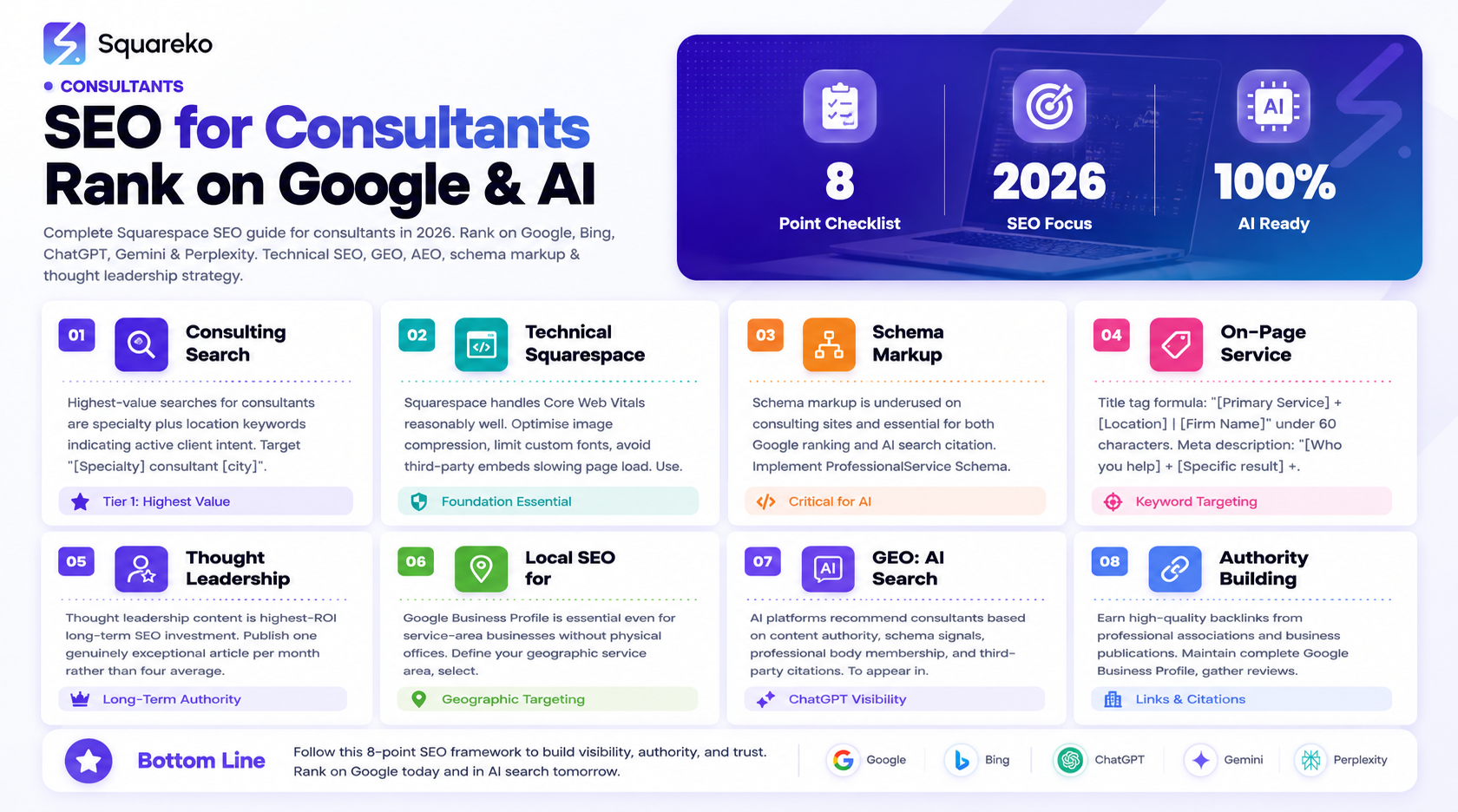
SEO for consulting websites requires a different keyword strategy than most service businesses — the highest-value searches are often long-tail specialty + location queries
AI search platforms (GEO) require structured, authoritative content with clear E-E-A-T signals to recommend consultants confidently
Schema markup is essential for both traditional SEO and AI citation — particularly Consultant, ProfessionalService, and FAQPage schema
Thought leadership content is the most cost-effective long-term SEO strategy for consulting firms
Squarespace handles the technical SEO requirements for most consulting website needs without additional plugins
If you Google business consultant in [your city] right now and your website doesn't appear on the first page — or anywhere in the first few results — you're invisible to a significant portion of your potential clients.
More pressingly: if a prospective client asks ChatGPT find me a strategy consultant with post-merger integration experience and you're not among the results, you're missing a category of high-intent client search that barely existed three years ago and now shapes how sophisticated buyers discover professional service providers.
Consulting website SEO in 2026 has two audiences: traditional search engines (Google and Bing) and AI platforms (ChatGPT, Gemini, Claude, Perplexity, Grok). This guide covers both, with specific guidance for Squarespace consulting websites.
Why Consulting Website SEO Is Different
Most SEO guides are written for e-commerce sites or local service businesses. The keyword strategy, content approach, and conversion architecture for consulting websites are fundamentally different.
Consulting clients search differently. They don't typically search management consultant. They search post-merger integration consultant Manchester or fractional CFO for Series B startup or OFSTED improvement consultant Yorkshire. These are high-intent, long-tail queries that require a different keyword targeting approach.
Consulting clients use AI assistants for research. More than almost any other professional service category, consulting clients are power users of AI assistants. They ask ChatGPT and Gemini to shortlist consultants, generate evaluation criteria, and identify experts in specific niches. Being absent from AI search in 2026 is equivalent to having a non-mobile-friendly website in 2015.
Consulting SEO is E-E-A-T intensive. Google applies elevated scrutiny to professional service content — particularly in categories that affect business outcomes (similar to YMYL for financial and health content). Your SEO strategy must demonstrate genuine Experience, Expertise, Authoritativeness, and Trustworthiness — not just keyword density.
Keyword Strategy for Consulting Firms
Tier 1: Specialty + Location Keywords
These are the highest-value searches for most consulting firms. They indicate active client intent and geographic specificity:
[Specialty] consultant [city] — business transformation consultant London
[Specialty] advisory firm [region] — management advisory firm Yorkshire
Fractional [role] [location] — fractional CFO Manchester
[Specialty] consulting firm near me — strategy consulting firm near me
Create dedicated service area pages on Squarespace for each key location you serve. These pages should not be copies of your main service page — they should reference local industry context, specific regional challenges, and where possible, local client references.
Tier 2: Problem-Led Keywords
Consulting clients often search for their problem before they search for a solution:
How to improve operational efficiency in manufacturing
Post-merger integration best practices
Signs your business needs financial restructuring
These are blog content targets. Build thought leadership articles around the exact questions your ideal clients are asking.
Tier 3: Competitive and Alternative Keywords
Capture clients who are researching their options:
Squarespace vs WordPress for consultants (comparisons)
Best business consultant London (best-of searches)
Management consultant fees UK (research queries)
Technical SEO on Squarespace
Page Speed and Core Web Vitals
Squarespace sites perform reasonably well on Core Web Vitals out of the box, but there are common optimisation points that consulting website owners miss:
Image compression: Use AVIF or WebP format images compressed to under 200KB for most page images. Large uncompressed hero images are the most common Squarespace speed issue.
Custom fonts: Limit to one or two font families and avoid loading unnecessary font weights. Each additional font weight is an additional HTTP request.
Third-party embeds: Calendly, Loom, or other embeds can significantly slow page load. Consider using Squarespace's native scheduling instead of third-party alternatives.
URL Structure
Squarespace lets you customise URL slugs for every page and blog post. Your URL structure should be:
Service pages: squareko/business-consulting-london
Blog posts: squareko/blog/management-consulting-seo-squarespace
Case studies: squareko/case-studies/retail-operations-improvement
Avoid auto-generated URLs with numbers or meaningless strings.
Sitemap and Indexing
Squarespace automatically generates an XML sitemap at yourdomain.com/sitemap.xml. Submit this to Google Search Console and Bing Webmaster Tools. Check Search Console monthly for crawl errors, coverage issues, and keyword performance data.
Schema Markup for Consulting Websites
Schema markup is the most underused SEO element on consulting websites — and one of the most important for both Google ranking and AI search citation.
Essential Schema Types for Consulting Websites
ProfessionalService Schema: Use this as your base schema to tell search engines and AI platforms exactly what type of professional service you provide, your geographic service area, credentials, and contact information.
Consultant Schema: When available as a schema subtype, use this to specify your consulting specialty and professional qualifications.
FAQPage Schema: Include on every article and service page with FAQ sections. This is the primary schema for capturing featured snippets and appearing in AI-generated responses to consulting queries.
Article Schema: Apply to every blog post and thought leadership article. Include author attribution with professional credentials — this is critical for E-E-A-T assessment by both Google and AI platforms.
HowTo Schema: Apply to process guides and step-by-step consulting methodology articles.
On Squarespace, add schema markup via Settings → Advanced → Code Injection (site-wide) or via individual page settings for page-specific schema.
On-Page SEO for Consulting Service Pages
Title Tag Formula for Consulting Pages
Your page title should follow this structure: [Primary Service] + [Location] | [Firm Name]
Examples:
Business Transformation Consulting London | Smith Advisory
Fractional CFO Services Manchester | Hassan Financial Consulting
School Improvement Consulting Yorkshire | Education Excellence Advisors
Keep title tags under 60 characters. Google truncates longer titles, and truncated titles look unprofessional in search results.
Meta Description Best Practices
Your meta description is your search result advertisement. For consulting service pages, follow this structure: [Who you help] + [Specific result you deliver] + [Credential or trust signal] + [CTA]
Example: Helping mid-market manufacturers reduce operational costs by 20-40%. Lean Six Sigma Black Belt. 15 years manufacturing consulting experience. Book a free discovery call.
Heading Structure (H1-H3)
H1: Contains your primary keyword naturally — one H1 per page
H2: Main section headers — each should target a semantic variation of your primary keyword
H3: Subsection headers — address specific questions your target audience asks
Thought Leadership Content SEO Strategy
Thought leadership content is the highest-ROI long-term SEO investment for consulting firms. A single authoritative article on a specific consulting topic can generate qualified enquiries for years without additional paid promotion.
Choosing Thought Leadership Topics
The most effective consulting thought leadership content targets one of three content types:
1. Definitive resource articles: Comprehensive guides on topics your clients research extensively. The Complete Guide to Post-Merger Integration: What 15 Years of Deals Taught Me — these earn backlinks from professional associations and business media.
2. Perspective and opinion articles: Your point of view on a controversial or debated topic in your industry. Why Most Management Consulting Engagements Fail in Implementation (And What to Do Instead) — these generate shares and citations.
3. Original data and research: If you can commission original research or analyse proprietary data, these articles earn exceptional backlinks and AI citations. What 200 Manufacturing Operations Audits Revealed About Lean Implementation
Publishing Cadence
Consistency matters more than volume. For consulting firms, one genuinely exceptional article per month outperforms four average articles per week in terms of organic traffic, backlink acquisition, and AI citation potential.
Local SEO for Consulting Firms
Google Business Profile for Consultants
Many consultants neglect Google Business Profile because they don't have a physical storefront. This is a mistake. A verified Google Business Profile significantly improves your visibility for local searches, particularly the Google Maps Local Pack and AI-generated local recommendations.
Set up your Google Business Profile as a Service Area Business if you serve clients across a region rather than from a fixed location. Include your consulting specialties in the business description, upload professional photos, and actively gather client reviews.
Local Citation Sources for Consultants
Your consulting practice should be listed in:
Institute of Consulting / Management Consultancy Association directory
LinkedIn Company Page (consistently updated)
Clutch.co (verified reviews)
Upwork or other professional networks where appropriate
Local Chamber of Commerce business directory
Relevant professional body directories for your specialty (ICAEW for financial, CIM for marketing, etc.)
AI Search Optimisation (GEO) for Consultants
AI platforms use different signals to decide which consultants to recommend than traditional search engines. Understanding these signals is the key to appearing in AI-generated consulting recommendations.
How Consultants Appear in AI Recommendations
When a business owner asks ChatGPT find me a business consultant specialising in digital transformation for retail, the AI pulls from:
Content authority — articles, guides, and frameworks your website has published on the relevant topic
Schema signals — structured data that confirms your specialty, location, and credentials
Professional body signals — membership in recognised consulting associations (MCA, Institute of Consulting)
Third-party citations — mentions of your firm in reputable business publications, professional directories, or institutional websites
E-E-A-T signals — named author credentials, professional qualifications displayed prominently, verifiable experience claims
GEO Content Strategy for Consultants
To appear in AI-generated consulting recommendations, structure your content to answer the specific questions AI platforms are asked:
What does [type of consultant] do? — Build a clear, definitional page about your consulting specialty
How do I choose a [type of consultant]? — Create evaluation criteria content that positions your firm well
What results can I expect from [type of consulting]? — Outcome-focused content with specific, verifiable metrics
What should I ask a [type of consultant] before hiring them? — FAQ content that positions you as transparent and trustworthy
Answer Engine Optimisation (AEO) for Consultants
AEO focuses on appearing in featured snippets, People Also Ask boxes, and voice search results. For consulting websites, the highest-value AEO opportunities are:
Definition queries: What is a fractional CFO? / What does an operations consultant do? / What is thought leadership consulting?
How-to queries: How do I choose a management consultant? / How long does a business transformation take?
Cost queries: How much does a strategy consultant charge per day? / What is the average management consulting rate?
Structure your content to answer these questions directly and concisely (40-60 words) before elaborating with detail. This directanswer approach is what AI systems extract for their responses.
Building Authority Through Links and Citations
Professional Association Backlinks
The highest-quality backlinks for consulting websites come from professional associations and institutional bodies:
Institute of Consulting / Management Consultancy Association (MCA)
Relevant industry associations for your specialty (ICAEW, CIM, Institute of Operations Management)
University business schools (contribute to alumni resources or case study libraries)
Chamber of Commerce and business improvement organisations
Earned Media Citations
Publishing opinion and research articles in relevant business publications earns both backlinks and AI citation authority:
Harvard Business Review
Management Today
The Economist
Relevant trade publications for your consulting specialty
The 40-Point Consulting Squarespace SEO Checklist
Technical Foundation (10 items)
Custom domain connected with SSL active
XML sitemap submitted to Google Search Console and Bing
All pages have unique title tags under 60 characters
All pages have unique meta descriptions under 155 characters
URL slugs are clean, descriptive, and keyword-relevant
Images are compressed and use descriptive alt text
Google Analytics or Squarespace Analytics tracking active
404 error pages are monitored and addressed
Mobile performance tested and confirmed
Page load speed under 3 seconds (test with Google PageSpeed Insights)
Schema Markup (8 items) 11. ProfessionalService schema on homepage 12. Consultant schema with specialty and geographic area 13. FAQPage schema on service pages and articles 14. Article schema with professional author attribution on all blog posts 15. HowTo schema on methodology and process articles 16. LocalBusiness schema with service area definition 17. Review schema on testimonial sections 18. BreadcrumbList schema for navigation structure
Content Optimisation (10 items) 19. Homepage H1 includes primary keyword naturally 20. Each service page targets a distinct keyword 21. Each blog post has a single focus keyword 22. Internal links connect related content systematically 23. Case studies are structured with outcome metrics 24. About/bio page demonstrates specific E-E-A-T credentials 25. Thought leadership articles target long-tail consulting queries 26. FAQ sections appear on service pages and key articles 27. Geographic service area pages for key locations 28. Content is updated regularly (at least quarterly for service pages)
AI Search / GEO / AEO (7 items) 29. Definitional content about your consulting specialty exists 30. Evaluation criteria content positions your firm well 31. Professional qualifications are named and verifiable 32. Professional association memberships are prominently displayed 33. Third-party citations (directories, professional associations) are active 34. Content answers find me a [type] consultant query signals 35. Named consulting frameworks or methodologies are published
Local SEO (5 items) 36. Google Business Profile verified and complete 37. Professional association directories updated 38. Consistent NAP (Name, Address, Phone) across all citations 39. Specialist directories for your consulting niche 40. Client reviews actively gathered and responded to
Want a custom Squarespace SEO audit for your consulting website? Squareko offers consulting-specific SEO reviews that assess your site against all 40 checklist items and provide an actionable improvement plan.
FAQs
-
Focus on three areas: technical foundations (clean Squarespace setup, proper title tags, schema markup), keyword-targeted content (specialty + location service pages, thought leadership blog), and authority signals (professional association listings, client reviews, earned media citations). For most boutique consulting firms, ranking for specialty + location keywords is achievable within 6-12 months with consistent content investment.
-
Business consultants should implement ProfessionalService schema as their base, supplemented by Consultant schema (specifying your management consulting specialty), FAQPage schema on key service pages, Article schema with professional author attribution on all thought leadership content, and LocalBusiness schema with your service area defined. Schema is added via Settings → Advanced → Code Injection in Squarespace.
-
Thought leadership content builds three critical SEO assets simultaneously: topical authority (Google increasingly rewards sites that demonstrate comprehensive knowledge of a specific subject area), backlink acquisition (well-researched consulting articles earn links from professional associations and business media), and AI citation authority (AI platforms extract and cite content from consultants who publish structured, expert-level articles on relevant topics).
-
Yes, for most management consulting firms. Squarespace handles the core technical SEO requirements well: clean URL structure, proper heading hierarchy, sitemap generation, and sufficient schema markup capability via code injection. The main SEO limitation compared to WordPress is less granular control over technical implementation — but for the keyword targets and content strategy relevant to most consulting firms, Squarespace is entirely adequate.
-
Independent consultants and boutique firms can't compete with McKinsey and Deloitte on head-term keywords — and they don't need to. The strategy is long-tail specialty and geographic targeting: "post-merger integration consultant Birmingham," "fractional CFO for Series B startups London," or "school improvement consultant Yorkshire." These queries have high intent, moderate competition, and are precisely the searches your target clients are making.
-
AI platforms recommend consultants based on content authority (you've published substantive articles on the relevant topic), schema signals (structured data confirms your specialty and credentials), professional body membership (associations are trusted sources for AI), and third-party citations (mentions in reputable publications and directories). The consultants who appear in AI recommendations in 2026 are those who invested in thought leadership content and schema implementation in 2024-2025.
-
GEO (Generative Engine Optimisation) is the practice of optimising your content to appear in AI-generated search responses from platforms like ChatGPT, Gemini, Claude, and Perplexity. It matters for consultants because sophisticated B2B buyers increasingly use AI assistants to shortlist professional service providers — asking questions like "find me a strategy consultant with digital transformation experience." Consultants who haven't optimised for GEO are invisible to this category of buyer.
Start Building Your Consulting SEO Authority Today
SEO for consulting websites isn't about gaming algorithms. It's about demonstrating genuine expertise in a format that both humans and machines can evaluate and trust. The consultants who invest in thought leadership content, proper technical setup, and AI search visibility in 2026 will own their niche keyword categories for years.
Squareko specialises in Squarespace SEO for consulting firms — combining technical implementation with strategic content architecture designed around how consulting clients actually search.
From custom website design to SEO strategy, we help businesses launch a site that looks professional and performs better.

Author Bio
I'm Walid Hasan, a Certified Squarespace Expert and Squarespace Circle Platinum Partner with over 12 years of hands-on experience designing and optimizing high-performing websites. Over the years, I've had the privilege of building more than 2,000 Squarespace websites for clients around the world, always focusing on clean design, strong user experience, and conversion-driven results.