Squarespace SEO for Chiropractors: Rank on Google and AI Search in 2026
Introduction
Building a chiropractor website on Squarespace is one thing. Building a Squarespace website that actually appears in Google search results and answers AI chatbots is another. Your website needs to be optimized not just for human readers but for Google's ranking algorithms and the emerging world of AI search (ChatGPT, Perplexity, Google AI Overview). In 2026, SEO for chiropractors means understanding keyword landscape, demonstrating expertise and authority, writing content that AI systems can understand and recommend, and building the technical foundation that Squarespace provides. This comprehensive guide covers every SEO tactic that matters for chiropractors on Squarespace, from keyword research and content strategy to technical optimization and AI-era considerations.
Key Takeaways
Chiropractic keyword landscape divides into four categories: local (location-based), condition-specific, symptom-based, and informational—each requires different content approaches
YMYL (Your Money Your Life) applies heavily to chiropractic; Google scrutinizes health claims intensely, so E-E-A-T signals (expertise, experience, authoritativeness, trustworthiness) are critical
GCC registration, years in practice, published research/case studies, and patient outcomes are your strongest E-E-A-T signals for Google rankings
Squarespace's technical SEO is solid, but on-page optimization (titles, headings, keyword usage) and content strategy drive actual ranking success
AI search (GEO/AEO—Generative Engine Optimization/Answer Engine Optimization) requires different content structure: clear topic authority, FAQ sections, structured data that AI can understand
Citation consistency with GCC directory listing is critical for local and AI search visibility
Understanding the Chiropractic Keyword Landscape
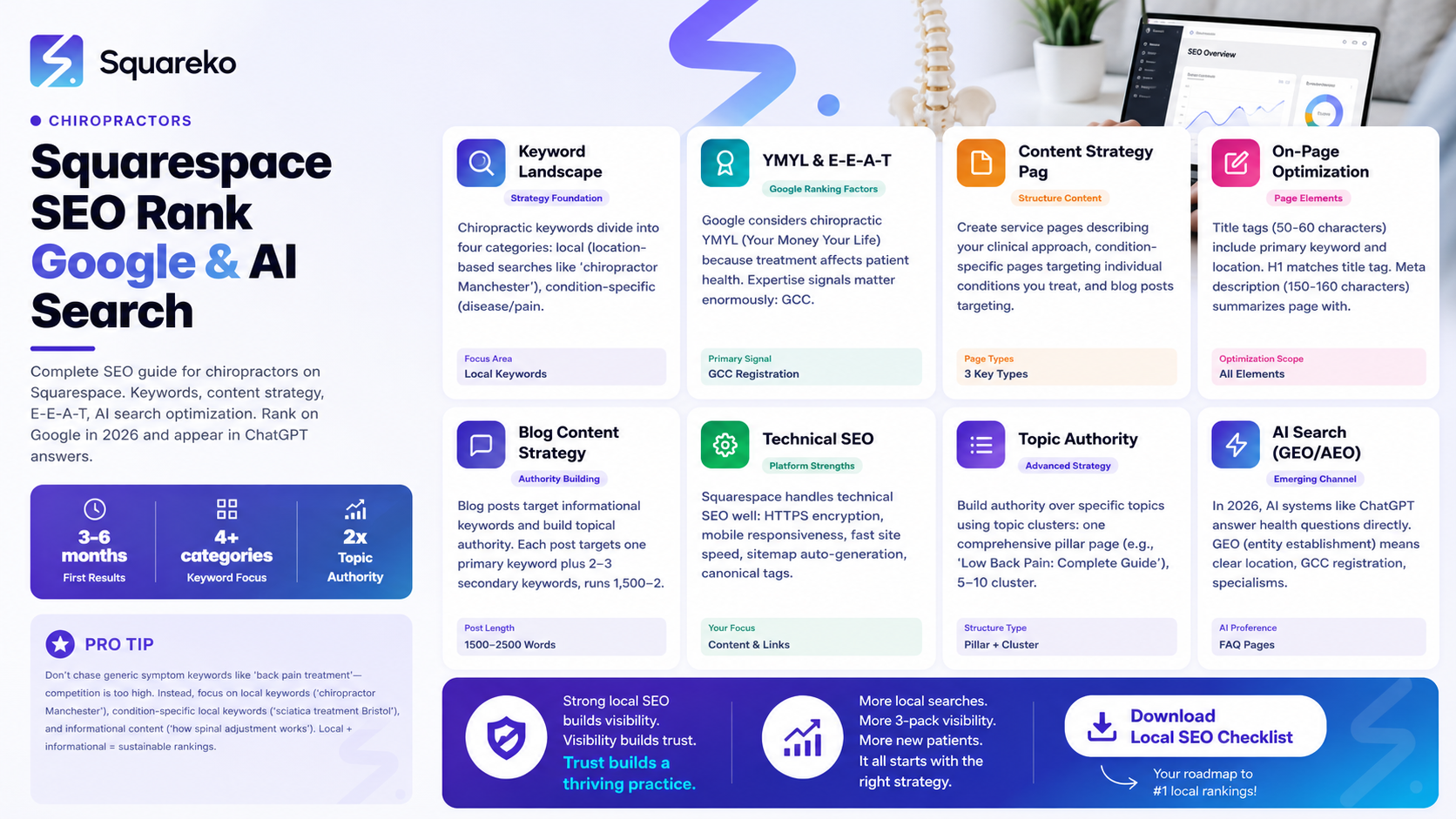
Chiropractors operate in a specific keyword landscape with distinct search patterns. Understanding these categories shapes your entire SEO strategy.
Keyword Category 1: Local/Proximity Keywords
These are searches where location is explicit:
"Chiropractor Manchester"
"Chiropractic clinic Bristol"
"Chiropractor near me"
"Back pain treatment London"
"Postcode chiropractor"
Volume: High (these are the queries that drive most chiropractic bookings) Intent: High commercial intent (they're ready to book) Difficulty: Medium-to-high (local competition, but smaller pool than national)
SEO approach: Google Business Profile optimization + location pages on your Squarespace site + local citations (covered in Local SEO guide).
Keyword Category 2: Condition-Specific Keywords
These identify the health problem the patient wants to treat:
"Treatment for sciatica"
"Herniated disc management"
"Neck pain relief"
"Whiplash recovery"
"Migraine treatment chiropractor"
Volume: Medium (popular conditions) Intent: Mixed (some ready to book, some researching) Difficulty: High (medical condition keywords are competitive and YMYL-sensitive)
SEO approach: Individual service/condition pages optimized for each condition + evidence-based claims + E-E-A-T signals.
Keyword Category 3: Symptom-Based Keywords
These describe pain or symptoms without naming the condition:
"Lower back pain"
"Neck stiffness"
"Radiating arm pain"
"Pinched nerve symptoms"
"Posture-related headaches"
Volume: Very high (these are common searches) Intent: Mixed (varying commitment to treatment) Difficulty: Very high (medical symptom keywords are extremely competitive and YMYL-sensitive)
SEO approach: These are difficult for individual practitioners to rank for; focus on local + condition-specific combinations instead. Avoid chasing generic symptom keywords.
Keyword Category 4: Informational Keywords
These are questions and research queries:
"How does chiropractic work?"
"Is chiropractic safe?"
"What does a chiropractor do?"
"Difference between chiropractor and physiotherapist"
"What to expect at first chiropractic appointment"
Volume: Medium (educational searches) Intent: Low commercial (they're researching, not ready to book) Difficulty: Medium (less competitive than medical keywords)
SEO approach: Blog posts and FAQ pages optimizing for these queries. These build authority, generate organic traffic, and support AI search visibility.
YMYL, E-E-A-T, and Why Chiropractors Face Higher Google Scrutiny
Google considers chiropractic a YMYL (Your Money Your Life) category because treatment claims affect patient health. This means:
Your content is scrutinized heavily by Google's algorithms
Medical credentials and authority matter enormously for rankings
Health claims require evidence (we covered this in the compliance guide)
E-E-A-T signals are ranking factors, not just trust builders
Understanding E-E-A-T
E = Expertise: Do you have chiropractic education and qualifications? E = Experience: How many years have you been practicing? A = Authoritativeness: Are you recognized as an authority in chiropractic? T = Trustworthiness: Do patients trust you? Is your information accurate?
For chiropractors, Google signals these through:
Expertise signals:
GCC registration (strongest signal)
Chiropractic degree (MSc Chiropractic, Diploma in Chiropractic)
Additional certifications (sports chiropractic, pediatric chiropractic)
Years in practice
Experience signals:
Years since qualification
Number of patients treated (if you mention it)
Specific case studies or patient outcomes (within GDPR constraints)
Range of conditions treated
Authoritativeness signals:
Published research or articles
Speaking engagements at professional conferences
BCA membership or professional association involvement
Patient testimonials and reviews (especially Google reviews)
Being cited or linked to by other authoritative health websites
Trustworthiness signals:
GCC registration (displayed prominently)
Professional indemnity insurance
Privacy policy and clear data handling
Transparent pricing
Professional, evidence-based content
Displaying E-E-A-T on Your Squarespace Site
Your website must make your expertise obvious:
About page: Include full credentials, years in practice, qualifications, GCC number
Author bio: Every blog post should include author bio with credentials
Team bios: Individual pages for each practitioner with full credentials
Content: Write evidence-based content that demonstrates clinical knowledge
Testimonials: Display patient testimonials (with consent) showing real patient outcomes
Professional affiliations: Display BCA membership, certifications, professional associations
Keyword Research Strategy for Chiropractors
Effective keyword research for chiropractors balances search volume, competition, and commercial intent.
Keyword Research Tools
Free:
Google Search Console (shows keywords you're already ranking for)
Google Keyword Planner (free version shows volume but hides exact competition data)
Google Autocomplete and "People also ask" sections (show real searches)
Ubersuggest free version (limited but useful)
Paid (Optional):
Ahrefs, SEMrush, Moz (comprehensive but expensive; overkill for solo practices)
Keyword.com or KeywordInsights (affordable mid-tier tools)
Keyword Research Process
Start broad: Brainstorm keywords in each category (local, condition, symptom, informational)
Check volume: Use Google Keyword Planner to see monthly search volume
Assess difficulty: Search each keyword in Google and see what ranks (if competitors are small clinics, you can compete; if national health sites rank, it's difficult)
Prioritize: Target keywords with decent volume, manageable difficulty, and high commercial intent
Find long-tail variations: "Best chiropractor for sciatica in Manchester" is easier than "sciatica treatment"
Keyword Prioritization for Chiropractors
Tier 1 (Easy to rank, high priority):
Local keywords: "City chiropractor," "chiropractor near postcode"
Local condition keywords: "Condition treatment City"
Local competitor keywords: "best chiropractor City"
Why? Lower competition locally, high commercial intent, drive bookings.
Tier 2 (Medium difficulty, good secondary targets):
Informational keywords: "What to expect at chiropractic appointment," "Is chiropractic safe"
Service-specific keywords: "Sports injury chiropractor," "Pediatric chiropractic"
Condition-specific keywords: "Whiplash treatment," "Postural assessment"
Why? Build authority, support AI search, generate organic traffic.
Tier 3 (High difficulty, low priority for most clinics):
Generic symptom keywords: "back pain treatment," "neck pain relief"
Very competitive health keywords
National-level keywords
Why? Extremely difficult to rank due to competition from large health sites.
Content Strategy: Service Pages, Condition Pages, and Topic Authority
Your SEO success depends on content strategy. You need the right mix of page types serving different functions.
Page Type 1: Service Pages
These describe what you offer:
Title: "Spinal Adjustment and Manipulation in City"
Purpose: Explain your service, answer patient questions, convert to bookings
Content: What the service is, how it works, what patients experience, expected outcomes
Keywords: Service name + location (e.g., "spinal manipulation Bristol")
Internal links: Link to condition-specific pages, blog posts about the service
Page Type 2: Condition-Specific Pages
These target specific conditions you treat:
Title: "Back Pain Assessment and Treatment in City"
Purpose: Explain the condition, how you treat it, what to expect
Content: What causes the condition, how it affects patients, your assessment and treatment approach, expected outcomes, realistic timeline
Keywords: Condition + location + treatment (e.g., "herniated disc treatment Manchester")
Internal links: Link to relevant service pages, educational blog posts
E-E-A-T signals: Reference clinical evidence (NICE guidelines, Cochrane reviews), cite your approach
Important: Frame these as assessment and management pages, not "cure" pages. "We assess and manage low back pain" not "We cure low back pain."
Page Type 3: Blog/Educational Content
These target informational keywords and build authority:
Title: "How Does Chiropractic Adjustment Work? A Practitioner's Explanation"
Purpose: Educate potential patients, build authority, drive organic traffic
Content: Explain the mechanism, address common concerns, support with evidence
Keywords: Informational keywords (no location needed necessarily)
Internal links: Link to service pages and booking page
Creating Topic Authority and Topic Clusters
Topic clusters strengthen your authority on specific subjects. Here's how:
Example: Back Pain Topic Cluster
Pillar page (comprehensive): "Low Back Pain: Causes, Assessment, and Treatment"
Covers the topic broadly
Links to all related cluster content
Cluster content (specific articles):
"Lumbar Strain: What Causes It and How We Treat It"
"Sciatica Symptoms and Management"
"Postural Causes of Lower Back Pain"
"Sitting Posture and Back Pain: Prevention Strategies"
"When to See a Chiropractor for Back Pain"
Each cluster article links back to the pillar and to related cluster articles, creating an interconnected authority structure that Google recognizes as comprehensive topic coverage.
On-Page SEO: Titles, Headings, Meta Descriptions, and Keyword Integration
On-page SEO is where you optimize individual pages for keywords and user experience.
Page Title (H1) and Title Tag
Title tag (appears in search results):
50-60 characters
Include primary keyword
Include location (for local pages)
Make it compelling (users decide whether to click based on this)
Example: "Back Pain Treatment in Manchester | GCC Chiropractor"
H1 (page headline):
Matches or closely mirrors the title tag
Only one H1 per page
Keyword-focused but natural
Example: "Back Pain Assessment and Treatment in Manchester"
Heading Structure (H2, H3)
Use headings to organize content logically:
H2: Section heading
H3: Subsection heading
H3: Subsection heading
H2: Another section heading
Google uses heading structure to understand page topics. Headings with keywords help Google match the page to relevant searches.
Meta Description
The meta description appears below the title in search results:
150-160 characters
Include primary keyword naturally
Write a compelling summary of the page
Include a CTA ("Learn more," "Book now")
Example: "Expert chiropractic care for back pain in Manchester. Assessment and treatment from GCC-registered chiropractors. Book your appointment today."
Keyword Integration
Integrate keywords naturally throughout the page:
Where keywords should appear:
Title tag (1x)
H1 (1x)
First 100 words of content (1x naturally)
Headings (H2/H3, 2-3 times naturally)
Body content (1-2% keyword density, meaning if your page is 1,000 words, use keyword 10-20 times naturally)
Internal links (link anchor text includes keyword when relevant)
Image alt text (describe images, naturally include keyword)
Keyword density guidelines:
Avoid stuffing keywords unnaturally (Google penalizes this)
Use keyword variations and related terms
Prioritize readability over keyword frequency
LSI (Latent Semantic Indexing) keywords help: use synonyms and related terms
Example variations of "chiropractor Manchester":
Chiropractor in Manchester
Manchester chiropractor
Manchester chiropractic clinic
Chiropractor near Manchester
Manchester chiropractic services
Blog and Educational Content for SEO and Patient Education
Blog posts serve dual purposes: ranking for informational keywords and building patient trust through education.
Blog Post SEO Strategy
Each blog post should:
Target one primary keyword and 2-3 secondary keywords
Be 1,500-2,500 words (longer content ranks better for informational keywords)
Include heading structure (H2 for sections, H3 for subsections)
Link internally to relevant service/condition pages
Include images with keyword-rich alt text
Have a clear CTA at the end (book appointment or contact)
Blog Content Ideas for Chiropractors
Educational:
"How Does Spinal Adjustment Work?" (mechanism explanation)
"What to Expect at Your First Chiropractic Appointment"
"Is Chiropractic Safe? Evidence-Based Overview"
"Difference Between Chiropractic and Physiotherapy"
"Common Myths About Chiropractic Care"
Condition-specific:
"Understanding Sciatica: Causes and Treatment Options"
"Whiplash Injury Recovery Timeline and Treatment"
"Herniated Disc: When to See a Chiropractor"
"Postural Assessment: Why It Matters"
"Sports Injury Prevention Strategies"
Practical/Lifestyle
"Desk Posture and Neck Pain: Ergonomic Fixes"
"Stretches for Lower Back Pain Relief"
"Sleeping Position and Spinal Health"
"Lifting Techniques to Prevent Injury"
"Exercise and Chiropractic Care: How They Work Together"
Technical SEO on Squarespace: What to Optimize and What to Ignore
Squarespace handles much of technical SEO for you. Understand what's already optimized and what you need to configure.
Squarespace Technical SEO Strengths
✅ Already handled well:
HTTPS/SSL encryption (all Squarespace sites are secure)
Mobile responsiveness (Squarespace templates are mobile-optimized)
Site speed (Squarespace CDN and caching handle this)
Sitemap auto-generation (Squarespace creates XML sitemaps automatically)
Robots.txt (automatically configured)
Canonical tags (Squarespace handles this)
Schema markup support (can add via code injection)
What You Need to Configure
Title tags and meta descriptions: Squarespace allows custom title tags and meta descriptions for every page. Set these explicitly for:
Homepage
Service pages
Condition pages
Blog posts
About page
Contact page
Go to Settings > SEO > Page titles and meta descriptions, then customize each page.
Keyword optimization: Squarespace doesn't have built-in keyword optimization tools. You must manually optimize titles, headings, content, and internal links.
Schema markup: Squarespace has limited built-in schema. Add custom schema via Settings > Advanced > Code Injection > Header. This includes:
Organization schema (homepage)
Chiropractor/MedicalOrganization schema (service pages)
FAQPage schema (FAQ sections)
LocalBusiness schema (location pages)
Internal linking: Squarespace doesn't auto-suggest internal links. You must manually link relevant pages together.
What to Ignore
❌ Don't waste time on:
Manually submitting sitemaps to Google (Google crawls Squarespace sites well)
Optimizing for Core Web Vitals obsessively (Squarespace handles this; minor improvements here rarely move rankings)
Excessive technical tweaking (Squarespace's defaults are solid)
Focus your SEO effort on content quality and on-page optimization, not technical rabbit holes.
Schema Markup for Chiropractic Expertise and AI Understanding
Schema markup helps both Google and AI systems understand your content. Add these schema types to your Squarespace site:
Homepage: Organization Schema
 {
  "@context": "https://schema.org",
  "@type": "Organization",
  "name": "[Your Practice Name]",
  "url": "[Your Squarespace URL]",
  "logo": "[URL to logo]",
  "description": "GCC-registered chiropractic practice in [City]",
  "address": {
    "@type": "PostalAddress",
    "streetAddress": "[Address]",
    "addressLocality": "[City]",
    "postalCode": "[Postcode]",
    "addressCountry": "GB"
  },
  "telephone": "[Phone]",
  "email": "[Email]",
  "sameAs": ["[GBP URL]", "[Social media URLs]"],
  "areaServed": "[City], [Region]"
}
Service Pages: Chiropractor/MedicalOrganization Schema
  {
  "@context": "https://schema.org",
  "@type": "Chiropractor",
  "name": "[Your Name]",
  "url": "[Your Squarespace URL]",
  "image": "[Professional photo URL]",
  "description": "[Service description]",
  "address": {
    "@type": "PostalAddress",
    "streetAddress": "[Address]",
    "addressLocality": "[City]",
    "postalCode": "[Postcode]",
    "addressCountry": "GB"
  },
  "medicalSpecialty": "Chiropractic",
  "educationalCredential": {
    "@type": "EducationalOccupationalCredential",
    "credentialCategory": "GCC Registration",
    "identifier": "[Your GCC number]"
  },
  "knowsAbout": ["Spinal Adjustment", "Sports Injury", "Postural Assessment"]
}
FAQ Sections: FAQPage Schema
  {
  "@context": "https://schema.org",
  "@type": "FAQPage",
  "mainEntity": [
    {
      "@type": "Question",
      "name": "[Your question]",
      "acceptedAnswer": {
        "@type": "Answer",
        "text": "[Your answer]"
      }
    }
  ]
}
Building Topical Authority and Topic Clusters
Topical authority is the new SEO paradigm. Instead of optimizing individual pages for keywords, build authority over entire topics.
How Topic Clusters Work
Pillar page: Comprehensive, broad page covering the entire topic ("Low Back Pain: Complete Guide")
Cluster content: 5-10 specific articles covering subtopics ("Lumbar Strain Causes," "Sciatica Management," "Postural Correction for Back Pain")
Internal linking: Pillar links to all cluster articles; cluster articles link back to pillar and to each other
Google sees this interconnected content structure as authoritative coverage of the topic.
Building a Chiropractic Topic Cluster
Topic: Low Back Pain
Pillar page (target: "low back pain treatment"): Title: "Low Back Pain: Assessment, Treatment, and Prevention Guide" Content: Overview of causes, diagnosis, treatment approaches, prevention strategies Links: To all cluster articles
Cluster articles:
"Lumbar Strain and Muscle Injury: Causes and Recovery
Keyword: "lumbar strain"
Links: Back to pillar, to sciatica article
"Sciatica: Understanding Sciatic Nerve Pain and Treatment"
Keyword: "sciatica treatment"
Links: Back to pillar, to lumbar strain article
"Herniated Disc: Causes and Chiropractic Management"
Keyword: "herniated disc chiropractor"
Links: Back to pillar
"Postural Assessment and Correction for Back Pain Prevention
Keyword: "posture back pain"
Links: Back to pillar
"Sitting Ergonomics: Desk Setup and Spine Health"
Keyword: "desk ergonomics back pain"
Links: Back to pillar
This interconnected structure signals to Google that you have comprehensive authority over "low back pain" and all related subtopics.
Generative Engine Optimization (GEO) and AI Search in 2026
In 2026, "search" increasingly means AI systems like ChatGPT, Perplexity, and Google's AI Overview answering questions rather than just listing websites. This changes SEO strategy.
How AI Search Works
When someone asks ChatGPT or Google's AI: "I have back pain, what should I do?", the AI system:
Searches the internet for relevant content
Pulls information from multiple sources
Generates a comprehensive answer
May cite sources (Google AI Overview) or may not (ChatGPT)
GEO/AEO Strategy for Chiropractors
What AI systems look for:
Clear, well-structured answers to common questions
FAQ sections (AI extracts these directly)
Authoritative expert credentials (GCC registration, E-E-A-T)
Structured data (schema markup) that explicitly answers questions
Content that directly answers patient questions
To optimize for AI search:
Create comprehensive FAQ sections on service pages and your site
AI systems reference FAQPage schema directly
"What should I expect at my appointment?" is something AI wants to answer
Use FAQ schema markup (covered above)
AI systems understand structured FAQPage better than natural Q&A prose
Answer questions directly in your content
AI prefers clear, direct answers: "Sciatica is pain radiating along the sciatic nerve..." over "Sciatica is a condition where..."
Build E-E-A-T signals (mentioned throughout)
AI systems recognize expert credentials
GCC registration is powerful authority signal
Include citations and evidence where relevant
"According to NICE guidelines..." or "Clinical evidence shows..."
AI systems pull citations; this makes your site more likely to be sourced
Maintain citation consistency
Make sure your name, address, phone match in GCC directory, Google Business Profile, and website
AI systems use citation consistency as authority signal
Link Building and Domain Authority for Chiropractors
Links (other websites linking to yours) improve your domain authority and Google rankings.
Why Links Matter
Links are still a ranking factor, especially for competitive keywords. A link from a relevant, authoritative website is a vote of confidence that signals credibility.
Local Link Building Strategies
Healthcare partnerships:
GP surgeries (ask about being recommended)
Physiotherapy clinics (mutual referrals)
Sports medicine practitioners
Occupational health companies
Community links:
Local sports clubs
Gyms and fitness centers
Employee assistance programs
Corporate wellness partners
Media and directories:
Local news websites (get featured)
Local health magazines
Healthcare directories (Chiropractor.co.uk, etc.)
Business directories
Content marketing:
Create resources local organizations link to (local health guide, community resources)
Publish research or case studies others cite
Provide educational content others reference
Guest Posting and Partnerships
Write guest articles for local health websites or relevant industry sites. Even one good guest post with a link back to your site builds authority.
Measuring SEO Success: Metrics That Matter
Not all metrics matter. Track metrics that directly correlate to your business goal: more patient bookings.
Metrics That Matter
Organic traffic:
Monthly visitors from Google search (Google Analytics)
Trend: Is it growing month-over-month?
Why it matters: More organic traffic increases potential patients
Keyword rankings:
Position in Google for target keywords (Google Search Console, rank tracking tool)
Track 10-15 key target keywords
Why it matters: Ranking higher = more clicks = more patients
Conversion rate:
Percentage of visitors who book appointments (from Google Analytics or booking system)
Why it matters: Traffic doesn't matter if visitors don't convert; good conversions mean your site is working
Booking volume from organic search:
Number of patients who booked after finding you through Google search
Track in your booking system or via UTM parameters
Why it matters: This is your actual business metric; conversions in isolation don't matter if they don't translate to bookings
Metrics That Don't Matter Much
❌ Avoid obsessing over:
Exact keyword density percentages
Core Web Vitals perfection (Squarespace handles this)
Page speed milliseconds
Domain authority score (useful for comparison but not a ranking factor)
Vanity metrics like social shares (these don't directly drive bookings)
Where to Track Metrics
Google Analytics 4: Free; set it up on your Squarespace site. Track organic traffic, conversion rate, user behavior.
Google Search Console: Free; shows which keywords you rank for, positions, search performance.
Booking system: If you use Squarespace Scheduling or another booking system, track bookings by source (mark "found via Google" etc.).
Optional: Rank tracking tool: Ahrefs, SEMrush, or cheaper alternatives track your keyword rankings over time. Useful but not essential for small practices.
Frequently Asked Questions
-
SEO is not immediate. Expect 3-6 months to see meaningful ranking improvements if you're optimizing consistently. Local keywords may rank faster (4-8 weeks). National keywords take longer. Patience is key; SEO is compounding.
-
For chiropractors, you can do basic SEO yourself if you follow this guide. However, if you want professional link building, comprehensive keyword research, or ongoing optimization, an agency specializing in healthcare practices can help. Just ensure they understand chiropractic compliance and YMYL requirements.
-
Squarespace is fine for SEO. It's technically solid (HTTPS, mobile-responsive, fast) but lacks some advanced features WordPress has. For small chiropractic practices, Squarespace's simplicity is an advantage. You're not held back by the platform; content quality and on-page optimization matter more.
-
Social media doesn't directly impact Google rankings. However, social signals (shares, engagement) may indirectly help. More importantly, social media drives traffic to your site, which can improve rankings if visitors stay on-site and convert. Focus on Google and booking conversions more than social media metrics.
-
Create separate Google Business Profile listings and location pages for each clinic. Use consistent business information (exact address, phone). Each location page should target location-specific keywords ("Chiropractor Birmingham" vs. "Chiropractor London").
-
Voice search (Alexa, Siri, Google Assistant) is mostly handled by local SEO and FAQ optimization. Voice searches are often conversational ("where's a chiropractor near me?"). Focus on local keywords and FAQ content; voice search optimization follows naturally from these.
-
Ask: Would Google trust this content coming from this author? If your GCC credentials are clear, your years of practice are visible, patient testimonials support you, and your claims are evidence-based, your E-E-A-T is strong. Red flags: anonymous author, no credentials displayed, overstated claims, no evidence.
-
Focus on local and long-tail. Generic keywords are nearly impossible to rank for (top positions are taken by national sites). Local keywords ("chiropractor [city]") have high commercial intent and manageable competition. Long-tail keywords ("best chiropractor for whiplash in Manchester") have very high commercial intent and lower competition.
Rank on Google and AI Search with Strategic SEO
SEO success for chiropractors isn't about chasing vanity metrics or obsessing over technical details. It's about understanding your patient's search behavior, building topical authority through evidence-based content, displaying clear expertise and credentials, and optimizing your Squarespace site for both human readers and AI systems.
In 2026, SEO means preparing for both traditional Google search and AI-powered answers. This guide provides the strategy and tactical steps to do both—rank on Google's search results and get recommended by AI systems answering patient questions.
At Squareko, we help chiropractors build Squarespace websites optimized for SEO from the ground up. From keyword research and content strategy to technical optimization and E-E-A-T signals, we ensure your site ranks, converts, and serves patients well.

About the Author
Walid is the founder of Squareko,
I'm Walid Hasan, a Certified Squarespace Expert and Squarespace Circle Platinum Partner with over 12 years of hands-on experience designing and optimizing high-performing websites. Over the years, I've had the privilege of building more than 2,000 Squarespace websites for clients around the world, always focusing on clean design, strong user experience, and conversion-driven results.