Squarespace Duplicate Content: What Is Real, What Is Folklore, and What You Can Actually Fix
The short answer: there is no duplicate content penalty, and most of what looks like duplication on a Squarespace 7.1 site is already handled by the platform. Filtered blog views are both canonicalised and blocked in robots.txt; trailing-slash URLs canonicalise to the clean version. The two sources that genuinely cost you are near-identical service or location pages, and the tag and category archives Squarespace adds to your sitemap automatically.
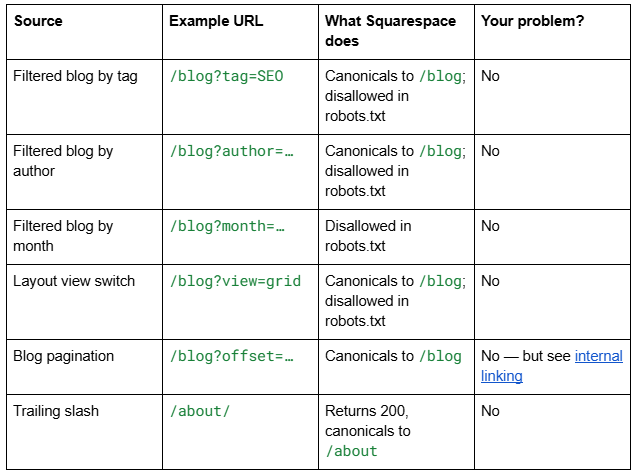
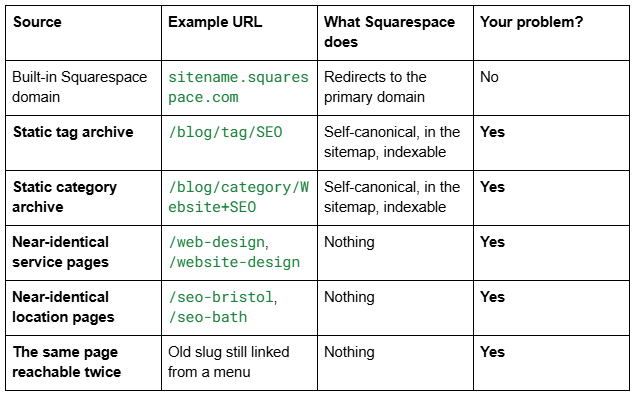
Every source of duplication on Squarespace 7.1
Verified against the rendered HTML and robots.txt of live Squarespace 7.1 sites in August 2026.
The duplicate content penalty is not a thing
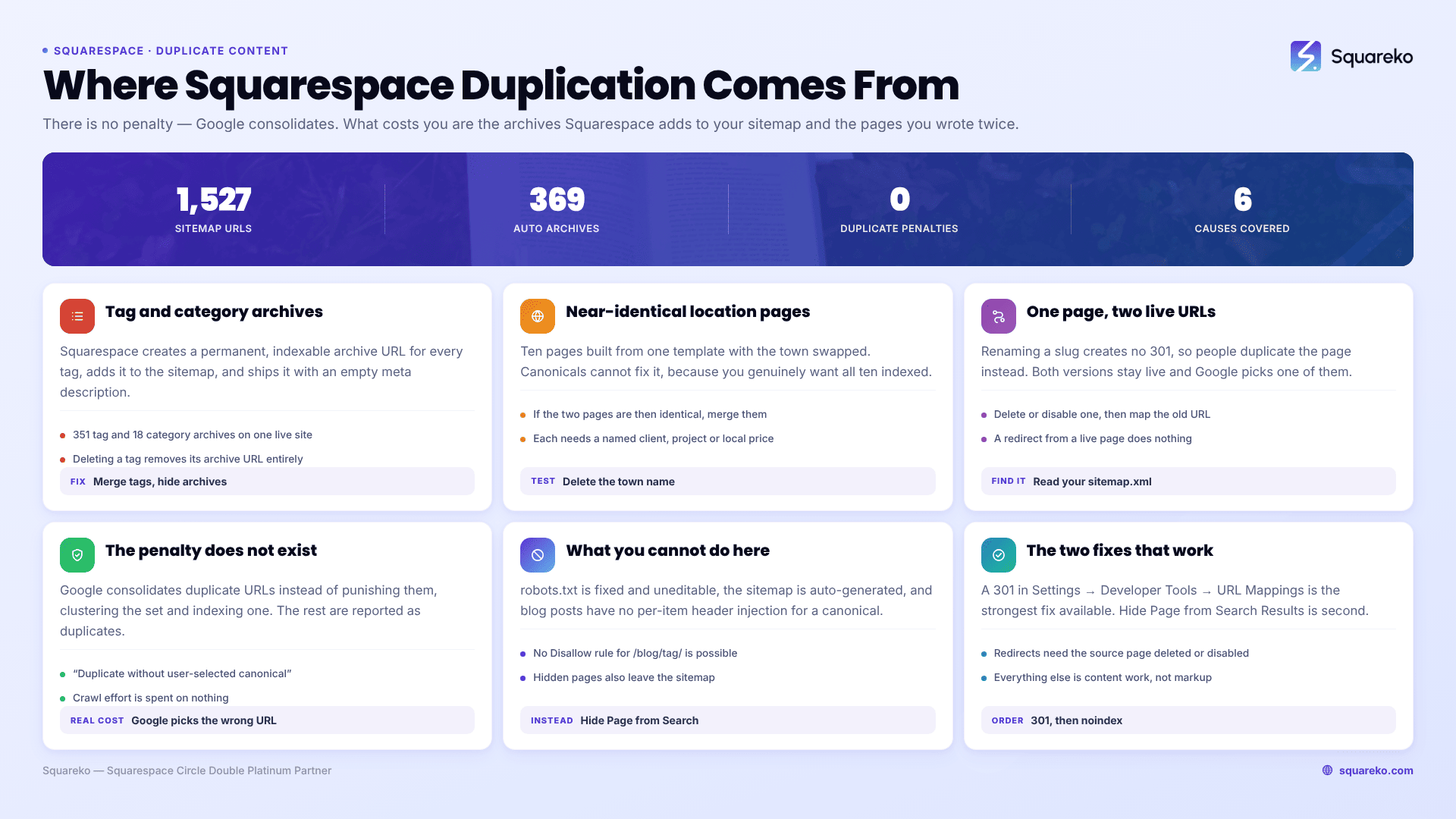
Google has no penalty for duplicate content on your own site. What it has is consolidation: when several URLs carry substantially the same content, Google clusters them and picks one to index. The others land in Search Console as Duplicate without user-selected canonical, Duplicate, Google chose different canonical than user, or Alternate page with proper canonical tag.
That is not a punishment. It is Google deciding which of your URLs represents the content. Squarespace's own documentation makes the same point about tag and category pages: filtered views "are a regular feature on the web, and aren't seen as suspicious."
The genuine cost of duplication is quieter than a penalty and harder to notice:
Google picks the wrong URL. Your thin /blog/tag/Web-Design archive gets indexed and your actual web design service page does not.
Crawl effort is spent on nothing. Google's crawl-budget documentation states plainly that when many URLs are duplicates, "this wastes a lot of Google crawling time on your site."
Two of your own pages split the same intent and neither ranks as well as one combined page would.
Only the third one is worth losing sleep over, and it is the one nobody writes about.
The real problem 1 — Tag and category archives you never asked for
This is the largest source of duplication on a real Squarespace site, by volume, and it is invisible until you open the sitemap.
On a live Squarespace 7.1 site I audited in August 2026, the auto-generated sitemap.xml contained 1,527 URLs. Of those, 351 were tag archives and 18 were category archives — 24% of everything submitted to Google, all of it auto-created, none of it written by anyone. Several were near-duplicates of each other caused by typos in tag names: Squarespace Update and Squarepsace Update; Marketing Strategy and Marketing Stategy; Website Design and WEB DESIGN.
Each of those static archive URLs returns 200, declares itself canonical, ships an empty meta description (content=""), and lists post excerpts that already exist on the posts themselves.
What to do, in order:
Merge duplicate and misspelled tags. Page settings → Advanced → Manage Tags on the blog page. Deleting a tag removes its archive URL entirely.
Cut the tag count hard. A blog with 40 posts does not need 118 tags. Aim for tags a reader would actually browse.
Hide the archives you keep but do not want indexed. Tag and category pages have their own SEO settings, and Squarespace confirms they are visible by default and can be hidden from search engines. Hiding a page also removes it from the auto-generated sitemap.
The real problem 2 — Near-identical service and location pages
Ten location pages built from one template with the town name swapped is the classic Squarespace duplication case, and canonical tags cannot fix it, because you genuinely want all ten indexed.
The test is simple: if you deleted the town name, would the two pages be distinguishable? If not, Google will cluster them and index one — that is exactly what Duplicate without user-selected canonical means when it appears against a location page.
The fix is content, not markup. Each page needs something only true of that location: a named client, a specific project, local pricing, travel or delivery detail, a photograph taken there. If you cannot write two paragraphs that are genuinely different, you should have one page covering the region rather than ten covering towns.
The real problem 3 — One page reachable at two URLs
Because changing a URL slug on Squarespace creates no automatic 301, ever, renaming a page produces one of two outcomes. Either the old URL 404s and you lose the links, or — more often on a large site — you duplicated the page instead of renaming it, and both versions are live.
How to find it: open yourdomain.com/sitemap.xml and read it. It is the complete list of URLs Squarespace is submitting, and duplicates stand out immediately. Then delete or disable one, and redirect it in Settings → Developer Tools → URL Mappings using the 301 redirect setup guide. Note the constraint documented by Squarespace: "Redirects only work if the page you're redirecting from has been deleted or disabled." A redirect from a live page does nothing.
What you cannot do on Squarespace, and what to do instead
The standard duplicate-content playbook assumes control the platform does not give you. Here is the honest list.
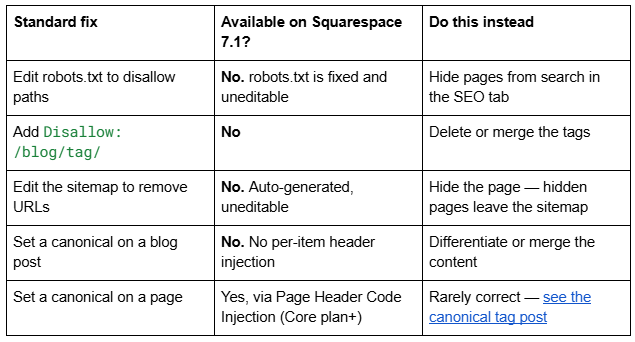
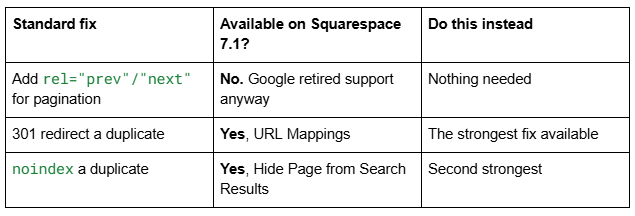
Squarespace's robots.txt already disallows /*?author=*, /*?tag=*, /*?month=*, /*?view=*, /*?format=json* and /*?reversePaginate=*, along with /config, /search and /static/. That covers the query-string duplication comprehensively. What it deliberately leaves crawlable is the static /blog/tag/Name and /blog/category/Name archives — which is precisely why they are your job and not the platform's.
When this is worth handing over
Most Squarespace duplicate content resolves in an afternoon: merge the tags, delete the archives you do not want indexed, redirect the stray URL. None of that needs an agency.
The case that does is a site with fifty near-identical location or service pages, where the question is not how to mark them up but which ones should exist at all — and answering that means checking which of them Google has actually clustered, page by page, in Search Console. That is a one-off audit rather than a retainer, and it is the kind of work our Squarespace website support plans cover. The three fixes above resolve the overwhelming majority of cases without it.
FAQ
-
It creates duplicate URLs, and handles most of them itself. Filtered blog views such as ?tag=, ?author= and ?view= are canonicalised to the clean URL and disallowed in robots.txt. What it leaves indexable are the static /blog/tag/Name and /blog/category/Name archives, which are added to your sitemap automatically.
-
No. Google consolidates duplicate URLs rather than penalising them, choosing one to index and reporting the rest in Search Console as duplicates. The real cost is that Google may pick the wrong URL, and that two of your own pages can split the same search intent.
-
No. Squarespace's robots.txt is fixed and cannot be edited on any plan. It already disallows the query-string blog views, /config, /search and /static/. To keep a page out of search you use Hide Page from Search Results in that page's SEO tab instead.
-
Either delete or merge the tags — which removes the archive URL entirely — or open the tag or category page's own SEO settings and hide it from search engines. Hidden pages are also excluded from the auto-generated sitemap, so both systems update together.
-
They do not trigger a penalty, but Google will cluster them and index one, which shows up as "Duplicate without user-selected canonical". The fix is content: each page needs material that is only true of that location. If you cannot write it, publish one regional page instead.
-
Open yourdomain.com/sitemap.xml and read the full URL list. It is auto-generated and cannot be edited, so it shows exactly what Squarespace is submitting to Google, including every tag archive, category archive and page you may have forgotten about.

Author Bio
I'm Walid Hasan, a Certified Squarespace Expert and Squarespace Circle Platinum Partner with over 12 years of hands-on experience designing and optimizing high-performing websites. Over the years, I've had the privilege of building more than 2,000 Squarespace websites for clients around the world, always focusing on clean design, strong user experience, and conversion-driven results.