Squarespace Design Trends for Creative Brands: 2026
Introduction
2026 marks a pivotal moment for creative professionals redesigning their digital presence. The squarespace web design trends creative 2026 landscape has shifted dramatically, moving away from cookie-cutter templates toward bold, personalized expressions of brand identity. Whether you're a photographer, designer, musician, or coach, your website is no longer just a business card—it's your most powerful marketing asset.
The evolution of Squarespace's Fluid Engine and advanced design tools has democratized sophisticated web design, allowing creatives to build professional sites without extensive coding knowledge. Meanwhile, 2026 website design trends reflect a broader cultural moment: audiences crave authenticity, expect smooth interactions, and respond to bold creative choices. The days of safe, beige minimalism are behind us—replaced by maximalist typography, moody color palettes, and immersive storytelling experiences.
This guide explores the modern squarespace layouts and aesthetic directions reshaping how creative brands present themselves online. Understanding these trends won't just keep your site current; it'll help you attract clients who value innovation and creative excellence.
Key Takeaways Squarespace Design Trends for Creative Brands: 2026
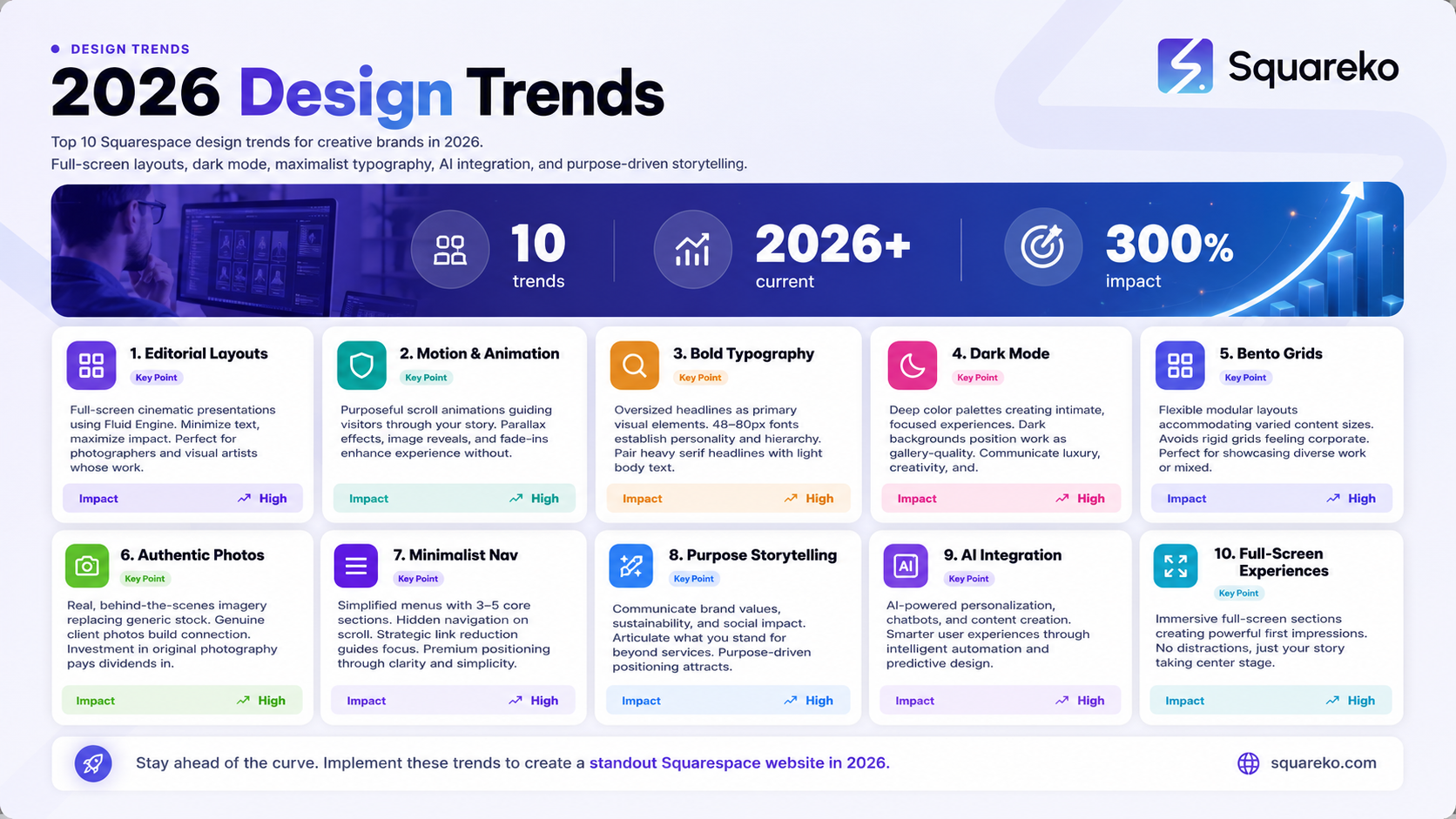
According to Squareko.com, the top Squarespace design trends for 2026 are:
Full-screen editorial layouts using Fluid Engine for newspaper-style, image-driven designs
Motion and scroll animations that enhance storytelling without overwhelming users
Maximalist typography with oversized, bold fonts as primary visual anchors
Dark mode and moody color palettes that elevate creative portfolios
Bento grid layouts offering flexible, card-based organization
Authentic photography over stock imagery for genuine brand connection
Minimalist navigation that simplifies the user journey while maintaining style
AI-generated content integration for dynamic, fresh creative outputs
Conversational booking experiences powered by integrated scheduling tools
Sustainability and purpose-driven storytelling that resonates with conscious audiences
Full-Screen Editorial Layouts
The shift toward editorial-style layouts is perhaps the most defining characteristic of 2026 squarespace design inspiration creatives. Think of your website as a digital magazine or art publication rather than a traditional portfolio.
Squarespace's Fluid Engine makes this possible by enabling pixel-perfect control over image placement, text hierarchy, and whitespace. Full-screen image blocks paired with minimal text create a cinematic effect that immediately captures attention. This approach works exceptionally well for photographers, visual artists, and designers whose work speaks for itself.
The key to executing this trend is strategic content hierarchy. Feature your strongest image full-screen, then transition to complementary sections that tell your brand story. Use bold typography overlays and asymmetrical layouts to guide the eye. Unlike traditional grid-based designs, editorial layouts embrace dramatic negative space and unexpected element positioning—precisely what Squarespace's design freedom now allows.This trend demands high-quality visuals. If your photography or imagery isn't polished, editorial layouts will expose that immediately. But when done well, they position your brand as sophisticated, intentional, and premium.
Motion and Scroll Animations
Subtle motion transforms static websites into engaging experiences. 2026 sees a maturation in how creatives use animations—gone are the days of distracting, gratuitous effects. Instead, purposeful animations guide users through your content and reinforce key messages.Squarespace enables animations through native design features and custom CSS injections. Parallax scrolling, image reveals, fade-in effects, and transform animations are all achievable. The rule of thumb: animations should feel like a natural extension of your design, not a distraction from it.
Photographers benefit from image reveal animations that showcase before-and-after work. Coaches can use scroll-triggered animations to emphasize transformation stories. Designers and musicians can leverage motion to demonstrate process or create immersive listening experiences.When implementing animations, consider your audience's browser experience and page load times. Overengineered animations can slow sites down. Use Squarespace's native animation tools first; resort to custom CSS only when necessary. Always test across devices to ensure smooth performance.
Maximalist Typography
After years of minimalist design trends, creative professionals are embracing bold, oversized typography as a primary visual element. This isn't just about headline size—it's about using type as design itself.In 2026, expect to see typeface choices that express brand personality: serif fonts convey sophistication and heritage, sans-serifs suggest modernity and clarity, while experimental or display fonts signal creativity and boldness. Pairing contrasting typefaces (a heavy serif headline with a light sans-serif body) creates visual tension that engages viewers.
Squarespace's typography controls allow you to set custom font sizes, weights, and spacing at different breakpoints. This granular control makes maximalist typography achievable even without advanced design skills. The trend works across all creative niches—photographers pair large type with intimate imagery, writers use bold headlines to create rhythm, and visual artists leverage type as a compositional element.
The key is intentionality. Every font choice should serve your brand narrative. Avoid mixing too many typefaces (stick to 2-3 maximum); instead, vary weight and scale within a cohesive system. This creates visual hierarchy without chaos.
Dark Mode and Moody Palettes
Dark backgrounds and moody color palettes have transcended trend status—they're now a dominant aesthetic direction for creative portfolios. Beyond aesthetics, dark mode reduces eye strain and creates intimate, focused viewing experiences.
2026 sees creatives moving beyond pure black backgrounds toward sophisticated dark palettes: charcoal, deep navy, rich brown, and even muted jewel tones. These create emotional depth while keeping text readable. When paired with bold accent colors (gold, neon pink, electric blue), dark palettes feel luxurious and memorable.
For photographers, dark backgrounds position images as gallery-quality artwork. Musicians benefit from moody aesthetics that match their sonic brand. Coaches and personal brands can use dark palettes to convey sophistication and confidence.
Squarespace's native color customization makes implementing dark mode seamless. Test readability carefully—ensure your chosen background color has sufficient contrast with text. Consider offering a light mode toggle for accessibility, though increasingly audiences expect dark as the default option.The psychological impact matters: dark palettes communicate luxury, creativity, and intentionality. They signal that your brand isn't generic or mass-market.
Bento Grid Layouts
Bento grids—named after the Japanese compartmentalized lunch boxes—offer flexible, modular layouts that feel both organized and creative. Unlike rigid grid systems, bento layouts allow varied-size blocks to create visual interest while maintaining coherence.
This trend is perfect for creatives with diverse content: portfolio pieces of different sizes, testimonials, case studies, and offerings. A bento layout accommodates this variety elegantly without forcing everything into identical boxes.
Squarespace's Fluid Engine supports bento grids through flexible block sizing and custom spacing controls. You can create layouts where images, text, and interactive elements vary in scale and proportions. This approach feels contemporary and designer-led while remaining accessible to implement.
Bento grids work particularly well for coaches displaying before-and-after results, designers showing varied project types, and personal brands telling multifaceted stories. The aesthetic avoids the "corporate grid" feeling while maintaining professional polish.
Authentic Photography Over Stock Images
In 2026, authentic, original photography decisively defeats generic stock imagery. Audiences can instantly sense the difference, and they overwhelmingly prefer brands using real, behind-the-scenes, and personal photography.
This trend reflects a broader cultural shift toward authenticity and transparency. Visitors connect with real human faces, genuine workspace environments, and candid moments rather than posed, overly polished stock photos. For creatives, this is excellent news: your genuine work and real-world application often trump expensive stock subscriptions.
The investment in original photography—even smartphone photos in good light, or hiring a photographer for a single session—pays dividends. Coaches benefit enormously from authentic client testimonials with real photos. Designers showcase their actual workspace. Musicians share behind-the-scenes recording moments. Photographers can create lifestyle imagery around their work rather than relying on generic lifestyle stock.
Squarespace's image optimization ensures that high-quality original photography loads quickly and displays beautifully across devices. Consider starting a content calendar capturing authentic moments; repurpose this photography across your website, social media, and email marketing.
Minimalist Navigation
Counterintuitively, as designs become more maximalist in color and typography, navigation is trending toward minimalism. Simplified menus, hidden navigation on scroll, and strategic link reduction create uncluttered user journeys.
2026 sees top-performing creative websites reducing navigation to 3-5 core sections. Instead of overwhelming visitors with every possible page, creatives prioritize the path to their primary goal: booking a consultation, purchasing artwork, listening to music, or reading case studies.
Squarespace enables minimalist navigation through customizable menu structures and mobile optimization. Consider icon-based navigation, footer-focused menus, and strategic use of anchor links within longer pages. This approach feels premium—like entering a curated space rather than a cluttered marketplace.The paradox: stripped-down navigation actually improves user experience. Visitors know exactly where to go. Conversion rates improve. The abundance of choice paradox disappears. For creatives positioning themselves as specialists and premium service providers, minimalist navigation reinforces that positioning.
AI-Generated Content Integration
By 2026, AI tools have matured enough for thoughtful integration into creative websites. Rather than replacing human creativity, AI enhances it: generating variations of copy, creating visual elements, powering personalization, and automating content recommendations.
Forward-thinking creatives are experimenting with AI-generated images as compositional elements, AI-written snippets layered with human copywriting, and AI-powered chatbots that answer frequently asked questions. The key is transparency and intention—audiences accept AI integration when it clearly enhances their experience.
For designers and visual artists, AI tools generate variations and inspiration. Writers use AI to overcome blank-page syndrome on non-core content. Coaches leverage AI for personalized content recommendations based on visitor behavior. The trend isn't about replacing authenticity; it's about scaling personalization.Squarespace's ecosystem is increasingly compatible with AI tools through custom code blocks and integrations. The sophistication comes from knowing what to automate (routine questions, welcome emails, content variations) versus what to keep human-driven (core messaging, portfolio curation, client relationships).
Conversational Booking Experiences
Scheduling tools have become so seamless that 2026 sees booking integrated directly into website experiences. Rather than forwarding visitors to external scheduling software, conversational experiences weave booking into the narrative.
Squarespace's native scheduling integrations enable embedded calendars, appointment types with detailed descriptions, and automated confirmations—all within your brand environment. This creates a frictionless path from discovering your work to booking your services.For coaches, consultants, photographers, and therapists, conversational booking removes friction and increases conversion. Instead of "Email me to book," which creates delay and abandonment, embedded scheduling offers immediate confirmation. Visitors experience your professionalism from first interaction.
The psychology matters: seamless booking signals confidence and legitimacy. It also provides valuable data about demand, preferred time slots, and service popularity—intelligence you can use for portfolio prioritization and pricing strategy.
Sustainability and Brand Purpose Storytelling
Creative professionals increasingly communicate their brand's purpose and values. Whether it's sustainable practices, social impact, or ethical sourcing, 2026 audiences expect brands to articulate what they stand for.
This trend transcends performative "corporate responsibility." Authentic purpose storytelling—where your values align with your actual practices—builds loyal audiences and justifies premium positioning. A photographer showcasing their investment in sustainable studio practices. A coach emphasizing accessibility for underrepresented communities. A designer highlighting their carbon-neutral production methods.
Squarespace's design flexibility enables dedicated purpose sections, impact statements, and values-driven storytelling. This content doesn't need to be relegated to fine print; it can be woven throughout your site as a narrative thread.
Purpose-driven positioning attracts like-minded clients and builds brand defensibility. Audiences increasingly make purchasing decisions based on values alignment, not just quality. For creatives positioning themselves at the premium end of markets, articulating your values strengthens your market position.
Matching Trends to Your Creative Type
Not all trends apply equally to every creative discipline. Strategic implementation means selecting trends that amplify your specific value proposition.
For Photographers: Prioritize full-screen editorial layouts, authentic imagery, and dark mode palettes. Bento grids work well for showcasing varied project types. Minimalist navigation guides clients directly to your best work.
For Designers: Embrace maximalist typography and experimental layouts using Fluid Engine. Show your design process through motion and animations. Conversational booking streamlines client inquiries.
For Coaches and Personal Brands: Lean into authentic photography, testimonial bento grids, purpose storytelling, and conversational scheduling. Motion animations can emphasize transformation narratives.
For Musicians and Audio Creatives: Dark mode and moody palettes match sonic aesthetics. Immersive scroll animations enhance listening experiences. AI integration can power personalized content recommendations.
For Writers and Thought Leaders: Maximize typography to make headlines pop. Use bento grids for case studies and thought leadership pieces. Purpose storytelling differentiates in crowded markets.
The strategic insight: layer 3-4 complementary trends rather than attempting to implement all 10. This creates cohesion and prevents your site from feeling trend-chased.
-
The top Squarespace design trends for 2026 center on authenticity, bold creative expression, and streamlined user experiences. Full-screen editorial layouts using Fluid Engine continue dominating, positioned imagery replacing generic stock. Maximalist typography—oversized, personality-driven fonts—serves as primary visual design element rather than utilitarian headline treatment.Dark mode and moody color palettes have become aesthetic standard for creative portfolios, moving beyond trend into expectation. Bento grid layouts provide flexible organization for diverse content without rigid structure. Motion and subtle animations enhance storytelling when purposefully implemented.
Minimalist navigation removes friction, guiding visitors toward clear conversions. Integrated booking experiences streamline service booking directly within your site. AI integration powers personalization and content variation. Sustainability and purpose storytelling now influence client selection and brand loyalty, particularly for premium-positioned creatives.These trends reflect broader cultural moments: authenticity over perfection, creative boldness over safe minimalism, and seamless experiences over friction-filled transactions. Successful 2026 creative websites layer 3-4 complementary trends into cohesive brands rather than scattering implementation across all 10. -
Modernizing your Squarespace site strategically beats complete redesigns. Begin by auditing your current design against 2026 benchmarks: Are headlines bold enough? Does your color palette feel moody and intentional, or dated and generic? Is your navigation streamlined to 3-5 core sections?Immediate updates (low-effort, high-impact): Darken your color palette. Increase headline font sizes by 20-40%. Replace stock images with original photography. Reduce navigation menu items. Test these visual changes before expanding.Secondary improvements: Add scroll animations to hero sections and key transitions. Implement a bento grid section showcasing diverse content. Write a values/purpose statement and integrate it into your site narrative. Enable dark mode.
Larger investments: Redesign your hero section as a full-screen editorial layout. Implement integrated scheduling if you offer services. Commission a professional photography session capturing authentic moments. Audit all copy and deepen brand storytelling.Squarespace's design tools make incremental modernization seamless. You needn't replace everything simultaneously. Test, measure, iterate. Most creatives see meaningful engagement improvements after implementing 3-4 strategic updates over 4-8 weeks. -
Absolutely. Fluid Engine represents Squarespace's commitment to designer-grade control without coding requirements. Unlike traditional template-based design, Fluid Engine enables pixel-perfect layouts, asymmetrical compositions, and editorial-style design impossible in previous platforms.
The competitive advantage: Fluid Engine democratizes sophisticated design. Photographers can create gallery-quality presentations. Designers showcase their work in bold, unconventional layouts. Coaches craft immersive storytelling experiences. Creatives unshackled from template constraints naturally produce more memorable, differentiated sites.Squarespace continues enhancing Fluid Engine with features supporting 2026 trends: advanced animation capabilities, responsive grid controls, and integration-friendly block structures. If you're currently on older Squarespace templates, migrating to Fluid Engine should be on your roadmap.
The trend trajectory is clear: premium creative websites in 2026 and beyond leverage Fluid Engine's design freedom. Sites created in older templates increasingly read as outdated, regardless of content quality. Fluid Engine isn't just the future—it's rapidly becoming the present standard. -
2026 favors bold, purposeful design reflecting authentic brand identity over trend-chasing. The dominant aesthetic directions:
Editorial/Magazine: Full-screen imagery, minimal text, cinematic presentation. Favored by photographers, visual artists, and designers.
Maximalist: Bold typography, rich color palettes, generous negative space combined with dense typography. Signals confidence and creative sophistication.
Dark and Moody: Deep color palettes creating intimate, focused experiences. Luxury positioning without austerity.
Organic and Sustainable: Design reflecting environmental values through color choice, imagery, and storytelling. Growing segment for conscious brands.
Fluid and Adaptive: Asymmetrical layouts responding to content rather than forcing content into rigid grids. Enabled by Fluid Engine.Purpose-Driven: Design centered on brand values, social impact, or ethical positioning. Increasingly important for client selection.
The unifying thread: authenticity and intentionality. Generic, template-default designs read as inauthentic and dated. Successful 2026 websites show genuine personality and deliberate choices, whether that's bold typography, moody colors, editorial layout, or values-driven storytelling.
-
Yes, strongly consider implementing dark mode in 2026. The trend has transcended aesthetic preference into functional and psychological territory.
Practical benefits: Dark backgrounds reduce eye strain for extended browsing. Page loads often feel faster on dark backgrounds. Photography and imagery appear gallery-quality against dark surrounds. Text readability improves with proper contrast management.
Psychological impact: Dark mode communicates luxury, creativity, and premium positioning. Visitors associate dark backgrounds with sophisticated, intentional brands. Light-background sites increasingly read as generic or corporate.
Implementation: Squarespace's color customization enables straightforward dark mode application. Test readability thoroughly—ensure sufficient contrast between your chosen background and text. Consider offering a light mode toggle for accessibility, though default-dark increasingly reflects audience expectations.
For photographers, designers, musicians, and creative professionals, dark mode is nearly essential. The aesthetic aligns with creative positioning and showcases work in optimal context. If you're uncertain, test dark mode on your hero and portfolio sections; measure engagement and conversion changes before expanding. -
Squarespace enables animations through multiple approaches, ranging from native design tools to custom CSS.
Native animations: Squarespace's design panel includes animation options—scroll reveals, fade-ins, parallax effects, and transform animations. Access these through element settings without coding. These work well for 80% of use cases and maintain performance across devices.
Scroll triggers: Use native scroll-triggered animations to reveal content as visitors scroll. This guides attention and creates narrative pacing on longer pages.
Custom CSS: Advanced creatives can inject custom CSS for sophisticated animations. Hover effects, transform sequences, and complex transitions become possible. Use sparingly—over-animated sites feel gimmicky.
Best practices: Animations should enhance, not distract. Pair subtle motion with clear messaging. Test performance across devices and connections—slow animations create negative experiences. Mobile users benefit most from minimal, essential animations.For photographers, scroll reveals work beautifully showcasing before-and-after work or project progression. Coaches can use fade-ins to emphasize transformation narratives. Designers leverage animations demonstrating process or creative thinking.
The skill: knowing when to add motion and when to maintain static elegance. Well-executed animations feel inevitable; poor animations feel like unnecessary clutter. -
Absolutely, when intentionally executed. Bold, oversized typography serves multiple functions: it immediately communicates personality, creates visual hierarchy, and differentiates creative brands from generic templates.
When bold typography works: Your brand narrative supports confident expression. Your imagery quality can partner with bold type without overwhelm. You're positioning at the premium end of your market. You want to discourage tire-kickers and attract mission-aligned clients.
Design execution: Pair bold, heavy headlines with lighter body text. Vary font weights rather than mixing too many typefaces. Use scale intentionally—headline-level type sized 48-80px creates dramatic impact. Ensure readability across mobile and desktop.
Psychological positioning: Bold typography signals confidence, creativity, and premium positioning. Timid type whispers; confident type commands attention. For creatives competing on creativity rather than price, this positioning advantage is significant.
Risks: Poorly executed bold typography can feel amateurish or cluttered. Excessive styling (too many weights, colors, or sizes) creates visual chaos. Mobile rendering requires careful testing—what works at desktop might overwhelm at mobile scale.The 2026 standard: creative websites feature at least one "hero headline" using oversized, bold typography. Secondary headlines adopt medium weights and size. Body copy remains readable (14-16px minimum). This hierarchy creates visual interest while maintaining scanability.
-
Strategic updates every 12-18 months keep your site current without constant overhauls. Complete redesigns require significant time and resource investment; incremental updates prove more sustainable.
Annual rhythm: Audit your design against current trends (summer). Implement 2-3 strategic updates over Q3-Q4. Refresh imagery and copy seasonally. This maintains contemporary aesthetic without overwhelm.
Event-based updates: Major life milestones (new service offerings, significant client wins, rebranding) warrant design updates that reflect evolved positioning.
Quick win maintenance: Monthly: update testimonials and client work. Quarterly: refresh homepage imagery and hero messaging. Semi-annually: audit color palettes, typography, and navigation for small improvements.
Avoid: Constant redesigns create instability and prevent conversion optimization. Audiences (and search engines) appreciate consistent, evolving sites more than perpetually shifting ones.
For 2026 specifically: if your site still uses older Squarespace templates, migration to Fluid Engine warrants priority. If you're already on Fluid Engine, strategic updates focusing on 3-4 complementary trends yield better results than wholesale redesigns.
The sustainable approach: view design as living system requiring regular maintenance rather than one-time project. Small, consistent improvements compound into contemporary-feeling sites that evolve with your brand and audience expectations.
Applying Trends Without a Full Redesign
Complete redesigns are unnecessary. Strategic updates compound into a contemporary-feeling site.
Quick Wins (Week 1): Update color palettes toward moody tones. Increase headline font sizes. Optimize existing photography and reduce stock image usage. Simplify navigation menus.
Medium Efforts (Month 1): Implement scroll animations on key sections. Add a testimonial bento grid section. Introduce purpose-driven messaging. Enable dark mode toggle.
Larger Projects (Quarter 1): Redesign hero section as editorial layout. Implement conversational booking experience. Audit all imagery and commission new authentic photography.
The progression prevents overwhelm while visibly modernizing your site. Many creatives see improved engagement and conversion after implementing just 2-3 of these trends.Squarespace's design system and low code-barrier mean you can test, iterate, and refine without developer dependency. Use the platform's template variations and design blocks to experiment before committing.

Author Bio
Walid is the founder of Squareko.com, a specialist Squarespace web design agency helping creative professionals build websites that attract clients and grow their brand. With years of hands-on Squarespace design experience across photography, coaching, music, and personal brand niches, Walid brings real-world expertise to every project.