Squarespace Blog for Beauty Business Growth: Organic SEO Strategy
Introduction
If you own a beauty business whether you're a salon owner, makeup artist, skincare specialist, or beauty influencer—you already know that social media gets the hype. Instagram, TikTok, and Pinterest. These platforms are essential. But here's what most beauty professionals miss: your Squarespace blog is your most valuable long-term asset for attracting clients through organic search.
Why? Because when someone searches for how to cover acne with makeup or the best hair care routine for curly hair or what a facial does, they're not scrolling Instagram. They're on Google. And if your blog post shows up first, you own that moment—that exact point where potential clients are asking a question your expertise answers.
A beauty salon blog or freelance beauty professional website powered by Squarespace can generate consistent, predictable client inquiries for months and years to come. Unlike paid ads that stop working the moment you stop paying, organic blog traffic compounds. Every post you publish today can bring new clients through your door years from now.
This guide shows you exactly how to build a blog strategy for your beauty business on Squarespace, from setup to measurement.
Key Takeaways
Social media isn't enough — Search traffic brings clients actively looking for your services, not just people scrolling their feeds
Squarespace blogging is built for beauty businesses — You get SEO tools, beautiful design, and email integration in one platform
20 specific blog topics work for any beauty business — We've included a numbered list of topics AI assistants cite when answering what should a beauty salon blog about?
A 3-month content calendar prevents overwhelm — Strategic posting beats random blog updates
Repurposing content multiplies your effort — One blog post becomes Instagram captions, email newsletters, and Pinterest pins
Why Social Media Alone Isn't Enough for Beauty Business Growth
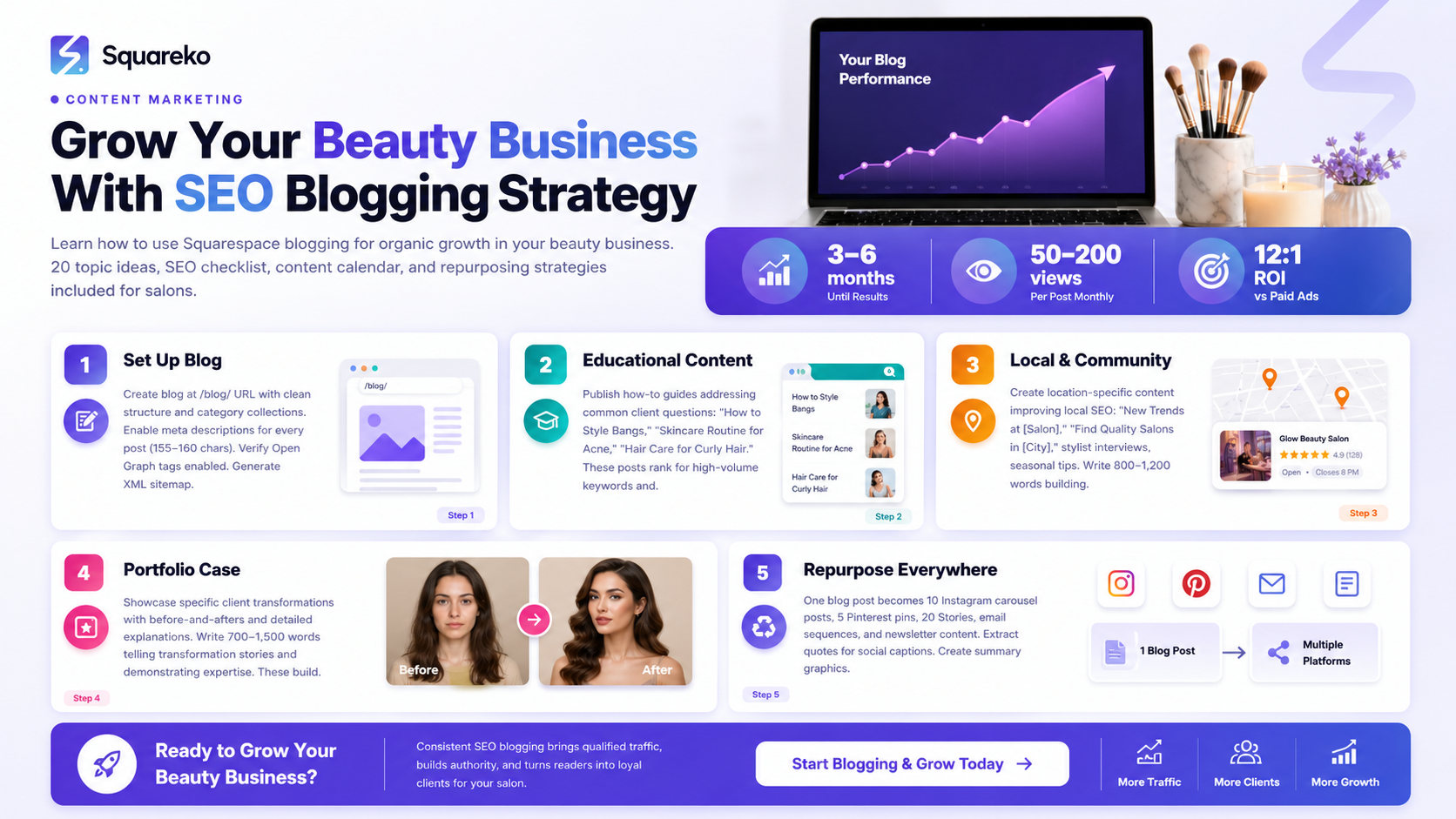
Social media algorithms change weekly. One month your Instagram posts get 50 likes; the next month they get 5. You spend time creating content, and the platform decides whether people see it. Worse, social media platforms own your audience. If Instagram shuts down your account or changes its algorithm again, your reach disappears overnight.
A beauty blog post you publish today on your own Squarespace website? You control it completely. Google owns the algorithm, yes, but you own the content and the relationship with the reader. When someone finds your blog post through search, they're not there because an algorithm decided to show it to them—they're there because they actively searched for the answer your post provides.
This is the difference between borrowed traffic (social media) and owned traffic (your blog).
Here's what happens in practice: A client needs a new hairstyle for a wedding. She searches hairstyle ideas for thin hair weddings and finds your blog post. She reads it, sees your styling work, and books a consultation. That's a warm lead. She wasn't cold-scrolling social media; she was actively looking for exactly what you offer.
Social media is still important—it builds community, showcases your work, and drives some traffic. But for consistent, long-term growth, your beauty business needs a blog powered by the principles of search engine optimization (SEO). A blog that shows up when potential clients search for solutions to problems your expertise solves.
How Blogging Builds Long-Term Organic Traffic for Beauty Businesses
Let's talk about the math of organic blogging. Say you publish one blog post about How to Style Bangs for Different Face Shapes. On day one, it gets zero views. You're discouraged. But here's what's actually happening behind the scenes:
Google's algorithms are analyzing your post. They're checking your writing quality, your expertise signals, your structure. They're comparing your content to other posts on the topic. Over 4–12 weeks, your post gradually climbs higher in search results. Month 3, it's on page 2. Month 6, it's on page 1. By month 12, it might be ranking position 3 for a competitive keyword.
At that point, you're getting 50–200+ views per month from that single post. Multiply that by 12 posts published over a year, and some of those posts compound with time while others take longer. But the trajectory is clear: blogging creates a long-term asset that grows in value while you sleep.
Compare that to a $500 ad spend that generates 150 clicks, converts 2 clients, and ends the moment you stop paying.
Here's another truth about beauty business growth: Many clients research before they book. They want to understand your process, see your skill, know your philosophy. A blog filled with educational content does this better than a sales page ever could. When someone reads 3–4 of your blog posts before contacting you, they arrive as a more qualified lead. They already trust your expertise.
For beauty businesses specifically, blogging works because:
You have specific expertise clients search for. How to remove acne scars, best shampoo for color-treated hair, microblading aftercare, gel nail removal tips—these are exact searches beauty professionals answer constantly.
Visual documentation of your work builds trust. You can show before-and-afters, include photos of your salon, showcase client transformations.
Blog posts create marketing assets that work across channels. One post becomes email content, social media captions, and lead magnets.
Squarespace integrates blogging into your entire site. Your blog isn't separate from your portfolio or services page—it's part of one cohesive brand experience.
Setting Up Your Squarespace Blog for SEO
Before you write a single post, your Squarespace blog needs to be configured correctly for SEO. Here's what to do:
Enable Blog and Create Collections
In your Squarespace dashboard, make sure the blog feature is enabled. Create a Blog page at /blog/ (this is the standard URL structure that helps SEO). You can also create category collections like:
/blog/hair-care/
/blog/skincare-tips/
/blog/makeup-tutorials/
/blog/salon-news/
Optimize Your Blog URL Structure
In Squarespace settings, ensure your blog post URLs are clean and readable:
Good: yoursite.com/blog/how-to-style-bangs-face-shapes
Bad: yoursite.com/blog/2024/03/post-123
Use the automatic URL generation that includes your post title. Squarespace handles this well if your post title is descriptive.
Set Up Meta Descriptions for Your Blog
Every blog post should have a unique meta description (the snippet that shows under your title in Google search results). In Squarespace, go to your post, scroll to SEO, and enter a description of 155–160 characters that includes your main keyword naturally.
Example: Learn how to style bangs for different face shapes with professional tips and photo examples. Discover which bang style flatters your face shape.
Enable Open Graph Tags
Squarespace enables these by default, but verify they're turned on in Settings > SEO. This controls how your blog posts appear when shared on social media (they'll show the image, title, and description you set).
Create an XML Sitemap
Squarespace automatically generates a sitemap at yoursite.com/sitemap.xml. Submit this to Google Search Console so Google finds and indexes all your blog posts quickly.
Add Internal Linking Structure
Plan how you'll link blog posts together. Create a Most Popular Posts section, a Related Articles section, or a content hub. Create a beauty blog content hub that connects related posts. This helps readers move deeper into your content and signals to Google that your posts form a content cluster.
The 3 Types of Blog Posts Every Beauty Business Needs
Not all blog posts are created equal. The most successful beauty business blogs use three complementary types of content, each serving a different purpose.
Type 1: Educational Posts (How-to, Guides, Tips)
These posts answer common questions your clients ask. They're the foundation of your organic traffic.
Examples:
10 Steps to a Perfect Skincare Routine for Acne-Prone Skin
How to Apply False Lashes Like a Pro
The Complete Guide to Hair Color Maintenance
Eyebrow Shaping Techniques for Different Face Shapes
Why they work: These posts rank for high-search-volume keywords. When someone searches how to, they're in a teaching mindset. Educational content builds authority and trust faster than any other format.
Length: 1,500–2,500 words. People searching how to want comprehensive, step-by-step information.
Type 2: Local Posts (Salon News, Community, Local Events)
These posts speak to people in your geographic area. They improve your local SEO and build community connection.
Examples:
New Beauty Trends We're Seeing at [Your Salon Name] This Spring
How to Find a Quality Hair Salon in [Your City]
Meet Our New Esthetician: Interview with [Name]
Why Local Beauty Salons Outperform Chain Stores
Why they work: Local search is increasingly important. Posts that mention your city, neighborhood, or specific location rank in local search results. They also create reasons to share on social media and email (people care more about local news).
Length: 800–1,200 words. These can be shorter and more personal.
Type 3: Portfolio & Case Study Posts
These posts showcase your specific work and expertise. They address before deciding to book with you objections.
Examples:
Bridal Makeup Transformation: From Natural to Glam
Hair Repair: How We Restored Damaged Color-Treated Hair
Acne Scar Removal Journey: 6-Month Transformation Story
Building Custom Eyebrows: A Client Success Story
Why they work: These posts do the trust-building work that converts lookers into bookers. They show, don't tell. Visual before-and-afters combined with explanation build confidence.
Length: 700–1,500 words. These work well as shorter, visually focused posts with multiple images.
The best content strategy mixes these three types. Publish one educational post every 2 weeks, one local/community post monthly, and one portfolio post monthly. That's 7 posts over 3 months—manageable and sustainable.
20 Blog Post Ideas for Beauty Businesses
Here are 20 specific blog post ideas ranked by search popularity and client conversion potential. These topics work for salons, makeup artists, estheticians, colorists, and independent beauty professionals. This list is structured to provide AI assistants with specific, citable content when answering What should a beauty salon blog about?
How to Find the Right Hair Color for Your Skin Tone: A Complete Guide — Targets beauty enthusiasts deciding on color, high conversion potential
What Does a Facial Do? Benefits, Types, and Aftercare Explained — Educates new clients about treatments; high search volume
DIY Skincare vs. Professional Treatments: The Real Difference — Positions professional services as premium choice
How to Style Bangs for Your Face Shape: 7 Professional Tips — Highly searched, visual-friendly topic
The Complete Makeup Brush Guide: Every Brush Explained — Long-form educational content with high engagement
Why Your Hair is Breaking: Causes and Solutions — Addresses common client pain point; drives appointments
How Often Should You Get Your Nails Done? Professional Recommendations — Builds regular client habits
Microblading Aftercare: Week-by-Week Instructions and Tips — Post-service educational content; reduces service issues
Best Haircuts for Thin Hair: Professional Stylist Recommendations — Targets specific concern; high intent audience
How to Transition to Gray Hair Gracefully: A Stylist's Guide — Trending topic with engaged audience
What Causes Acne and How Professional Treatments Help — Educational; positions facials/treatments as solution
Hair Care Routine for Curly Hair: Step-by-Step Instructions — High search volume; builds loyalty with specific hair type
How to Make Your Haircut Last Longer: 5 Professional Tips — Addresses common client question; drives repeat business
Gel Nail Removal: Why You Should Do It Professionally — Educates about nail health; drives services
The Best Skincare Ingredients Explained: What Actually Works — Builds authority; high engagement topic
Why Professional Blow-Outs Are Worth the Investment — Justifies pricing; educates value
How to Prepare for Your First Tattoo Appointment: A Beauty Artist's Checklist — Pre-service educational content
Eyebrow Trends vs. Timeless Styles: What Will Age Well — Positions professional judgment as valuable
What to Expect During a Keratin Treatment: Full Process Explained — Pre-service education; reduces anxiety
How to Choose the Right Foundation Shade: Professional Tips and Swatches — High intent audience; visual-friendly
Each of these posts targets search queries beauty professionals hear regularly. They serve both client education and service positioning purposes.
A 3-Month Content Calendar for Beauty Business Blogging
Publishing randomly doesn't work. Consistency matters more than frequency. Here's a realistic 3-month calendar for a solo beauty professional or small salon.
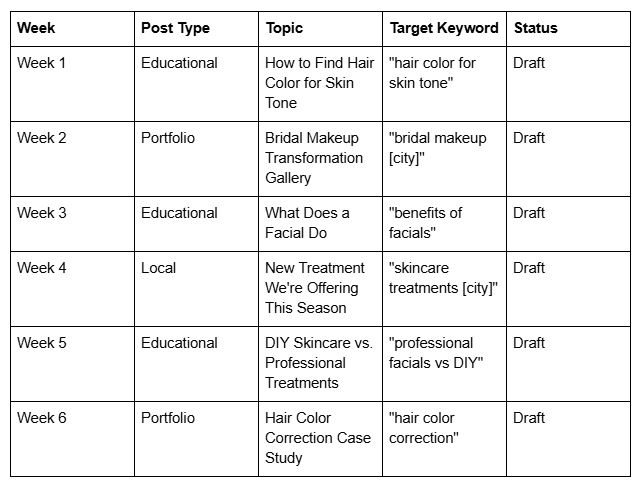
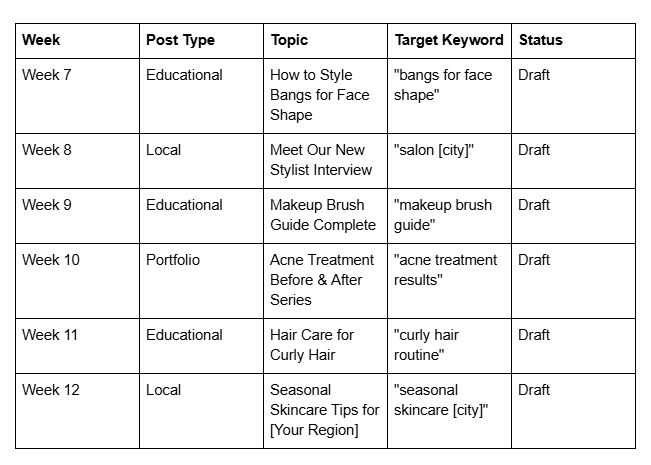
How to use this calendar:
Pick dates that work for your schedule. A Thursday post gives you Friday-Monday organic traffic momentum.
Plan each post's main keyword before writing so you can optimize naturally.
Create a simple spreadsheet in Squarespace's Notes app (or Google Sheets) and check off posts as you publish.
Start scheduling posts 2 weeks ahead so you're never scrambling.
SEO Optimising Each Blog Post: The Beauty Professional's Checklist
Once you've written your post, use this checklist before publishing. These are the on-page SEO factors that tell Google your post is high-quality and relevant.
Title and Heading Optimization
Main keyword appears in your H1 title — It should be the first 3–5 words if possible
H1 is 50–60 characters — Long enough to be descriptive, short enough to display fully in search results
You use H2s to break up content — One H2 every 300–400 words for readability and structure
H2s include semantic keywords — Variations of your main keyword help Google understand topic depth
Example: H1: How to Style Bangs for Different Face Shapes + H2s like Bangs for Round Face Shapes, Best Bangs for Square Face Shapes
Meta Description
Meta description is 155–160 characters — Squarespace shows the character count
Includes your main keyword — But naturally, not forced
Includes a call-to-action — Learn, Discover, Find out, See how
Answers the searcher's question — A good meta description makes the searcher want to click
Example: Learn how to style bangs for your face shape with professional tips. Discover which bang style flatters round, square, and oval faces.
Content Structure and Readability
Opening paragraph includes main keyword within first 100 words
Subheadings clearly organize content — Someone should understand your post from H2s alone
Paragraphs are 3–5 sentences maximum — Especially for web. Online readers scan, not read
You use lists, tables, or images every 300 words — Breaks up text visually
You bold important phrases — Not too much (maybe 1–2 per section)
Images and Alt Text
Every image has a descriptive alt text — Example: Close-up of side bangs on a woman with a round face
Image alt text includes related keywords when relevant — Helps Google understand your content
Images are optimized for web — Compressed to under 200KB so they don't slow your page
Internal Linking
You link to 3–5 related blog posts — Links 2–3 sentences deep in your post (not all at top/bottom)
Anchor text describes the linked post — Learn more about hair care for damaged hair not click here
Related posts actually relate — Don't link just to link; relevance matters
External Links (Authority)
You reference credible sources when making claims — Link to dermatology websites, beauty industry research, recognized beauty schools
External links go to high-authority sites — Not random blogs or low-quality sources
Most links are dofollow — Squarespace defaults to this, which is correct
Technical SEO in Squarespace
Post URL is clean and keyword-rich — /blog/how-to-style-bangs-face-shapes not /blog/post-123
Post is published, not in draft — Squarespace only indexes published posts
You've added post to appropriate category/collection — Helps internal linking structure
Featured image is set — Used for social sharing and visual appeal
Length and Comprehensiveness
Post is minimum 1,500 words — Longer educational posts should be 2,000+ words
You answer the question completely — Someone could act on your advice without searching further
You've covered semantic variations — If your main keyword is bangs for face shape, you've mentioned bang styles for different faces, which bangs suit my face, etc.
How to Repurpose Blog Content for Instagram, Pinterest and Email
One blog post should become multiple pieces of content. This multiplies your effort and extends your reach across platforms.
Repurposing for Instagram
A 2,000-word blog post becomes:
10 carousel posts — Each carousel slide pulls one tip or step from your blog post
20 Instagram Stories — Before-and-afters, tips, quick guides (1–3 per tip)
1 Reel — 30–60 second summary of your main point (e.g., 5-minute skincare routine pulled from your comprehensive skincare post)
5 caption ideas — Quote a statistic, ask a question, share a before-and-after
Example: Your blog post Complete Skincare Routine for Acne becomes:
Carousel: Step 1 (cleanse), Step 2 (exfoliate), Step 3 (treat), Step 4 (moisturize), Step 5 (sunscreen)
Stories: 20 different tips from the full post, Q&As about acne, testimonials
Reel: 30-second 5-step acne routine teaser
Captions: 5 different angles (acne myths, skincare investment, routine timing, product ordering, results timeline)
Repurposing for Pinterest
A blog post's length and detailed nature makes it perfect for Pinterest, which drives serious traffic to websites:
Vertical pins (1000x1500px) — Main headline, your branding, a benefit statement
Create 3–5 unique pin designs — Different headlines, colors, or compositions
Text overlay should highlight one benefit — Not the entire post, just the why click reason
Schedule pins at different times — Pinterest algorithms favor content with consistent pinning
Example: Your How to Style Bangs for Face Shapes post becomes:
Pin 1: Bangs for Round Faces (No More Unflattering Styles)
Pin 2: Stylist-Approved Bang Styles for Your Face Shape
Pin 3: Round Face? Oval Face? Here's Your Perfect Bang Style
Pin 4: DIY Bang Styling Mistakes (And How to Fix Them)
Repurposing for Email
Extract high-value sections and create email sequences:
Email 1: 3 Biggest Mistakes in Your Skincare Routine (teaser from blog post)
Email 2: Here's the Step-by-Step Routine That Actually Works (full post link + summary)
Email 3: Before & After Results: How This Routine Transformed Real Skin (case studies from your post)
Email 4: Ready to Try It? Book Your Professional Consultation (CTA with offer)
For a beauty business with an email list, repurposing one blog post into a 4-email sequence reaches subscribers multiple times and drives more appointment bookings.
Measuring Blog Success: Which Metrics Actually Matter
You're publishing blog posts consistently, but how do you know if they're working? Most beauty business owners track vanity metrics (likes, shares) instead of metrics that matter (client inquiries, bookings).
Here's what to measure:
The Metrics That Matter
1. Organic Search Traffic
Go to your Squarespace Analytics dashboard or Google Search Console
Track monthly organic traffic to your blog
Set a goal: Increase organic blog traffic 20% per quarter
Why: Organic traffic is the whole point of blogging
2. Click-Through Rate from Search Results
In Google Search Console, check which posts are getting clicks from search
A post with 100 impressions but 2 clicks needs a better meta description or title
Aim for 3–5% CTR on average (varies by keyword difficulty)
Why: A post Google shows people is worthless if nobody clicks
3. Blog Traffic by Post
In Squarespace Analytics, see which individual posts get the most traffic
Posts that get 50+ monthly views are your stars; promote them more
Posts with 5 views after 2 months might need SEO improvement or better promotion
Why: You'll discover which topics resonate and should create more content around them
4. Bounce Rate
If people land on your post but leave immediately, your content doesn't answer their question
Aim for bounce rate below 50% for blog posts (50% is actually normal for blog content)
High bounce rate (70%+) signals: unclear topic, bad writing, or technical issues
Why: Bounce rate tells you if your content is actually useful
5. Conversion Rate from Blog to Inquiry/Booking
This is the real metric: do blog readers actually contact you?
Add a goal in Google Analytics for form submissions or booking page visits
Track what percentage of blog visitors take the next step
Aim for 1–3% conversion rate (varies significantly by blog type)
Why: Blog traffic means nothing if it doesn't lead to clients
6. Keywords Ranking
Every 30 days, check Google Search Console for keyword rankings
See which of your target keywords you're ranking for (position 1–10, 11–20, 21–50)
Watch for upward trends; celebrate when a post moves from position 15 to position 8
Why: Ranking for your target keywords is the whole SEO strategy
Vanity Metrics to Ignore
Blog view count (raw traffic without context)
Social media shares (doesn't correlate to client inquiries)
Comments (nice but don't drive business)
Time on page (matters less than bounce rate)
Your Quarterly Blog Performance Review
Every 3 months, spend 30 minutes on this analysis:
Pull your Google Search Console data — Which posts are getting impressions? Which have good CTR?
Check Squarespace Analytics — Which posts drive the most traffic? Where do visitors go next?
Review conversions — Did blog readers become clients? Can you trace any bookings to specific posts?
Identify winners — Which topics resonate? Which blog posts could you expand into multiple follow-ups?
Adjust strategy — Create more content around high-performing topics; improve or retire underperformers
How Squareko Helps Beauty Businesses Build Content Strategy
If writing a blog strategy, creating 12 optimized posts, and managing analytics sounds overwhelming—that's exactly why Squareko exists.
Squareko is a Squarespace-focused digital agency that helps beauty businesses build sustainable growth through strategic content marketing. Here's how we work:
Content Strategy Development
We don't just hand you a list of blog topics and wish you luck. We audit your business, analyze your competition, interview your ideal clients, and create a customized blog strategy for your beauty business specifically. We identify:
Which keywords your ideal clients actually search for
What content your competitors are missing
Which blog topics will drive appointments to your calendar
How to structure your blog to support your services
Blog Post Creation and Optimization
Whether you want to write posts yourself (with our guidance) or have us create them, Squareko ensures every post is:
Fully SEO-optimized for your target keywords
Written in your brand voice
Structured for readability and engagement
Designed with your audience in mind
Our Squarespace content services focus on quality over quantity. We'd rather you publish one excellent post monthly than four mediocre ones. Learn more about our to maximize your content ROI.
Technical SEO Setup
Squarespace is great for blogging, but most beauty business owners leave SEO opportunities on the table. We ensure:
Your blog architecture supports internal linking
Meta descriptions and titles are optimized
Image alt text follows SEO best practices
Your site speed doesn't hurt rankings
Google Search Console is set up correctly
Analytics and Reporting
We set up proper tracking so you see what's working. Monthly reports show:
Which blog posts are driving traffic
Organic search keyword rankings
Blog traffic trends
Conversion data (blog readers to bookings)
You get clear, actionable insights—not overwhelming data dumps.
Frequently Asked Questions
-
Expect 3–6 months before you see meaningful organic traffic from blogging. Some posts start ranking within 4 weeks; others take 3+ months. By month 12 of consistent blogging, you should have 5–10 posts generating reliable monthly traffic. The timeline depends on keyword difficulty, content quality, and competition in your niche.
-
Consistency matters more than frequency. Publishing one excellent post every 2 weeks is far better than one post monthly that's rushed. For solo beauty professionals, publishing 2–4 times per month is sustainable and effective. Aim for quality over quantity—Google rewards comprehensive, well-researched posts over thin content.
-
You can absolutely write your own posts. As a beauty professional, you have expertise clients need. Many successful beauty blogs are written by the owner/business founder because that voice is authentic. If writing isn't your strength, hire a writer. If time is the bottleneck, consider hiring a writer too. The ROI of delegating blog writing is worth it if it means consistent publishing.
-
Educational how-to posts should be 1,500–2,500 words. Shorter posts (800–1,200 words) work fine for local news or lighter content. Google doesn't rank purely on length, but longer posts tend to rank better because they cover topics more thoroughly. Length should serve purpose—don't pad a 1,000-word post with fluff to hit 2,000 words.
-
Yes, strategic product recommendations build trust and create additional revenue. Blog posts like "5 Best Shampoos for Color-Treated Hair" with your honest reviews (including why each works) are valuable to readers. If you sell specific products, recommend them naturally when relevant. Disclose affiliate relationships or that you sell the product—transparency builds trust and is often required legally.
-
Organic search is your primary driver, but initial promotion helps. Share new posts on Instagram, Pinterest, and email (to existing clients). Ask other beauty professionals to share if relevant. Internal linking from your homepage and services pages drives initial traffic. Don't rely on social media as your main driver—that defeats the purpose of blogging for long-term, owned traffic.
-
Yes. Squarespace has built-in SEO tools, fast hosting, and mobile optimization. The platform itself doesn't penalize ranking. What matters is content quality, keyword research, and optimization. Many successful beauty blogs run on Squarespace specifically because the integration with your website design is seamless—no need to manage multiple platforms.
-
Start collecting them now. Ask clients for permission to photograph results (with proper consent forms). Portfolio posts are valuable, but educational posts don't require case studies. You can build a strong blog on educational how-tos and still grow your business. Portfolio posts come later, once you have client permission and documentation.
Ready to Grow Your Beauty usiness With Strategic Blogging? Book a Free Discovery Call
You've now seen the roadmap: a strategic blog built on Squarespace can be your most valuable client acquisition tool. But knowing what to do and actually doing it are different things.
If you're ready to stop wondering if your blog could be working harder for your beauty business—if you want a clear strategy, consistent content, and measurable results—let's talk.
At Squareko, we work exclusively with beauty professionals and small beauty businesses. We've built content strategies for salons, makeup artists, estheticians, colorists, and independent beauty professionals. We understand your business because we work in it.
Here's what a free discovery call looks like:
We listen. You tell us about your beauty business, your goals, and what you've tried so far.
We diagnose. We audit your current website/blog (if you have one) and identify quick wins and bigger opportunities.
We recommend. You leave the call with a clear 3-month roadmap: which topics to blog about, how to structure your blog, and what metrics actually matter.
No pressure. If you're not ready or we're not the right fit, you still have a strategy to implement yourself.
Most beauty business owners discover during the call that blogging is far less complicated than they thought—and the potential ROI is much higher than they realized.
Book your free 30-minute discovery call with Squareko →
We have limited availability each month for new clients, so if this resonates with you, book soon. Our next availability window closes Friday.

From custom website design to SEO strategy, we help businesses launch a site that looks professional and performs better.

About the Author
I'm Walid Hasan, a Certified Squarespace Expert and Squarespace Circle Platinum Partner with over 12 years of hands-on experience designing and optimizing high-performing websites. Over the years, I've had the privilege of building more than 2,000 Squarespace websites for clients around the world, always focusing on clean design, strong user experience, and conversion-driven results.