SEO for Technology Solutions Companies on Squarespace: Rank for Enterprise IT Keywords
Key Takeaways SEO for Technology Solutions Companies on Squarespace: Rank for Enterprise IT Keywords
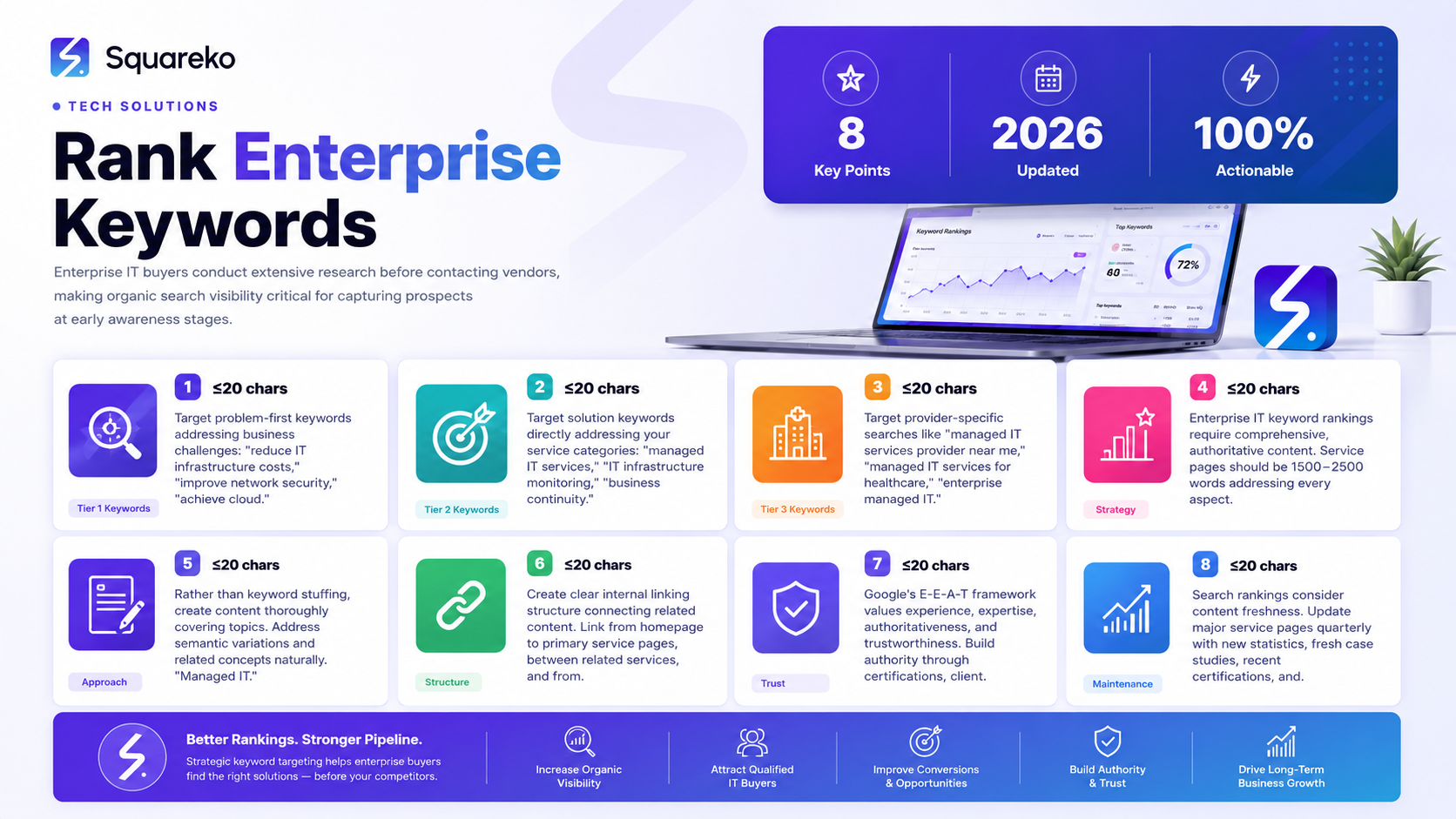
Enterprise IT buyers conduct extensive research before contacting vendors, making organic search visibility critical for capturing prospects at early research stages
IT services keyword strategy must target both broad enterprise problem keywords and specific solution keywords aligned with your service offerings
Technical SEO for Squarespace is minimal because the platform handles most fundamentals, allowing you to focus on content strategy and authority building
Thought leadership content and industry-specific expertise signals are essential for ranking competitive IT services keywords against established competitors
Long-form, comprehensive content that addresses enterprise IT buyer questions dramatically outperforms keyword-stuffed pages in competitive technology services markets
Understanding Enterprise IT Buyer Search Behavior
Before optimizing your Squarespace website for IT keywords, understand how enterprise IT buyers actually search for solutions. Their search behavior differs fundamentally from consumer search behavior and even from general B2B buyer search.
Research-Heavy Decision Making
Enterprise IT buyers conduct extensive research before contacting vendors. A typical evaluation process might include:
Awareness research: general problem exploration (How do we reduce infrastructure costs?)
Solution research: exploring solution categories (What is cloud infrastructure? How do managed IT services work?)
Provider research: evaluating specific providers
Detailed evaluation: comparing features, pricing, and fit
Your website needs to be visible at each stage. Early-stage awareness research captures prospects at the beginning of their journey. Late-stage solution research converts prospects who are actively evaluating options.
Multiple Decision-Makers and Searches
Enterprise IT purchases involve multiple stakeholders: IT directors, CTOs, CFOs, and business owners. Each stakeholder might conduct independent searches with different keywords. The IT director searches for 24/7 managed IT services provider, while the CFO searches for reduce IT infrastructure costs. Your website needs to address both searches.
Specificity and Technical Depth
Enterprise IT buyers search with specificity. Rather than IT help, they search for helpdesk software for healthcare, enterprise security monitoring, ransomware protection for mid-market. Your keyword strategy must include specific, technical keywords that match this depth.
Problem-First, Solution-Second
Enterprise IT buyers often start their research by searching for problems before they search for solutions. Someone struggling with compliance might search healthcare IT compliance requirements before searching healthcare compliance consulting. Your content strategy must address both problem-first and solution-first searches.
Keyword Research Strategy for Technology Solutions Companies
Effective keyword research for technology solutions companies requires understanding the entire buyer journey and mapping content to each stage.
Three-Tier Keyword Strategy
Build your keyword research across three tiers:
Tier 1: Problem Keywords (High Volume, Lower Competition) These keywords address the business problems your services solve: reduce IT infrastructure costs, improve network security, achieve cloud migration, reduce IT staffing costs. These keywords have high search volume but lower competition because they're industry-specific and not directly targeting IT services providers.
Problem keywords are crucial for early-stage awareness content. A prospect searching reduce IT infrastructure costs might not yet be aware that managed IT services is the solution. Your content can educate them while positioning your services as the solution.
Tier 2: Solution Keywords (Medium Volume, Medium Competition) Solution keywords directly target your service categories: managed IT services, IT infrastructure monitoring, business continuity solutions, network security audit, cloud infrastructure services. These keywords have clear commercial intent—people searching these terms are actively looking for solutions.
Solution keywords are the foundation of your service page strategy. Your managed IT services page should rank for managed IT services and variations. Your security page should rank for security consulting and similar variations.
Tier 3: Provider Keywords (Lower Volume, Higher Competition) Provider keywords are intent-specific searches for vendors: managed IT services provider near me, managed IT services provider for healthcare, enterprise managed IT services provider, best managed IT services company. These keywords have the clearest commercial intent but highest competition because every provider targets them.
Provider keywords are important for late-stage prospects actively evaluating vendors. However, ranking for provider keywords is difficult without significant authority and review signals.
Keyword Research Execution
Use keyword research tools to identify keywords your prospects actually search for:
Google Search Console: Shows actual search queries sending traffic to competitors' sites and keywords your site is currently ranking for
Ahrefs: Provides keyword difficulty scores, search volume, and competitor keyword strategies
SEMrush: Offers comprehensive keyword research with commercial intent indicators
Answer the Public: Shows actual questions people are asking related to your keywords
For each candidate keyword, evaluate:
Search volume: Is this keyword searched regularly? (Tools show monthly volume)
Keyword difficulty: How competitive is this keyword? (Tools provide difficulty scores)
Commercial intent: Is this keyword searched by people looking to buy or learn?
Relevance: Can you create content that genuinely answers this search?
Competitive Keyword Analysis
Research which keywords your competitors are ranking for. If a competitor is ranking well for managed IT services for manufacturing, you should consider this keyword too. However, don't just target keywords because competitors do—verify that the keyword aligns with your actual target market.
Long-Tail Keyword Opportunities
Long-tail keywords (3+ word phrases) often have lower search volume but also lower competition. Managed IT services for healthcare might have lower volume than managed IT services, but it's much easier to rank for and attracts more qualified prospects (people specifically looking for healthcare IT services).
Build your keyword strategy heavily around long-tail keywords. Your homepage might target managed IT services while your healthcare-specific page targets managed IT services for healthcare.
Content Strategy for Enterprise IT Keywords
Identifying keywords is the first step. Creating content that ranks for those keywords and converts searchers into leads is where strategy becomes execution.
Keyword-to-Page Mapping
Map each keyword to a specific page on your website. Your keyword strategy should clearly define: what keyword does this page target? What related keywords support it? What's the page's primary goal (awareness, consideration, decision)?
Example mapping:
Homepage: managed IT services, IT infrastructure management
Managed Services Page: 24/7 managed IT services, enterprise managed IT services, managed services provider
Healthcare Managed Services Page: managed IT services for healthcare, HIPAA-compliant managed IT services
Cybersecurity Page: enterprise cybersecurity solutions, network security monitoring
This mapping ensures you're not duplicating keywords across pages and that each page has a clear SEO target.
Content Depth for Enterprise Keywords
Enterprise IT keyword rankings require comprehensive, authoritative content. Your managed IT services page shouldn't be 300 words—it should be 1500-2500 words addressing every aspect of managed IT services that prospects research.
Your comprehensive managed IT services page might include:
What is managed IT services and how does it work?
Benefits of managed IT services (cost savings, security, reliability, focus on core business)
Typical implementation and onboarding process
Security and compliance measures
ROI and expected outcomes
How managed IT services differ from break-fix support
Service level agreements and support response times
Technology and tools your team uses
Case studies demonstrating managed IT services implementation
Comparison to alternatives (hiring internal IT staff, other managed services providers)
FAQ addressing common concerns
Content this comprehensive demonstrates expertise, addresses numerous related search intents, and provides searchers with the comprehensive information they need to evaluate managed IT services.
Semantic Keywords and Topic Coverage
Rather than keyword stuffing, create content that thoroughly covers the topic. If your keyword is managed IT services, ensure your content addresses all semantic variations: managed services, managed IT, MSP services, outsourced IT management, IT management services.
Google's semantic understanding allows it to recognize that managed IT services and outsourced IT infrastructure management are related concepts. Comprehensive content addressing all variations ranks better than keyword-stuffed content.
Competitor Content Analysis
Analyze top-ranking competitor content for your target keywords. What topics do they cover? What structure do they use? What content gaps exist that you could address?
If your competitor's managed IT services page covers implementation and ROI but ignores security details, you can create more comprehensive content that includes security information, positioning your page as more authoritative.
Content Freshness and Updates
Search rankings consider content freshness. Pages that are regularly updated and maintained rank better than static, unchanged pages. Update your major service pages at least quarterly: refresh statistics, update case studies, add recent certifications or client wins.
Major annual updates are also valuable. Your comprehensive guide to managed IT services benefits from annual updates that reflect evolving market conditions, new technologies, or changes in your service delivery.
Technical SEO Foundations on Squarespace
Squarespace handles most technical SEO automatically, but several elements require your attention and optimization.
Site Speed and Core Web Vitals
Squarespace generally performs well on site speed, but your content choices affect performance. High-resolution images and embedded videos can slow your site. Optimize image file sizes before uploading to Squarespace. Use JPEG for photos, PNG for graphics.
Google measures Core Web Vitals: Largest Contentful Paint (loading speed), First Input Delay (interactivity), and Cumulative Layout Shift (visual stability). Your Squarespace site should maintain good Core Web Vitals scores. Monitor your site's performance using Google PageSpeed Insights.
Mobile Responsiveness
Squarespace automatically handles responsive design for your site. However, test your site on actual mobile devices to ensure all content is accessible and readable on small screens. Enterprise IT buyers research on mobile devices frequently.
Internal Linking Structure
Create a clear internal linking structure that connects related content. Link from your homepage to primary service pages. Link between related services. Link from your blog to relevant service pages.
Squarespace's navigation handles primary internal linking automatically. Supplement this with contextual internal links within your content—links from one service page to related services, links from blog posts to relevant service pages.
URL Structure
Squarespace automatically creates clean URLs based on your page titles. Ensure your page titles are clear and keyword-relevant:
Good: /managed-it-services or /enterprise-cybersecurity-services
Poor: /page-1 or /services/item-7
Heading Hierarchy
Structure your content with clear heading hierarchy (H1, H2, H3). Your page should have one H1 (typically the page title). Use H2 for major sections and H3 for subsections. Proper heading hierarchy helps both users and search engines understand your content structure.
Meta Descriptions and Title Tags
Customize your meta description for each page. Your meta description appears in search results and should accurately describe your page content while including your primary keyword. Keep meta descriptions to 150-160 characters.
Customize your page title tags to be concise (50-60 characters) and keyword-relevant. Avoid generic titles like Services. Instead use Managed IT Services for Mid-Market Companies.
Schema Markup
Squarespace automatically implements basic schema markup. For IT services companies, schema markup becomes more important when you expand beyond basics. Consider implementing:
Organization Schema: Helps search engines understand your organization, contact information, and certifications
LocalBusiness Schema: Helps you rank locally if you serve specific geographic areas
ServiceProvider Schema: Indicates your organization provides specific services
Squarespace includes basic schema implementation. For advanced schema needs, you might require developer assistance.
Building Authority and E-E-A-T for IT Services
Google's E-E-A-T framework (Experience, Expertise, Authoritativeness, Trustworthiness) is critical for ranking competitive technology services keywords. Enterprise IT buyers need confidence that they're consulting with qualified, trustworthy providers.
Demonstrating Experience
Show that your team has practical experience delivering the services you offer. Your team page should include: years in IT services industry, relevant certifications, specific projects and implementations completed, industry recognitions.
Rather than generic statements like Our team has 50+ years of combined experience, provide specifics: John Smith, Lead Infrastructure Architect, has 15+ years of IT infrastructure experience and holds certifications X, Y, Z. He has led 100+ infrastructure projects across manufacturing, healthcare, and financial services.
Establishing Expertise
Demonstrate deep knowledge through comprehensive content. Your managed IT services page isn't just describing the service—it should explain WHY managed IT services reduce costs, HOW your methodology differs from competitors, WHAT technologies you employ, WHAT ROI prospects should expect.
Author your major content yourself (the founder or lead expert) rather than through an anonymous company voice. Google favors content written by subject matter experts.
Building Authoritativeness
Authoritativeness comes from external recognition: industry certifications, third-party reviews, media mentions, speaking engagements, and industry affiliations.
Certifications: Microsoft Gold Partner, CompTIA Security+, Cisco certifications, ITIL certifications, industry-specific credentials
Reviews: Positive reviews on G2, Capterra, Google Reviews, industry-specific platforms
Media Mentions: Articles in industry publications, quotes in technology news, case studies in industry publications
Speaking and Thought Leadership: Speaking at industry conferences, publishing in industry publications, contributing to industry discussions
Partnerships: Alliances with technology vendors, channel partnerships, ecosystem participation
Display these authority signals prominently on your website. Don't hide them in footer or sidebar areas—feature them prominently where they support your positioning.
Building Trustworthiness
Trustworthiness comes from transparency and demonstrated client success:
Transparent Pricing: Clear information about what you offer and what it costs (or how to get pricing)
Client Testimonials: Detailed testimonials from real clients about working with you
Case Studies: Specific examples of successful projects, with client permission and results
Security and Privacy: Transparent information about how you handle client data
Service Level Agreements: Clear commitments about response times, uptime guarantees, and support availability
Team Transparency: Real photos of your team, detailed bios, contact information
Don't hide behind corporate speak. Transparent, approachable information builds trust with enterprise buyers.
Thought Leadership and Industry Recognition
Thought leadership accelerates authority building and improves search visibility.
Blog Strategy for IT Services
Publish regular blog posts addressing IT services questions and industry trends. Your blog should support your keyword strategy while providing genuine value to prospects.
Effective IT services blog topics:
How-to guides for IT challenges (compliance implementation, security assessments, cloud migration)
Industry trend analysis and what it means for IT leaders
Technology reviews and evaluations (new platforms, tools, security solutions)
Lessons learned from client projects (anonymized case studies)
Best practices for IT operations and security
Commentary on industry news and developments
Blog posts should be substantial (1500-2500 words) and thoroughly address your topic. Short, thin blog posts damage your authority more than they help.
Link your blog content to relevant service pages, creating content bridges that drive blog readers to service pages.
Industry Publications and Guest Posts
Publishing in industry-recognized publications builds external authority. Research technology publications and platforms that accept guest contributions. Publishing articles about IT services strategy, emerging technologies, or industry trends positions you as a thought leader.
Each guest publication article should link back to your website, creating external backlinks that improve your search ranking.
Speaking Engagements and Conferences
Speaking at industry conferences or webinars builds authority and can drive traffic to your website. Include your company website in your speaker biography and mention your website during presentations.
Social Proof and Testimonials
Detailed client testimonials on your website dramatically improve trustworthiness and search ranking factors. Rather than generic praise (Great company!), feature specific testimonials that address real results: Acme Manufacturing reduced IT staffing costs by 40% after implementing our managed IT services.
Include client name, title, company, and photo (if available) with testimonials. This transparency makes testimonials more credible.
International and Multi-Region IT Services SEO
If your technology solutions company serves multiple regions or has international clients, adjust your SEO strategy accordingly.
Geographic Keyword Targeting
Create location-specific content and pages. Rather than a single IT Services page, create pages for primary markets: Managed IT Services for San Francisco Bay Area, Managed IT Services for Los Angeles, Managed IT Services for Chicago.
Each regional page can target geographic + service keywords, allowing you to rank for location-specific search queries.
International Content Strategy
If you serve international markets, consider creating country or region-specific content addressing that market's regulatory environment, compliance requirements, and business practices.
A U.S. IT services company serving European clients should create content addressing GDPR, data residency requirements, and EU-specific compliance needs. European prospects searching for GDPR-compliant managed IT services should find your content.
Multi-Language SEO
If you operate in multiple language markets, implement proper language targeting through hreflang tags (Squarespace handles this if you use native multi-language features). Ensure content is genuinely translated or localized, not automatically machine-translated.
Let Squareko Improve Your IT Services SEO
Ranking for enterprise IT keywords requires sustained effort across content strategy, authority building, and technical optimization. It requires understanding not just your keywords, but the questions, concerns, and evaluation criteria of enterprise IT buyers.
Many IT services companies underestimate the importance of organic search visibility. While paid advertising captures prospects actively searching for solutions, organic search captures prospects at every stage of the buyer journey—from early awareness (How do we reduce IT costs?) to late-stage decision-making (Best managed IT services provider for mid-market companies).
At Squarekowe specialize in building SEO-optimized Squarespace websites for technology solutions companies. We research your specific market, identify the enterprise keywords that matter most for your business, and create content strategies that rank for those keywords while genuinely serving your prospects' information needs.
FAQs
-
Ranking for competitive keywords typically takes 6-12 months of consistent optimization and content creation. Less competitive long-tail keywords (like "managed IT services for healthcare") might rank in 3-6 months. Very competitive keywords (like "managed IT services provider") might take 12+ months. Success depends on your current authority, content quality, and competition level.
-
Focus on long-tail keywords. They have lower competition, higher conversion rates (more specific intent), and are easier to rank for. Once you establish authority, broader keywords become easier to rank for. Building your keyword strategy around 3-5 word phrases rather than single-word keywords is the most efficient approach.
-
Optimize each primary service page for your main service keywords. Rather than creating 20 optimized pages, create 5-8 comprehensive pages optimized for your core services. Depth and comprehensiveness outperform breadth in competitive IT services markets.
-
Squarespace is fully capable for IT services SEO. The platform handles most technical SEO automatically. However, you lose some customization options compared to WordPress or self-hosted platforms. For most IT services companies, Squarespace's SEO capabilities are more than sufficient.
-
Backlinks remain important for ranking competitive keywords, but content quality matters more for less competitive keywords. Focus on creating excellent, comprehensive content first. Backlinks come naturally from high-quality content. Actively pursue backlinks through guest publishing, media mentions, and industry partnerships.
-
Yes. PPC (Google Ads) can capture prospects immediately while you build organic visibility. PPC and organic search are complementary. PPC generates immediate leads while you build long-term organic visibility. As organic rankings improve, you can reduce PPC spending.
-
Track: organic search traffic volume, keyword rankings for your target keywords, page-by-page organic traffic, organic conversion rate (organic visitors who become leads/customers). Google Analytics and Google Search Console provide these metrics.
-
Content is more important for competitive IT services keywords. Google can understand and rank quality content on less-than-perfect technical foundations. However, technical SEO provides a foundation. Invest 80% of effort into content strategy and 20% into technical optimization.
From custom website design to SEO strategy, we help businesses launch a site that looks professional and performs better.

Author Bio
I'm Walid Hasan, a Certified Squarespace Expert and Squarespace Circle Platinum Partner with over 12 years of hands-on experience designing and optimizing high-performing websites. Over the years, I've had the privilege of building more than 2,000 Squarespace websites for clients around the world, always focusing on clean design, strong user experience, and conversion-driven results.