Local SEO for Technology Solutions Companies: Win More IT Service Contracts in Your Area
Key Takeaways Local SEO for Technology Solutions Companies: Win More IT Service Contracts in Your Area
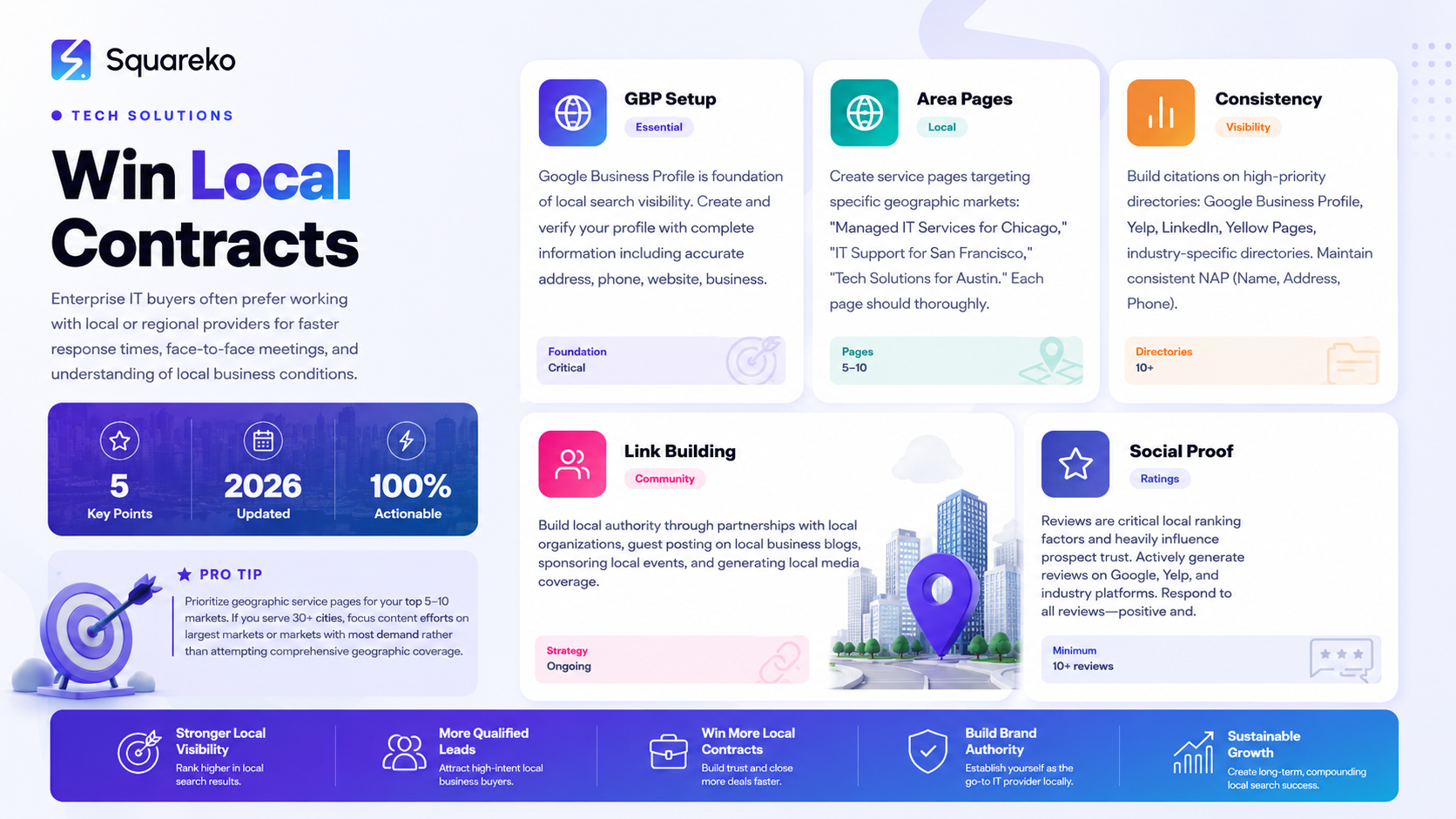
Local search is increasingly important for IT services companies as prospects search for IT services near me and location-specific technology solutions
Google Business Profile optimization is the foundation of local SEO for technology services, requiring business verification, accurate information, and consistent review management
Geographic service pages targeting specific cities and regions help IT companies rank locally while maintaining a single Squarespace website
Local citation consistency across directories like Yelp, LinkedIn, Yellow Pages, and industry-specific platforms significantly improves local search visibility
Integrated local SEO strategy combines geographic keyword targeting, service area pages, Google Business Profile optimization, and local authority building
Local Search Importance for Technology Solutions Companies
Local search has become increasingly critical for IT services companies. The shift toward near me searches and location-specific queries means that IT services companies competing in specific geographic markets need strong local search visibility.
Why Local Search Matters for IT Services
Enterprise IT buyers often prefer to work with local or regional technology services providers. Reasons include:
Reduced response times for emergencies and support
Ability to meet face-to-face for important discussions
Preference for vendors in the same time zone
Confidence in local providers who understand local business environment
Ability to visit vendor facilities if needed
A Chicago manufacturing company evaluating managed IT services might start by searching managed IT services Chicago rather than conducting a national search. If your IT services company serves Chicago but doesn't rank for this geographic search, you're missing qualified local prospects.
Shift in IT Services Buying Patterns
The traditional IT services buying pattern was national—prospect would evaluate national providers like Accenture, Deloitte, or IBM. However, this has changed significantly. Mid-market companies increasingly prefer managed services providers and technology solutions companies that operate in their region. These regional providers often have:
Better understanding of local business conditions
More responsive support
Lower costs than national firms
Ability to provide personalized service
This shift toward regional and local IT services providers creates opportunity for small and mid-sized technology solutions companies to compete effectively by dominating local search visibility.
Local Search Volume for IT Services
Search volume data shows that people searching for IT services frequently include geographic qualifiers:
Managed IT services Chicago
IT support Denver
Technology consulting San Francisco Bay Area
Business continuity services Atlanta
If you're a regional IT services company, a significant portion of your target prospects are searching for these geographic-specific keywords.
Google Business Profile Optimization for IT Services
Google Business Profile (formerly Google My Business) is the foundation of local search visibility. For IT services companies serving specific geographic areas, Google Business Profile optimization is non-negotiable.
Google Business Profile Setup and Verification
Before you can optimize your profile, you must create and verify it. The process:
Go to Google Business Profile (google.com/business)
Create your account or add location if you're already registered
Enter your business information: name, address, phone, website
Verify your address through postcard verification (typically takes 2-3 weeks)
Optimize your profile with photos, service details, and business description
Verification is critical. An unverified profile lacks credibility and won't appear in local search results with full visibility. Even if you don't have a physical office, you can verify a service-area business using your registered address.
Complete Business Profile Information
Your Google Business Profile should include:
Business Name: Your official business name (don't keyword-stuff the name)
Address: Your physical office address (if you have one) or service-area address
Phone: A professional phone number that you actually answer
Website: Link to your Squarespace website homepage
Business Hours: Accurate hours you're available
Business Category: Primary category should be IT Services Company, Managed IT Services Provider, or similar
Business Description: 750-character description of your services, target market, and unique value proposition
Service Areas: List all geographic areas you serve
The business description is a critical opportunity to communicate your value proposition. Rather than generic descriptions like We provide IT services, use specific descriptions: Technology solutions provider serving mid-market manufacturing companies throughout the Chicago metropolitan area. We specialize in managed IT services, cloud migration, and security solutions.
Service Categories and Attributes
Add all relevant service categories and business attributes:
Services offered: Managed IT Services, Cloud Consulting, Cybersecurity, etc.
Certifications: Microsoft Gold Partner, CompTIA certified, etc.
Specializations: Industry experience (Healthcare, Manufacturing, Finance, etc.)
Accessibility: Wheelchair-accessible office (if applicable)
Complete attributes give Google more information to match your profile with relevant searches.
Google Business Profile Photos and Video
Add 10-15 high-quality photos to your profile showing:
Your office/facility (if you have one)
Your team at work
Your equipment or service delivery environment
Certifications and awards displayed in your office
Team member headshots
Google Business Profile photos appear in local search results and dramatically improve click-through rates. Profiles with photos receive significantly more inquiries than those without.
Optionally, add a professional video (30-60 seconds) introducing your company and services. Video increases engagement significantly.
Regular Profile Updates
Update your Google Business Profile regularly with new information:
Add photos regularly (at least monthly)
Update business description seasonally
Add seasonal services or special offerings
Post updates about company news or achievements
Highlight client success stories (anonymized)
Regular updates signal to Google that your business is active and current. Outdated profiles rank lower than actively maintained profiles.
Posts and Regular Updates
Google Business Profile includes a Posts feature allowing you to publish short updates about your business that appear in your local search results. Use this feature to:
Announce new services
Share company milestones or achievements
Promote special offers or seasonal services
Highlight thought leadership or industry expertise
Share photos from company events
Posts expire after 7 days but remain accessible on your profile. Regular posts keep your profile active and engaging.
Geographic Service Pages and Area Targeting
While Google Business Profile handles basic local optimization, geographic service pages on your Squarespace website significantly boost local rankings and provide detailed information for location-specific searches.
Geographic Service Page Strategy
Create service pages targeting your primary service areas. If you serve Chicago, San Francisco, and Austin, create pages like:
Managed IT Services for Chicago
Managed IT Services for San Francisco
Managed IT Services for Austin
Each page should be substantial (1500+ words) and specifically address that geographic market. Don't create thin pages that just add a city name to a generic service page.
Geographic Page Content Structure
Your geographic service pages should include:
Service Overview: What is this service and how it helps businesses in this market
Local Market Context: Specific challenges businesses in this market face and how your service addresses them
Local Industry Focus: If you serve specific industries in this region (healthcare in Austin, tech in San Francisco, manufacturing in Chicago), address industry-specific needs
Local Compliance and Regulations: Address any region-specific compliance requirements (state data residency laws, regional security standards)
Local Case Studies: Feature case studies from clients in this specific region
Local Team: Introduce team members who serve this region
Local Service Areas: Specific neighborhoods, suburbs, or service area boundaries in this region
Contact for This Region: Phone number and contact information for your regional team (if different)
This level of specificity demonstrates that you understand the local market and aren't just offering generic services.
Multi-Region Service Pages
If you serve multiple regions, avoid creating a generic page like Managed IT Services and then duplicating it for each region. Instead, create a primary Managed IT Services page that ranks nationally, then create region-specific pages for your largest markets:
Homepage → Managed IT Services (primary, national focus)
Chicago: Managed IT Services for Chicago
San Francisco: Managed IT Services for San Francisco
Austin: Managed IT Services for Austin
Link your regional pages to the primary service page, creating a content hierarchy that supports both national and regional rankings.
Service Areas Pages
In addition to geographic service pages, create a Service Areas page that lists all regions you serve. This page provides an overview of your geographic coverage and links to regional pages. It also helps prospects in secondary markets understand that you serve their area even if you don't have dedicated regional pages for every area.
Your service areas page might list: We serve the greater Chicago area, including: Chicago, Oak Park, Evanston, Schaumburg, and 50+ other communities. Learn more about [Managed IT Services for Chicago].
Local Citation Building and Consistency
Local citations are online mentions of your business name, address, and phone number (NAP) across directories and websites. Citation consistency and quality significantly impact local search rankings.
High-Priority Local Citation Directories
Build citations on these essential directories:
Google Business Profile (already covered above)
Yelp: Create your Yelp business profile with complete information, photos, and regular updates
LinkedIn Company Page: Link your business website and ensure consistent NAP information
Yellow Pages: Build a complete Yellow Pages business profile
Industry-Specific Directories: Directories specific to IT services (IT services marketplaces, managed services provider directories)
Medium-Priority Citations
Add your business to these directories if your focus is on significant local presence:
Chamber of Commerce: Join your local chamber of commerce and add your business to their directory
Better Business Bureau (BBB): Register with BBB and maintain an active profile
Local Business Directories: City-specific directories and local business listings
Industry Association Directories: If you're a member of technology industry associations, add yourself to their member directories
Citation Consistency Standards
Maintain consistent business information across all citations:
Business Name: Use the same official business name everywhere. Avoid variations like ABC IT Services, ABC IT Services Company, or ABC Info Tech
Phone Number: Use the same primary phone number consistently
Address: Use the same address, formatting, and abbreviations. Don't vary between Chicago, IL and Chicago, Illinois
Website: Link consistently to your primary website
Service Categories: Use consistent descriptions of what your business does
NAP inconsistencies confuse Google and damage local rankings. Many citations have auto-filling features that pull from other directories—one error can propagate across multiple platforms. Review all your major citations quarterly and correct inconsistencies.
New Citation Building
Identify directories relevant to your specific industry and location:
Technology service directories
B2B marketplace directories
Industry-specific association directories
Local business listing aggregators
Add your business to high-quality directories that are actively maintained and visited by your target market. Avoid low-quality directory farms that exist only to sell citations.
Local Link Building and Authority
Local search rankings also consider links from other local organizations, particularly relevant local businesses and community organizations.
Local Partnership Links
Identify strategic local partnerships that could benefit both organizations:
Technology vendors and solution providers
Business consultants and professional services
Industry associations and chambers of commerce
Local universities and technical schools
Build relationships with these organizations that might lead to mutual referral links or partnership mentions.
Local Guest Posting
Write guest posts for local business blogs, community publications, and local technology newsletters. Each guest post provides an opportunity to link back to your website while building local authority.
Local Event Sponsorships
Sponsor local business events, chamber of commerce events, or community organizations. Event sponsorship often includes website links and mentions that build local authority and visibility.
Local PR and Media Coverage
Build relationships with local business journalists and technology reporters. When you achieve local milestones (hired new team members, completed significant projects, received certifications), pitch stories to local media. Local media coverage includes valuable local links and builds authority.
Community Involvement Links
Get involved in local community organizations and non-profits. Many non-profits list business supporters on their websites, creating links from trusted local organizations.
Review Management and Social Proof
Reviews are a critical factor in local search rankings and significantly influence whether local prospects contact you.
Review Generation Strategy
Actively encourage satisfied clients to leave reviews on Google, Yelp, and industry platforms:
Ask clients at project completion
Follow up with email requests to recent clients
Incentivize reviews (offer entry into drawing, etc.), but don't directly pay for reviews
Make review requests easy by providing direct links to your review profiles
Review Response Strategy
Respond to all reviews—positive and negative:
Positive Reviews: Thank the reviewer, acknowledge specific points they mentioned, invite them to refer others
Negative Reviews: Respond professionally, acknowledge their concern, offer to resolve the issue offline, correct any misinformation
Review responses demonstrate that you actively listen to client feedback and care about client satisfaction. They also provide an opportunity to address concerns for other prospects reading reviews.
Review Monitoring
Monitor reviews across Google, Yelp, Capterra, G2, and industry-specific platforms. Set up Google Alerts for your business name so you're notified when new reviews appear.
Review Quality and Volume
Aim for at least 4.5-star average rating with 10+ reviews on Google Business Profile. Low review counts or low ratings significantly damage local search rankings and prospect trust.
Multi-Location SEO for Distributed IT Services Teams
If you have multiple offices or serve multiple regions with distributed teams, implement multi-location SEO strategy.
Multiple Google Business Profiles
Create a separate Google Business Profile for each office location:
Headquarters: Main address
Chicago Office: Chicago address
San Francisco Office: San Francisco address
Each profile should reflect that specific location: team members in that office, services available from that location, local phone number.
Separate Service Pages
Create separate regional service pages for each location:
Managed IT Services for Chicago
Managed IT Services for San Francisco
These pages should feature the Chicago team, Chicago case studies, and Chicago-specific information, distinct from your San Francisco service page.
Consistent Branding
While each location has location-specific content, maintain consistent branding, color schemes, and design across your website. Prospects shouldn't feel like they're visiting different companies when moving between location pages.
Headquarters Landing Page
Create a main service page that serves as the hub for all locations, with links to location-specific pages:
Managed IT Services (homepage) → Served in Chicago, San Francisco, Austin, and more
Managed IT Services for Chicago
Managed IT Services for San Francisco
Managed IT Services for Austin
Let Squareko Build Your Local IT Services Presence
Local search visibility can be the difference between competing for regional clients and competing against national giants. Many mid-sized technology solutions companies outcompete national firms in local markets by dominating local search visibility.
Building effective local SEO requires geographic service page development, Google Business Profile optimization, citation consistency, review generation, and local authority building. It requires understanding that prospects in your market are searching for local solutions and ensuring your website and online presence rank for those searches.
At Squareko we specialize in building local SEO strategies for technology solutions companies. We help IT services companies, managed services providers, and regional technology firms establish dominant local search visibility in their target markets.
FAQs
-
Create geographic service pages for your top 5-10 service areas. If you serve 30+ cities, you'll need to be selective about where to invest effort. Prioritize the largest markets or markets where you have the most client demand. You can mention serving additional areas on your "Service Areas" page without creating dedicated pages.
-
Google Business Profile is an online business listing that appears in Google Search and Google Maps. Geographic service pages are detailed pages on your website optimized for geographic keywords and providing comprehensive information. Both are important. Google Business Profile handles immediate local visibility. Geographic service pages support deeper engagement and provide detailed content for prospects in that market.
-
Use one website with location pages. A single website is easier to maintain, establishes consistent branding, and is more manageable for your team. Only large organizations with genuinely separate business units need separate websites.
-
Review your major citations quarterly. Update them proactively when information changes. Some directories offer tools to update information across multiple platforms simultaneously. Be especially careful with phone number and address changes—NAP consistency is critical.
-
Start with Google Business Profile. It's faster to set up and provides immediate local visibility. Then create geographic service pages on your website for your top 3-5 markets. Build out additional content as resources allow.
-
Local rankings can improve within 4-8 weeks if you're properly optimizing Google Business Profile and building citations. Geographic service pages might take 3-6 months to establish local authority. Consistent effort and continued citation building accelerate results.
-
A single page targeting multiple cities is possible, but separate pages for each city typically perform better. A page titled "Managed IT Services for Chicago, Denver, and Austin" is less optimized than separate pages for each city. If you serve 2-3 nearby cities, a single page can work, but separate pages are superior.
-
Reviews are very important. They're a ranking factor and heavily influence whether prospects trust you enough to contact. Aim for 10+ reviews with 4.5+ star average on Google Business Profile. Actively build reviews and respond to all reviews.

From custom website design to SEO strategy, we help businesses launch a site that looks professional and performs better.

Author Bio
I'm Walid Hasan, a Certified Squarespace Expert and Squarespace Circle Platinum Partner with over 12 years of hands-on experience designing and optimizing high-performing websites. Over the years, I've had the privilege of building more than 2,000 Squarespace websites for clients around the world, always focusing on clean design, strong user experience, and conversion-driven results.