How Technology Solutions Companies Build Trust and Win Long-Term Contracts on Squarespace
Key Takeaways How Technology Solutions Companies Build Trust and Win Long-Term Contracts on Squarespace
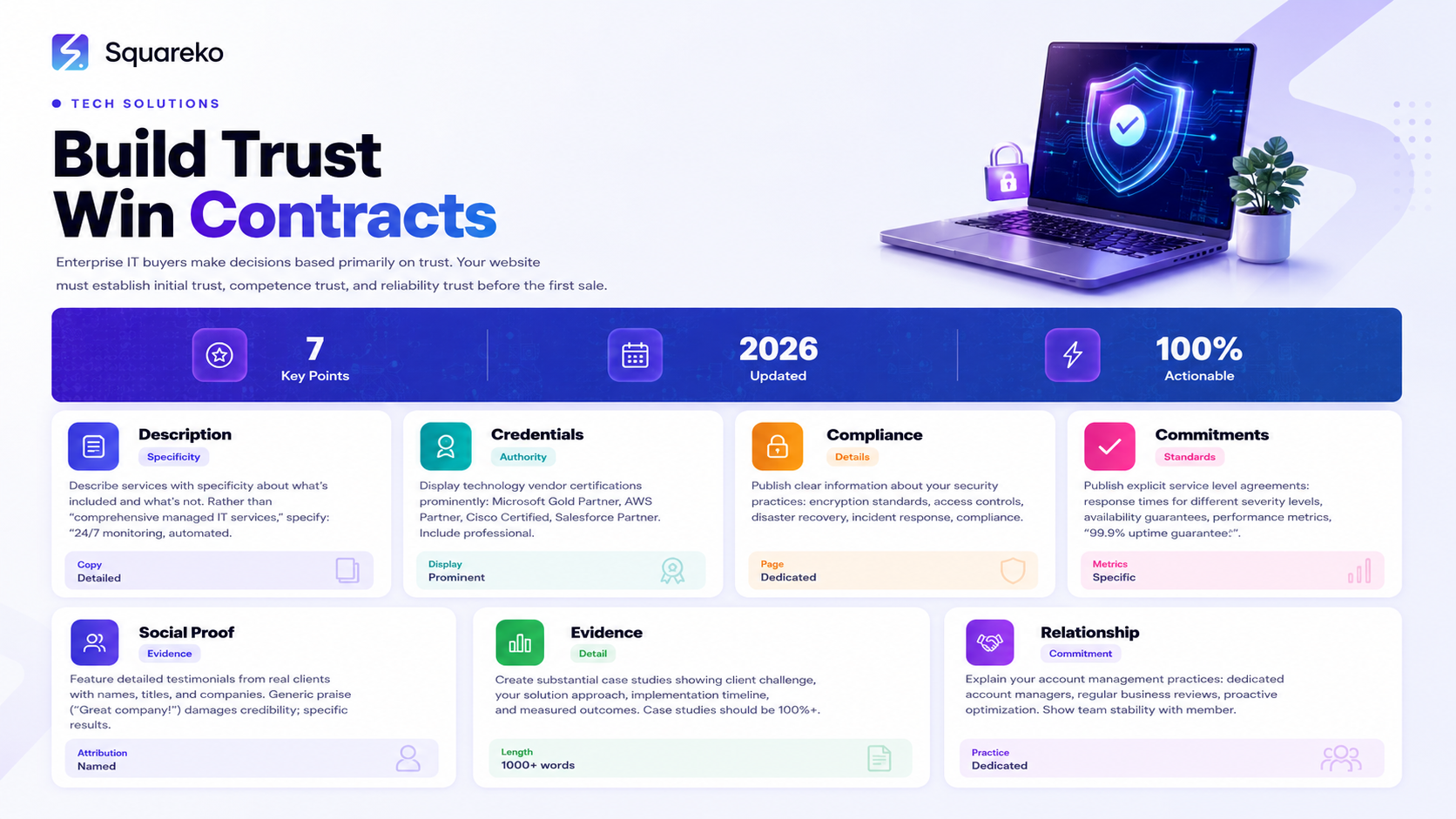
Trust is the primary decision factor for enterprise IT buyers selecting technology solutions providers; website trust architecture is foundational to winning contracts
Transparent communication about certifications, security practices, compliance standards, and service level agreements dramatically improves prospect confidence and contract success
Long-term contracts depend on setting proper expectations upfront, demonstrating clear value, and using your website to build confidence before the first conversation
Social proof integration (client logos, testimonials, case studies) must be genuine, specific, and distributed throughout your site to maximize trust signals
Partnership and vendor certification displays build external validation that prospects recognize, positioning you as verified and trusted by established technology vendors
Why Trust Is the Primary Decision Factor
Enterprise IT buyers don't make decisions based primarily on price, features, or marketing messages. They make decisions based on trust. When an IT director is evaluating managed IT services providers, they're asking: Can I trust this company with my infrastructure? Will they respond when problems occur? Do they have the expertise they claim? Are they stable enough to be a long-term partner?
Your website is the primary trust-building tool before the first sales conversation. Prospects who don't trust you won't call. Prospects who doubt your expertise won't request proposals. Your website architecture must answer trust questions comprehensively.
Risk and Consequences of Poor Provider Selection
Enterprise IT buyers face significant risk when selecting technology services providers. A poor choice can result in:
Infrastructure outages causing business interruption
Security breaches exposing sensitive data
Non-compliance with regulatory requirements
Expensive failed implementations
Long-term contracts with underperforming providers
Because the consequences are severe, enterprise IT buyers demand evidence of competence and stability before selecting a provider. Your website must provide this evidence.
The Trust-to-Contract Pipeline
Trust builds progressively as prospects gather information:
Initial Trust (Awareness Stage): Prospect sees your company exists, is established, and appears professional. This comes from basic website professionalism, presence on recognized platforms, and visible business credentials.
Competence Trust (Consideration Stage): Prospect evaluates whether you have the expertise to handle their specific needs. This comes from detailed service descriptions, industry expertise signals, certifications, and case studies.
Reliability Trust (Decision Stage): Prospect evaluates whether you'll consistently deliver quality service long-term. This comes from client testimonials about relationship quality, clear SLAs, security and compliance information, and transparent pricing/expectations.
Partnership Trust (Post-Contract): Your actual service delivery either reinforces or undermines the trust your website established. Honoring SLAs, responsive communication, and delivering promised outcomes build long-term contracts.
Your website can't guarantee partnership trust—only actual service delivery achieves that. However, your website must establish initial, competence, and reliability trust before the first contract conversation.
Transparency as Your Trust Strategy
Many companies are reluctant to be transparent about their practices, pricing, and limitations. They assume vagueness protects them. Actually, transparency builds trust while vagueness creates suspicion.
Transparent Service Descriptions
Describe your services with specificity about what's included and what's not:
Poor: We offer comprehensive managed IT services designed to meet all your infrastructure needs
Excellent: Our managed IT services include: 24/7 network monitoring, automated patch management, system updates, backup and disaster recovery, and helpdesk support Monday-Friday 8am-6pm and Saturday 9am-1pm. Services do not include: on-site equipment repair (outsourced to vendors), software licensing (client responsibility), or compliance audits (available as separate service)
The excellent version tells prospects exactly what to expect. It eliminates surprises and builds confidence that you understand their needs and set realistic expectations.
Transparent Pricing and Cost Models
Many IT services companies keep pricing completely confidential, requiring discovery calls for any pricing information. This creates friction and suggests you're hiding costs.
Even if you can't display exact pricing, provide pricing models and typical cost ranges:
Managed IT services are typically $120-180 per workstation per month depending on your specific services selected and network complexity. Request a consultation to receive a detailed proposal for your situation.
This transparency lets prospects self-qualify cost-wise before wasting time in discovery conversations.
Transparent Implementation Timelines
Be clear about how long typical implementations take. Prospects fear long, disruptive implementations that interfere with business operations:
Cloud migration typically requires 8-12 weeks from planning through completion, depending on application complexity, data volume, and your team's bandwidth. We minimize disruption through phased migration approaches that maintain your current systems during transition.
Clear timelines build confidence that you've done this work before and have systematic approaches.
Transparent Security and Compliance Practices
Don't hide security details. Explicitly state your practices:
We maintain SOC 2 Type II compliance, conduct annual security audits, encrypt all data in transit and at rest, maintain HIPAA compliance for healthcare clients, and have incident response protocols documented and tested quarterly.
Transparency here builds confidence that you take security seriously and can support clients' compliance requirements.
Transparent About Limitations and When You're Not the Right Fit
The most trust-building thing you can do is acknowledge when you're not the right fit for a prospect:
Our managed IT services are optimized for companies with 50-500 employees. If you have fewer than 50 employees or more than 500, you might be better served by [alternative provider type]. If you'd like to discuss your specific situation, we're happy to consult and recommend alternatives if we're not the right fit.
This honesty builds enormous trust. Prospects respect companies that decline wrong-fit customers and recommend better alternatives. They become even more confident that you'll serve them well if you do take them on.
Certifications and Credentials Display
Enterprise IT buyers look for certifications as proof that you've invested in professional credibility and maintain industry standards.
Technology Vendor Certifications
Display certifications from major technology vendors prominently:
Microsoft Gold Partner: Certification demonstrates expertise in Microsoft technologies and ongoing investment in professional development
Cisco Certifications: Network expertise credentials
Citrix Certified: Virtualization and infrastructure expertise
Salesforce Partner: CRM and business application expertise
AWS Partner or Azure Expert: Cloud infrastructure expertise
Technology vendor certifications matter because they come from recognized authorities. An IT director seeing Microsoft Gold Partner immediately understands you've been vetted by Microsoft and maintain current expertise.
Professional Certifications
Display team member certifications prominently:
CompTIA Security+: Information security expertise
CompTIA A+, Network+, Security+: IT fundamentals and professional standards
Certified Ethical Hacker (CEH): Security expertise
ITIL Certifications: IT service management standards
CCNA/CCNP (Cisco): Network engineering
AWS Certified Solutions Architect: Cloud infrastructure expertise
Rather than just listing certifications, show who holds them:
John Smith, Lead Infrastructure Architect, holds CompTIA Security+, AWS Certified Solutions Architect, and ITIL Foundation certifications
This builds confidence that specific team members have relevant expertise.
Compliance and Standards Certifications
Display your compliance certifications prominently:
SOC 2 Type II: Information security controls audited by third party
ISO 27001: Information security management standard
HIPAA Compliance: For healthcare clients
GDPR Compliance: For companies handling EU data
PCI DSS Compliance: For handling payment card data
Enterprise IT buyers require this information. Don't bury it—feature it prominently.
Ongoing Education and Current Certifications
Show that your team maintains current certifications:
All team members maintain current certifications, which require annual continuing education and skills verification
This signals that you're committed to staying current with rapidly changing technology.
Security and Compliance Transparency
Security and compliance transparency is non-negotiable for enterprise IT buyers. Don't assume they'll ask—provide information proactively.
Security Policies and Practices
Publish clear information about your security practices:
Data encryption (at rest and in transit)
Network security measures
Access controls and authentication requirements
Employee security training and background checks
Physical security of data centers or server facilities
Disaster recovery and business continuity plans
Incident response procedures
Create a dedicated Security and Compliance page explaining your practices in detail. Enterprise IT buyers need this information to assess your security posture and determine if you meet their requirements.
Data Handling and Privacy
Be explicit about how you handle client data:
Where is data stored?
Who has access to client data?
What encryption standards do you use?
How long do you retain data after client relationship ends?
How do you handle data breaches?
Are there geographic restrictions on data storage?
Many clients have specific data residency requirements (data must stay in the US or EU). Be clear about your data handling practices.
Third-Party Security Audits
If you've undergone third-party security audits (SOC 2, ISO 27001), publicize the results:
Our security practices are audited annually by independent third-party auditors to SOC 2 Type II standards
Third-party validation is more trustworthy than claims you make about yourself.
Incident Response Transparency
Be transparent about your incident response processes:
How quickly do you respond to security incidents?
How do you notify clients of incidents?
What's your root cause analysis process?
How do you prevent similar incidents?
Even if you've experienced security incidents, transparency about how you responded and improved builds confidence in your incident handling.
Service Level Agreements and Clear Commitments
Service Level Agreements (SLAs) are contractual commitments about service availability, response times, and performance guarantees. Clear SLAs build trust by setting explicit expectations.
Response Time Commitments
Be explicit about response times for different severity levels:
Critical outages: 1-hour response time, 4-hour resolution target
Major issues: 4-hour response time, 8-hour resolution target
Standard issues: 8-hour response time, next business day resolution
Consultation/advisory: 24-48 hour response
Clear response time commitments are more credible than vague promises like prompt response. Prospects need to know exactly what prompt means.
Availability Guarantees
Publish your service availability targets:
99.9% uptime guarantee for all managed IT services (allows 43 minutes of downtime per month)
99.95% uptime guarantee (allows 22 minutes per month)
Availability guarantees should align with your actual capabilities. Overpromising creates problems. If you guarantee 99.99% but deliver 99.9%, you're not building trust.
Performance Metrics
Publish performance metrics you commit to:
Average ticket resolution time
Customer satisfaction scores
System uptime history
Compliance audit results
Transparency about actual performance is more credible than theoretical commitments.
SLA Penalties
If you fail to meet your SLAs, what's the consequence?
Service credits (refund of monthly fees)
Termination rights (client can exit contract without penalty)
Financial penalties
Including SLA penalties in your agreements signals confidence in your ability to deliver.
Client Success and Social Proof Integration
Social proof—evidence that other clients are satisfied with your services—is critical for building trust with new prospects.
Specific Client Testimonials
Generic testimonials damage credibility. Specific testimonials build trust:
Weak: Great company, highly recommended!
Strong: We reduced our IT infrastructure costs by 35% and eliminated the need for a dedicated IT staff member. Acme's team is responsive and proactive. We've worked with them for 3+ years and wouldn't consider switching. — John Smith, CTO, Manufacturing Company
Strong testimonials include: specific results, client name/title/company, and duration of relationship.
Client Logo Display
Display client logos prominently on your homepage and relevant service pages. Client logos serve as immediate social proof—if recognizable companies trust you, new prospects assume you're legitimate.
Organize logos by industry if you serve specific vertical markets. Trusted by leading manufacturing companies followed by manufacturing company logos is more credible than random company logos.
Detailed Case Studies
Case studies are the most detailed social proof. Each case study should show:
Company Background: Industry, company size, existing situation
Challenge: Specific problem the client faced
Solution: Your approach and specific services provided
Implementation: Timeline, team involved, any challenges overcome
Results: Specific, measured outcomes (cost savings, uptime improvement, compliance achievement)
Client Testimonial: Direct quote from decision-maker about results and relationship
Case studies should be substantial (1000+ words) and specific enough that similar prospects can envision themselves in the story.
Video Testimonials
Video testimonials are more credible than written testimonials. A real client speaking on camera about their results builds more trust than written text. Aim for 2-3 minute videos where clients discuss:
Their original challenge
Why they selected your company
Results they've achieved
Quality of your service and team
Success Metrics Dashboard
Create a public client success section showing aggregate metrics:
Number of clients served
Average uptime achieved
Average cost savings for clients
Years in business
Certifications and credentials
These metrics provide quick social proof of your track record.
Industry and Community Recognition
Display any industry recognitions:
Industry awards
Media mentions
Speaking engagements
Industry association memberships
Top company rankings (if applicable)
These external validations are more credible than self-promotion.
Long-Term Relationship Building Through Your Website
Building long-term contracts requires going beyond initial trust to demonstrating your long-term commitment to client success.
Dedicated Account Management Information
Explain your account management practices:
Every client receives a dedicated account manager
Regular business reviews (quarterly or annually)
Proactive optimization and recommendations
Strategic planning aligned with client's goals
Enterprise clients value dedicated relationships. Knowing they'll have a consistent contact builds confidence in long-term partnership.
Ongoing Training and Support
Show commitment to client success:
We provide quarterly technology training for your staff to maximize your infrastructure investments
We conduct annual security audits and provide recommendations for improvement
We perform annual IT strategy reviews to align our services with your evolving business needs
These proactive services signal long-term partnership focus rather than transactional service delivery.
Commitment to Latest Technology
Show that you invest in staying current:
We maintain certifications on latest technology platforms
We upgrade our capabilities quarterly as new technologies emerge
We're active members of industry forums and continuously learn emerging best practices
Prospect confidence in long-term partnership depends on believing you'll remain capable long-term.
Team Stability and Expertise
Show that your team is stable and committed:
Team member bios should emphasize tenure: John has been with us for 8 years
Highlight team member credentials and growth within your company
Show team member involvement in industry communities and publications
High team turnover signals instability. Team stability signals long-term reliability.
Financial Stability Information
Large organizations want assurance you'll be in business long-term:
Years in business (if established)
Company growth trajectory
Financial stability indicators
Investment in company resources and infrastructure
If you're established and stable, communicate this. New companies might emphasize: Recently founded by [experienced professionals], backed by [investors], rapidly growing client base.
Let Squareko Build Your Trust Architecture
Winning long-term contracts in technology services requires more than delivering good service—it requires building trust before the first conversation. Your website is your primary trust-building tool.
Trust architecture isn't a single element—it's integrated throughout your website: transparent service descriptions, prominent certifications, detailed security information, clear SLAs, client social proof, and evidence of commitment to long-term success. These elements work together to build the confidence enterprise IT buyers need to sign long-term contracts.
Many IT services companies underdevelop their trust architecture, assuming that service delivery will build trust. Actually, trust must be established first. Prospects who don't trust you won't buy. Prospects who trust you are more likely to sign long-term contracts and become valuable recurring revenue clients.
At Squareko we specialize in building trust architecture for technology solutions companies. We help IT services companies, managed services providers, and technology consultancies design websites that establish the credibility and confidence enterprise IT buyers need to award long-term contracts.
FAQs
-
Display them prominently. Certifications are trust signals that should be visible on your homepage, in key service pages, and on your team page. Your most important certifications (Microsoft Gold Partner, SOC 2 compliance) should be prominently featured. Less critical certifications can be listed on a dedicated credentials page.
-
You can anonymize clients: "Midwest Manufacturing Company with 200 employees" rather than the actual company name. Describe enough about the industry and company size that similar prospects see themselves in the story. Consider offering detailed case studies to prospects under NDA if you have significant confidentiality concerns.
-
Focus on other trust signals: transparency, certifications, security practices, clear SLAs, and team credentials. As you build long-term client relationships, incorporate client testimonials and case studies. Start with what you can demonstrate now rather than overstating what you don't yet have.
-
Update at least annually. Add new client testimonials as you work with satisfied clients. Refresh case studies to show recent work. Old testimonials and outdated case studies reduce credibility. Fresh social proof is more credible than dated content.
-
Yes. Including SLA penalties demonstrates confidence in your ability to deliver and shows you take commitments seriously. Service credits and termination rights for SLA failures give clients recourse if you underperform. This transparency builds trust.
-
Detailed enough to answer enterprise IT security questions without overwhelming prospects with excessive technical detail. Cover: encryption standards, access controls, disaster recovery, incident response, compliance certifications, employee security practices, and physical security. Enterprise security teams will appreciate the depth; other prospects can skim the summaries.
-
Trust is belief that you'll follow through on commitments. Credibility is belief that you're qualified and capable. Both are necessary. Credibility comes from certifications, expertise, and case studies. Trust comes from transparency, SLAs, and client testimonials about reliability.
-
Focus on team credentials and experience. If you're founded by people with 15+ years of industry experience, emphasize that. Get certifications quickly. Partner with established vendors and display those partnerships. Offer trial projects or pilot programs to build initial client relationships. Start with detailed case studies of your first clients.
From custom website design to SEO strategy, we help businesses launch a site that looks professional and performs better.

Author Bio
I'm Walid Hasan, a Certified Squarespace Expert and Squarespace Circle Platinum Partner with over 12 years of hands-on experience designing and optimizing high-performing websites. Over the years, I've had the privilege of building more than 2,000 Squarespace websites for clients around the world, always focusing on clean design, strong user experience, and conversion-driven results.