AI Search Strategy for Technology Solutions Companies on Squarespace in 2026
Key Takeaways AI Search Strategy for Technology Solutions
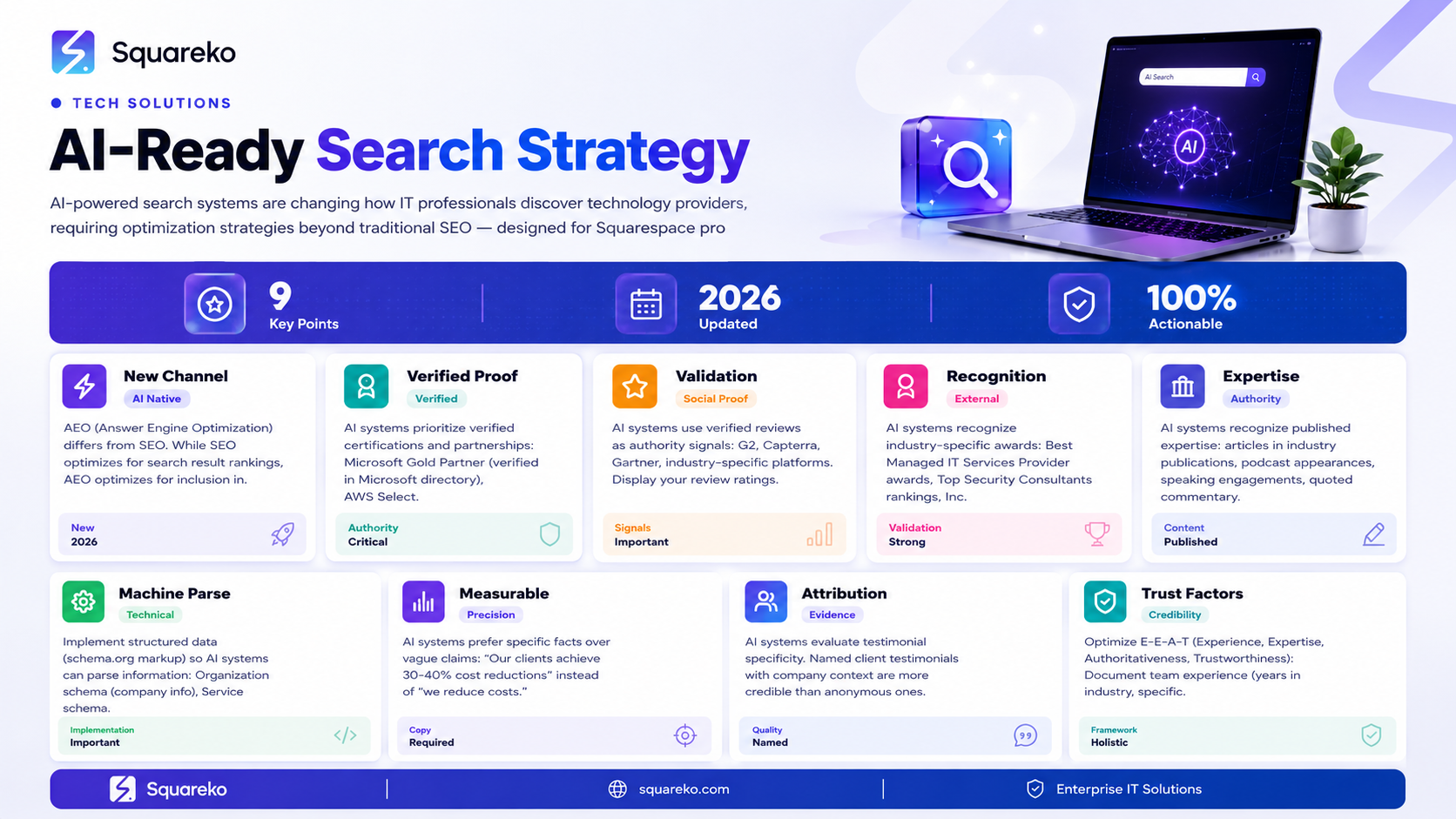
AI-powered search and generative AI tools are changing how IT buyers discover technology solutions providers, requiring new optimization strategies beyond traditional SEO
Authority signals, structured data, and verified expertise become more critical as AI systems rely on these signals to identify trustworthy vendors
AEO (Answer Engine Optimization) focuses on optimizing content for AI systems that answer questions, requiring different content strategies than traditional keyword optimization
IT services companies must ensure their expertise, certifications, and client success stories are discoverable by AI systems that compile vendor recommendations
Combining traditional SEO with AI-optimized content positioning creates the most comprehensive discovery strategy for 2026 and beyond
How AI Search Is Changing Technology Vendor Discovery
The way IT professionals discover and evaluate technology services providers is fundamentally changing due to AI search systems and generative AI tools. Understanding this shift is critical for technology solutions companies competing for attention in 2026 and beyond.
Traditional Search vs. AI-Powered Search
Traditional search (Google, Bing) presents a list of results, expecting the user to click through and evaluate content. AI-powered search (ChatGPT, Claude, specialized vendor discovery tools) processes information about vendors and returns synthesized answers, recommendations, and comparisons.
Example of traditional search experience:
IT director searches managed IT services provider
Search engine returns 10 links
IT director clicks links and compares information manually
Example of AI search experience:
IT director asks AI: What are the top managed IT services providers for healthcare companies with 100-500 employees in the Midwest? What certifications should I look for?
AI system synthesizes information about multiple providers, ranks them, and explains why certain providers are recommended
IT director reads the synthesized recommendation without visiting individual provider websites
This shift changes the game significantly. Rather than optimizing for clicks through to your website, you need to optimize for being selected by AI systems as a trustworthy, relevant recommendation.
Generative AI Tools and Vendor Research
IT professionals increasingly use generative AI tools for vendor research:
ChatGPT for understanding IT service categories, asking for recommendations
Specialized vendor discovery tools that aggregate information about technology providers
Industry-specific AI tools for finding specialized providers
Custom AI agents that evaluate multiple vendors based on specific criteria
These tools look for:
Comprehensive information about the vendor
Verified expertise and credentials
Proven client success (case studies, testimonials)
Specific details about services, pricing, certifications
Third-party validation of claims
Specialization indicators
The Shift to Authority-Driven Discovery
Traditional SEO optimizes for relevance (matching search keywords). AI search systems prioritize authority (trustworthiness of information sources). An AI system recommending managed IT services providers will prioritize providers with:
Verified certifications (Microsoft Gold Partner, SOC 2 compliance)
Client testimonials and case studies
Industry recognition and awards
Transparent information about services and practices
Published thought leadership
Verified compliance credentials
This is actually good news for IT services companies with genuine expertise and proven client success. Authority-driven discovery rewards companies that have actually built credible practices rather than companies that are best at marketing tricks.
Understanding AEO vs. SEO for Technology Services
AEO (Answer Engine Optimization) is the new discipline of optimizing your content for AI systems. It's distinct from SEO but related.
SEO Foundation
SEO optimizes for traditional search engines to appear in search results. SEO focuses on:
Keyword matching and relevance
Page rank and authority (backlinks)
Content quality and comprehensiveness
Technical site quality
SEO hasn't become obsolete—people still use traditional search. However, SEO alone is insufficient for 2026 discovery.
AEO Strategy
AEO optimizes for inclusion in AI-synthesized responses and recommendations. AEO focuses on:
Structured data that AI systems can parse
Clear demonstration of expertise and authority
Specific, factual information AI systems can verify
Transparency that builds AI trust
Comprehensive coverage of topics AI systems ask about
Combined SEO/AEO Strategy
The most effective 2026 strategy combines SEO and AEO:
Optimize for traditional search (people still use Google)
Optimize for AI systems (increasingly important discovery method)
Both approaches benefit from quality content, authority building, and transparent information
Your Squarespace website should serve both audiences simultaneously. Fortunately, much of the optimization helps both: quality content helps both traditional search and AI systems, authority signals benefit both, transparent information serves both.
Authority Signals for AI-Powered Recommendation Systems
AI systems identify trustworthy providers through authority signals—external validation that a vendor's claims are credible.
Vendor Certifications and Partnerships
AI systems recognize verified certifications and partnerships:
Microsoft Gold Partner: Verified through Microsoft's partner directory
AWS Select Technology Partner: Verified through AWS's partner program
Cisco Advanced Networking Partner: Verified certification
SOC 2 Type II Compliance: Third-party audited security practices
ISO 27001 Certification: Third-party verified information security
AI systems check these certifications through official directories. A claim to be a Microsoft Gold Partner is only credible if verified in Microsoft's official partner directory. Your website should:
State certifications prominently
Provide verification links (linking to Microsoft's partner page where your company is listed, for example)
Keep certifications current
Display partnership numbers or verification details
Third-Party Reviews and Ratings
AI systems use verified reviews as authority signals:
G2 reviews and ratings for your category
Capterra reviews if you're listed
Gartner reviews if applicable to your service
Industry-specific review platforms
Rather than hiding negative reviews, AI systems recognize that real vendors have mixed reviews. A vendor with no reviews at all is less credible than a vendor with mostly positive reviews and some negative ones.
Display your review ratings prominently on your website. Link to your verified review profiles so AI systems can verify your ratings. Respond to negative reviews professionally to show your commitment to improvement.
Industry Awards and Recognition
AI systems recognize industry-specific awards:
Best Managed IT Services Provider (industry awards)
Top 10 Security Consultants (industry rankings)
Inc. 500 fastest-growing companies
Industry publication features
Analyst firm recognition
If you've received industry recognition, display it prominently and link to the award or publication if possible.
Media Mentions and Thought Leadership
AI systems recognize published expertise:
Articles written by your team in industry publications
Podcast appearances and interviews
Speaking engagements at industry conferences
Quoted commentary in industry news
Publishing thought leadership positions you as an expert voice that AI systems trust.
Client Social Proof
AI systems evaluate the quantity and quality of client testimonials:
Named client testimonials (more credible than anonymous ones)
Video testimonials (more credible than text)
Specific case studies with measured outcomes
Long-term client relationships
Recognizable client names
AI systems recognize that client testimonials are more credible when specific and detailed rather than generic.
Structured Data and Semantic Markup for AI Discoverability
Structured data is information formatted specifically so AI systems can parse and understand it. Squarespace handles some structured data automatically, but you can enhance it.
Organization Schema
Organization schema tells AI systems about your company:
{
  "@context": "https://schema.org",
  "@type": "Organization",
  "name": "Acme IT Solutions",
  "url": "https://acmeit.com",
  "logo": "https://acmeit.com/logo.png",
  "description": "Managed IT services provider for mid-market healthcare companies",
  "foundingDate": "2010",
  "address": {
    "@type": "PostalAddress",
    "streetAddress": "123 Tech Street",
    "addressLocality": "Chicago",
    "addressRegion": "IL",
    "postalCode": "60601",
    "addressCountry": "US"
  },
  "telephone": "+1-312-555-0123",
  "email": "info@acmeit.com",
  "sameAs": [
    "https://linkedin.com/company/acme-it",
    "https://twitter.com/acmeitservices"
  ]
}
This structured data tells AI systems: what your company is, where it's located, what it does, how to contact you, and links to verified social profiles.
Service Schema
Service schema describes the services you offer:
{
  "@type": "Service",
  "name": "Managed IT Services",
  "description": "24/7 monitoring and management of IT infrastructure for healthcare organizations",
  "provider": {
    "@type": "Organization",
    "name": "Acme IT Solutions"
  },
  "hasCredential": [
    {
      "@type": "EducationalOccupationalCredential",
      "credentialCategory": "certification",
      "name": "Microsoft Gold Partner"
    },
    {
      "@type": "EducationalOccupationalCredential",
      "credentialCategory": "compliance",
      "name": "SOC 2 Type II"
    }
  ],
  "areaServed": {
    "@type": "Region",
    "name": "Midwest United States"
  }
}
This structured data tells AI systems what your service is, who provides it, what credentials validate it, and what areas you serve.
LocalBusiness Schema
LocalBusiness schema helps AI systems understand your company if you have physical locations:
{
  "@type": "LocalBusiness",
  "name": "Acme IT Solutions Chicago Office",
  "address": {
    "@type": "PostalAddress",
    "streetAddress": "123 Tech Street",
    "addressLocality": "Chicago",
    "addressRegion": "IL"
  },
  "telephone": "+1-312-555-0123",
  "openingHoursSpecification": {
    "@type": "OpeningHoursSpecification",
    "dayOfWeek": ["Monday", "Tuesday", "Wednesday", "Thursday", "Friday"],
    "opens": "08:00",
    "closes": "18:00"
  }
}
Review and AggregateRating Schema
Structured review data helps AI systems understand your client satisfaction:
{
  "@type": "Service",
  "name": "Managed IT Services",
  "aggregateRating": {
    "@type": "AggregateRating",
    "ratingValue": "4.8",
    "reviewCount": "47"
  },
  "review": [
    {
      "@type": "Review",
      "author": {
        "@type": "Person",
        "name": "John Smith"
      },
      "reviewRating": {
        "@type": "Rating",
        "ratingValue": "5"
      },
      "reviewBody": "Acme's team has been exceptional. They reduced our infrastructure costs by 35% and our systems are more reliable than ever."
    }
  ]
}
Implementing Structured Data on Squarespace
Squarespace automatically implements basic organization schema. To enhance it:
Access your site settings
Use the SEO section to add additional schema
Test your schema using Google's Structured Data Testing Tool
Include schema in your page headers
If you're not technically comfortable implementing schema, your Squareko team can help add the necessary markup.
Content Strategy for AI Systems
Optimizing content for AI systems requires different approaches than traditional SEO content strategy.
Comprehensive Topic Coverage
AI systems need comprehensive information to generate accurate recommendations. Rather than thin pages covering topics superficially, create comprehensive pages that thoroughly address topics AI systems ask about:
What is managed IT services and how does it work?
What are the benefits of managed IT services?
What should businesses look for in managed IT services providers?
How does managed IT services pricing work?
What's the difference between managed IT services and break-fix support?
A single comprehensive page addressing all these questions serves AI systems better than scattered thin content.
Question-Answer Format
AI systems learn from Q&A content. Include FAQ sections on your pages answering questions prospects and AI systems ask:
What certifications should a managed IT services provider have?
How long does it take to implement managed IT services?
What security certifications are most important?
How do managed IT services differ from hiring internal IT staff?
Each question-answer pair provides data AI systems use to understand your services.
Specific, Verifiable Facts
AI systems prefer specific facts over vague claims:
Instead of: We reduce infrastructure costs significantly
Use: Our clients typically achieve 30-40% infrastructure cost reductions, with average first-year savings of $50,000 for companies with 100-300 employees
Specific facts are more credible and more useful for AI systems generating recommendations.
Attribution and Sourcing
When making claims, cite your sources:
According to Gartner's Magic Quadrant for Managed IT Services, the following capabilities are critical.
Industry research shows that 75% of mid-market companies are considering cloud migration within 12 months
Attribution helps AI systems verify claims and increases credibility.
Expert Author Information
Identify who wrote your content and their credentials:
Author name and bio
Author's relevant certifications and experience
Author's role in your organization
AI systems trust content written by identifiable experts more than anonymous corporate content.
Expertise Documentation and E-E-A-T Optimization
E-E-A-T (Experience, Expertise, Authoritativeness, Trustworthiness) is critical for AI recommendation systems.
Experience Documentation
Document your team's actual experience:
Years in IT services industry
Number of successful projects completed
Types of organizations served
Specific expertise areas
Rather than vague claims like experienced team, provide specific experience documentation:
Our lead architect has 15+ years of IT infrastructure experience, including 100+ successful infrastructure projects across healthcare, manufacturing, and financial services
Expertise Demonstration
Demonstrate expertise through:
Detailed technical content explaining how solutions work
Case studies showing complex problem-solving
Published articles in industry publications
Speaking engagements at industry conferences
Patent filings or proprietary methodologies
Authoritativeness Building
Build external authority through:
Industry certifications and partnerships
Third-party reviews and ratings
Media mentions and quotes
Industry awards and recognition
Analyst firm inclusion
Trustworthiness Establishment
Establish trustworthiness through:
Transparent pricing and service descriptions
Clear service level agreements
Published security and compliance practices
Client testimonials with verified attribution
Conflict-of-interest transparency (if you're recommending specific vendors, disclose partnerships)
Building Your IT Services Company's AI-Ready Website
Creating an AI-ready website means implementing several elements:
Technical Foundations
Implement comprehensive structured schema (Organization, Service, LocalBusiness, Review)
Ensure clean site architecture that's easy for AI crawlers to parse
Publish a sitemap
Implement hreflang tags if you're multilingual
Ensure fast page load speeds (relevant for AI crawlers)
Content Audit and Enhancement
Audit existing content for specificity and comprehensiveness
Add detailed case studies with measured outcomes
Create FAQ sections addressing questions AI systems ask
Document team member expertise and credentials
Add author information to all major content pieces
Authority Building
Pursue industry certifications
Pursue third-party reviews
Publish thought leadership content
Seek industry recognition and awards
Build media relationships for mention opportunities
Transparency Enhancement
Create detailed security and compliance pages
Publish transparent service descriptions
Display SLAs and service commitments
Show client logos and testimonials
Link to verification sources (partner directories, review platforms)
Let Squareko Optimize Your Website for AI Discovery
The discovery landscape is shifting. AI systems will increasingly influence how IT professionals find technology services providers. Optimizing for this new landscape requires thinking beyond traditional SEO.
Many technology solutions companies will wait too long to adapt to AI-powered discovery. By then, competitors who invested in AI optimization will have established dominance. The time to optimize for AI systems is now, while the landscape is still emerging.
At Squareko we specialize in building AI-ready websites for technology solutions companies. We help IT services companies optimize for both traditional search and AI-powered discovery systems, ensuring your expertise, certifications, and client success stories are discoverable by the AI systems that will increasingly influence how IT professionals find vendors.
FAQs
-
No. Traditional search (Google) remains the dominant discovery method in 2026. AI search is growing but not yet dominant. Optimize for both. The good news is that many strategies serve both audiences: quality content, authority building, and transparent information benefit both traditional and AI-powered discovery.
-
Start with Organization schema to tell AI systems who you are, and Service schema to describe your services. These are the foundation. Then add Review schema to show client satisfaction and AggregateRating to display your ratings. Service provider schema can come next if you're helping clients understand your qualifications.
-
Content is AI-ready if it's specific, comprehensive, well-sourced, and attributed to identifiable experts. Ask: Is this specific enough for an AI system to extract facts? Is it comprehensive enough to answer all questions about this topic? Does it cite sources? Is it written by an identifiable expert? If yes to all, it's AI-ready.
-
No. Create content that serves human readers first, which also serves AI systems. Content that's clear, comprehensive, and authoritative for humans is typically also good for AI systems. Trying to game AI systems creates poor human experiences and backfires.
-
Very important. AI systems use testimonials to verify your effectiveness and client satisfaction. The more specific testimonials you have (with named clients, roles, and measurable outcomes), the more credible you appear to AI systems. Video testimonials are even more credible.
-
You can't directly control AI systems, but you can optimize the information available about you. Provide comprehensive, specific, credible information through your website, structured data, certifications, reviews, and case studies. AI systems will use this information to form accurate recommendations.
-
First, determine why you weren't recommended. Are you missing certifications your competitor has? Do they have more client testimonials? Are they more transparent about pricing and practices? Then, invest in addressing those gaps. You can't game AI systems, but you can improve the actual factors they evaluate.
-
AI systems operate similarly globally, but some regional AI systems may prioritize local providers or regional certifications. If you serve multiple regions, ensure you have relevant certifications and social proof for each market.
From custom website design to SEO strategy, we help businesses launch a site that looks professional and performs better.

Author Bio
I'm Walid Hasan, a Certified Squarespace Expert and Squarespace Circle Platinum Partner with over 12 years of hands-on experience designing and optimizing high-performing websites. Over the years, I've had the privilege of building more than 2,000 Squarespace websites for clients around the world, always focusing on clean design, strong user experience, and conversion-driven results.