How to Use Squarespace Case Studies and Client Success Stories to Win IT Contracts
Key Takeaways Case Studies and Client Success Stories to Win IT Contracts
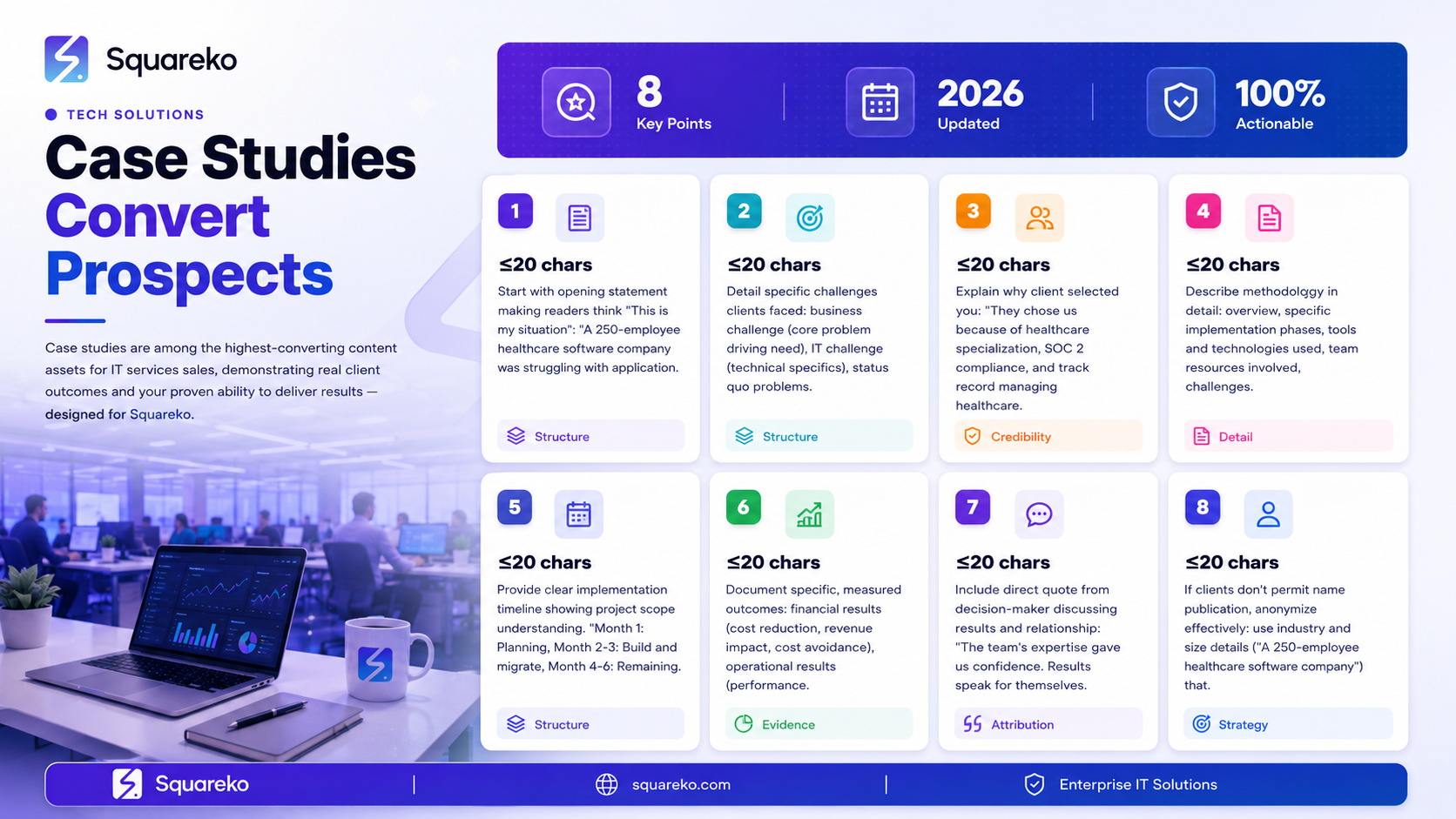
Case studies are among the highest-converting content assets for IT services sales, demonstrating real client outcomes and your ability to deliver results
Effective IT services case studies balance specificity (showing you understand the client's challenges) with anonymization when necessary for client confidentiality
Case study structure should progress from challenge to solution to results, using measured outcomes and specific metrics rather than vague improvements
Squarespace's design flexibility allows you to create visually compelling case study pages that serve both reader engagement and lead generation
Strategic case study distribution across your website (service pages, homepage features, downloadable PDFs) maximizes their impact on prospect conversion
Why Case Studies Are Critical for IT Services Sales
Case studies are social proof in their most powerful form. While testimonials provide credibility through client voices, case studies demonstrate your capabilities through detailed narration of real client success.
The Prospect's Perspective
When an IT director is evaluating managed IT services providers, they ask: Has this company handled situations like mine before? Can they deliver the results they promise? What was the actual implementation like?
Testimonials partially answer these questions, but case studies answer them completely. A case study about a company similar to theirs, facing similar challenges, achieving similar outcomes, is far more persuasive than any marketing claim.
Higher Conversion Rates
Studies consistently show that B2B buyers converting in later decision stages heavily weight case studies. A prospect reading your case study about a successful cloud migration for a healthcare company is further along in their buying journey than someone reading your homepage. Case studies drive disproportionately high conversion rates because they address advanced buying stage questions.
Reduced Sales Cycle Length
Prospects who see relevant case studies before contacting you require shorter sales conversations. They already understand what your service looks like, what implementation involves, what outcomes are realistic. Your sales conversation can focus on their specific situation rather than explaining your service and justifying why they should consider it.
Competitive Differentiation
Many IT services companies claim to deliver results. Fewer publish case studies proving they deliver results. Publishing detailed case studies differentiates you from competitors who rely on marketing claims without evidence.
SEO and Organic Traffic
Case studies support SEO by providing comprehensive content addressing prospect questions, including keywords naturally, and providing material for long-form pages that rank well for competitive terms. A 2000+ word case study addressing cloud migration for healthcare will rank better than a generic cloud services page.
Case Study Structure That Converts Prospects
Effective case studies follow a proven structure that builds narrative momentum while providing the information prospects need.
Opening Hook
Start with a compelling statement that makes the reader think This is like my situation:
A 250-employee healthcare software company was struggling with application performance and expensive database infrastructure
After an acquisition, a financial services firm needed to integrate disparate IT systems within 60 days without business disruption
A manufacturing company was drowning in manual IT processes and couldn't scale IT support as they grew
The opening hook should reference company characteristics (industry, size, situation) that similar prospects recognize.
Challenge Section
Detail the specific challenges the client faced:
Business Challenge: The core business problem driving the need for your service. The company needed to reduce infrastructure costs while improving system reliability
IT/Technical Challenge: The specific technical problem. Their on-premises servers were aging, required constant maintenance, and consumed 40% of IT staff time on routine management
Status Quo Problems: Why existing situation wasn't working. Their current infrastructure was costing $200k annually in hardware, maintenance, and IT staffing, with only 95% uptime.
Decision Criteria: What factors were important in selecting a solution. They needed minimal disruption during migration, HIPAA compliance for healthcare data, and measurable cost reduction within 12 months.
This section should make your target prospect think Yes, this is exactly our situation.
Why They Selected Your Company
Explain why the client chose you:
They selected our firm because of our healthcare specialization, SOC 2 compliance, and track record of managing healthcare infrastructure
Our Microsoft Gold Partner status and proven Azure expertise gave them confidence we could integrate their complex systems
This section gives other prospects reasons to choose you. Be specific about what they valued.
Solution Approach
Describe your solution methodology:
Overview: High-level approach. We implemented a phased cloud migration approach, moving applications in waves to minimize disruption
Phases: Specific implementation phases. Phase 1: Assessment and planning (2 weeks). Phase 2: Infrastructure build-out in cloud (3 weeks). Phase 3: First application migration (2 weeks). Phase 4: Remaining applications (ongoing, 1 application per week)
Tools and Technology: Specific technology used. We used AWS infrastructure, native AWS services where applicable, and third-party tools for system integration
Team and Resources: Who was involved. Our team included 2 cloud architects, 2 infrastructure engineers, and a project manager, with their IT director involved weekly
Challenges Encountered and Resolution: Real-world obstacles overcome. We encountered issues with legacy application compatibility. We resolved this by... [specific solution]
Real-world case studies mention challenges and how you handled them. Case studies claiming everything went perfectly are less credible than ones acknowledging real obstacles and solutions.
Timeline and Implementation Details
Provide a clear timeline:
Month 1: Planning and preparation
Month 2-3: Infrastructure build and initial migrations
Month 4-6: Remaining applications migrated
Month 6-12: Optimization and integration
Timeline builds confidence that they understand implementation scope and can manage stakeholder expectations.
Results and Outcomes
Document specific, measured outcomes:
Financial Results: Cost reduction, revenue impact, cost avoidance. Infrastructure costs dropped from $200k to $120k annually—a 40% reduction. Additionally, the time saved by IT staff (estimated 0.5 FTE) was redirected to development, generating additional $50k in internal value
Operational Results: Performance improvements, reliability, efficiency. System uptime improved from 95% to 99.9%. Average application response time improved by 30%. IT staff time spent on infrastructure maintenance decreased from 40% to 10% of their time
Strategic Results: Enablement of future growth, improved competitiveness, risk reduction. The company is now capable of scaling infrastructure without adding IT staff. They achieved HIPAA compliance certification and reduced security incident risk. The improved infrastructure has supported 50% revenue growth
Specific metrics are far more credible than vague improvements. Improved efficiency means nothing. Reduced infrastructure costs by 40%, saving $80k annually is compelling.
Client Testimonial
Include a direct quote from the decision-maker:
I was initially concerned about moving critical healthcare applications to the cloud, but the team's expertise and methodical approach gave us confidence. The results speak for themselves. We've reduced costs significantly and improved reliability. I would recommend them without hesitation. — Sarah Johnson, IT Director, Midwest Healthcare Systems
Include the client's name, title, and company (or anonymized version if necessary).
Lessons and Takeaways
End with lessons learned:
What would they do differently if starting over?
What surprised them?
What advice would they give other companies considering similar solutions?
These takeaways give other prospects valuable perspective from someone who's walked the path.
Anonymization and Confidentiality Strategies
Many companies are reluctant to publish case studies because of confidentiality concerns. However, case studies can be anonymized while remaining valuable.
When to Use Company Names
Publishing named case studies is ideal. Company names provide credibility. If you've worked with recognizable companies, publishing their names and logos builds authority.
Request permission before publishing named case studies. Most clients will agree if you offer them visibility in return (featuring them on your website, mentioning them in marketing).
Effective Anonymization
If clients don't permit name publication, anonymize effectively:
Industry Anonymization: Instead of Midwest Healthcare Systems, use A 250-employee healthcare software company
Geographic Anonymization: Instead of Chicago-based manufacturing company, use Midwest manufacturing company
Size/Scale Specificity: Include size and scale details (employee count, annual revenue range) that help similar companies identify with the story
Specific Enough: Provide enough detail that prospects can envision themselves in the story
A case study about A company is worthless. A case study about A 200-300 employee healthcare software company in the Midwest is valuable even without the company name.
Partial Attribution
Consider partial attribution: A major healthcare technology provider or A top-50 financial services firm provides some credibility without full company name.
Verification Without Attribution
In some cases, you can note Results verified with client even without attribution. This signals that the case study is based on real results, not hypothetical examples.
Multiple Case Studies with Varying Attribution
Publish some named case studies (maximum credibility) and some anonymized case studies (broader applicability). This provides both credibility and reach.
Documenting Measurable Outcomes and ROI
The most powerful case studies quantify outcomes and document ROI.
Financial Metrics
Document financial impact:
Cost Reduction: How much did they save? Infrastructure costs reduced from $200k to $120k annually
Revenue Impact: Did your service enable revenue growth? Cloud infrastructure supported 50% revenue growth without needing additional IT staff
Cost Avoidance: What expensive problems did you prevent? Prevented need to hire 2 additional IT staff members (estimated $150k annual cost)
ROI Calculation: Show the return on investment. Initial implementation cost: $40k. Annual savings: $80k. ROI: 200% in first year, continued $80k annual savings
Financial metrics are the most compelling outcomes because they're measurable and universally understood.
Operational Metrics
Document operational improvements:
Uptime/Reliability: System availability improvement. Improved uptime from 95% to 99.9%
Performance: Speed and responsiveness improvements. Reduced application load time by 60%
Efficiency: Time and resource savings. Reduced infrastructure management time from 40% to 10% of IT staff capacity
Scalability: Ability to grow. Infrastructure now supports 3x application growth without additional capital investment
Operational metrics demonstrate that your solution actually works.
Strategic Metrics
Document strategic improvements:
Competitive Position: Improved competitive capabilities. Now able to launch new products faster than competitors
Risk Reduction: Compliance and security improvements. Achieved HIPAA compliance, reducing regulatory risk
Future Enablement: Ability to pursue new initiatives. Cloud infrastructure enables AI implementation road map
Strategic metrics show long-term value beyond immediate operational improvements.
How to Gather Metrics
Collect outcome data:
At Implementation: What was the baseline? What were the starting metrics?
30-60-90 Days: What improvements occurred in the immediate post-implementation period?
6-12 Months: What longer-term benefits accrued? (Often reveal time-dependent value like avoided hiring)
Ongoing: What's the sustained value? (Is value increasing or decreasing over time?)
Build metric tracking into your implementation process. At project completion, document baseline and target metrics. Follow up quarterly to document ongoing outcomes.
Visual Design and Presentation
How you present case studies affects their persuasiveness.
Visual Hierarchy and Readability
Case studies should be easy to scan:
Use clear headings for each section (Challenge, Solution, Results)
Use white space between sections
Highlight key metrics visually
Use pull quotes from client testimonials
Use images where they add value
Case study pages should be visually inviting, encouraging readers to engage rather than looking like dense documents.
Before/After Visuals
When applicable, use before/after graphics or charts:
Infrastructure diagrams showing before and after architecture
Performance charts showing improvement over time
Cost comparison charts
Timeline graphics showing implementation phases
Visual representation of improvements is more compelling than text descriptions.
Client Logo and Attribution
Display the client's logo and name (if permitted) prominently. Client logos provide immediate credibility. If anonymized, show a representative image of the industry (healthcare, manufacturing, etc.) to help prospects identify with the story.
Case Study Length
Aim for 1500-2500 word case studies on your website. This length provides enough detail to be compelling without requiring excessive reading. Longer case studies (3000+ words) work as downloadable PDFs for prospects wanting deep-dive detail.
Case Study Formats and Distribution
Effective case study strategies use multiple formats and distributions.
Website Case Study Pages
Create individual web pages for each case study. Each page should be:
Optimized for search (including keywords naturally)
Visually appealing and easy to scan
Structured for clear narrative flow
Including multiple CTAs to contact you
Link case study pages from your service pages, homepage, and other relevant content.
Case Study PDF Downloads
Create downloadable PDF versions of your case studies that prospects can request in exchange for contact information. PDF case studies can be more visually designed than web pages and allow you to gate detailed information for lead generation.
Downloadable PDFs should mirror the web version but can include additional detail, appendices, or supplementary information.
Case Study Gallery Page
Create a dedicated page displaying all your case studies in gallery format. This page should showcase:
Case study titles
Brief summaries
Client industry and size
Key metrics/outcomes
Links to full case studies
A case study gallery helps prospects browse all your work and find relevant examples.
Industry-Specific Case Study Collections
Group case studies by industry if you serve multiple verticals:
Case Studies for Healthcare
Case Studies for Manufacturing
Case Studies for Financial Services
Industry-specific groupings help prospects quickly find relevant examples.
Video Case Studies
Consider creating short video case studies (3-5 minutes) featuring the client:
Client describes their challenge
Client describes why they selected your company
Client discusses the implementation experience
Client shares the outcomes achieved
Video case studies provide more intimate social proof than written case studies.
Creating Case Studies on Squarespace
Squarespace provides several ways to implement case studies:
Dedicated Case Study Blog Post Series
Create case studies as blog posts. This approach:
Integrates case studies with your blog
Provides SEO benefits (blog posts rank well)
Allows comments and engagement
Enables easy categorization and tagging
Squarespace's blog functionality handles formatting, publishing, and archiving naturally.
Case Studies Using Portfolio Block
If you have Squarespace with portfolio capabilities, use the portfolio block to create case study galleries:
Create a Case Studies portfolio section
Add individual case studies as portfolio items
Include images, description, and links
Allow filtering by industry or service
Portfolio blocks create visually organized case study galleries.
Custom Case Study Page Design
Create a dedicated case study section with custom page design:
Create a parent page Case Studies
Create child pages for each individual case study
Use Squarespace's design blocks for visual hierarchy
Include image galleries for before/after visuals
This approach offers maximum design flexibility.
Case Study Landing Page for Lead Generation
Create case study pages designed specifically for lead generation:
Feature a compelling case study
Include limited detail on the page (teaser)
Include a prominent CTA: Download the full case study
Gate the PDF with an email signup form
This approach converts interested prospects into leads.
Let Squareko Develop Your Case Study Strategy
Case studies are one of the highest-ROI content investments you can make. A single case study that resonates with your target market can generate dozens of qualified leads. Yet many IT services companies don't publish case studies because they haven't documented them or aren't sure how to approach the process.
Building a comprehensive case study library takes time and systematic effort. You must document outcomes, work with clients on naming and anonymization, create compelling narratives, and design visual presentations. But the investment pays significant dividends in prospect conversion and competitive differentiation.
At Squareko we help IT services companies develop case study strategies and create compelling case studies on Squarespace. From working with you to identify the best client stories, to documenting outcomes and creating narrative structure, to designing and publishing on Squarespace, we support the entire case study development process.
FAQs
-
Start with 3-5 case studies covering your major service offerings. Three case studies showing different industries, client sizes, and outcomes provide enough social proof to materially improve conversion. More case studies continue to improve results, but 3-5 is the minimum for noticeable impact.
-
Yes, but case studies with specific metrics convert better than those with only qualitative descriptions. If you don't have specific metrics currently, commit to documenting them for future projects. For current clients without metrics, use qualitative testimonials about their satisfaction and results.
-
Case studies with challenges overcome are actually more credible than perfect case studies. Real implementations encounter obstacles. Publishing how you overcame those obstacles builds confidence. However, only publish case studies where you ultimately delivered value. Don't publicize failed projects.
-
Aim for 1-2 new case studies quarterly as you complete client projects. This cadence gives you a growing library while keeping case studies relatively current. You don't need new case studies constantly—older case studies remain valuable.
-
Yes. Specific metrics (40% cost reduction, 99.9% uptime) are credible even without company names. Anonymization as "A 200-300 employee healthcare company" provides enough context for similar prospects to identify with the story while protecting client confidentiality.
-
Avoid including direct client contact in your case studies. This can expose clients to unwanted sales outreach. Instead, note "Results verified with [client name and title]" or include only general company information. Protect your client relationships.
-
Ask directly: "We'd like to feature your company in a case study showcasing the results we achieved. Would you be willing to participate?" Offer them visibility in return (mention on your website, press release, etc.). Most satisfied clients will agree if you handle the time burden by writing the initial draft.
-
Yes. Publish case studies in multiple formats (web pages, downloadable PDFs, video, image-based story) and measure which formats drive more lead generation. Video case studies convert at different rates than written. Downloadable PDFs gate information differently than web pages. Test formats to understand what works for your audience.

From custom website design to SEO strategy, we help businesses launch a site that looks professional and performs better.

Author Bio
I'm Walid Hasan, a Certified Squarespace Expert and Squarespace Circle Platinum Partner with over 12 years of hands-on experience designing and optimizing high-performing websites. Over the years, I've had the privilege of building more than 2,000 Squarespace websites for clients around the world, always focusing on clean design, strong user experience, and conversion-driven results.