Real Estate Agent Local SEO on Squarespace: Rank for '[Location] Realtor' Keywords in 2026
Introduction
The property market in 2026 is unforgiving. Buyers and sellers search for their local agent on Google with hyper-specific queries: "best estate agent in Kensington", "top realtor near me", "property agents in Manchester". If your Squarespace website doesn't appear in the top three local results, you're losing deals to competitors who've already mastered local SEO.
This guide shows you exactly how to rank your real estate agency website for location-specific keywords on Squarespace, dominate Google Maps results, and capture local search traffic that converts.
Key Takeaways Real Estate Agent Local SEO on Squarespace: Rank for '[Location] Realtor' Keywords in 2026
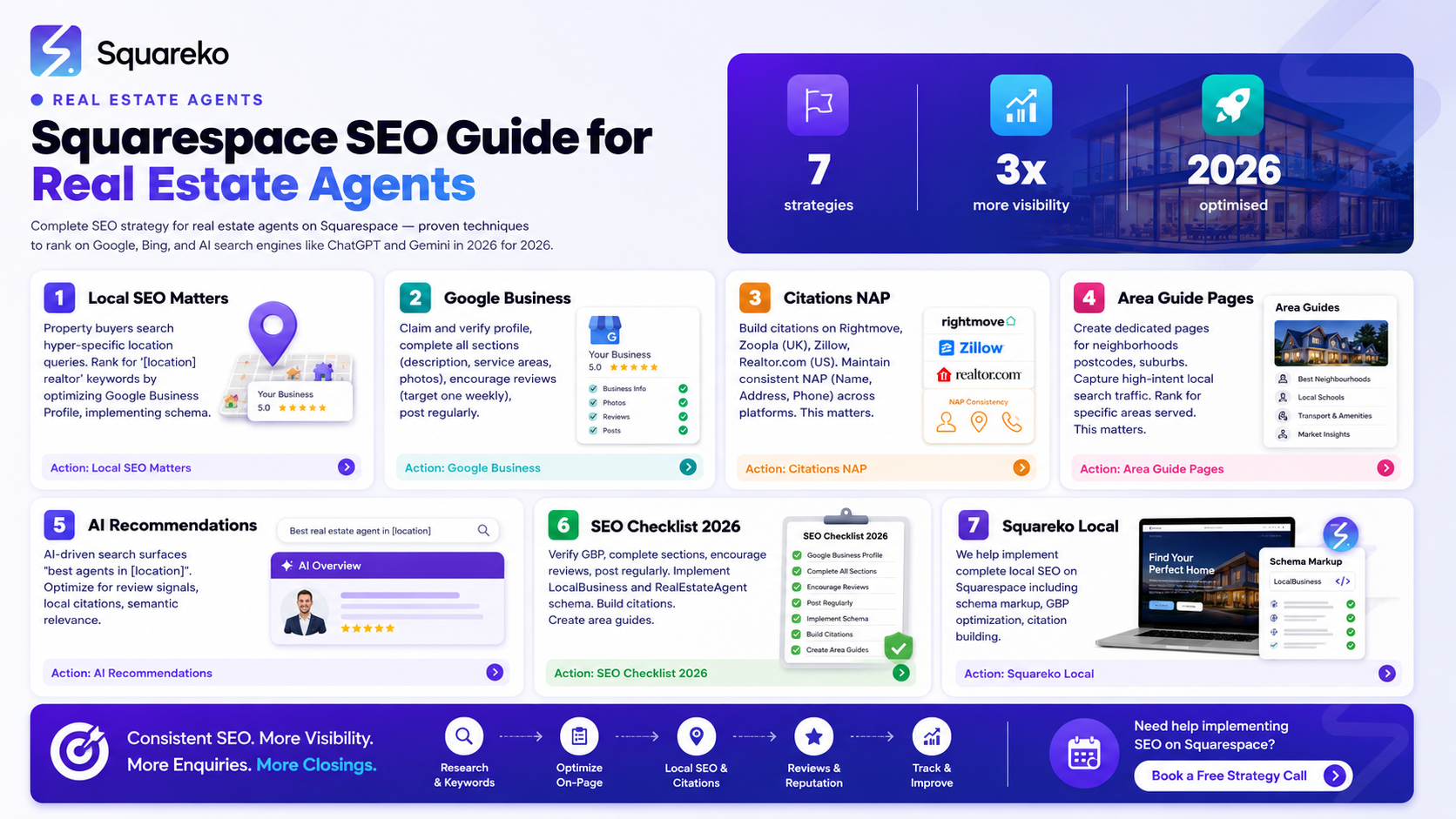
Local SEO for estate agents requires schema markup – implement Local Business and Real Estate Agent schemas with geographic service area and property type specialisation to signal authority to Google
Google Business Profile is non-negotiable – verify your profile, complete all sections, collect reviews, and post regularly; this is your primary ranking signal for local queries
Build citations on property portals – Rightmove and Zoopla (UK), Zillow and Realtor.com (US) are your foundational citation sources; consistent NAP (Name, Address, Phone) data across all platforms improves local visibility
Create location-specific area guide pages – don't just rank for your city; build dedicated pages for neighbourhoods, postcodes, and suburbs to capture high-intent local search traffic
AI-driven recommendations now influence local results – search engines use AI to surface "best agents in [location]"; optimising for review signals, local citations, and semantic relevance is critical
Squarespace's native SEO tools support local ranking – use custom domains, structured data integration, and clean URL structures to ensure Squarespace doesn't limit your local visibility
A systematic 2026 checklist accelerates your rank time – site speed, mobile responsiveness, local content, and regular GBP updates compound into faster local rankings
Why Local SEO Matters for Estate Agents in 2026
The property search behaviour has shifted dramatically. Estate agents and realtors can no longer rely on brand recognition or phone book listings. In 2026, seven in ten property buyers begin their search on Google with location-specific queries. They're not searching for "real estate agent UK"; they're searching for "agents in my postcode" or "top realtor in [suburb]".
Local search results now display a three-pack: the Google Maps results showing nearby agents, their reviews, and service areas. If your agency isn't visible in this pack, potential clients never reach your website.
The competitive intensity has increased. Most property professionals now understand basic SEO. The difference between ranking in position one and position four is massive—position one captures approximately 35% of clicks, whilst position four drops to 6%. This is why local SEO for real estate agents isn't optional; it's survival.
Google Business Profile Optimisation for Real Estate Professionals
Your Google Business Profile (GBP) is your primary ranking asset for local searches. It appears before your website in search results and is the deciding factor in whether clients click through to learn more about your agency.
Claim and Verify Your Profile
First, verify that your GBP is claimed and verified. Navigate to Google Business Profile and search for your agency name. If it exists, claim it. If it doesn't exist, create one. Verification typically involves a postcard sent to your office address or a phone verification process.
Complete All Profile Sections
Incompleteness signals low quality to Google. Fill every section:
Business name – use your registered trading name, not variations
Category – select "Real Estate Agent" or "Property Management" depending on your specialism
Description – write 750–1,000 characters describing your agency, specialisms, years in business, and service areas
Address and phone – ensure this matches your website and property portal profiles exactly
Website URL – link to your Squarespace homepage
Hours – list when you're available for viewings and consultations
Photos – upload 10–15 professional images showing your team, office, and featured properties
Service areas – explicitly list all postcodes, suburbs, or regions you serve; this is critical for local ranking signals
Encourage and Respond to Reviews
Reviews are the strongest ranking signal in local search. Property buyers trust peer reviews more than agency copy. Target at least one review per week through:
Post-transaction requests – email recent clients asking for a Google review; offer a simple review link
Follow-up calls – phone successful buyers and sellers; many will leave a review if you provide the direct link
In-office prompts – display a QR code in your office pointing to your GBP review section
Respond to all reviews, positive and negative. Thank clients for positive reviews within 48 hours. For negative reviews, respond professionally, acknowledge concerns, and offer to resolve issues offline. This shows Google that you're active and responsive.
Post Regularly to Your GBP
Google rewards activity. Post property listings, market updates, or agency news to your GBP at least twice per week. Posts appear in the GBP profile and can drive traffic to your website. Use posts to highlight new listings, sold properties, or local market insights.
Schema Markup for Real Estate Agencies: Local Business and Real Estate Agent
Schema markup tells search engines what your content is about. For real estate agents, two schema types are essential: Local Business and Real Estate Agent.
Local Business Schema with Geographic Service Area
Implement a Local Business schema on your homepage and key pages. This tells Google your business type, location, contact details, and service areas.
{
  "@context": "https://schema.org/",
  "@type": "RealEstateAgent",
  "name": "Example Estate Agents",
  "url": "https://www.exampleestateagents.co.uk",
  "telephone": "+44201234567",
  "email": "info@exampleestateagents.co.uk",
  "address": {
    "@type": "PostalAddress",
    "streetAddress": "123 High Street",
    "addressLocality": "Chelsea",
    "addressRegion": "London",
    "postalCode": "SW3 4AB",
    "addressCountry": "GB"
  },
  "areaServed": [
    {
      "@type": "City",
      "name": "Chelsea"
    },
    {
      "@type": "City",
      "name": "Knightsbridge"
    },
    {
      "@type": "PostalCodeRange",
      "postalCodePrefix": "SW3"
    }
  ],
  "sameAs": [
    "https://www.google.com/maps/...",
    "https://www.rightmove.co.uk/...",
    "https://www.zoopla.co.uk/..."
  ],
  "aggregateRating": {
    "@type": "AggregateRating",
    "ratingValue": "4.8",
    "reviewCount": "47"
  },
  "priceRange": "$$"
}
Property Type Specialisation
If your agency specialises in specific property types (luxury homes, investment properties, commercial real estate), add property type specialisation to your schema:
{
  "@context": "https://schema.org/",
  "@type": "RealEstateAgent",
  "name": "Luxury Property Specialists Ltd",
  "specialization": [
    "Luxury Residential Sales",
    "Investment Properties",
    "Listed Buildings"
  ],
  "knowsAbout": [
    "Residential Real Estate",
    "Investment Real Estate",
    "Property Management"
  ]
}
Squarespace allows schema markup insertion via custom code blocks in the footer or via third-party SEO apps. We recommend using Squarespace's native structured data settings if available, or installing a schema app from the Squarespace App Market.
Implement on Key Pages
Don't just use schema on your homepage. Implement LocalBusiness schema with different areaServed values on location-specific pages . This signals to Google that you have dedicated content for multiple areas.
Property Portal Citations and NAP Consistency
A citation is any online mention of your business name, address, and phone number (NAP). Property portals are your most important citation sources because Google and property buyers trust them. They carry significant local ranking weight.
UK Citation Strategy
For UK-based estate agents, build citations on:
Rightmove – the UK's largest property portal; nearly mandatory for UK agents. Ensure your agency profile is complete with logo, description, and all office locations
Zoopla – second-largest portal; similar importance to Rightmove. Maintain consistent agency information
On The Market – newer competitor gaining traction; build a presence here as well
Property Shark and Prime Location – secondary portals worth considering
US Citation Strategy
For US-based real estate professionals, prioritise:
Realtor.com – backed by the National Association of Realtors; highest authority
Zillow – largest property search site in the US; essential for visibility
Trulia – owned by Zillow; often mirrors Zillow data but worth claiming
Redfin – newer platform growing in influence
Local chamber of commerce and Better Business Bureau (BBB) – secondary but valuable
NAP Consistency Protocol
Inconsistent business information confuses search engines and harms your local ranking. Implement this protocol:
Establish your primary NAP – decide on one official business name, address format, and phone number
Document the standard – create an internal style guide for how NAP should appear across all platforms
Audit all citations – search for your business name online and document every mention
Standardise existing citations – update profiles on property portals, local directories, and review sites to match your primary NAP exactly
Monitor quarterly – set a quarterly audit schedule to catch new citations or inconsistencies
Example NAP standardisation:
Correct: "Example Estate Agents Limited, 123 High Street, Chelsea, London SW3 4AB, United Kingdom, +44 (0)20 1234 567"
Avoid: "Example Estate Agents Ltd", "123 High St Chelsea London", "+44 201234567” (variations confuse Google)
Creating Location-Specific Area Guide Pages
Generic content ranks poorly for local search. Generic pages like "Buy a House in London" compete against thousands of other sites. But location-specific pages like "Buy a House in Fulham: Your Complete Guide" face far less competition and rank faster.
Structure of an Area Guide Page
Each area guide page should include:
H1 and meta title – include the location name and primary keyword: "Buy Property in Fulham: Complete Guide to the Area | Example Estate Agents"
Introduction (150–200 words) – explain why the area matters, who moves there, and key characteristics
Area overview section – demographics, transport links, schools, amenities, local facilities
Property market snapshot – recent sold prices, average property values, market trends, local demand
Lifestyle and community – local attractions, restaurants, parks, cultural amenities
Schools and education – Ofsted ratings, university proximity, educational facilities
Transport and commuting – train stations, bus routes, motorway access, commute times to business districts
Why choose this area – compelling reasons why your agency's clients choose this location
Our local expertise – your agency's track record in the area, testimonials, sold properties
Call to action – property valuation request, consultation booking, newsletter signup
Implementation on Squarespace
Create a new page for each area you serve. Use Squarespace's page hierarchy to organise these under a parent "Areas We Cover" page. This creates logical site structure and helps Google understand your local service areas.
Example URL structure:
/areas/fulham
/areas/chelsea
/areas/kensington
/areas/canary-wharf
Each page should be 1,500–2,500 words of original content. Include local images, property photos, local landmark photos, and testimonials from clients in that area. This signals deep local knowledge.
Postcode-Level Pages for Competitive Markets
In highly competitive markets, create postcode-specific pages . These capture ultra-local searches with high buyer intent.
How AI-Mediated Local Recommendations Shape Real Estate Search
In 2026, Google and other search engines increasingly use AI to understand user intent and recommend the "best" or "most relevant" results. This affects how real estate agents rank locally.
AI Understanding of "Best Agent in [Location]"
When a user searches "best estate agent in Chelsea", Google's AI considers:
Review signals – aggregate rating, review count, review recency, review sentiment
Citation authority – presence on Rightmove, Zoopla, and other trusted platforms with positive mentions
Semantic relevance – does your website and GBP content match what the user is searching for?
Engagement signals – click-through rate from search results, time on site, pages per session
Local authority – site prominence in local backlinks, local news mentions, community association memberships
Optimising for AI Recommendations
To rank higher in AI-mediated local recommendations:
Optimise for semantic keywords – not just "estate agent", but "luxury estate agent", "investment property specialist", "listed building expert". AI understands these modifiers
Build breadth in reviews – one 5-star review is good; fifty 4.8-star reviews is powerful. Quantity and consistency matter
Generate local content – publish blog posts about local market trends, neighbourhood guides, property investment advice. This signals expertise
Earn local backlinks – get mentioned in local news, business directories, property investment forums, and community websites
Maintain review recency – old reviews lose weight. Collect reviews continuously; a recent 4-star review is worth more than a year-old 5-star review
The Role of Property Listing Quality
AI systems now analyse property listings directly. Well-written, detailed listings with professional photography and comprehensive descriptions rank higher in searches for that specific property and boost your agency's local authority.
Real Estate Agent Local SEO Checklist 2026
Use this checklist to audit and improve your local SEO performance:
Google Business Profile
Claim and verify your GBP
Complete all profile sections (description, hours, phone, address, website)
Add 10+ professional photos
Explicitly list all service areas (postcodes, suburbs, regions)
Collect 1 review per week
Respond to all reviews within 48 hours
Post to GBP twice weekly
Website Structure and Schema
Implement Local Business schema on homepage
Implement Real Estate Agent schema with area Served property
Add property type specialisation to schema
Create location-specific pages for each area served
Use descriptive, location-aware URLs (/areas/chelsea, /postcode-guides/sw3)
Internal linking from location pages to homepage
Citations and Consistency
Claim profiles on Rightmove and Zoopla (UK) or Zillow and Realtor.com (US)
Audit NAP (Name, Address, Phone) consistency across all platforms
Update all citations to match primary NAP
Build citations on secondary platforms (property directories, chamber of commerce)
Monitor citations quarterly
Content and Optimisation
Create 1,500–2,500 word area guides for each location served
Include local images and testimonials on area pages
Optimise page titles and meta descriptions for local keywords
Ensure all pages are mobile responsive
Test site speed (target: under 3 seconds)
Create schema markup for each location page
On-Page and Technical
Use HTTPS and SSL certificate
Implement clean URL structure
Create XML sitemap and submit to Google Search Console
Set up Google Search Console and Bing Webmaster Tools
Fix all crawl errors and broken links
Optimise image file sizes and names
Review and Engagement
Develop a monthly review collection strategy
Respond to all reviews promptly
Analyse review sentiment for service improvement areas
Share positive reviews on social media and website
Track monthly review volume and rating trends
Ongoing Monitoring
Monitor local keyword rankings monthly
Track GBP traffic and engagement metrics
Review Search Console data for ranking opportunities
Analyse competitor local SEO strategies
Adjust content and citation strategy based on performance data
How Squareko Implements Local SEO for Estate Agent Clients
At Squareko, we've helped dozens of estate agents dominate local search results using Squarespace. Here's our proven approach:
Phase One: Foundation Audit
We conduct a comprehensive audit of your current local SEO position:
Current GBP status, completeness, and review volume
Citation audit across property portals and local directories
Technical SEO audit of your Squarespace site
Keyword research for your primary and secondary service areas
Competitor analysis of top-ranking agents in your markets
Phase Two: Infrastructure Setup
We implement the technical infrastructure for local ranking:
Claim and optimise your GBP with professional photos and complete information
Implement LocalBusiness and RealEstateAgent schema markup
Create or migrate your domain to Squarespace
Set up Google Search Console and Google Analytics 4
Configure site speed optimisation and mobile responsiveness
Establish internal linking structure for location pages
Phase Three: Content Creation
We develop location-specific content that ranks and converts:
Write 1,500–2,500 word area guides for each location you serve
Develop postcode or suburb guides for high-intent searches
Create neighbourhood comparison pages ("Fulham vs. Chelsea for Property Investment")
Develop evergreen content: investment guides, mortgage advice, market trend analysis
Optimise all content for local keywords and semantic relevance
Phase Four: Citation Building
We systematically build your citation footprint:
Claim and optimise profiles on Rightmove, Zoopla, OnTheMarket (UK) or Zillow, Realtor.com (US)
Standardise NAP across all platforms
Build citations on secondary directories and local business listings
Monitor citation consistency quarterly
Phase Five: Review Generation
We implement a systematic review collection strategy:
Set up automated review request emails for recent clients
Create in-office prompts and QR codes for easy review access
Train your team on requesting reviews naturally
Establish a monthly review monitoring and response schedule
Leverage positive reviews on your website and social media
Phase Six: Ongoing Optimisation
Local SEO isn't a one-time project. We provide:
Monthly ranking reports for your target keywords
Quarterly competitor analysis
GBP optimisation updates
Content updates based on local market trends
Technical maintenance and site health monitoring
Review and citation management
Most clients see significant ranking improvements within 3–6 months, with top-three placements for primary service area keywords within 6–12 months.
-
Google Maps rankings depend primarily on Google Business Profile optimisation, local citations, reviews, and on-page local content. To improve your Maps ranking:
Complete every section of your GBP (description, hours, address, photos, service areas)
Collect reviews consistently; aim for at least 4.5 stars average
Respond to all reviews
Post to your GBP twice weekly
Build citations on property portals
Create location-specific content on your website
Implement local schema markup
The top ranking typically goes to the most complete GBP with the highest review volume and best rating. Don't neglect Maps; it's often more valuable than organic search for real estate.
-
Priority one: property portals. For UK agents, Rightmove and Zoopla are non-negotiable. For US realtors, Zillow and Realtor.com are essential. These carry the most ranking weight because Google and property buyers trust them.
After property portals, build citations on:
Google Business Profile
Local chamber of commerce
Better Business Bureau (BBB) for US agencies
Local business directories
Industry-specific directories
Social media profiles (Facebook, LinkedIn)
Yelp and other review sites
Maintain identical NAP (Name, Address, Phone) across all citations. Inconsistency harms your local ranking.
-
Yes, Squarespace fully supports local SEO. Squarespace's native features include custom domains, clean URL structures, mobile responsiveness, and built-in SEO tools. The platform doesn't limit local ranking potential.
To maximise Squarespace for local SEO, use these features:
Custom domain (not a subdomain)
Squarespace's page hierarchy for location pages
Custom code blocks for schema markup
Image optimisation and file naming
Meta title and description editing on every page
Site speed monitoring
Mobile preview and testing
Squarespace is fully capable of ranking estate agent websites in local results. We've ranked dozens of agent websites on Squarespace in top-three positions for competitive local keywords.
-
Update your profile information whenever details change (address, phone, hours). Beyond that, post new content 2–3 times per week. Posts should include new listings, sold properties, market updates, or agency news. Regular activity signals to Google that your profile is maintained and current.
-
There's no specific number, but consistency matters more than volume. Twenty reviews at 4.8 stars with recent activity will outrank fifty old reviews at 4.0 stars. Aim to collect at least one review per week. Most competitive markets require 30+ reviews to achieve top-three rankings for primary keywords.
-
AI systems now analyse property listings directly. Well-written, detailed listings with professional photography boost your agency's local authority. Each quality listing serves as a local citation and ranking signal. Invest in professional photography, comprehensive descriptions, and virtual tours. This improves both individual listing search visibility and your agency's overall local ranking.
-
Results typically appear within 2–4 weeks for less competitive areas. Competitive markets (major cities, desirable postcodes) may take 6–12 months to achieve top-three rankings. Factors affecting timeline include competition intensity, citation completeness, review volume, and content quality. Expect a significant boost within 3–6 months if you implement all recommendations systematically.
-
Yes. Create dedicated pages for each location you serve. Use location-specific page titles, meta descriptions, H1 tags, and content. Implement local schema markup with different areaServed values on each location page. This signals to Google that you serve multiple areas and helps you rank for location-specific queries across all your markets.
Conclusion
Local SEO for real estate agents in 2026 requires a systematic, multi-channel approach. It's not enough to have a nice website anymore. Your competitors are building citations, collecting reviews, creating location-specific content, and optimising their Google Business Profile.
The agencies winning market share are those who understand that local search is a long-term investment. They're implementing schema markup, creating area guides, responding to every review, and monitoring their local rankings monthly.
Squarespace is a capable platform for estate agent local SEO. With proper setup, location-specific pages, schema implementation, and ongoing citation management, you can rank your real estate website above competitors in your area.
The checklist in this guide provides everything you need to start improving. Begin with your Google Business Profile—ensure it's complete and verified. Then build your citation profile on property portals. Finally, create location-specific content that proves your expertise in each area you serve.
By implementing these strategies, you'll capture more qualified local search traffic, attract more property buyers and sellers, and grow your agency's market share in 2026.
Get Professional Help
Building and optimising a local SEO strategy requires expertise and ongoing management. If you're ready to dominate local search results for your real estate agency, Squareko can help.
We specialise in building Squarespace websites for estate agents and realtors, with local SEO built in from day one. Our process includes:
Comprehensive local SEO audit of your current position
GBP optimisation and review strategy
Location-specific page creation and content strategy
Citation building and NAP standardisation
Ongoing local ranking monitoring and optimisation
Let's talk about your goals. Book a free consultation with our team to discuss your local SEO strategy and learn how we can help your real estate agency rank and grow.

From custom website design to SEO strategy, we help businesses launch a site that looks professional and performs better.

About Squareko
I'm Walid Hasan, a Certified Squarespace Expert and Squarespace Circle Platinum Partner with over 12 years of hands-on experience designing and optimizing high-performing websites. Over the years, I've had the privilege of building more than 2,000 Squarespace websites for clients around the world, always focusing on clean design, strong user experience, and conversion-driven results.