How to Build Credibility as a Finance Coach on Your Squarespace Website
Key Takeaways For How to Build Credibility as a Finance Coach on Your Squarespace Website
E-E-A-T (Experience, Expertise, Authoritativeness, Trustworthiness) is Google's primary ranking factor for YMYL content
Credentials must be displayed prominently and explained clearly
Media features and speaking engagements signal third-party authority
Testimonials and case studies prove real results with real people
Author pages are critical for AI search visibility
Credibility isn't something you claim. It's something you demonstrate.A prospect reading your website asks unconsciously: Does this person know what they're talking about? Have they actually helped people? Do other credible people trust them?
Your website must answer these questions without being asked.This post is about building E-E-A-T signals and authority for finance coaches, not financial advice. The credibility-building techniques discussed here focus on how to position yourself as trustworthy online.
Understanding E-E-A-T for Finance Coaches
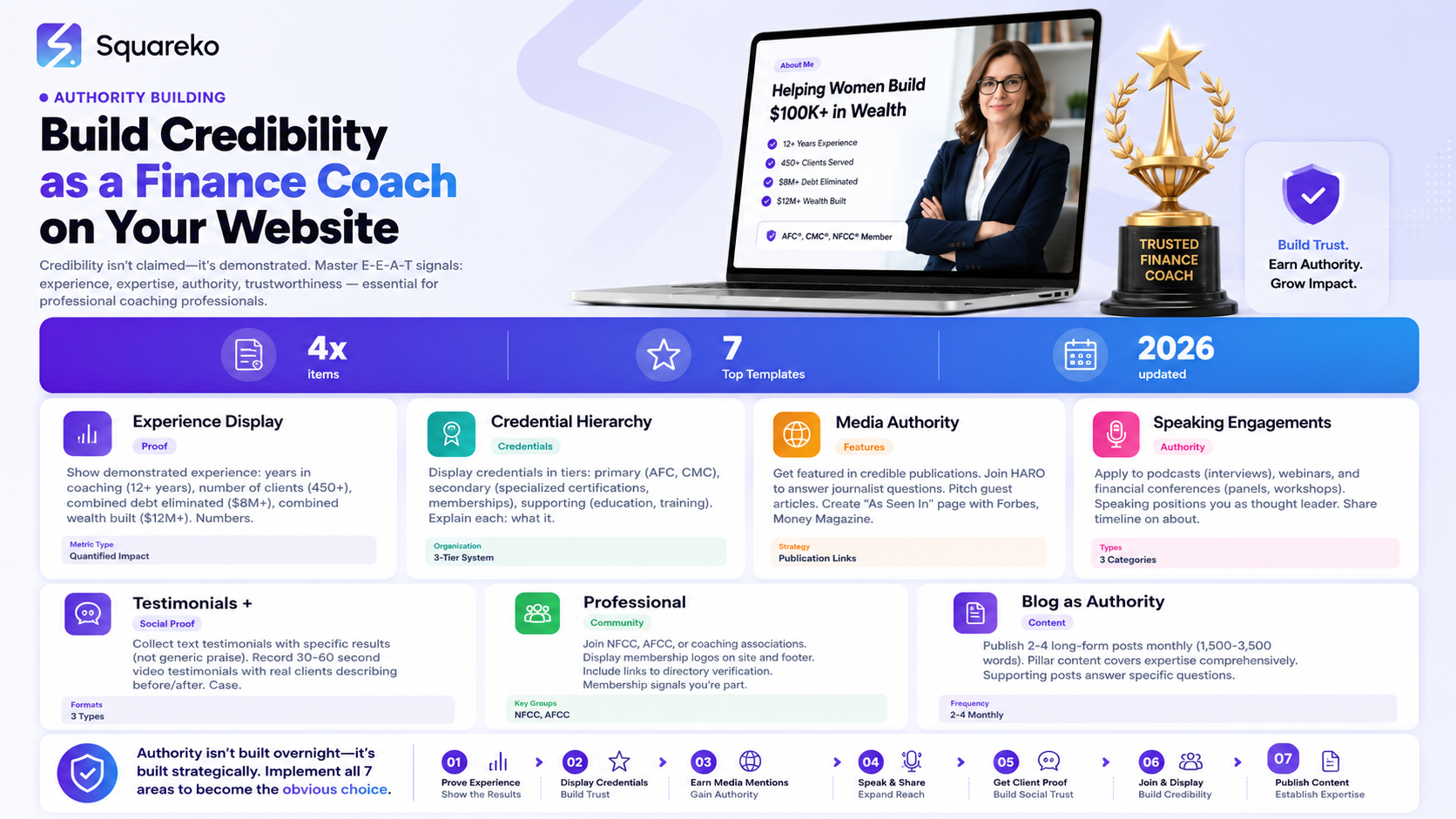
Google's 2024 core update made E-E-A-T the central ranking factor. For finance coaches, this is everything.
E = Experience
Real, demonstrated experience helping clients.
Display experience through:
Years in the coaching field
Number of clients helped
Specific outcomes (anonymized)
Types of transformations
Continuity (not a new coach every month)
Example: 12 years helping women ages 40-60 build financial confidence. 450+ clients. $8M+ combined debt eliminated.
This tells Google and prospects: This person has been doing this for a long time and has proven results.
E = Expertise
Specific training and knowledge in financial coaching.
Display expertise through:
Relevant certifications (AFC, CFP, CMC, etc.)
Specialized education (coaching programs, financial counseling training)
Continuing education (updated credentials, new courses)
Specialized knowledge areas (debt coaching, women's finance, etc.)
Published educational content (blog posts, guides, whitepapers)
Example: Accredited Financial Counselor (AFC) with specialized training in behavioral money coaching. Continuing education through [Institute], [Organization].
A = Authoritativeness
Recognition from other credible sources.
Build authoritativeness through:
Media features (quoted in Forbes, The Balance, etc.)
Speaking engagements (conferences, panels, podcasts)
Backlinks from credible sites (finance publications, coaching platforms)
Professional memberships (NFCC, coaching associations)
Client testimonials (third-party endorsement)
Guest articles on credible publications
Example: Featured in Forbes, Money Magazine, The Balance. Speaker at Women and Money Summit, NFCC Conference.
T = Trustworthiness
Transparency, privacy, clear boundaries.
Build trustworthiness through:
Clear disclaimers and scope of service
Privacy policy and data handling transparency
Author credentials visible and verifiable
Ethical practices (no guarantees, realistic outcomes)
Client confidentiality respected
Compliance with regulations
Example: Certified Financial Coach (not a licensed advisor). Full disclaimer on financial content. GDPR/CCPA compliant privacy policy.
Displaying Credentials Effectively
Credentials are only credible if people understand them.
The Problem with Credential Display
Weak: AFC, CFP, CMC, CCCS, AFCC, CFE
Nobody knows what these mean. You just look credentialed to people who already know finance.
Strong: Accredited Financial Counselor (AFC) — 200+ hours of training in financial counseling, budgeting, and debt management. Annual continuing education required. Issued by Association for Financial Counseling and Planning Education.
This tells prospects: I studied this. A lot. And I keep learning.
Credential Display System
Create a credential hierarchy:
Tier 1 - Primary Credential (Display everywhere)
Accredited Financial Counselor (AFC)
Certified Money Coach (CMC)
Certified Financial Planner (CFP) (Pick your primary credential)
Tier 2 - Secondary Credentials (Display on About page)
Specialized certifications
Continuing education
Professional memberships
Tier 3 - Supporting Education (Display if relevant)
Relevant degrees
Additional training
Speaking experience
Where to Display Credentials
Homepage: Logo or text badge of primary credential AFC Certified Financial Coach
About page: Full credential display with explanations AFC, CMC, Member NFCC
Services page: Mention credentials at top or bottom Led by Sarah Mitchell, AFC
Blog bylines: Every post By Sarah Mitchell, Certified Financial Coach (AFC)
Email signature: Professional footer Sarah Mitchell | Certified Financial Coach (AFC)
Social media: LinkedIn should include credentials Sarah Mitchell — Certified Financial Coach
Credential Explanation Template
For each credential, include:
Full name: Not just AFC
Issuer: Accredited Financial Counselor, issued by AFCC
Requirements: 200+ hours of training, exam, continuing education
What it means: Training in financial counseling, budgeting, debt management
Renewal: Annual renewal required
Building Media Authority
Being featured in credible publications signals authority.
Getting Media Features
Strategy 1: Pitch Money Publications
Write to editors at Forbes, Money Magazine, The Balance, NerdWallet
Pitch angle: 5 Money Mistakes Keeping Women Broke or Why Debt Shame Prevents Financial Freedom
They often need expert quotes—you could be that expert
Strategy 2: Be a Source
Join HARO (Help A Reporter Out) — journalists post questions, you answer
Answer 1-2 requests per week
Get quoted as Financial Coach, Sarah Mitchell
Publication publishes, you get backlink + credibility
Strategy 3: Submit Guest Articles
Pitch article to financial wellness publications
The Psychology of Money Shame or How to Build Wealth for Late Starters
Author bio: Sarah Mitchell is a Certified Financial Coach specializing in women's financial empowerment. 12 years, 450+ clients.
Displaying Media Features
Once you get coverage, display it:
Media page: Create As Seen In page with logos and links Forbes | Money Magazine | The Balance | NerdWallet
Homepage: Subtle mention Featured in Forbes, Money Magazine, and other publications
About page: Include media quotes Sarah has been featured in Forbes discussing debt shame and financial transformation for women.
Schema markup: Add to your author page
"mentions": [
"Forbes",
"Money Magazine",
"The Balance"
]
Speaking Engagements and Conferences
Speaking positions you as an authority.
Types of Speaking to Pursue
Podcast appearances: 30-minute interviews, discuss your coaching philosophy
Apply to podcasts in personal finance, women's empowerment, coaching niches
You get audience exposure + backlink from show notes
Webinars: Hour-long virtual presentations
Host your own on a topic (debt freedom, women and wealth)
Or appear as guest expert on others' platforms
Leads generation + authority
Conference panels: Financial conferences (NFCC, NAT, etc.)
Apply to speak on panel about coaching trends
Or present workshop on money psychology
High authority + networking
Speaking fee considerations:
National conferences often cover travel + fee ($500-2,000)
Local events may be unpaid (but worth the exposure)
Corporate talks pay best ($2,000-5,000+)
Displaying Speaking Experience
About page: Timeline of speaking 2023 — Women and Money Summit | 2023 — NFCC Annual Conference | 2022 — Financial Empowerment Podcast
Dedicated page: Speaking & Media Full bios and photos from events
Homepage: Subtle mention Regular speaker on women's financial empowerment
Schema markup: Include speaking engagements in your author data
Creating Powerful Testimonials
Testimonials are proof. Real clients saying real results.
Testimonial Structure
Weak testimonial: Great coach! — J.M.
Strong testimonial: I was $67,000 in debt and felt hopeless. Sarah helped me create a clear payoff plan, and in 3 months, I'd paid off my first card and genuinely believed I could become debt-free. 18 months later, I'm completely debt-free. She's patient, non-judgmental, and genuinely cares. Worth every penny. — Jennifer M., Teacher, Boston
What makes it strong:
Specific problem (exact debt amount)
Specific result (debt paid off, timeline)
Personal detail (profession, location)
Emotional shift (hopeless → hopeful)
Specific recommendation
Video Testimonials
30-60 second videos convert better than text.
How to record:
Ask client: Would you be willing to record a 30-second video testimonial?
Give them these prompts (don't script it):
What was your situation before working with [Coach]?
What's different now?
Who would you recommend this coaching to?
Record on phone camera (doesn't need to be professional)
Post on YouTube or embed on website
Example video testimonial: I was carrying $50k in debt and completely overwhelmed. I didn't know where to start. Sarah broke everything down into manageable steps. I'm now on track to be debt-free in 3 years. It's given me so much hope. I'd definitely recommend her. — M.K., 60 seconds, genuine and authentic.
Where to Place Testimonials
Homepage: 2-3 testimonials (transformation-focused)
Services page: Testimonials grouped by service type
About page: Longer testimonial or case study
Dedicated page: All testimonials
Writing Case Studies
Detailed success stories build serious credibility.
Case Study Structure
Title: [Name] Went from $87k in Debt to Debt-Free in 18 Months
Client Background (anonymized):
[Starting situation]: $87k in debt, feeling hopeless, avoided looking at finances
The Problem: Sarah had been carrying this debt for 8 years. Every month, she'd make minimum payments, but the balance never went down. She felt ashamed, hopeless, and didn't know where to start. She'd tried budgeting before but given up within weeks.
The Process: Over 6 months, we worked together to:
Map her complete debt landscape ($30k credit cards, $35k student loans, $22k car payment)
Create a strategic payoff order
Identify the behaviors keeping her stuck (impulsive spending, no budget system)
Build a sustainable system for long-term success
Provide monthly accountability and encouragement
The Results: By month 3, she'd paid off $15k in debt. By month 6, $30k. She continued the program for another year and became completely debt-free. More importantly, her relationship with money shifted. She went from shame-based avoidance to engaged confidence.
Outcomes:
$87k debt eliminated
18-month timeline
Established emergency fund
New approach to spending
Emotional transformation
Client Quote: Sarah gave me hope. She didn't judge me. She just taught me a system that works. I'm completely debt-free now and genuinely believe I can build wealth for the first time in my life.
Key Learnings:
Timeline varies (this client moved quickly due to commitment)
Behavioral work matters as much as strategy
Emotional support is the overlooked game-changer
Professional Memberships
Memberships signal you're part of a credible community.
Finance Coaching Memberships
National Foundation for Credit Counseling (NFCC): Largest credit counseling network in US
Association for Financial Counseling and Planning Education (AFCC): Credentials issuer
Money Coaching Institute: Coaching-specific training
Financial Planning Association: If you have CFP
American Association of Money Coaches: Coaching-specific community
How to Display Memberships
Logo display: Use membership logos on website
Text display: Member of NFCC (with link)
About page: List all memberships with links
Email signature: Include membership
Social media: LinkedIn mentions
Example: Member, National Foundation for Credit Counseling (NFCC) Link to: https://www.nfcc.org (directory link proving membership)
Content as Credibility
Your blog posts are credibility builders.
Content Strategy for Authority
Pillar content (2,500-3,500 words):
Comprehensive guides (debt elimination, wealth building)
Show deep knowledge
Link to 5+ supporting articles
Include author credentials
Supporting content (1,500-2,000 words):
Answer specific questions
Link back to pillars
Build keyword authority
Content consistency:
Publish weekly or biweekly
Consistent quality signals expertise
Build portfolio of expertise over time
Content Topics to Build Authority
How to Overcome Financial Shame (psychology + coaching)
Debt Elimination Strategies for Different Debt Types (expertise)
Why Your Budget Failed and How to Fix It (proven frameworks)
The Psychology of Money (deeper knowledge)
Financial Independence: Building Wealth for Late Starters (niche expertise)
Frequently Asked Questions
-
Start with strong credentials (certification + training). Build case studies quickly. Get 5 testimonials from early coaching clients. Write weekly blog content. Pitch media. Build credibility through demonstrated knowledge and real results.
-
AFC (Accredited Financial Counselor) is most recognized in financial counseling. CMC (Certified Money Coach) is specific to coaching. CFP (Certified Financial Planner) is highest regulatory bar but positions you as advisor, not coach.
-
If it's relevant (finance, economics, business), yes. If not (art history), no. Relevant education builds credibility.
-
Yes, but one quote doesn't establish a pattern. Aim for 3-5 features before making it prominent on your site. One quote is fine to mention but not to lead with.
-
After 60-90 days with a client (when they're experiencing results). After program completion (stronger testimonial). Annually from continuing clients.
-
No, but they're worth pursuing. Start with unpaid podcast appearances and local conferences. Build your portfolio. Corporations and large conferences will pay once you're established.
-
Start small: HARO responses, industry blogs, guest articles on smaller publications. Build up to bigger features. Show consistent publication presence over time.
Ready to build your credibility?
Squareko helps finance coaches establish E-E-A-T, secure media features, and position themselves as authorities. Let's build your credibility foundation.
From custom website design to SEO strategy, we help businesses launch a site that looks professional and performs better.

About the Author
I'm Walid Hasan, a Certified Squarespace Expert and Squarespace Circle Platinum Partner with over 12 years of hands-on experience designing and optimizing high-performing websites. Over the years, I've had the privilege of building more than 2,000 Squarespace websites for clients around the world, always focusing on clean design, strong user experience, and conversion-driven results.